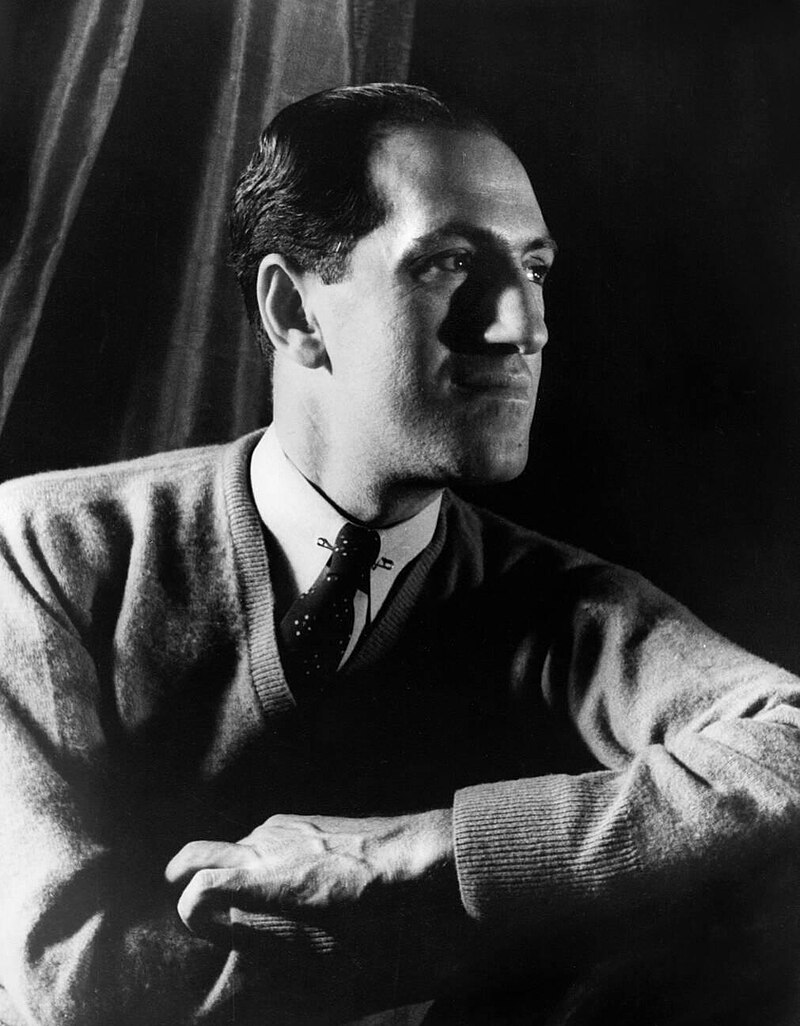
by Ben Hogwood Photo by By Carl Van Vechten – Library of Congress
On this day in 1932, the first performance of Gershwin’s Cuban Overture took place in New York’s Lewisohn Stadium. Originally titled Rumba, its premiere with the New York Philharmonic conducted by Albert Coates was a success – and the work was renamed soon after. You can hear it below in a performance from the Orchestre national de France, conducted by Dalia Stasevska:
Hyeyoon Park (violin, above), City of Birmingham Symphony Orchestra / Alexander Shelley (below)
Gershwin An American in Paris (1928) Price Violin Concerto no.2 in D minor (1952) Price arr. Farrington Adoration (1951) Ravel Le Tombeau de Couperin (1914-17, orch. 1919) Stravinsky The Firebird – suite (1910, arr. 1919)
Symphony Hall, Birmingham Thursday 20 February 2025 (2:15pm)
Reviewed by Richard Whitehouse
Although he holds major posts in Canada and Naples and has a longstanding association with the Royal Philharmonic, Alexander Shelley seems not previously to have conducted the City of Birmingham Symphony Orchestra, and this afternoon’s concert made one hope he will return soon.
An American in Paris was a tricky piece with which to open proceedings, but here succeeded well on its own terms. Somewhere between tone poem and symphonic rhapsody, Gershwin’s evocation of a compatriot (maybe himself?) not a little lost in the French capital was treated to a bracingly impulsive and most often perceptive reading. A slightly start-stop feel in those earlier stages ceased well before Jason Lewis’s eloquent though not unduly inflected take on its indelible trumpet melody, with the closing stages afforded a tangible sense of resolution.
Much interest has centred over this past decade on the music of Florence Price – the Chicago-based composer and pianist, much of whose output was thought lost prior to the rediscovery of a substantial cache of manuscripts in 2009. One of which was her Second Violin Concerto, among her last works and whose 15-minute single movement evinces a focus and continuity often lacking in her earlier symphonic pieces (not least a Piano Concerto which Birmingham heard a couple of seasons ago). Its rich-textured orchestration (but why four percussionists?) is an ideal backdrop for the soloist to elaborate its series of episodes commanding, ruminative then impetuous, and Hyeyoon Park made the most of her time in the spotlight for an account that presented this always enjoyable while ultimately unmemorable work to best advantage.
The concerto being short measure, Park continued with an ideal encore. Written for solo organ, Price’s Adoration was given in Iain Farrington’s arrangement that brought out its elegance and warmth, if also an unlikely resemblance to Albert Fitz’s ballad The Honeysuckle and the Bee.
After the interval, music by composers from whom Gershwin had sought composition lessons when in Paris. Orchestral forces duly scaled down, Ravel’s Le Tombeau de Couperin was at its best in a deftly propelled Forlane, the alternation of verses with refrains never outstaying its welcome, then a Menuet whose winsome poise – and delectable oboe playing from Hyun Jung Song – emphasized the ominous tone of its central section. The Prélude was a little too skittish, while a capering Rigaudon was spoiled by an excessive ritenuto on its final phrase.
Interesting how the 1919 suite from Stravinsky’s The Firebird has regained a popularity it long enjoyed before renditions of the complete ballet became the norm. Drawing palpable mystery from its ‘Introduction’, Shelley (above) secured a dextrous response in Dance of the Firebird then an alluring response from the woodwind in Khovorod of the Princesses. Contrast again with the Infernal Dance of King Kashchei, even if its later stages lacked a measure of adrenalin, then the Berceuse had a soulful contribution by Nikolaj Henriques and fastidiously shaded strings. Hardly less involving was the crescendo into the Finale, started by Zoe Tweed’s poetic horn solo and culminating in a peroration with no lack of spectacle. It made an imposing end to this varied and cohesive concert, one that confirmed Shelley as a conductor with whom to reckon.
Stewart Goodyear (piano), City of Birmingham Symphony Orchestra / Ilan Volkov (above)
Ives Three Places in New England (1911-14, rev. 1929) Zappa Bob in Dacron and Sad Jane (1982-3) Lewis Memex (2014) Gershwin orch. Grofé Rhapsody in Blue (1924, rev. 1942)
Symphony Hall, Birmingham Wednesday 27 March 2024
Reviewed by Richard Whitehouse
Ilan Volkov is always a welcome presence on the Symphony Hall podium, and this evening he conducted the City of Birmingham Symphony Orchestra in a fascinating programme of works by American composers – three of them established in music notably removed from classical.
The concert was framed by what have now become repertoire pieces, but Ives’s Three Places in New England had to wait over half a century to be accorded this status. Using what sounded to be the most recent edition, Volkov stressed its late-Romantic impulsiveness and rhetorical eloquence, though some over-emphatic pauses or phrasing slightly undersold the cumulative majesty of The Saint Gaudens and coursing energy of Putnam’s Camp – which latter still teetered (rightly) on chaos at its close. If the build-up in The Housatonic at Stockbridge felt unduly precipitate, Rachel Pankhurst’s rendering of its cor anglais melody had ideal pathos.
The three decades since Frank Zappa’s untimely death have brought into focus his sheer range of musical preoccupations, though his pair of early 1980s albums with the London Symphony Orchestra made plain that being one of rock music’s finest guitarists and leading provocateurs was never enough. Despite their linkage via a ballet with its somewhat dubious scenario, Bob in Dacron and Sad Jane are individual entities and their respective two movements underline Zappa’s concern for musical and expressive diversity – whether in the reckless overkill of the male protagonist or halting fatalism of the female. Volkov secured dedicated playing from the CBSO as brought out Zappa’s debt to ‘third stream’ jazz as much as his modernist forebears.
George Lewis is another figure whose creativity ranges over multiple media – not least that of the orchestra which, thanks not least to Volkov’s advocacy, has gained some familiarity in the UK. Its title referring to a theoretical device for establishing connections across an otherwise unregulated body of information, Memex is typical of the composer through its complexity of textures which affords a heady virtuosity but also a measure of subtlety and inwardness, not least in those final stages when the earlier volatility gradually coalesces into something akin to resolution; as if all that information was, if not dispersed, at least finding discipline. Such, at least, was the impression left by this committed reading of a striking and absorbing piece.
It might have been a conceptual leap too far from here to Gershwin’s galvanizing of the ‘jazz age’ aesthetic almost a century earlier, though Rhapsody in Blue has lost relatively little of its edge during the interim – especially when Stewart Goodyear projected the steely spontaneity of its solo part with such gusto. Admittedly the large orchestral forces (a feature of each work heard tonight) lacked a degree of co-ordination in tutti sections, but Volkov was at one with his pianist in conveying the breezy and often brittle excitement of music which sounded as if evolving in real-time – not least the final stages that emerged as a high-octane apotheosis.
No little excitement, then, was generated over the course of this performance as of this concert overall: just the sort of event the CBSO should be putting on each season, which latter would certainly be the poorer were artists such as Volkov not encouraged to follow their convictions.
Breathtaking music-making for an attentive audience including a sparkling Petrushka.
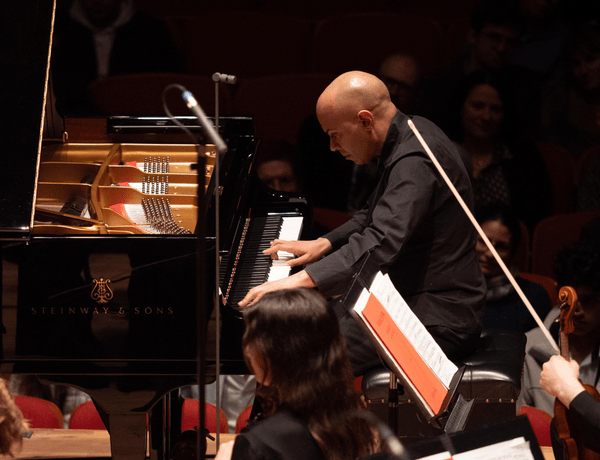
Marcus Roberts Trio [Marcus Roberts, Martin Jaffe, and Jason Marsalis] Philadelphia Orchestra / Yannick Nézet-Séguin
Stravinsky Petrushka (1910-11 rev.1947) Weill Symphony No. 2 (1933-34) Gershwin Rhapsody in Blue (1924)
Carnegie Hall, United States Tuesday 23 January 2024
Reviewed by Jon Jacob. Photo (c) Jon Jacob
For those of us from the UK more accustomed to perfunctory applause, the enthusiastic response from the audience welcomed conductor Yannick Nézet-Séguin to the stage ahead of Stravinsky‘s ballet Petrushka came as a bit of a surprise. The sound of the applause crinkled in the acoustics in a way I don’t remember hearing at the Cleveland concert. The capacity crowd was already psyched. Uplifting stuff before a single note was heard.
The Philadelphia Orchestra’s sound is incredible, generated by a powerful, carefully controlled machine that delivers both weight and delicacy. The band feels incredibly responsive, meaning the smallest of gestures can bring about a range of different colours and textures that illicit all manner of emotional responses. This receptiveness demands players at the top of their game. They are the elite.
There’s also a perceptible self-assurance in the sounds they produce. That promotes a sense of confidence in the listener, in turn elevating listening experience. Put simply if the first sounds you hear aren’t like anything you’ve heard before you’re going to listen more attentively, in the same way you’ll drive an expensive BMW differently simply because of the feel of the steering wheel and the smoothness of the ride.
In Petrushka the principal flute had a bright sweet sound, flanked by a delicate and precise piccolo. There were beautifully burbling and babbling clarinets. Trumpets sparkled with rapid articulation that was clear but avoided fussy-ness. A virtuosic piano line highlights that the material was originally conceived as a concert piece for piano – the demands Stravinsky makes on the pianist remain high and it’s a dazzling contribution from pianist Kiyoko Takeuti.
Elsewhere, the big string section brings phenomenal weight given the heft (no great surprises perhaps – 17 first violins, 14 seconds, 12 violas, 10 cellos and 8 basses). When the basses underpinned a sequence, it felt as though we were digging down into the foundations, great jabs slicing into the ground with a sharp-edged spade.
The WeillSecond Symphony opened the second half. A smaller number of players on stage but still the same detail, responsiveness and jaw-dropping spirit that elevates this band above so many others. At three movements it is a concise work, packed full of evocative tunes, inventive treatments, and tantalising textures. It undoubtedly entertains but does it move? I’m not entirely convinced, although age has mellowed me, so my conclusions are not as severe as those reported by Weill to a friend after the 1934 premiere who said the work had been dismissed as ‘banal, ‘disjointed’, and ‘empty’.
There were plenty of entertaining thrills and spills conjuring up nail-biting peril and jeopardy in the first movement. The Mahlerian second movement funeral march had some respite from the powerful grandeur on display in the sweet flute and trombone solos. It was a much prompter reading compared to some of the recordings I’ve listened to after the concert. Weill’s trademark melodies are evident in the final raucous movement.
Running to half an hour, Weill’s second symphony isn’t a long work, but given the stage move necessary to bring the piano and drum kit on for the final Rhapsody in Blue, the evening was feeling long. But the payoff was undoubtedly worth it. Hearing the music of New York, written in New York, here in New York was special. So too hearing the Marcus Roberts Trio with Philadelphia Orchestra.
Pianist Marcus Roberts treats the work’s piano sequences with far more improvisational zeal than the more familiar ‘straight’ recordings (you can get a sense of the material from this performance filmed in Geneva’s Victoria Hall
The familiar signpost orchestral sequences remain, but the energy is upped tenfold by the seeming flights of creative fancy the trio embarked upon. Excited applause rippled around the auditorium accordingly. The effect of this ‘directors cut’ was for competition to emerge between orchestra and trio. When the improvisations concluded and the orchestra kicked in, the well-known orchestral score sounded dull in comparison to the spectacle we had been treated to before. Was the kind of ‘Experiment in Modern Music’ Gershwin had in mind when the work was first premiered at the Aoliean Hall down the road a hundred years before?
The energy in the auditorium unexpectedly seemed to come with me as I made a ‘dash’ up the steep balcony steps for the exit. After I’d run for a subway train (conveniently located outside the concert hall), I sat down and immediately yawned. Heads turned.
“It was a long evening, wasn’t it?” said the man sat next to me. “It was. But I loved every single minute of it.” “The Weill was fantastic. I do think they packed in more than they needed to. And I’m sure the ensemble was off in the Petrushka.” He looked across the aisle to a couple who were listening to our exchange. “I thought so too,” said the woman. Then a man stood in the aisle, “No. It was the Weill that was the problem. I can’t stand Weill.”
I gently protested, jokingly telling them they were all wrong and they should take a long hard look at themselves and listen back to the broadcast when they got home. A surprisingly in-depth conversation ensued amongst the five of us. I missed my stop as a result.
“You know, you’d never have this kind of post-kind of conversation on the Tube in London”, I explained. “Oh we know,” replied the woman, “That’s what we do here.” It’s a lovely thing too.
Jon Jacob is a writer, digital content producer and strategist, authors the Thoroughly Good Classical Music Blog, and produces the Thoroughly Good Podcast.
Published post no.2,066 – Wednesday 24 January 2024
Nordheim Den første sommerfugl (1982) Martinů Sonatina for trumpet and piano (1956) Shostakovich 4 Romances on Poems by Alexander Pushkin Op. 46 (1936-7) Piazzolla Café 1930 from Histoire du Tango (1986) Grieg 6 Songs Op. 48 (1884-8) Gershwin Prelude No. 2 in C sharp minor (c1923-6); By Strauss (1936) Weill Youkali (1934) Kreisler Toy Soldiers March (1917)
Wigmore Hall, Monday 6 March 1pm
by Ben Hogwood
What a joy to see the partnership of trumpeter Tine Thing Helseth and pianist Kathryn Stott renewed at Wigmore Hall, united in an original program of trumpet originals and imaginative arrangements from vocal sources.
Dreamy lines from the piano introduced the concert’s first item, Arne Nordheim’s Den første sommerfugl (The First Butterfly), full of spring promise as the insect’s flight gracefully orbited the hall. Helseth’s trumpet line was a lyrical one, speaking faintly of folk song. From here the pair moved straight into the compact and winsome Sonatina for trumpet and piano, one of the Czech composer Martinů’s miniature gems. Written while experiencing homesickness in New York, the work began with a gruff introduction from the piano, its repeated note figurations taken up by the trumpet in fanfare-like salvos generating a good deal of energy. Gradually this subsided into more poignant thoughts, the composer revealing his softer centre, and by the bittersweet chorale with which the work ends the sense was that of a composer looking for his fortunes to change. Both performers caught that shift of focus.
Next up was an imaginative choice, an arrangement of Shostakovich’s Four Pushkin Songs. The vocal lines transfer to the trumpet with surprising accuracy, both artists playing in such a way that the original spirit of the songs was fully maintained. Regeneration, the first song, was thoughtfully done, held notes on the trumpet carrying above delicate figuration on the piano. Premonition was an easy amble in triple time, but the fourth song, Stanzas, held the cycle’s emotional centre. A substantial song, as long as the other three combined, it began with a stern introduction from Stott before a compelling dialogue unfolded.
Complementing this was a beautifully floated account of Piazzolla’s Café 1930, tastefully augmented by Stott’s rhythmic attention to detail. The melodies really sang from Helseth’s trumpet, any breathing challenges overcome with deceptive ease. As she said at the end, a bit of Piazzolla is never wrong!
Helseth’s announcements between the groups of pieces were nicely done, with an easy charm that also showed how much the two artists were enjoying themselves. This much was clear again in six songs by Grieg, grouped together as Op.48 but once again transcribing with relative ease for the trumpet. Gruss (Greeting) featured a lovely depiction of bells, an outdoor scene, while Lauf der Welt was a rustic march. Helseth’s characterisation of Die verschwiegene Nachtigall (The secretive nightingale) was nicely done. Zur Rosenzeit (Time of roses) presented bright colours, while the final Ein Traum (A dream) was especially full of feeling.
We moved to a stylish Gershwin duo, starting with an account of Prelude no.2 that was especially enjoyable when the main theme returned with the mute in the trumpet. By Strauss was also a highlight, enjoying the Viennese waltz send-up, while Weill’s Youkali was a soave tango. Finally Kreisler’s Toy Soldiers March was a perky account, led off by the piano with crisp fanfares. Topping a highly enjoyable concert was an encore of Piazzolla’s Libertango, led off with a swing by Stott and played with great panache by Helseth, including pitch slides to perfection.
For more livestreamed concerts from the Wigmore Hall, click here