

John Findon (tenor), Niamh O’Sullivan (mezzo-soprano), David Ireland (bass-baritone), Three Choirs Festival Chorus, Philharmonia Orchestra / Adrian Partington
Wagner Parsifal – Prelude to Act One (1878)
Elgar The Dream of Gerontius, Op. 38 (1899-1900)
Gloucester Cathedral
Saturday 1 August 2026
Reviewed by Richard Whitehouse Photo credits (c) James O’Driscoll
Closing this latest edition of the Three Choirs Festival with Elgar’s The Dream of Gerontius felt both inevitable and fitting, given its seminal place in the annals of the English choral tradition as of this festival, in what proved if not an unblemished then certainly a memorable realization.
Hearing this work now is to feel surprise how, aside from aspects of Cardinal Newman’s text, its musical treatment could have seemed so problematic whether technically or interpretively. Maybe the musical lineage on which it drew being not yet fully assimilated by musicians and listeners, or its contrasts between life and after-death being so emotionally charged, presented challenges to be overcome only with time and perseverance. If such were the case, then those challenges have certainly been met in the 124 years since its first hearing at the Three Choirs.
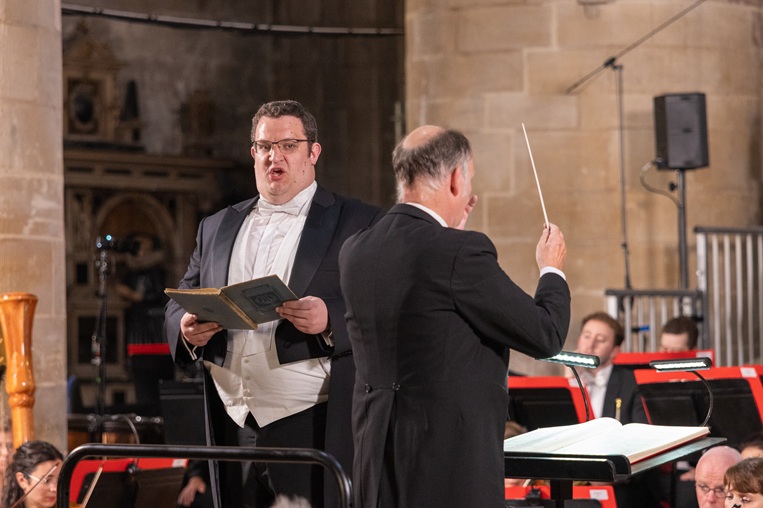
Allotting the vocalists so they merge into a balanced and complementary whole is a task this evening’s performance met convincingly. John Findon (above) brought fervour and an immediacy to Gerontius which never threatened overkill. Witness the assured pacing of his ‘Sanctus fortis’ solo so it dominated the opening part without undermining the latter’s formal and expressive trajectory; or the respective poise and fervour of ‘I went to sleep’ and ‘Take me away’, at the start then climax of the second part, in furthering overall dramatic flow.
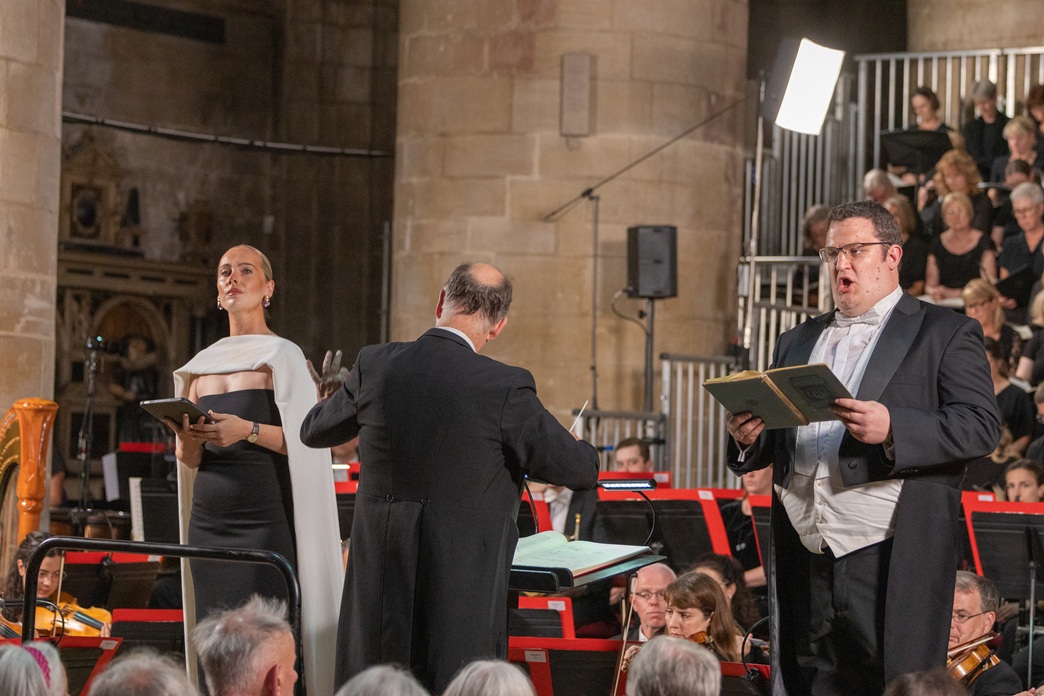
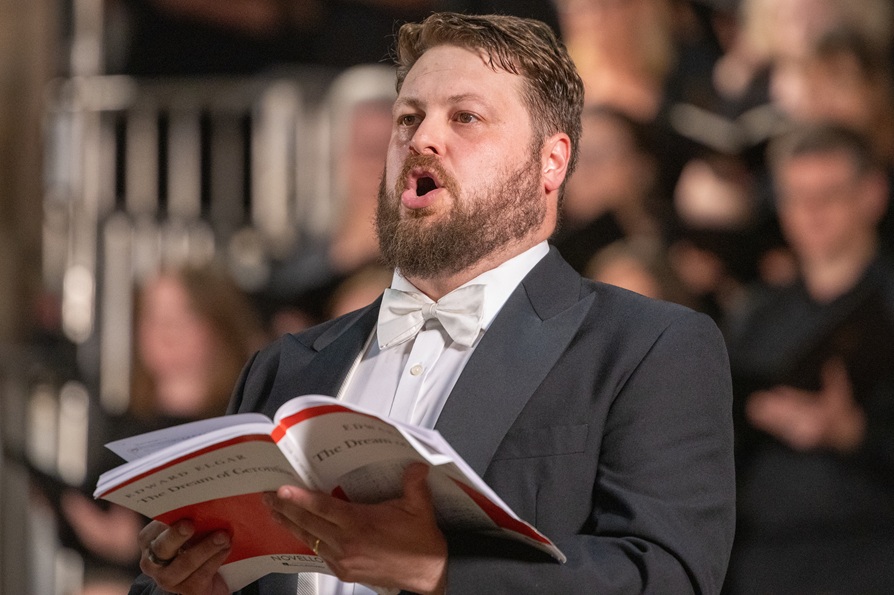
A little too detached initially, Niamh O’Sullivan (above, with Findon) duly entered into the persona of the Angel such that ‘Softly and gently’ exuded an affecting poise. Starkly implacable as the Priest, David Ireland (below) brought to Angel of the Agony an understatement preferable to that wanton rhetoric often encountered.
Few such works have so extensive and varied a choral component as Gerontius, in which the Three Choirs Festival Chorus did not disappoint. Thus the distant response of the Assistants, menacing aggression of the Demons, accumulating power of the Angelicals in their majestic ‘Praise to the Holiest’ or ethereal chant of the Souls in Purgatory were all characterized with the requisite insight. Nor was the Philharmonia found wanting in Elgar’s always resourceful though often demanding orchestral writing, notably a Prelude such as unfolded purposefully towards its eloquent culmination. Here, as throughout, Adrian Partington (below) gave notice of his deep knowledge of and unfailing involvement with this score – not least when bringing out those sombre if luminous hues as were a hallmark of the composer’s orchestration forthwith.

Orchestral and conductor were also at one when delineating the hieratic mystery or grandeur of the Prelude to Wagner’s Parsifal. Its inclusion prior to Gerontius has often found favour in recent years yet, other than pointing up that debt which Elgar repaid handsomely in his own terms, it hardly seems necessary given the emotional scope or inclusiveness of what follows. If it is included then better, surely, to play this piece without its Act One ‘resolution’ then go straight into the Elgar to point up their conceptual connection and ensure cohesion forthwith.
Attendees at the performance had the benefit of programme notes by Martin Lee-Browne – author, authority on British music (not least Delius) and one-time Chairman of Gloucester Three Choirs – whose presence at and contributions to this festival will be greatly missed.
To read more about the 2027 festival in Worcester, head to the Three Choirs Festival website. Click on the names for more on the artists in this concert – tenor John Findon, mezzo-soprano Niamh O’Sullivan, bass-baritone David Ireland, the Philharmonia Orchestra and conductor Adrian Partington
Published post no.2,954 – Monday 6 July 2026

