As this is our first post of the year, let me take the opportunity to wish all readers of Arcana a very Happy New Year! Thanks for taking the time to visit the site, I hope you will find much of interest.
In a musical sense, 2024 promises much – and offers a great opportunity to celebrate the music of some classical composers whose anniversaries fall this year. Keep visiting for more on Gustav Holst (above, his statue in Cheltenham), Gabriel Fauré, Darius Milhaud and Nick Drake – as well as the continuation of our Beethoven 200 series, which will pick up the composer’s work where we left off, with the opera Lenore. There will also be the usual reviews of concerts and new music, playlists and interviews. The aim is to add a post each day, so if you come back to the site on a daily basis you should find something new to read – and something new to listen to.
We aim to do what Manfred Mann’s Earth Band did to Holst – and bring some joy to our readers. Wishing you a wonderful 2024!
Prom 32 – Geneva Lewis (violin), BBC National Orchestra of Wales / Jaime Martín
Pejačević Overture in D minor Op.49 (1919) [Proms premiere] Williams Violin Concerto (1950) [Proms premiere] Holst The Planets Op.32 (1914-17)
Royal Albert Hall, London Tuesday 8 August 2023
by Richard Whitehouse photos by Chris Christodoulou / BBC
Although this evening’s Prom did not quite conform to that ‘overture – concerto – symphony’ format it came quite close, with its first half bringing to the attention of a near-capacity house two representative pieces by women composers who most definitely warrant greater exposure.
The centenary of Dora Pejačević’s death has duly consolidated what was already a burgeoning reputation curtailed by her untimely demise at only 37. Written two years after her impressive Symphony, which Sakari Oramo has performed and recorded (and will revive at these concerts on August 14th) to great acclaim, the Overture is a curtain-raiser as succinct as it is eventful – ably contrasting its respectively impetuous and equable main ideas in a tensile development, then on to a coda which rounds off this immensely appealing piece with decisive affirmation.
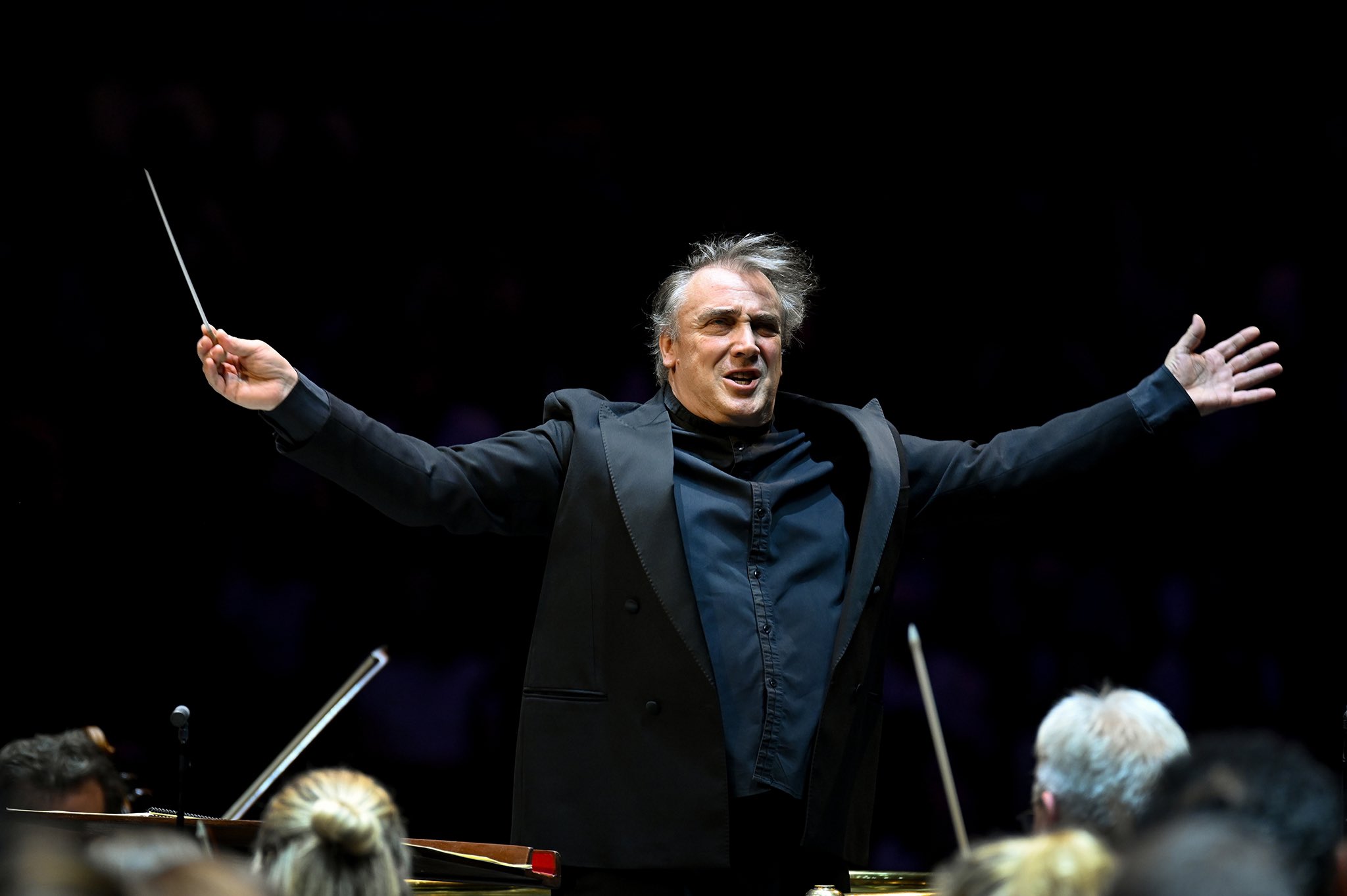
With Jaime Martín an animated podium presence, the BBC National Orchestra of Wales gave it a rousing rendition then was no less finely attuned to the very different ethos of the Violin Concerto by Grace Williams, which it premiered (as the BBC Welsh Orchestra) 73 years ago. There have been few performances since but, on the basis of that tonight, New Zealand-born Geneva Lewis is an eloquent advocate – even if the initial Liricamente arguably needed more purposeful sense of direction for its pensive and often searching inwardness not to risk inertia.
Not that Lewis’ unforced manner or tonal elegance were other than appropriate in this music, as was demonstrated even more directly in the central Andante with its impressionist eddying of melodic phrases and fastidious timbral shading. Following without pause, the final Allegro brought the work’s only fast music in which Lewis’s deftness and articulation gained through her assured coordination with BBCNOW. The cadenza was incisively despatched, while the ensuing coda brought the work to a close the more satisfying for its teasing unexpectedness.
There cannot have been many Proms season this past half-century when Holst’s The Planets has not been played, and it would be good to have welcomed this account more consistently. As it was, the performance took time to recover from a Mars whose stolid tread and lack of textural clarity made for a less than gripping traversal. Venus was better, for all that Martín’s fluctuations of pulse undercut its essential raptness, and though Mercury started off with the requisite humour, some effortful playing in its latter stages left the music feeling earthbound.
This was less of an issue in Jupiter, whose outer sections had all the right verve and energy, even if the trio’s indelible tune verged on the blousy. Pacing its stark opening bars effectively, Martín rather rushed the baleful climax of Saturn, though the radiance of what followed was nothing if not eloquent and bought the best out of BBCNOW. Uranus was almost as fine in this respect, and if the central processional sounded affable rather than sardonic, the sudden emptiness of its closing stages prepared well enough for the otherworldliness of Neptune.
If Martín might have obtained even more hushed and inward playing in this final movement, a sensuous contribution from the London Symphony Chorus enhanced the music-making. An enjoyable reading, albeit one where the whole was less than the sum of its individual planets.
by Ben Hogwood Picture courtesy ALMA – ESO/NAOJ/NRAO, E/O’Gorman/P.Kervella
A report on the Guardian website today asks why the great red giant star Betelgeuse is glowing so brightly and behaving so strangely. It is a fascinating read, and its remarkable conclusion is a reminder that the light we see from the star is actually 600 years old.
It brought to mind a setting by Gustav Holst of a great poem about the star by Humbert Wolfe. This is a highly unusual song, proceeding such a slow speed that the age of the star is never in doubt. Here it is, sung by tenor Philip Langridge with pianist Steuart Bedford:
Alexandre Kantorow (piano), CBSO Youth Chorus, City of Birmingham Symphony Orchestra / Kazuki Yamada
Tchaikovsky Piano Concerto no.2 in G major Op. 44 (1879-80) Holst The Planets Op. 32 (1914-17)
Symphony Hall, Birmingham Thursday 2 February 2023
Reviewed by Richard Whitehouse
He may not take up his role as Chief Conductor for a couple of months, but Kazuki Yamada already has acute rapport with the City of Birmingham Symphony Orchestra, as was evident tonight in this unlikely though effective coupling of major works by Tchaikovsky and Holst.
While it has never aspired to the popularity of its predecessor, Tchaikovsky’s Second Piano Concerto lacks none of the melodic appeal or emotional heft synonymous with this composer. Growing conviction that piano and orchestra were best heard separately rather than together can give the first movement a rather stop-start trajectory, but with Alexandre Kantorow (below) alive to its bravura and poetic facets there was never a sense of disjointedness in a first movement – emphasis on whose ‘brillante’ and ‘vivace’ markings avoided any risk of portentousness.
Although those aspects of the edition by Alexander Ziloti that simplify the solo writing have now been consigned to history, truncation of the Andante into an intermezzo akin to that of the First Concerto remains common. To do so, however, misses out on the expansiveness of this movement – notably its eventful trialogue between piano, violin and cello as dominates the latter stages, and which here saw a sustained interaction between Kantorow and the CBSO section leaders (Eugene Tzikindelean and an as yet unidentified cellist. Yamada directed with an unobtrusive rightness, then gave the soloist his head in a finale that makes up for its relative brevity with scintillating wit and agility – not least in the coda when, having resisted any temptation for a grand apotheosis, Tchaikovsky allows soloist and orchestra an effervescent race to the close.
Tchaikovsky was never an influence on Holst, and the conventional scoring of the former’s piece is worlds away from that of The Planets with its extended range of ingenious timbres and textures. Finding the right martial pulse at the outset of Mars, Yamada built this first piece to a pulverizing climax – after which, the enfolding raptness of Venus was the more tangible in its serenity and poise. The deftness and insouciance of Mercury was no less to the fore, and the only reservations came in a Jupiter whose bracing outer sections verged on the dogged; with a central section whose indelible melody took on a ceremonial turgidity which has nothing to do with this music as Holst conceived it. Happily, the remaining three pieces, which all too often seem anticlimactic, emerged as highlights of this performance.
Undeniably the emotional focal-point, Saturn unfolded from initial remoteness to a climax whose sense of crisis was palpably evident, before withdrawing into a radiant evanescence. Contrast with the sardonic humour of Uranus was pronounced – Yamada making the most of its flights of fancy, then lurchingly triumphant parade, before the heart-stopping dissolve near its close. Neptune capped proceedings superbly – its strangeness and insubstantiality allied to searching introspection which afforded cohesion to this venture into the unknown.
Placed high to the left of the auditorium, the CBSO Youth Chorus added its ethereal tones. The final fadeout began almost too remotely to be sustained yet, as this repeating vocalise moved beyond earshot, there was no doubt as to the totality of what had been experienced.
Tippett Quartet [John Mills, Jeremy Isaac (violins), Lydia Lowndes-Northcott (viola), Bozidar Vukotic (cello)]
VaughanWilliams String Quartet no.2 in A minor (1942-43) Holsted. Swanston Phantasy Quartet (1916) VaughanWilliams String Quartet no.1 in G minor (1909)
Somm Recordings SOMMCD 0656 Producer Siva Oke Engineer Adaq Khan Recorded 7-8 February 2022, St. Nicholas Parish Church, Thames Ditton
Reviewed by Ben Hogwood
What’s the story?
In case you have missed it, 2022 marks 150 years since the birth of Ralph Vaughan Williams. A great deal has been made of his symphonic and choral output, and rightly so, but an added benefit of such an anniversary is the chance to look at other relatively neglected corners of a composer’s work. Chamber music is one such area that is infrequently explored, and there are some fine works ready for reappraisal.
The two published string quartets sit as principal examples. The String Quartet no.1 in G minor was written in Paris, during a period of study with Ravel, and reflects new influences at work in 1909. A great deal of water had past under the bridge by the arrival of the String Quartet no.2 in A minor in 1942-43. Written for the composer’s friend Jean Stewart, who played viola in the Menges Quartet, it gives great deal of prominence to her instrument.
Complementing the quartets is the Phantasy Quartet by Gustav Holst, a close friend and confidante of Vaughan Williams for many years. Their mutual love of folksong is perhaps their strongest musical link, though as the quartet shows Holst had a different way of expressing his sources. Claiming the work was ‘insufficient’, the composer withdrew it some years after its first performance in 1917, though his daughter Imogen saw its worth and published a version for string orchestra. On this recording the Tippett Quartet use an edition made by Roderick Swanston.
What’s the music like?
The Vaughan Williams quartets are a complementary pairing, and although starting with the later work may seem a curious decision it makes good musical sense in the context of this recording.
As described above, the viola takes an assertive lead in the first movement of the String Quartet no.2, pushing the source material forward with silvery tones that nonetheless have a strong autumnal shade. The harmonic writing is shot through with an anxiety reminding us of this work’s position in the Second World War and its proximity to the Sixth Symphony, a powerful yet haunted work. The solemn second movement is deepened further by an almost complete lack of vibrato, while the viola takes charge again in the ghostly third movement, with the other instruments muted. The prayerful finale offers some solace, referring to the reverent calm of the recently completed Fifth Symphony, but the end is still shrouded in uncertainty.
The String Quartet no.1 is often talked about in the same breath as Ravel, but Debussy and Borodin are notable influences here. After a tautly argued first movement, the Scherzo is particularly successful, its motif recurring with just the right degree of playfulness. The third movement Romance is lovingly rendered, while the finale has a great deal of positive energy, Vaughan Williams showing great agility in his writing for four instruments that often sound like a small string orchestra.
Holst’s Phantasy Quartet is beautifully judged, celebrating its folk sources but also throwing context of light and shade that reflect another time of uncertainty during the First World War. The work has more than a little in common with the celebrated St Paul’s Suite for string orchestra, moving between energetic tunes and more thoughtful episodes, where a shadow passes over the face of the music.
Does it all work?
It does. These are fine performances from the Tippett Quartet, who understand the emotional and often anxious pull of the second quartet. Its urgency is compelling, and the harmonic tensions are finely judged here. Meanwhile the compositional promise of the first quartet is clearly shown, with its rich melodic content and the vigorous exchanges of the outer movements, which are extremely well played. The Holst is affectionately given, the quartet revelling in the folk melodies but also the composer’s imaginative harmonies. Swanston’s version works extremely well.
Is it recommended?
Enthusiastically. There are already some fine recordings of the Vaughan Williams string quartets, but the Tippett Quartet join the very best with performances of spirit and deep feeling. The Holst is the ideal complement, and with excellent booklet notes (Robert Matthew-Walker) and a cover picture to match (Simon Palmer) this is one of the finest releases so far in the Vaughan Williams 150 celebrations.
Listen
Buy
You can listen to clips from the recordings and explore purchase options at the Somm Recordings website





 Arcana.fm