Ask the Audience at the BBC Proms – Tony Winter on the BBC National Orchestra of Wales playing Vaughan Williams, Parry & Holst

For the latest in Arcana’s Ask The Audience series Tony Winter gives his verdict on the BBC National Orchestra of Wales and their Prom of English music.

Prom 17: Tai Murray  (violin), Francesca Chiejina (soprano), Ashley Riches (bass-baritone),  BBC National Chorus and Orchestra of Wales / Martyn Brabbins

Parry Symphony no.5 in B minor (Symphonic Fantasia ‘1912’) (1912)
Vaughan Williams The Lark Ascending (1914, rev 1920)
Parry Hear my words, ye people (1895)
Holst Ode to Death, Op.38 (1919)
Vaughan Williams A Pastoral Symphony (Symphony no.3) (1921)

Royal Albert Hall, Friday 27 July 2017

You can watch this Prom on the BBC iPlayer here

ARCANA: Tony, how would you describe your musical upbringing?

I had a brief encounter with the violin which I never really got on with – I didn’t get on with the teacher – and then when I was about 13 the guitar, but that was rock music. I played the guitar for years. When I retire it’s going to come out again! I played in a band called The Committee, but to be fair by the time they’d risen to fame they’d chucked me out!

Name three musical acts you love and why:

I love Bach, just because of the melodies. I think you can look at other people and say the orchestration is great but for me the genius is the melody. James Rhodes says ‘the immortal Bach’, which sums it up.

I’ve been playing a lot of David Bowie recently with his demise, I was a big fan of Bowie up to about the Let’s Dance era, and now suddenly I’ve been playing some of the later albums as I’ve been guilty of overlooking some of them. I don’t like it when it gets too commercial! But I think later on he was saying that he didn’t give a shit, which is an approach I’ve always liked. The Outside album was described as ‘difficult and industrial’ but I think it’s great. I wonder in 200 years if people will be playing Bowie? He died at the same age as Shostakovich but who knows? Only time will tell. How many people were on stage tonight, over 100? I’m sure everyone would be using that if there weren’t cost implications to it!

I don’t know whether to say the Rolling Stones or Mozart for the third!

Have you been to classical music concerts before, and if so what has been your experience?

I’ve been to a few over the years – I’ve even started going to a few operas! Living close to the Watford Coliseum I’ve been going to concerts there as I’m a bit of a lazy bugger. I tend to go to any classical concerts they put on there. I’ve seen Beethoven’s 9th, that was a bit echoey. James Rhodes sticks in the mind for his more modern presentation which particularly appealed to my kids. They’re learning the piano so that helped but it helped that he stood up and made a few jokes. I’m not saying everyone has to turn into a variety act but he judged it right. I like sitting at the front in an intimate gig, but coming here tonight though I think I should drag my sorry arse into London more as I don’t think you could fit that orchestra on the stage in Watford!

Can you give a snapshot of the music you’ve been listening to in the past week?

Yesterday I was going through making a playlist for stuff we’re going to play on holiday when we’re driving in the car. I found something on Tidal called ‘Music Your Kids Like That Won’t Drive You Crazy’ but we were doing one of our own. We had a couple of Michael Jackson tracks – Thriller, Pretty Young Thing (there’s some good grunting on that!) My daughter jumps up and down on the sofa to it.

I stuck on some David Bowie because my wife wanted Adam Ant – Stand And Deliver – and the video put me in mind of Ashes To Ashes – which then made me think of Life Is Lost, which refers back to that song. Bowie was brilliant at referring back to things from years before. We had A-ha, Earth, Wind and Fire – an ever-growing playlist!

Apart from that I’ve been playing Daniel Barenboim’s recording of the Bach Well-Tempered Clavier at work. It’s my fallback and I put it on when it all gets a bit too much for me!

What did you think of tonight’s Prom?

I thought it was excellent! Parry I know absolutely nothing about. With Holst I know the proverbial Planets but nothing at all about the piece we heard tonight, and Vaughan Williams I’m very familiar with. I’m a huge fan anyway, and think his music is absolutely sublime, but it also comes from being a massive fan of The Fast Show – with Ralph and Ted! A friend of mine used to say ‘rural cowpat music’, which is not my take on it but there you go. I do think it is reminiscent of a lost England – not even John Major’s Middle England, an England before that – and certainly not Theresa May’s Brexit idiot England that we have now. We’re getting a bit political here!

What did you think of the Parry’s Fifth Symphony?

I thought it was a bit short – that’s not a symphony! I was quite impressed with it, and some of it was reminiscent of Carnival of the Animals for me, some of the slow bits in the score. I’m not at all familiar with it but I did enjoy it.

Which of the pieces left the most impression tonight?

It’s the one I am most familiar with – which is The Lark Ascending. The soloist (Tai Murray) was fabulous and it is one of my favourite pieces anyway, I just love it. It’s like the pop concert where the Rolling Stones do Satisfaction I think!

How would you describe your experience in the Arena tonight?

It was great. I love standing up in there, I think it’s more rock ‘n’ roll, you can move to the front. Someone came and stood in front of us in the first half but there you are! I really enjoyed it.

Verdict: SUCCESS
Prom 17 – BBC NoW & Martyn Brabbins: Vaughan Williams ‘Pastoral’ Symphony, Parry Symphony no.5 & Holst

Prom 17: Tai Murray  (violin), Francesca Chiejina (soprano), Ashley Riches (bass-baritone),  BBC National Chorus and Orchestra of Wales / Martyn Brabbins

Parry Symphony no.5 in B minor (Symphonic Fantasia ‘1912’) (1912)
Vaughan Williams The Lark Ascending (1914, rev 1920)
Parry Hear my words, ye people (1895)
Holst Ode to Death, Op.38 (1919)
Vaughan Williams A Pastoral Symphony (Symphony no.3) (1921)

Royal Albert Hall, Friday 27 July 2018

Reviewed by Ben Hogwood Photos of Martyn Brabbins and Tai Murray (c) BBC/Mark Allan

You can watch this Prom on BBC4 on Sunday 22 July here

This was a fascinating concert, a celebration of Sir Hubert Parry both in his music and the work of his pupils.

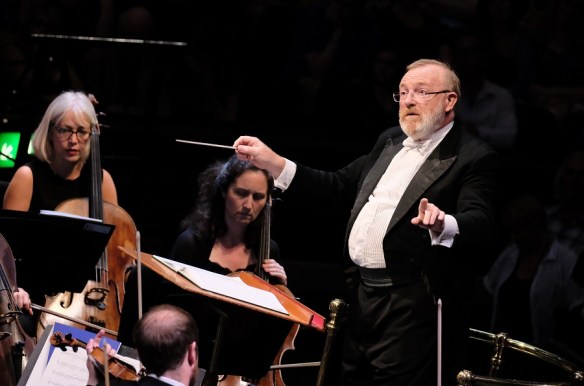
Parry – composer of the music to Jerusalem and royal anthem I Was Glad for many of us – wrote five symphonies, and it is bordering on ridiculous that only one of them, the Symphony no.5 in B minor, has been heard at the Proms before. Hopefully this excellent performance from the BBC National Orchestra of Wales under Martyn Brabbins will open the door to further hearings, for it presented the piece as an extremely coherent stream of consciousness.

With its Schumann-like dimensions, the Fifth flows for 27 minutes unabated, and is almost constantly melodic, its themes and motives passed through the instruments. There were some lovely moments of clarity in the first movement where a certain English splendour came through, whereas elsewhere Parry was in thrall to Richard Strauss and his hero Brahms without ever slipping into parody.

The programmatic nature of the piece is revealed in the titles of its movements (Stress, Love, Play and Now) and Brabbins shaped his response accordingly, lovingly tendering the phrases but enjoying the more adventurous and colourful aspects of the score.

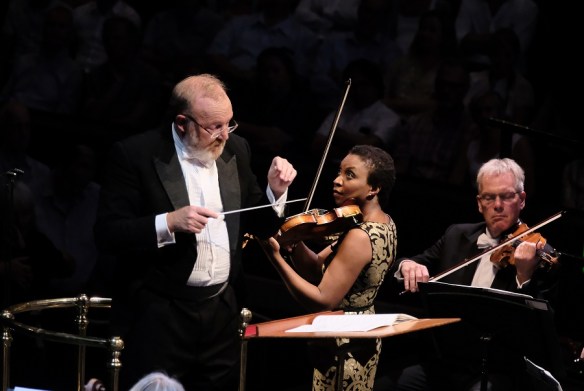
The rapt stillness of Vaughan WilliamsA Lark Ascending followed, in which the audience were immediately relocated to the stillness of an English field to witness the freedom of the lark as its song spiralled upwards. Tai Murray (above) was the violinist inhabiting its character, and she allowed the music all the room it needed. Brabbins enjoying the softly burnished strings – some beautiful shading from the BBC Welsh – before the slightly more playful and folksy central section took hold. Her encore, a gravity defying account of Ruggiero Ricci’s arrangement of Tárrega’s Recuerdos de la Alhambra, felt a little misplaced but was played with exceptional athleticism and virtuosity.

There was more music from Vaughan Williams’ teacher Parry after the interval, in celebratory festival mood for Hear my words, ye people. This presented a couple of tricky performance issues, with the soloists Francesca Chiejina (below) and Ashley Riches just in front of Sir Henry Wood’s bust at the back of the stage, with a 120-strong choir behind them. To the side were the brass of the BBC Welsh – but all gelled together in classic Anglican exultation, nicely held together by organist Adrian Partington, who delivered sensitive registrations on the Royal Albert Hall organ.

Parry’s celebrations were checked by a polar opposite in a work from another of his pupils, Holst’s Ode to Death – a choral setting of Walt Whitman. This left an incredibly powerful impact in an understated way, leaving us mindful of the First World War – to which the piece responds. The best Holst music takes its listener to the brink of another world and this was another such occasion, Brabbins overseeing a performance of subtlety and beauty but uncertainty too, especially when the composer’s oblique harmonies and silvery orchestration were at work. As in the Parry, the BBC National Chorus of Wales were superb.

Vaughan Williams invested heavily in the First World War, not from a position of overwrought patriotism but from a sense of duty to his country. What he saw as an ambulance driver in France in 1916 is not fully documented, but it left a lasting impression fully realised in A Pastoral Symphony, his third – following musical depictions of the Sea (no.1) and London (no.2).
While ostensibly a peaceful work, there are hints around the edges that its composer is struggling to come to terms with peace in the wake of such a terrible conflict. Martyn Brabbins felt this too, and brought from the orchestra some beautifully judged phrasing, colourful textures and eloquent playing, none more so than Neil Brough‘s exquisite off-stage trumpet solo in the second movement.

Everything was headed for the appearance of soprano Chiejina at the height of the fourth movement, and the balance was ideal as her wordless vocalise sounded from on high – a touch too much vibrato for my taste, but leaving a strong impact nonetheless. In our uncertain times now, we would do well to heed Vaughan Williams’ subtle but incredibly powerful warning of the consequences of war.

BBC Proms 2017 – John Wilson conducts Holst’s The Planets & Vaughan Williams’ 9th Symphony

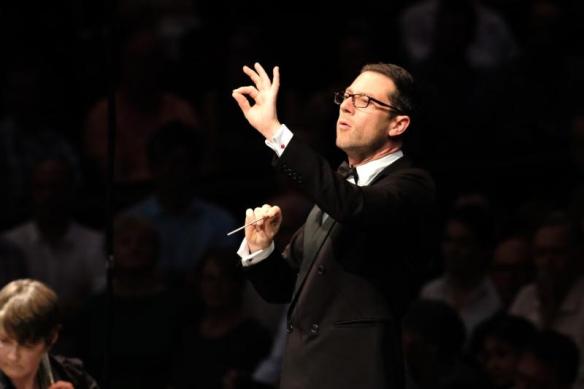
CBSO Youth Chorus (female voices), BBC Scottish Symphony Orchestra, John Wilson (above)

Vaughan Williams Symphony No.9 in E minor (1957)

Holst The Planets, Op.32 (1917)

Royal Albert Hall, Tuesday 25 July 2017

You can listen to this Prom by clicking here

Firmly established at the Proms during this past decade through his high-profile musical and film programmes, John Wilson has enjoyed relatively little exposure in terms of the classical repertoire for which he evidently feels great affinity. His recent appointment as the Associate Guest Conductor of the BBC Scottish Symphony Orchestra should hopefully rectify this, and this early-evening concert cannily juxtaposed what has long been regarded as Vaughan Williams’s most recalcitrant (and underrated) symphony with what will always be Holst’s most popular work.

As dense in texture as it is ambiguous in content, Vaughan Williams’s Ninth Symphony has enjoyed limited advocacy (it went un-played at these concerts for almost three decades after 1960), though it has latterly enjoyed something of a return to favour and one anticipated that Wilson would have its measure. What resulted was something of a curate’s egg in terms of interpretation, not least in an opening movement whose Moderato maestoso marking was scarcely evident – Wilson favouring a fluid approach as emphasized this music’s ominous import while leaving the (often shaky) orchestral ensemble to fend for itself. Better in this respect was the second movement, its sombre and Hardy-inspired imagery made tangible through haunting flugelhorn solos and the baleful music that intervenes at crucial moments.

Neither was the militaristic scherzo wanting in impetus, though here Wilson’s preference for deftly sprung rhythms and relatively transparent textures served to rob this music of its sheer malevolence. Much the hardest movement to bring off, the lengthy finale emerged surely and methodically – its polyphonic weave rendered with a clarity that not even the expanse of the Albert Hall acoustic could deny – to an apotheosis more telling for its tangible equivocation. Whether those blazing E major chords convey affirmation or resignation is open to question.

The Planets has, of course, never looked back over the near-century since it first astounded a public confronted with the terrors of mechanized war. Perhaps one should not be surprised that Wilson was at pains to play down its cinematic quality (hardly something of which Holst could have been aware in any case) – his vehement take on Mars proceeding an eloquent if slightly cloying Venus; itself followed by an almost dance-like Mercury and an incisive Jupiter at its best in a trio section that managed to eschew almost all trace of false solemnity

By contrast, Saturn succeeded better in its listless opening and radiant closing sections than in the anguished music at its centre; Wilson’s preference for measured tempi continuing into an unusually steady Uranus marked by deadpan humour and the spectacularly OTT organ glissando at its climax. The enigmatic Neptune was almost as successful, its disembodied textures securely rendered by the BBCSSO, though a lack of integration with the wordless voices in its latter stages meant that the close felt less ‘other-worldly’ than it needed to be.

Overall, a promising showing for what ought to develop into a productive and worthwhile association. Wilson palpably has much to contribute in this repertoire, and what technical flaws there were only intermittently undercut the qualities of these probing performances.

Richard Whitehouse (photos (c) Chris Christodoulou

BBC Proms 2017 – Malcolm Sargent tribute: BBC Symphony Orchestra / Sir Andrew Davis

Beatrice Rana, BBC Symphony OrchestraSir Andrew Davis

arr. Sir Henry Wood The National Anthem

Berlioz Le carnaval romain Overture, Op.9 (1844)

Schumann Piano Concerto in A-minor, Op.54 (1845)

Elgar Cockaigne (In London Town) Op.40 (1900-01)

Walton Façade – Suite No.1; Popular Song (1922-28)

Holst The Perfect Fool – Ballet Music (1918-22)

Delius On Hearing the First Cuckoo in Spring (1912)

Britten Variations and Fugue on a Theme of Purcell (The Young Person’s Guide to the Orchestra), Op.34 (1945)

Royal Albert Hall, Monday 24 July 2017

Sir Malcolm Sargent holds a prominent place in Proms history, especially so for those Prom goers of an older vintage. It was therefore only right that in the 50th year since his passing there was a concert commemorating one of English classical music’s favourite sons. Sargent lived in a flat opposite the Royal Albert Hall, a blue plaque marking this clearly visible from Door 4 of the auditorium.

Calling Sargent a ‘favourite son’ is a statement that needs to be qualified, for not everybody held him in such high esteem. For orchestral players he could be anything but, being a hard taskmaster, but he was hugely popular with Proms audiences, boosting the profile of the festival and the Last Night in particular, to an art form fit for television. As tonight’s conductor Sir Andrew Davis recounted in a glowing tribute, he also knew how to get the best out of large choral and orchestral forces. Davis was a prommer in the 1960s, and held fond memories of Elgar, Shostakovich and Britten under the Sargent baton.

Davis himself is now 73, but still a sprightly figure who lovingly led his BBC Symphony Orchestra charges in a wide variety of English music, recreating the program given for Sargent’s 500th Prom in 1966. We ducked and dived through Berlioz, and his Le carnaval romain overture, before a glittering account of Schumann’s Piano Concerto from Beatrice Rana, herself in glittering green (above). Her quiet moments were especially profound, and she took charge of the more tempestuous passages of the outer movements with impressive control and expression. Balance is often a problem between piano and orchestra in the cavernous Royal Albert Hall acoustic, but here it was nicely achieved, and with phrases that were fleet of foot (and hand!) Rana showed why she is a highly coveted soloist.

Davis (below) came into his own for the second half. An English music expert whose interpretations are now virtually unrivalled, he brought forward the bustling streets of London for Elgar’s Cockaigne Overture, balancing the organ with the orchestra impeccably as he did so. The big tunes were affectionately wrought and great fun, as they were in Walton’s mischievous music for Façade, an entertaining suite where the percussion section, led by the ever masterful David Hockings, came out on top form.

Holst’s ballet music for The Perfect Fool was treated to a delicately shaded performance, sonorous trombones underpinning a rewarding orchestral sound, with dances of great character. Meanwhile Delius gave us a sunkissed reverie, On Hearing the First Cuckoo in Spring, temporarily overriding the clouds outside.
Finally we moved to Britten, and a performance of the Young Person’s Guide To The Orchestra that was as much fun to watch as it was to listen to. The composer’s clever navigation of each orchestral section is a great introduction for new listeners but also reminds the older ones of the colours and expressive techniques each instrument can produce. Davis handled the twists and turns to great effect, and this hugely entertaining evening reached its peak with all sections combined, Purcell’s original theme now refracted through Britten’s technicolour lens.

It was a great way to finish and a fitting tribute to Sargent, who conducted the work’s world premiere back in 1946. He would surely have been proud of Davis and his charges, who sent the crowd away smiling – something Sargent himself achieved on countless occasions.

Ben Hogwood (photos (c) Ben Hogwood (plaque) and Chris Christodoulou (performances)

Stay tuned for the first in Arcana’s Ask The Audience series, where drum ‘n’ bass DJ Rob Chung will give his verdict on the Malcolm Sargent Prom. Coming shortly!

Live review – CBSO with Nicholas Collon: Savitri & The Planets

nicholas-collon

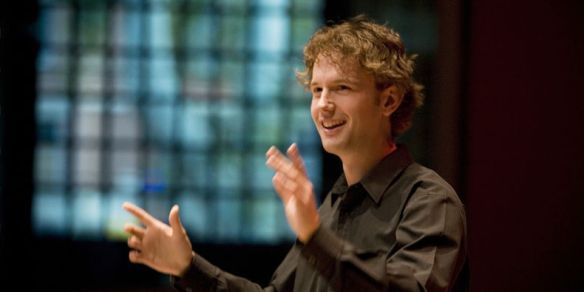
Yvonne Howard (mezzo-soprano, Sāvitri), Robert Murray (tenor, Satyavān), James Rutherford (baritone, Death), CBSO Youth Chorus, City of Birmingham Symphony Orchestra / Nicholas Collon (above)

Symphony Hall, Birmingham. Wednesday 8th February, 2017

Holst Sāvitri, H96 (1909); The Planets, H125 (1916)

holst

Gustav Holst (1874-1934)

Written by Richard Whitehouse

Cheltenham-born Gustav Holst enjoyed a close relationship with the City of Birmingham Symphony right from its inception, so it was good to see a concert being devoted to his music as part of The Spirit of England series running through to the orchestra’s centenary in 2020.

The elapsing of 108 years has not dulled the innovative qualities of Sāvitri, Holst’s one-act opera with which he made a decisive move from the Wagnerian opulence of his earlier music (not least the three-act opera Sita, still awaiting complete performance), towards the lean and often introspective expression of his maturity. Just over half-an-hour in length, it explores the time-honoured operatic themes of love and redemption as a means of transcending death – all rendered from a curious amalgam of Vedic teaching and Socialist thinking wholly of its time yet no less influential for being so. In addition, the scoring for just three woodwinds and nine strings, along with (wordless) offstage female voices, blazed the trail for later generations of British opera. No Sāvitri = no Britten chamber-operas and no Maxwell Davies music-theatre.

First heard in Birmingham 63 years ago, Sāvitri was given by the CBSO in 2004 and 2008. Then, as now, James Rutherford took the role of Death – his forceful yet ultimately humane assumption complementing the title-role, in which Yvonne Howard (replacing an indisposed Sarah Connolly) responded with fearlessness but also compassion; Robert Murray likewise conveying the heroic vulnerability of Satyavān as he succumbs to then escapes death via the intercession of Sāvitri. Choral and instrumental forces responded ably to Nicholas Collon’s direction, using the spatial possibilities of Symphony Hall’s acoustic to telling effect, but it was a pity that dimmed house-lights made it impossible to follow the succinct yet detailed libretto which was otherwise not always audible. Maybe surtitles could have been provided?

It would be an unlikely all-Holst concert as did not feature The Planets, which duly followed the interval. Collon presided over a performance which, while it offered few revelations, still did justice to the power and originality of this music. Mars evinced a brooding implacability through to those seismic closing bars, then Venus brought eloquence without sentimentality and a solace that was never cloying. Mercury was nimble and quick-witted, not least in the hectic approach to its close, and the only partial disappointment (as so often in this work) was Jupiter, whose outer sections were a shade unsubtle rhythmically, the indelible melody at its centre haltingly paced.

Saturn went much better – Collon alive to the gaunt solemnity of its opening pages and the monumental climax, the final section effortlessly combining radiance and resignation. Nor was there any lack of impetuousity in the goings-on of Uranus, the martial episode reaching a heady culmination (its organ glissando finely integrated into the texture) and wrathful final climax not pre-empting the stillness around it.

Following-on without pause, Neptune rounded-off this reading with a fitting evocation of the ethereal – the CBSO Youth Chorus now placed high in the Symphony Hall auditorium so its role was wholly audible yet, in keeping with Holst’s conception, poised on the intangible.

For more information on future CBSO concerts head to their website