

Gwilym Bowen (tenor), Gareth Brynmor John (baritone), William Vann (piano), Navarra Quartet [Benjamin Marquise Gilmore, Eva Aronian (violins), Sascha Bota (viola), Brian O’Kane (cello)]
Venables Out of the Shadows Op.55 (2023)
Vaughan Williams arr. Vann Fantasia on Greensleeves (1934)
Vaughan Williams On Wenlock Edge (1909)
Vaughan Williams Love Bade Me Welcome (1911)
Venables Portraits of a Mind Op.54 (2022)
Howells An Old Man’s Lullaby (1947)
The Temple Church, London
Tuesday 4 November 2025
Reviewed by Richard Whitehouse
The emergence of Ian Venables as the leading British art-song composer was suitably marked with a 70th-birthday concert, sponsored by the Morris-Venables Charitable Foundation under the auspices of Temple Music Foundation and held in the evocative setting of Temple Church.
Song cycles being at the forefront of Venables’s output, it made sense to start with one of his most recent – Out of the Shadows a wide-ranging overview of male love. From the coyness of Constantine Cavafy’s At the Cafè Door and the barbed humour of Horatio Brown’s Bored, this takes in the fleeting ecstasy of Cavafy’s The Mirror in the Hall and stark soulfulness of Alfred Tennyson’s Dark House, prior to the overt playfulness of John Addington Symonds’s Love’s Olympian Laughter and calm affirmation of Edward Perry Warren’s Body and Soul.

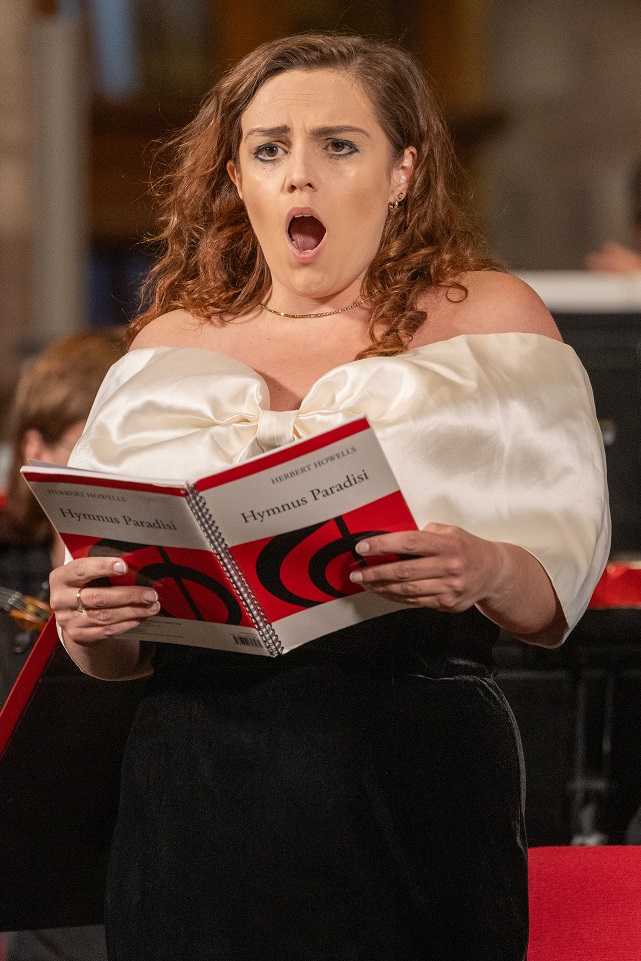
Affectingly sung by Gareth Brynmor John (above), it preceded likely the most influential such cycle in English. A. E. Housman may have disliked his settings, but Vaughan Williams always gets to the heart of the matter in On Wenlock Edge. Hence the volatile imaginings of its title-number or hymnic poise of ‘From Far, from Eve and Morning’, the brooding dialogue of ‘Is My Team Ploughing’ or nonchalant wit of ‘Oh, When I Was in Love with You’; reaching a climax in the innocence to experience of ‘Bredon Hill’, with ‘Clun’ ending the sequence in fatalistic repose.

Gwilym Bowen gave a searching account of this cycle (doubly so having replaced Alessandro Fisher at such short notice), with Brynmor John comparably attuned to the understatement of George Butterworth’s Love Blows as the Wind Blows. These settings of W. E. Henley amount to a cohesive yet subtly contrasted entity – the existential musing of In the Year that’s Come and Gone followed by the deadpan charm of Life in Her Creaking Shoes and effervescence of Fill a Glass with Golden Wine, then On the Way to Kew brings a close of deftest poise.
Bowen duly tackled a further Venables cycle. Written to commemorate the 150th anniversary of Vaughan Williams’s birth, Portraits of a Mind is a notably inclusive one of the composer. Hence the gentle pantheism of George Meredith’s The Lark Ascending and the meditation on creativity of Ursula VW’s Man Makes Delight His Own; the engaging impetus of R. L. Stevenson’s From a Railway Carriage a perfect foil to the resignation of Christina Rosetti’s Echo, before lines from Walt Whitman’s A Clear Midnight conjure a warm transcendence.
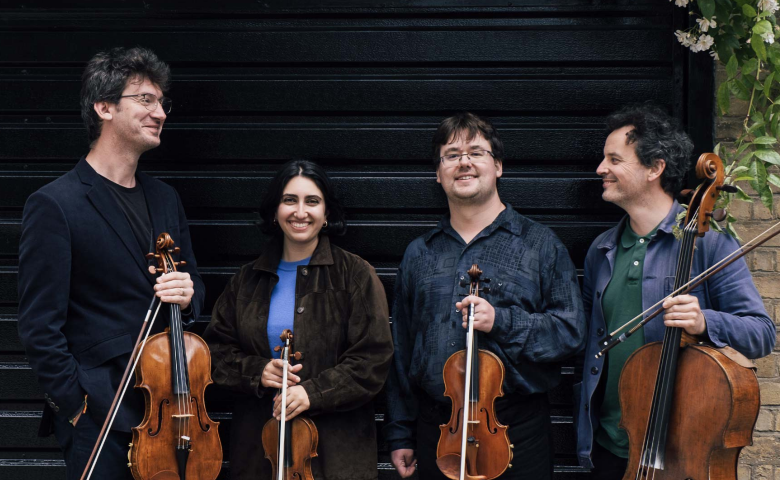
Throughout these performances, the playing of the Navarra Quartet (above) evinced an incisiveness and eloquence always at the service of this music; William Vann’s attentive pianism astutely deployed in his appealing arrangement of VW’s Fantasia on ‘Greensleeves’. Brynmor John opened the second half with that composer’s disarming take on George Herbert’s Love Bade Me Welcome (first of Five Mystical Songs), with both vocalists heard to advantage in An Old Man’s Lullaby – Herbert Howells’s setting of Thomas Dekker that made for a winsome envoi.
Taken overall, this was a wholly pleasurable evening and welcome confirmation of Venables’ creative prowess – his corpus of songs or song-cycles surely second to none among those for whom the English language is a source of never-ending and always unexpected possibilities.
Click here to read an extensive tribute to Ian Venables on from his husband, pianist Graham J. Lloyd – or click on the names to read more about Gwilym Bowen, Gareth Brynmor John, William Vann, the Navarra Quartet and Temple Music Foundation
Published post no.2,710 – Thursday 6 November 2025
 Matthew Schellhorn (piano)
Herbert Howells
Phantasy (1917)
Harlequin Dancing (1918)
My Lord Harewood’s Galliard (1949)
Finzi: His Rest (1956)
Summer Idyls (1911)
Siciliana (1958)
Pavane and Galliard (1964)
Petrus Suite (1967-73)
Naxos 8.571382 [65’52”]
Producers Rachel Smith<
Engineer Ben Connellan
Recorded 19-21 August 2019 at The Menuhin Hall, Stoke D’Abernon
Written by Richard Whitehouse
What’s the story?
Naxos continues its coverage of Herbert Howells with this initial instalment (presumably one more to follow) of his piano music, all pieces being previously unrecorded and authoritatively rendered by Matthew Schellhorn in what is a notable addition to the composer’s discography.
What’s the music like?
Long before his death (at the age of 90), Howells’s reputation rested firmly on his output of choral and organ works. Only quite recently has his considerable earlier output of orchestral and chamber music received serious re-evaluation, so revealing one whose distinct change of outlook in his early forties came about as much through cultural as personal reasons. Modest in scope and dimension, his piano music features no extended or career-defining works, yet its technical poise and always idiomatic feel for this instrument makes for a rewarding listen.
The present selection interleaves miniatures and cyclical works in chronological order. As to the former, Phantasy finds the recently graduated composer assured in his handling of those impressionist aspects derived from Debussy and Ravel, while Harlequin Dreaming inhabits a world of Satie-esque whimsy and nonchalance as a reminder that Howells was then close friends with Bliss. Moving on to the Renaissance-inspired piano pieces of his later years, My Lord Harewood’s Galliard fuses its recherche manner with engaging harmonic astringency, whereas Finzi: His Rest is a pensively ambivalent in-memoriam to a younger colleague. The Siciliana is a languorous if non-indulgent take on the characteristic dance rhythm, while the Pavane and Galliard juxtaposes the confessional and combative with stark emotional acuity.
The suites come from either end of Howells’s career, with all that implies for a half-century timespan. Summer Idyls [sic] formed a part of his portfolio for the Royal College of Music; its stylistic indebtedness to the mid- and late Romantics – not least Rachmaninov – would soon be left behind, but the appeal in these evocations of rural environs no doubt familiar from his childhood endures. Pick of the seven is the wistful rumination of ‘Near Midnight’, with the central ‘Minuet Sine Nomine’ similarly dominating the Petrus Suite in its limpid refinement. Otherwise, the seven pieces evince a sinewy counterpoint and tensile linearity as are audibly a product of Howells’s late style, yet the origin of several in sketches made decades before confirms an overriding consistency of approach heightened by experience.
Does it all work?
Yes, allowing that Howells never sought to suffuse this music with the degree of emotional intensity reserved, at least in his maturity, for the larger choral works. Yet his quintessential expression is arguably to be found in those many shorter choral or organ pieces intended for liturgical purpose; in which case, the expressive focus and restraint of what is recorded here is its own justification. It could hardly have a more persuasive advocate than Schellhorn, who credits the late Stephen Cleobury for introducing him to the extent of Howells’s piano music.
Is it recommended?
Indeed. The closely unduly defined sound is ideal for piano music of this kind, and Jonathan Clinch’s annotations (along with a reminiscence by the pianist) are succinct and informative. The follow-up volume, mainly of better-known music, will doubtless prove just as rewarding.
Listen & Buy
You can listen to clips from the recording and purchase, either in physical or digital form, at the
Matthew Schellhorn (piano)
Herbert Howells
Phantasy (1917)
Harlequin Dancing (1918)
My Lord Harewood’s Galliard (1949)
Finzi: His Rest (1956)
Summer Idyls (1911)
Siciliana (1958)
Pavane and Galliard (1964)
Petrus Suite (1967-73)
Naxos 8.571382 [65’52”]
Producers Rachel Smith<
Engineer Ben Connellan
Recorded 19-21 August 2019 at The Menuhin Hall, Stoke D’Abernon
Written by Richard Whitehouse
What’s the story?
Naxos continues its coverage of Herbert Howells with this initial instalment (presumably one more to follow) of his piano music, all pieces being previously unrecorded and authoritatively rendered by Matthew Schellhorn in what is a notable addition to the composer’s discography.
What’s the music like?
Long before his death (at the age of 90), Howells’s reputation rested firmly on his output of choral and organ works. Only quite recently has his considerable earlier output of orchestral and chamber music received serious re-evaluation, so revealing one whose distinct change of outlook in his early forties came about as much through cultural as personal reasons. Modest in scope and dimension, his piano music features no extended or career-defining works, yet its technical poise and always idiomatic feel for this instrument makes for a rewarding listen.
The present selection interleaves miniatures and cyclical works in chronological order. As to the former, Phantasy finds the recently graduated composer assured in his handling of those impressionist aspects derived from Debussy and Ravel, while Harlequin Dreaming inhabits a world of Satie-esque whimsy and nonchalance as a reminder that Howells was then close friends with Bliss. Moving on to the Renaissance-inspired piano pieces of his later years, My Lord Harewood’s Galliard fuses its recherche manner with engaging harmonic astringency, whereas Finzi: His Rest is a pensively ambivalent in-memoriam to a younger colleague. The Siciliana is a languorous if non-indulgent take on the characteristic dance rhythm, while the Pavane and Galliard juxtaposes the confessional and combative with stark emotional acuity.
The suites come from either end of Howells’s career, with all that implies for a half-century timespan. Summer Idyls [sic] formed a part of his portfolio for the Royal College of Music; its stylistic indebtedness to the mid- and late Romantics – not least Rachmaninov – would soon be left behind, but the appeal in these evocations of rural environs no doubt familiar from his childhood endures. Pick of the seven is the wistful rumination of ‘Near Midnight’, with the central ‘Minuet Sine Nomine’ similarly dominating the Petrus Suite in its limpid refinement. Otherwise, the seven pieces evince a sinewy counterpoint and tensile linearity as are audibly a product of Howells’s late style, yet the origin of several in sketches made decades before confirms an overriding consistency of approach heightened by experience.
Does it all work?
Yes, allowing that Howells never sought to suffuse this music with the degree of emotional intensity reserved, at least in his maturity, for the larger choral works. Yet his quintessential expression is arguably to be found in those many shorter choral or organ pieces intended for liturgical purpose; in which case, the expressive focus and restraint of what is recorded here is its own justification. It could hardly have a more persuasive advocate than Schellhorn, who credits the late Stephen Cleobury for introducing him to the extent of Howells’s piano music.
Is it recommended?
Indeed. The closely unduly defined sound is ideal for piano music of this kind, and Jonathan Clinch’s annotations (along with a reminiscence by the pianist) are succinct and informative. The follow-up volume, mainly of better-known music, will doubtless prove just as rewarding.
Listen & Buy
You can listen to clips from the recording and purchase, either in physical or digital form, at the 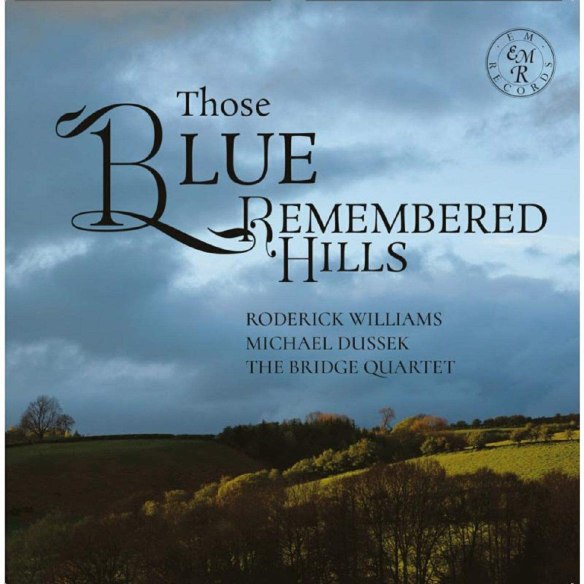

 Arcana.fm