Switched on – Aārp – Propaganda (InFiné)

What’s the story?

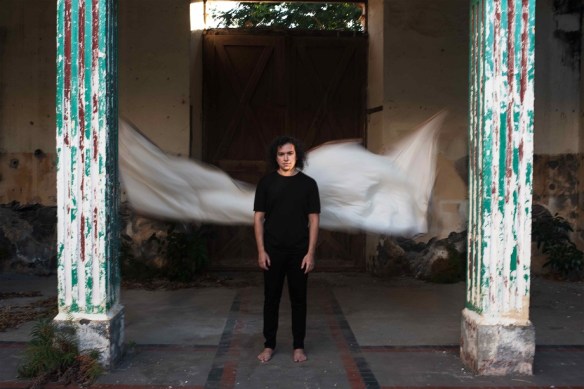
Aārp is an intriguing figure. Having started out as a viola player in an orchestra, the producer – whose real name is elusive – found his head turned by electronic music, specifically the likes of Squarepusher, Amon Tobin and Oneohtrix Point Never. His love of classical and exploratory electronic music spills over into a full length record for InFiné, his first album Propaganda.

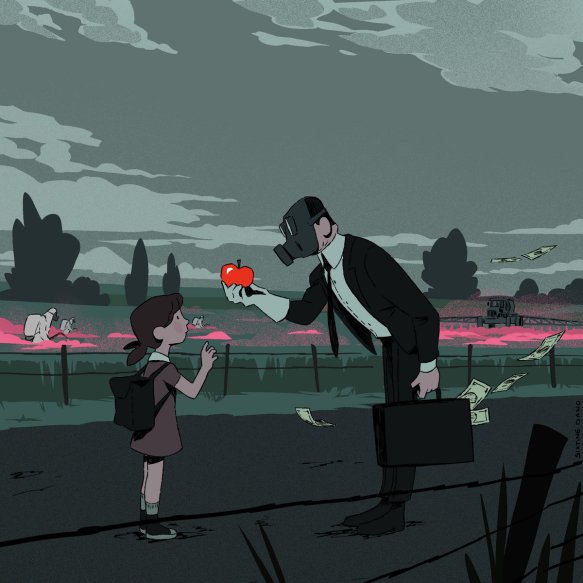
With a title like that it is no surprise to report a political slant to Aārp’s thinking. It is a response to the tragedy of a young festival-goer in Nantes who drowned following a police altercation – and specifically a response to how that tragedy was reported and spun by the press. Aārp was inspired to create a series of tracks, each given the title of an important quote from world news that was treated in a similar way.

What’s the music like?

While it sounds like he is working with a heavy subtext, it is great to report that Aārp does not get too weighed down by his subject matter. In fact the opposite is true, as Propaganda has moments of light and shade, seriousness and humour. It is a restless piece of work, full of riffs that never quite stay still but go really well with his beat making. Nothing is off the table here and there is a lot of excellent work by instinct.

Ca fuit de partout sets the tone with a descending motif that has a quirky edge, which Condamnez-vous les violences? runs with, the riffs becoming more oblique. The Axis of Evil is a thrilling ride, glitchy beats preceded by a blast of rich organ chords. Meanwhile on The Herbicide That Gets To The Root Of The Problem, riffs flit across the stereo picture like birds not quite settling, the music hyperactive and uneasy.

Not all Aārp’s writing is as packed with events as the opening trio. His descending motif gets a different perspective in the more introspective Less than 1% of Patients Become Addicted, while darkness descends with the low threat of Nada es gratis en esta vida, a short but heavily loaded track.

Some of his soundscapes are really impressive – try the breadth of vision from I Prefer a Liberal Dictator to Democratic Government Lacking Liberalism, or Les malheureux sont les puissances de la Terre, which moves from what sounds like electronic steelpans to pinball-style beats and shimmering chords.

Does it all work?

As an album, yes – because Aārp has a distinctive style that constantly asks questions of its surroundings. The duration might be relatively short but a lot happens in 35 minutes! The bursts of hyperactivity might also be a bit too much for some, with a short attention span meaning some of the ideas don’t get developed as fully as they might, but the album follows a compelling path which rewards repeated listening.

Is it recommended?

Yes. Aarp has a fresh approach to electronic music that works rather well, and although the topics covered by Propaganda are pretty weighty, the responses to them offer blasts of fresh air.

Listen

Buy

Switched on – Bruce Brubaker & Max Cooper – Glassforms (InFiné)

What’s the story?

The music of the so-called ‘minimalists’, led by Philip Glass and Steve Reich, has always provided a strong link between classical and electronic music, and has naturally inspired a number of artists positioned at that junction.

Reinterpretations of Glass and Reich have varied considerably though, from those who like to perform the music straight with no added frills to those who have added drum tracks and remixed them beyond almost all recognition. In that sense the music has been an inspiration, but it has on occasion proved difficult to get the balance right.

Pianist Bruce Brubaker and scientist / electronic music producer Max Cooper have teamed up for their own reinterpretation of the music of Philip Glass, approaching it with a view to adding subtle enhancements rather than radically changing its essence. Cooper has developed his own system for musical expression with Alexander Randon, taking live feeds from the piano to drive his own systems.

What’s the music like?

Brubaker performs well-known Glass piano pieces such as Mad Rush, Two Pages and Metamorphosis 2 with great sensitivity, to which Cooper adds the expressive studio touches and atmospherics. That may seem like straightforward solution, but both performers have to be careful to avoid over-egging what Glass has already done.

The pair link the originals with improvised music of their own. This is through a series of five preludes where Brubaker channels the spirit of Glass but brings in external influences from the likes of Liszt and Bach to galvanizing effect.

There are so many notes in the busy keyboard pieces such as Mad Rush that to do too much would not work – but here the judgement of both performers is right on the money. The piano parts are essentially the same, but Cooper cleverly highlights elements of the busy lines with his own spotlit textures, putting shards of white noise on the top of the likes of Mad Rush and opening out the sound with long bass notes, taking us from intimate beginnings to cinematic, big-venue textures. He does this without compromising the solitary world of a piece like Metamorphosis 2, and each one makes an unexpectedly weighty emotional impact.

While the reinterpretations of pieces like Tirol Concerto are excellent, Brubaker and Cooper’s interpretation of Two Pages is outstanding. It is ideally paced, the tracer lights of the keyboard operating over great waves of synthesizer pads, the chords shifting simply but with a devastatingly effective emotional payoff. So far each listen to this particular track has left a tear in the eye!

Does it all work?

Yes. It is immediately clear that Brubaker and Cooper hold the music of Glass in the utmost respect, but also that they know how to bring it forward and point it towards a slightly more club-orientated audience. There are no beats at any point, but the electronic sounds and textures bring them much closer – and Glass’s own rhythmic impetus is enough in any case. Each track is carefully woven and lovingly produced, and sounds great on headphones.

Is it recommended?

Very much so. Glass and Reich have had some excellent remix treatment in the last 25 years or so, but Bruce Brubaker and Max Cooper have really raised the game with this album, which is both wholly complimentary to Glass but offers something new in its own right. It is a really fine  achievement.

Listen

Buy

On Record – Vanessa Wagner: Inland (InFiné)

What’s the story?

After her Statea collaboration with Murcof, Vanessa Wagner turns to solo piano for this substantial anthology of pieces with a minimalist slant. It is a broad selection, from the established coffee shop soundtracks of Michael Nyman through to longer pieces by Gavin Bryars, Hans Otte and Pēteris Vasks. Wagner brings together different approaches from either side of the Atlantic, and in doing brings up a half century of albums for French label InFiné.

What’s the music like?

The key to the success of this album is in the planning. By bringing together different approaches Wagner keeps the interest level high, from short but poignant pieces such as Moondog’s Für Fritz (Chaconne in A minor) to Otte’s Das Buch der Klänge, Pt. 2, which has a tonal base but ventures quite a long way harmonically, as its ripples get more pronounced. The pronounced statement at the end serves of a reminder of the influence of Janáček on this area of music.

There are two pieces from Bryce Dessner, with Ornament 3 especially animated, bringing suggestions of Sibelius. The Etude no.9 of Philip Glass drives forward obstinately, its kinetic energy bracing if slightly clinical, but this is complemented by the short but descriptive Railroad (Travel Song) from Meredith Monk. If Michael Nyman’s The Heart Asks Pleasure First inevitably conjures up visions of an Italian coffee chain in the early morning, it is still given extra freshness here, Wagner giving Nyman’s arpeggios a flowing sweep and a really nice sense of space.

Gavin BryarsRamble On Corona hits some deeper set emotions as it works out, reminiscent of the Spanish composer Mompou in its pairing of intimacy and space, while Nico Muhly’s Hudson Cycle has a lovely, lilting syncopation that rocks gently.

The best is saved for last, however, the Latvian composer Vasks really casting a spell with the stillness and poise of Baltâ ainava (White scenery), a cold excerpt from his substantial piano suite The Seasons, serving as one of those ‘last pieces before sleep’.

Does it all work?

Yes, very well indeed. Wagner has a very sympathetic ear for music that has plenty to offer, getting to the nub of its meditative qualities but bringing out its positive energy too. Each composer holds their own, the result an authoritative and accurate look at piano music in the 21st century, showing how it is possible to write with both simplicity and substance.

Is it recommended?

Yes, in all sorts of different musical directions! Recommended to fans approaching from the more ordered classical direction of Reich and Glass, but also to those coming in from the more electronic approaches of Nils Frahm and Murcof.

Stream

Buy

Talking Heads: Labelle

Arcana chats with Jérémy Labelle, the prodigiously talented composer and performer signed to InFiné, about his album Orchestre Univers. This ambitious project looks to bring classical and electronic music together, as well as the musical cultures of Europe and the Indian Ocean. We explore his methods behind that combination, beginning with the inevitable first question…

Can you remember your first encounter with classical music?

Not exactly, it was at primary school. But the first piece that really did stand out for me was Stravinsky’s The Soldier’s Tale:

You say your family home had a wide range of styles – was it important for you to reflect this in your own music?

Yes, it’s very important as this wide range of styles is an expression of the multiculturalism in which I was brought up in and through which I define myself. Actually, these different styles belong to the same world for me. If you look beyond the differences, you can see what links them.

What dance music did you grow up with? The InFiné site makes reference to Derrick May and Jeff Mills.

I discovered Detroit techno when I was around 10/11 in 1995 and 1996, thanks to my older brother. It was the first type of music I played when I was a DJ and from then on it was the base of the music I was composing.

Was it a long (but enjoyable!) process getting the musicians together for ‘Orchestre univers’?

Getting the musicians together was actually pretty fast (a few weeks). It was the writing process that was very long (but enjoyable!)

It is very difficult to place the music of ‘Orchestre univers’, in a good way. Was it important for you to bring these contrasting styles of music together?

Yes it was very important for me as it’s how I see music for ensembles. A music that is capable of integrating instruments from other cultures but more importantly to find space for the body again. It had become too disconnected from the mind in certain contemporary expressions throughout the ’90s and the ’00s. The body and the mind are a whole for me, a single unit with which I try to communicate.

Where did you learn your skills for making colour with orchestral forces?

I learnt to write at university when I was studying music. But what I did really learn was to understand the different schools of thought and genres that have existed in the history of classical and contemporary music and how and when these genres appeared. Practical exercises allowed me to understand and appreciate the mechanics of these music. But beyond learning, I also have teachers that gave me the keys to understanding the space and the dimensions inside a piece as well as contemporary orchestration and time.

How did you arrive at such rhythmically driven music too?

Rhythm is a fundamental part of maloya and how the trance emerges. It’s in this spirit that rhythm expresses itself. I can’t not work with rhythmic instruments 🙂

The track Oublie-voie-espace-dimension brings in some remarkably strong percussion to go with the held chords. What were you describing in this music?

It’s exactly the beginning of the trance! You have to understand the title as a succession of states. Oublie = forget, forget your markers, letting go; Voie = path, the path that appears at that moment ; Espace = space, the feeling of vertigo, of depth that having chosen this path brings to you ; Dimension = a new dimension opens up (the one that expresses itself in O).

You did a concert recently at the Philharmonie in Paris? What was that like

The concert at the Philharmonie was one of the most beautiful concerts of my young career. The feeling of the acoustic space when you’re on stage is incredible. You can really feel how the sound moves in the room, it’s beautiful. Also the energy that the stage catalyses and disperses is out of this world. The stage seems to float in this circular movement with the audience. The room is unique.

What else can we expect from you this year?

Starting from now until the end of the year, I’m going to be working on my next piece, which is written for a string quartet, as well as on my next album. I’ll also be touring my solo electro-maloya act from the end of August till mid September for the promotion of Digital Kabar with my friend BoogzBrown and the Sheitan Brothers! A special night will happen at La Réunion early Octobre (Digital Kabar – Le Club) with many of the artists that appear on the compilation! Finally, for the first time I’m organising a night dedicated to experimental music on the island. It will happen at the end of Septembre.

What does ‘classical’ music mean to you?

The term “classical” is rather distorted actually. Musicologists refer to MOTE (musique occidentale de tradition écrite = western music of written tradition) and it’s in this sense that I understand classical as a traditional music just like other traditional music in the history of humanity.

What other musical plans and ambitions do you have for the future?

Writing pieces for large instrumental ensembles! But also develop the trance and dancing. I want to stay in touch with the club world and the festival world while writing pieces for orchestras that have this unique combination of classical instruments, electronics and the percussion from maloya.

You have contributed to the new InFiné compilation Digital Kabar. What does the word ‘kabar’ mean to you?

Historically, the kabar is the place and time of maloya, but for me it’s also the place and time of all the maloyas: electronic, electric, pop etc…

The track ‘Block Maloya’ has a strong rhythmic drive. How does maloya manifest itself in your writing?

It’s actually in the rhythms but it also manifests itself through other means! The distant pad that introduces the track is an ancestral reminiscence that carries the track through its development. It’s this relation to ancestors and customs that’s particular in maloya. Maloya is also a spiritual music when it’s played in ceremonies.

Could ‘Block Maloya’ become a really substantial track in a live performance?

Yes and that’s exactly what you’ll hear in my solo electro-maloya live act that will be touring for Digital Kabar in August.

If you could recommend one piece of music from this year to Arcana readers, what would it be?

I know I should think about other artists but right now I’m thinking of my piece Playing at the end of the Universe from Orchestre univers 🙂 It’s a song that always surprises me. I wrote it for my previous record Univers-île but it took another dimension on my new record.

Labelle’s third album Orchestre univers is out now on InFiné, who have also just released the Digital Kabar compilation which can be heard below:

Vanessa Wagner – Expanding the piano

vanessa-wagner

We’ve already spoken to Murcof about his collaboration with pianist Vanessa Wagner – and now it’s time for her side of the story. She describes how she found classical music and how her meeting with Murcof opened up all sorts of electronic possibilities. Here they are on their work together:

Vanessa, can you remember your first encounter with classical music?

My parents were not listening to a lot of classical music. They were rather into jazz and the French chanson. Then one day, the piano of my great-grandmother came home, and I started to play. My childhood idol was a wonderful Romanian pianist named Clara Haskil, far away from the glamour girls are usually dreaming of! She is still an artist that I love.

Who are the composers you have grown to particularly admire?

I grew up with the music of Bach, Schubert, Schumann, Mozart, Rachmaninov, Brahms and Janáček, who are still my favourites, Schubert especially. His melancholy, and the time stretched in his music touches me enormously. Die Schöne Müllerin and Winterreise are pieces that never leave me.

What was it that appealed to you about working with Murcof?

I was the one to initiate this encounter. I have listened to his music for a long time. I met him at the workshop of the Infiné label, and we made an improvised test. Then I had the chance to have a residency in a room of the Arsenal of Metz. They gave me carte blanche to develop new projects, I invited Murcof to play with me, and Statea was born.

How did you make sure you got a good balance between the piano and the electronics?

I always asked Murcof to pay attention to the acoustic piano sound. The piano is the starting point of this project, and it was important that the electronic effects do not swallow its sound even if it is sometimes distorted. Similarly, it also seemed very important to stay true to the scores of composers that I interpret. That’s why the album is called Statea, which means balance in ancient Italian.

Had you listened to much electronic music prior to working with him?

I have listened to electronic music for 20 years. At that time, in my classical circles, it was frowned upon. I had never heard of the big techno anthems, and I went right back to ambient/IDM artists – the likes of Autechre, Aphex Twin, Model 500, Maurizio, UR etc.

Do you think there are other albums or pieces of music that bring classical and electronic together well?

Max Richter´s Four Seasons of Vivaldi works pretty well. Brian Eno also has a beautiful piece called Fullness of Wind, taking its lead from Pachelbel.

Do you think classical and electronic music have a lot more in common than one would expect?

I think meetings of the two styles are quite possible, if one avoids falling into the mainstream that we call crossover classical. The approach focuses on the sound result. We must respect the original script. Adding a beat onto a piece of Mozart or Beethoven cannot be a creative artistic process in itself.

Moreover, music known as ‘contemporary classical’ and art music has a lot in common with experimental electronic. Bridges are possible and desirable between these universes.

Has working with electronic music helped your appreciation of classical?

This does not specifically help me in my classical interpretation. What I greatly appreciate is to exercise out of my classical world, to transform the sound of my instrument, and to experience concerts differently, giving a new fresh perspective to my daily occupation of being a pianist.

For me, it is an interior window that opened itself, and I strongly hope that this is new cornerstone in the musical world which will contribute to the opening of minds and ears!

If you could recommend one piece of classical music to Arcana readers that you’ve been listening to recently, what would it be and why?

I would recommend listening to the Goldberg Variations of Bach (Glenn Gould, for example), the Death and the Maiden String Quartet by Schubert, or Tabula Rasa by Arvo Pärt, especially the second movement Silentium.

Statea, by Murcof and Vanessa Wagner, is out now on Infiné. The pair will appear at the Barbican on Monday 31 October as part of a bill including pianist Lubomyr Melnyk. Tickets can be purchased from the Barbican website. Vanessa will also be giving her thoughts on classical music to Arcana shortly!