

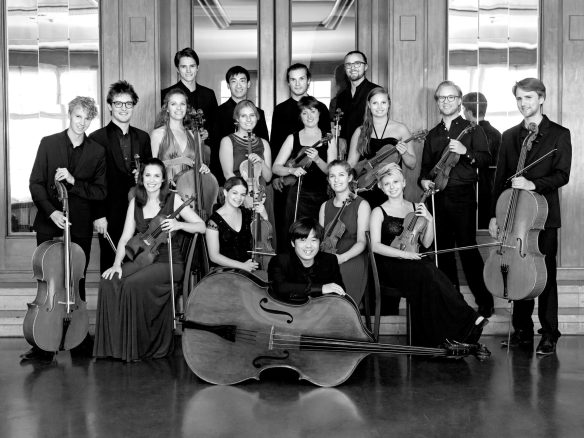
Kensington Symphony Orchestra / Russell Keable (above)
St. John’s, Smith Square, London. Monday October 15, 2018
Tower Fanfare for the Uncommon Woman No. 1 (1986)
Bernstein Divertimento (1980)
Adams Doctor Atomic Symphony (2007, rev 2008)
Schuman Symphony No. 3 (1941)
Written by Richard Whitehouse
The Kensington Symphony Orchestra‘s 63rd season got off to a most impressive start with tonight’s concert of American music (simultaneously continuing the Americana ’18 festival taking place at St John’s during this year), opening with the Fanfare for the Common Woman with which Joan Tower launched her wider reputation over three decades ago. Rhythmically bracing while not without harmonic subtlety, it provided a fitting showcase for the KSO brass and percussion as well as a pertinent tribute to this composer in the year of her 70th birthday.
Leonard Bernstein‘s centenary was marked with his Divertimento, seven succinct movements that touch upon most of his salient traits and a reminder that his latter-day creativity was one where less equals more. Highlights include a delectable Waltz (enjoying frequent exposure on Classic FM), wistful Mazurka, evocative Blues then a rousing March: The BSO Forever whose Johann Strauss take-off duly makes for an uproarious close. Suffice to add the KSO was not found wanting in a piece written for the Boston Symphony’s own 100th birthday.
As Russell Keable‘s opening remarks made plain, John Adams’s Doctor Atomic Symphony was an altogether more serious proposition. First heard at the 2007 Proms, the rather diffuse 45-minute work in four movements was duly streamlined into a continuous structure lasting barely half an hour. Surprising, then, that the result seems less than cohesive – its reworking of material from the composer’s third opera one of cinematic contrast than symphonic unity. Some of his most virtuoso orchestral writing, which the KSO tackled with relish, is hampered by the recourse to post-minimalist gestures that remain Adams’s (unwitting?) stock-in-trade. Even the final section, a setting of John Donne‘s sonnet Batter my heart with its baritone part taken by trumpet (here the mellifluous Stephen Willcox), felt less than truly affecting.
After the interval, a welcome revival (likely the first in London for two decades) for William Schuman‘s Third Symphony. One of a triumvirate of such pieces by American composers to emerge either side of the Second World War, it evinces a formal integration and expressive panache that its composer never surpassed – not least in the way its four movements are arranged in two larger parts such as complement each other unerringly, and with a steadily accumulating momentum which emerges across the whole in what is itself a marvel of tensile dynamism.
Keable delineated the variations of the initial Passacaglia with assurance, ensuring textural clarity here and in the ensuing Fugue while underlining how the numerous woodwind and brass solos emerge naturally from the string polyphony rather than sounding laminated onto it. Nor was there any lack of emotional poise with the Chorale, its understated eloquence in contrast to the inexorably mounting impetus of the closing Toccata whose final pages are as visceral as any in the symphonic literature – not least when rendered with such verve as here.
A memorable reading of a seminal though under-appreciated piece such as the KSO has long championed. Hopefully future seasons will see revivals of comparable American works – the Second Symphony of Roger Sessions and Seventh (Variation) Symphony of Peter Mennin.
For further information on the Kensington Symphony Orchestra you can visit the orchestra’s website
 Arcana returns to the BBC Proms in the company of friends – and for our second visit this season we are dipping into one of the festival’s themes, the music of John Adams. Offering his thoughts was Steve Hodges (above)
 This was no doubt intentional, for we were privy to a wonderful performance from French mezzo-soprano Marianne Crebassa (above). Shéhérazade is a magical song cycle when performed well, but here it transcended all expectations – in fact I don’t recall ever seeing a singer who gauged the acoustic of the Royal Albert Hall with quite the accuracy of Crebassa. Her direct communication with the audience was reinforced by the elegance and understated strength of her vocal delivery, a truly beautiful tone that caressed Ravel’s lines with clear love and affection.
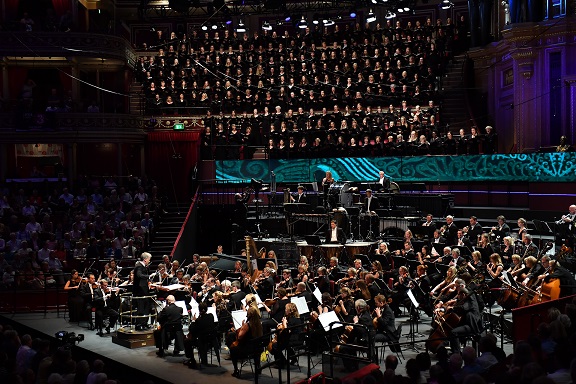 The first night of the BBC Proms is a watershed moment in the summer of a classical music lover. Yet increasingly the festival is working on being more inclusive, and some of this year’s BBC Proms Youth Choir (seen above the BBC Symphony Orchestra and conductor Edward Gardner) had not even sung in public before, let alone attended the festival.
 Levit (above, at the piano) also had quiet asides, but his were absolutely spellbinding – the first movement cadenza and slow movement introduction in Beethoven‘s Piano Concerto no.3 both cases in point. Here we could easily have been back at the Wigmore Hall, witnessing a solo sonata performed to a select few, such was the intensity of his communication at a quiet dynamic. When he was with the orchestra the intensity subsided a little, not least because the balance favoured a coarse timpani sound. That said, the playing of the BBC Symphony Orchestra woodwind was particularly beautiful under Edward Gardner’s watchful eye.
 Arcana.fm