In concert – Jeremy Denk, CBSO / Kazuki Yamada: Gershwin, Clyne, Ravel & Mussorgsky / Wood

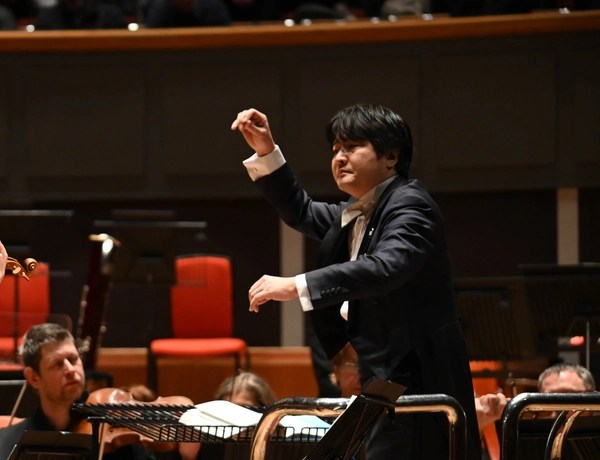
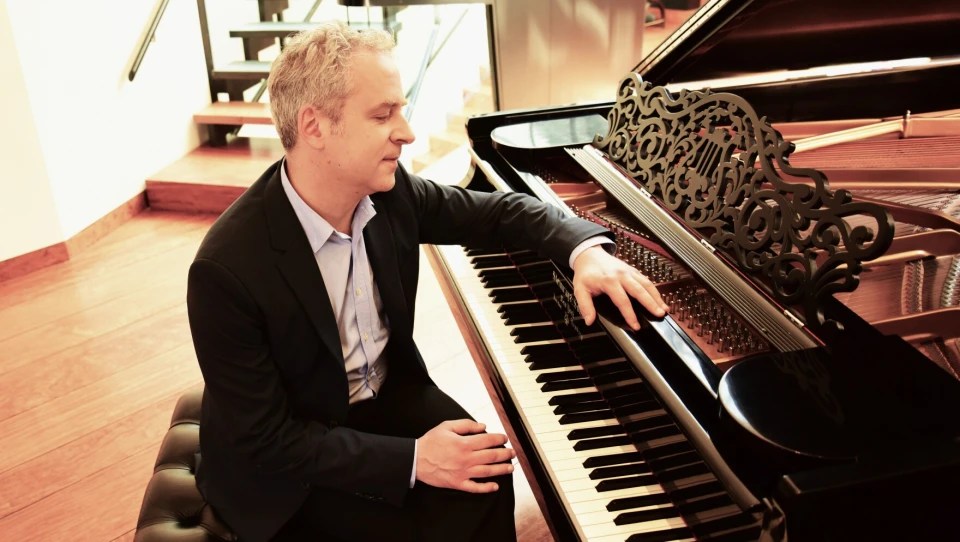
Jeremy Denk (piano, above), City of Birmingham Symphony Orchestra / Kazuki Yamada

Gershwin An American in Paris (1928)
Clyne ATLAS (2023) [CBSO Co-Commission: UK Premiere]
Ravel Pavane pour une infante défunte (1899, orch. 1910)
Mussorgsky orch. Wood Pictures at an Exhibition (1874, orch. 1915)

Symphony Hall, Birmingham
Wednesday 1 May 2024

Reviewed by Richard Whitehouse

This evening’s concert by the City of Birmingham Symphony Orchestra may have taken its overall title from the final work, but ‘pictures’ were everywhere in evidence and not merely those ‘at an exhibition’ – not least with Kazuki Yamada as enthusiastic as ever at the helm.

While it loses out to his Rhapsody in Blue in the popularity stakes, Gershwin’s An American in Paris is surely the most successful of his orchestral pieces for matching its immediacy of imagery to a resourceful structure. Encouraging the CBSO to a bracing response in the outer sections, and with Jason Lewis’s nostalgic trumpet initiating that pathos-laden central phase, Yamada secured a response whose full-on expression was offset by too sectional an approach – the music proceeding in a stop-start fashion rather than unfolding organically as it should.

Over recent years, the New York-based Anna Clyne has emerged among the leading British composers of her generation, with this first UK hearing for her piano concerto ATLAS keenly anticipated. Inspired by the eponymous and epic collection of the artist Gerhard Richter, this likewise falls into four ‘volumes’ rather than movements, which also underlines their relative formal freedom. Certainly, the ingenious interplay between soloist and orchestra is a tough challenge which Jeremy Denk met head-on – whether in the coursing energy then yielding eloquence of the opening Fierce, alluring textural overlaps of Freely, intimate, the lilting nonchalance of Driving or cumulative activity of the final Transparent with its surge to an emphatic close that (as with this work overall) was capricious and allusive in equal measure.

Doubtless motivated by Denk’s coruscating virtuosity, the CBSO gave its collective all in a work which (rightly) appealed to those present – the pianist responding with his deft take on the Heliotrope Rag co-written by Scott Joplin and the tragically short-lived Louis Chauvin.

After the interval, a rare moment of calm – Ravel’s Pavane for a Dead Princess given with a studied if never stolid grace, Elspeth Dutch’s horn and Katherine Thomas’ harp enhancing its appeal. As with Fauré’s Pavane, this is ideal music for opening the second half of a concert.

And so, to Mussorgsky’s Pictures at an Exhibition – heard here in the orchestration by Henry Wood which preceded and was duly superseded by Ravel’s. Wood is more interventionist, not least by reducing the recurrent ‘Promenade’ to a stealthy introduction, but not necessarily less faithful to the piano work’s spirit – hence the scabrous immediacy of Gnomus, sombre aura of The Old Castle (Andrew McDade’s tuba balefully intoning on high above stage-right), or fatalistic tread of Bydlo with its evocative percussion. Respighi was probably taken by this glowering depiction of Catacombs with a ghostly recollection of the promenade hardly less effective, and if Baba Yaga gets summarily curtailed here, the crescendo of bells launching The Great Gate[s] of Kiev set the tone for a treatment whose opulence borders on overkill.

Not that this inhibited the CBSO from projecting Wood’s organ-clad texture to the maximum, to the enthusiasm of an audience that erupted in the lingering resonances at its close. Quite a way to end an impressive performance, and a memorable concert, on a day that saw Yamada become this orchestra’s Music Director and the CBSO launch ‘A Season of Joy’ for 2024/25.

Click on the link to read more on the current CBSO concert season, and also to read about the recently announced 2024/25 programme. Click on the names for more on pianist Jeremy Denk, conductor Kazuki Yamada, and composer Anna Clyne

Published post no.2,168 – Saturday 4 May 2024

In concert – Maria Dueñas, CBSO / Kazuki Yamada: Beethoven Violin Concerto & Elgar ‘Enigma’ Variations

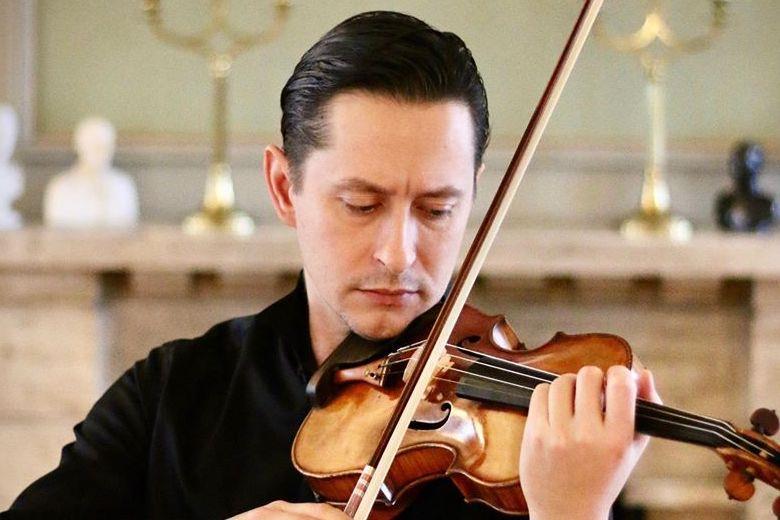
Maria Dueñas (violin, above), City of Birmingham Symphony Orchestra / Kazuki Yamada (below)

Beethoven Violin Concerto in D major Op. 61 (1806)
Elgar Variations on an Original Theme, ‘Enigma’, Op. 36 (1898-9)

Symphony Hall, Birmingham
Thursday 22 February 2024

Reviewed by Richard Whitehouse Picture (c) Tam Lan Truong

Having given its ‘first part’ yesterday evening, Kazuki Yamada and the City of Birmingham Symphony Orchestra moved on to ‘Elgar & Beethoven: Part 2’ this evening, with an astute coupling of the latter’s Violin Concerto being followed by the former’s ‘Enigma’ Variations.

Anyone having heard Maria Dueñas in Lalo’s Symphonie espagnole at last year’s Proms will know she is a violinist destined for great things, as was reinforced her take on the Beethoven. Admittedly she and Yamada were not consistently as one in its lengthy first movement – the soloist’s tendency to rhapsodize and to tease out expressive nuance jarring, however slightly, with the conductor’s forthright assertiveness in tuttis. Yet there was no absence of insight on either part, such undeniable eloquence continuing through a central Larghetto that was more adagio as Dueñas conceived it, though which still conveyed a rapt inwardness. The ensuing Rondo lifted this mood appreciably, its impulsive main theme and whimsical episodes deftly eliding into a purposeful traversal of a finale whose conclusion was nothing if not decisive.

As with her recent recording of this concerto, Dueñas played her own cadenzas. That for the first movement had Bach-like deliberation and a harmonic astringency which readily held the attention; if that connecting the latter two movements seemed a little too protracted, and that towards the close of the finale rather offset its overall momentum, there could be no doubting her underlying conviction. She duly acknowledged the considerable applause with a suitably serene, never cloying arrangement for violin and strings of Fauré’s early song Après un rêve.

In his initial remarks, Yamada recalled conducting a Japanese brass band in the First Pomp and Circumstance March as his first experience with Elgar, and this account of the ‘Enigma Variations amply reaffirmed his identity with the composer. Not that this was an integrated or seamless account – Yamada’s halting, even ambivalent take on the Theme intensified in the first variation and, while the swifter variations had no lack of character or impetus, it was in such as the fifth variation’s suffused earnestness with whimsy that this reading left its mark.

On one level the Enigma is a forerunner of the ‘concerto for orchestra’ with its emphasizing various soloists – not least viola in the sixth variation, dextrously negotiated by Adam Römer, or cello in the 12th where Eduardo Vassallo was at his ruminative best. Initially a little stolid, Nimrod built to a culmination of real pathos, and even finer was Yamada’s take on the 10th variation for an intermezzo of unfailing poise and deftness. A tangible atmosphere pervaded the 13th variation – uncertainty as to its dedicatee just part of its fascination, with those veiled allusions to Mendelssohn elegantly rendered by Oliver Janes. From here to the final variation in all its confidence and anticipation was to be recall the impact this music made at the end of the 19th century, Yamada steering it with unforced rightness towards a resounding peroration. Overall, a performance full of insight and one hopes that Yamada will be continuing his Elgar exploration in future seasons. Next week, though, brings two concerts for which former music director Sakari Oramo will be returning to this orchestra for the first time in some 15 years.

Click on the link to read more on the current CBSO concert season, and on the names for more on violinist Maria Dueñas and conductor Kazuki Yamada. Arcana’s Listening to Beethoven series will reach the Violin Concerto soon!

Published post no.2,101 – Tuesday 27 February 2024

In concert – Eugene Tzikindelean, CBSO / Kazuki Yamada: Dai Fujikura, Walton & Berlioz

Eugene Tzikindelean (violin), City of Birmingham Symphony Orchestra / Kazuki Yamada

Fujikura Wavering World (2022) [CBSO co-commission: UK premiere]
Walton Violin Concerto in B minor (1938-9, rev. 1943)
Berlioz Symphonie Fantastique, Op. 14 (1830)

Symphony Hall, Birmingham
Wednesday 17th January 2024

Reviewed by Richard Whitehouse. Photos (c) Beki Smith

Tonight’s concert by the City of Birmingham Symphony Orchestra brought a varied trilogy of works, one which started with a first UK hearing (following its premiere in Seattle almost two years ago) of Wavering World by the Japanese-born and British-based composer Dai Fujikura.

In his programme note, Fujikura remarks on how little he knew of his traditional culture until having left Japan, and this piece draws upon the myth surrounding creation for an eventful if always cohesive journey through the emergence of the heavenly world, the human world and the underworld. This is achieved by separating the orchestra into stratified layers that do not succeed each other as merge into diverse and intricate textures where these sizable forces are imaginatively deployed; the music gradually moving away from its earlier austerity toward a luxuriance whose salient motifs are recognizable despite their transformation. Directing with unerring focus, Kazuki Yamada secured a vivid rendition which also served as a reminder that Fujikura is less often heard than might be in his country of residence these past three decades.

The fortunes of Walton’s Violin Concerto have lessened this past quarter-century, so Eugene Tzikindelean’s advocacy was its own justification. He had the measure of the initial Andante’s alternation between languor and agitation, ingenuity of thematic transformation offsetting any lack of originality in its themes, then gave of his best during a central Presto whose technical fireworks are tellingly balanced by yearning lyricism. If the final Vivace was less convincing, this might have reflected on the actual music – Walton putting his ideas through their audibly Prokofievian paces before evoking Elgar in a lengthy accompanied cadenza then gratuitously affirmative coda. The CBSO gave stalwart support, just over 50 years since it accompanied Yehudi Menuhin and the composer in a performance commemorating Walton’s 70th birthday.

After the interval, Yamada (above) presided over a ‘no holds barred’ reading of Berlioz’s Fantastic Symphony. The latter-day tendency is to stress its symphonic cogency, but there was little of this in a Daydreams and Passions veering impulsively, even recklessly, between despondency and elation. The waltz element of A Ball was nudged out of shape, but its darker undertones were well judged, with the lengthy build-up then lingering subsidence of Scene in the Fields enhanced by Rachael Pankhurst’s plangent cor anglais and ominous timpani toward the close.

This was hardly the first performance to head off seemingly at a tangent, but March to the Scaffold (shorn of its first-half repeat, as had been the opening movement) quickly became   a parade-ground romp in which the fateful fall of the guillotine went for relatively little. Nor was Dream of a Witches’ Sabbath without its Disney-like element of overkill, though here Yamada ensured a stealthy accumulation through its reiterations of the Dies irae plainchant and fugal episode to a peroration whose thunderous power seemed nothing if not conclusive.

An Episode in the life of an Artist, indeed, as demonstrably left its mark on the enthusiastic audience. Yamada and the CBSO will be doing it all again on April 10th, but next week sees the more Classical appeal of Mozart and Beethoven in the company of Maxim Emelyanychev.

Click on the link to read more on the current CBSO concert season, and on the names for more on violinist Eugene Tzikindelean, conductor Kazuki Yamada and composer Dai Fujikara

Published post no.2,063 – Sunday 21 January 2024

In concert – Eduardo Vassallo, Chris Yates, CBSO / Kazuki Yamada: Richard Strauss – Don Quixote; Beethoven ‘Eroica’ Symphony

Eduardo Vassallo (cello), Chris Yates (viola), City of Birmingham Symphony Orchestra / Kazuki Yamada

Richard Strauss Don Quixote Op.35 (1897)
Beethoven Symphony no.3 in E flat major Op.55 ‘Eroica’ (1803-4)

Kazuki Yamada and Tom Morris (concept), Rod Maclachlan (video design), Zeynep Kepekli, lighting design), Gustave Doré (illustrations)

Symphony Hall, Birmingham
Wednesday 13 December 2023

Reviewed by Richard Whitehouse. Photos (c) Hannah Fathers

Tonight’s concert from the City of Birmingham Symphony Orchestra was not only the orchestra’s final concert before its Christmas season, but also the first to feature a new concept of presentation with a view to reimagining just what the concertgoing experience might be like in the future.

Not that this concept was uniformly applied to the pair of works in question. In the first half, Richard Strauss’s Don Quixote was accompanied by rehearsal and live footage relayed via screens as placed to the left, above and to the right of the platform. They gave passing insight into cellist Eduardo Vassallo’s preparing to take the stage, then kept a close watch on his interaction with violist Chris Yates – their musical repartee informing much of what follows. Less convincing was the selection from Gustave Doré who, while he died over a decade before Strauss’s work, still anticipated its concerns in his illustrations for an 1863 edition of Cervantes. These were rather generally applied over the work’s course with few references to Dulcinea who, while she does not appear in the novel, is yet a pervasive influence on the latter stages of the score.

The performance was a notable one in terms of Kazuki Yamada’s surveying this piece as a cumulatively unfolding whole – its 10 variations, each keenly characterized, framed by an increasingly ominous introduction and warmly resigned epilogue. Vassallo had the measure of what, for all its virtuosity, is essentially a concertante rather than solo part and, for which reason, tends to come off best when taken by a section-leader. Not all those frequently dense textures emerged with ideal clarity and motivic unity, which ensures formal and expressive focus as the work proceeds, could have been clearer in its climactic stages, but an essential humanity was always to the fore as Yamada perceived it. Those hearing it for the first time could hardly have failed to be impressed with Strauss’s ambition or moved by his response.

Less so, perhaps, by Beethoven’s Eroica Symphony after the interval. Here the visual element centred largely on the musicians as the account took place – except during the first movement, when a photographic roll-call of the CBSO’s ‘heroes’ (musical and otherwise) was laminated onto the music – thus robbing it of the means to transcend time and place as surely as had the composer those of revolution or Bonaparte. Elsewhere, the standing-up of individual players and sections to highlight salient aspects of the piece was rather inconsistently applied – why, for instance, did the horns not do so with their unison statement of the ‘Prometheus’ theme in the finale (Thomas Beecham did this decades ago) – while the emerging photos of orchestral members mid-way through that movement risked seeming an awkwardly sentimental gesture.

All of this might have mattered less had the reading carried consistent conviction. As it was, the opening Allegro stuck doggedly to a tempo that felt more than a little stolid – its climactic moments undermined by pauses that impeded the musical flow, though the coda yielded the right emotional frisson. The highlight was a Funeral March whose fatalism was leavened by acute pathos at its climax, with a coda whose disintegration audibly left its mark. If the outer sections of the Scherzo seemed just a little deadpan, its trio was rousingly despatched by the three horns, and the initial stages of the finale had a welcome spontaneity as the ‘Prometheus’ theme is put through its paces. A pity Yamada slowed right down for its restatement midway through, resulting in a serious loss of momentum that not even an incisive coda could regain.

Tonight’s concert was a concerted and not unsuccessful attempt to confront the issue of how to attract a younger and more inclusive audience to classical music. Where it foundered was on a misguided premise that bombarding those present with images somehow makes them listen more intently. For this to come about, they need to be encouraged to focus collective attention aurally rather than just visually – a challenge such as Symphony Hall, with its all-round excellence and its many acoustical resources, would seem ideally equipped to fulfil.

This is evidently an experimental phase for the CBSO, as various possibilities are tried out, but an emphasis on sonic enhancement, allied to the subtle if pervasive presence of lighting, is arguably one way forward and could ultimately blaze a trail for the concert of the future.

You can read all about the 2023/24 season and book tickets at the CBSO website. Click on the names for more information on conductor Kazuki Yamada, cellist Eduardo Vassallo, violist Chris Yates – and also on the names for more on Tom Morris, Rod Maclachlan, Zeynep Kepekli and Gustave Doré

Published post no.2,044 – Tuesday 19 December 2023

In concert – Fazil Say, CBSO / Kazuki Yamada: Prokofiev, Saint-Saëns & Rachmaninoff

Fazil Say (piano), City of Birmingham Symphony Orchestra / Kazuki Yamada

Prokofiev Symphony no.1 in D major Op.25 ‘Classical’ (1916-17)
Saint-Saëns Piano Concerto no.2 in G minor Op.22 (1868)
Rachmaninoff Symphonic Dances Op.45 (1940)

Symphony Hall, Birmingham
Wednesday 4 October 2023

Reviewed by Richard Whitehouse. Picture (c) Fethi Karaduman

French and Russian music has dominated the start of this season by the City of Birmingham Symphony Orchestra, this afternoon’s programme continuing the trend with early pieces by Prokofiev and Saint-Saëns heard alongside Rachmaninoff’s last and arguably greatest orchestral work.

Prokofiev consigned two earlier such pieces as juvenilia prior to his Classical Symphony, an infectious refit of Haydn in the early 20th century and calling-card for a career that beckoned in the West. If Kazuki Yamada slightly over-egged the humour in the opening Allegro, as too a rather self-conscious take on the Gavotte, the limpid phrasing of the intervening Larghetto was as disarming as was the interplay of wind and strings in the Finale – a reminder, here as throughout, that such musical directness should not be mistaken for mere technical facility.

This could be said of the Second Piano Concerto that Saint-Saëns unleashed on an evidently nonplussed Parisian audience half-a-century earlier. True, the conflation of Bach – given a makeover worthy of Alexander Siloti – with Liszt affords the opening movement an almost makeshift design, but Fazil Say took it firmly in hand from a surging ‘chorale-prelude’ to a tersely decisive coda. A pity his pianism was not applied a little more deftly in the ensuing intermezzo, its ingratiating poise smothered by an almost hectoring insistence, but the final Presto suited this most demonstrative of present-day virtuosi to a tee – its perpetuum mobile undertow maintained with unflagging resolve through to those almost brutal closing chords. Credit to Yamada for enhancing the total effect with his astute and precise accompaniment.

Say, as much composer as pianist, responded to the applause with his Black Earth – a study in sonority alluding to the golden-age of Turkish balladry as well as the Saz (a Turkish lute) in a mood of sombre fatalism which, unlike his orchestral epics, did not outstay its welcome.

The CBSO has given frequent performances over the decades of Rachmaninoff’s Symphonic Dances, but none so incendiary. Not that there was anything overly powerhouse in Yamada’s conception of an initial piece whose outer sections felt trenchant in their energy, with the alto saxophone melody at its centre eloquently given by Kyle Horch and the coda rendered with melting grace. Nor was any lack of suavity in the central piece, its underlying waltz motion poised on a knife-edge of sardonic humour rightly given its head in the hectic closing pages.

Yamada had the measure, too, of the last piece with its dramatic introduction and impulsive continuation, but it was in the lengthy central episode this reading really came into its own – the composer creating music of an intoxicating expression via subtleties of harmonic nuance or textural shading rather than any defining melodic line. From here, impetus was seamlessly restored to a climactic emergence of the Dies irae plainchant then surged on to the explosive closing gesture that might have resounded longer had the audience not unreasonably erupted.

Yamada responded with Lezginka from Khachaturian’s ballet Gayane. An exhilarating close to an afternoon as began for early arrivals with what sounded like a medley from a mid-1970s children’s TV show on the first-floor performance space: it could only be here in Birmingham.

You can read all about the 2023/24 season and book tickets at the CBSO website. Click on the artist names for more information on pianist Fazil Say and conductor Kazuki Yamada