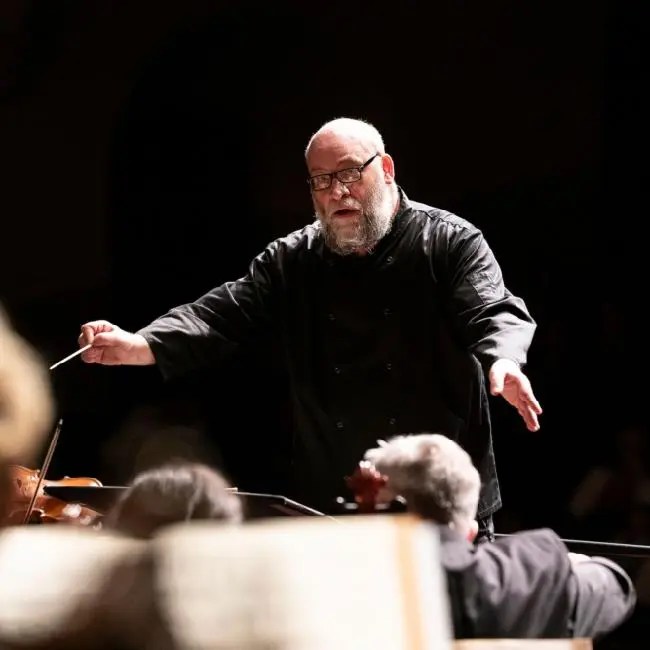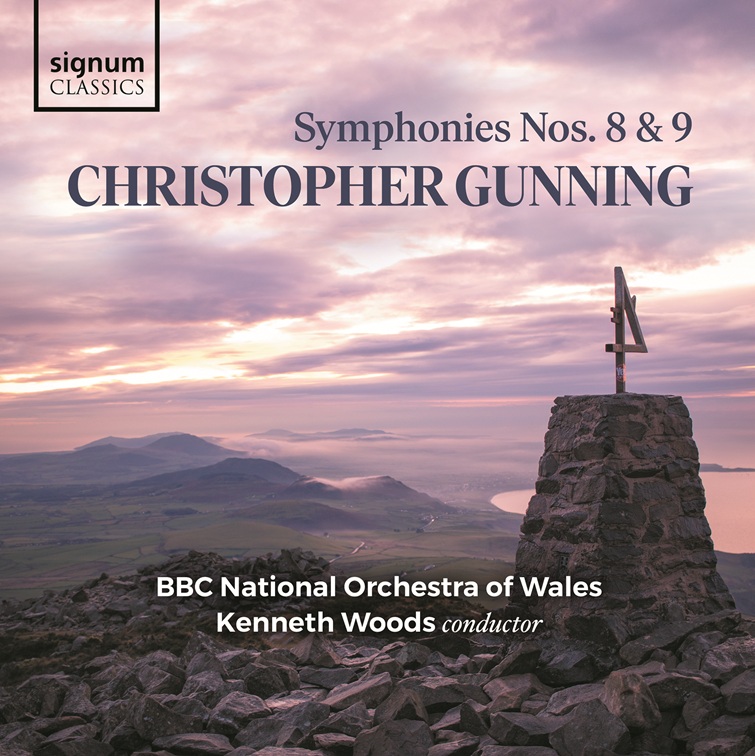
On Record – BBC National Orchestra of Wales / Kenneth Woods – Christopher Gunning: Symphonies nos. 8 & 9 (Signum Classics)

BBC National Orchestra of Wales / Kenneth Woods

Christopher Gunning
Symphony no.8 (2015)
Symphony no.9 (2016)

Signum Classics SIGCD949 [67’33”]
Producer Phil Rowlands Engineer Mike Hatch

Recorded 11-13 March 2024, Hoddinott Hall, Wales Millennium Centre, Cardiff

Reviewed by Richard Whitehouse

What’s the story?

Signum Classics continues its coverage of the late Christopher Gunning with this coupling of two symphonies, a genre that dominated the composer’s thinking in later years, and which get the advocacy they deserve from the BBC National Orchestra of Wales with Kenneth Woods.

What’s the music like?

Although he studied at London’s Guildhall School of Music and Drama with early ambitions as a symphonist, Gunning’s subsequent career was centred on scores for film and television with successful excursions into popular music. Not until 2001, when he was nearing 58, did he complete his First Symphony that was followed by a further 12 over the next two decades, along with several concertos and other orchestral pieces, in what is among the more notable instances of a composer moving between very different disciplines with comparable success.

Written for modest and what might be called ‘late-Classical’ forces, both symphonies are as integrated formally as they are resourceful motivically while, in both instances, movements are merely numbered rather than designated by tempo or expression. The Eighth Symphony consists of three movements unfolding from a sonata design of deft formal proportions with a slower introduction, via a slow movement whose ruminative cast is enhanced by plaintive contributions from flute and cor anglais, to a finale whose scherzo inclinations afford it an impetus and lightness maintained through to the decisive close. An earlier era of American symphonism (ostensibly that of Walter Piston or Randall Thompson) can be detected in its harmonic colouring and melodic contours, but Gunning’s personality is audible throughout.

Scored for slightly larger forces and with four movements, the Ninth Symphony feels no less focussed formally while admitting a wider range of or, at least, of more ambivalent emotions. Thus the opening movement again adheres to sonata design, with a more discursive (though never rhapsodic) take on its primary ideas. This is followed by a speculative or even fugitive scherzo, then a slow movement whose sustained eloquence arguably makes for the highlight of either symphony. It only remains for the finale, its progress as purposeful as it is eventful, to afford a conclusiveness that feels not at all premeditated, let alone predictable. If, in both these works, there is a tangible inner drama which is being played out, Gunning is first and foremost a symphonist for whom abstract concerns override any more subjective tendencies.

Does it all work?

It does indeed – thanks, above all, to Gunning’s unstinting focus on what symphonic form is and can be. Those familiar with any of his other symphonies will know that there is nothing anecdotal or half-baked about his handling of the genre, which emerges as the self-sufficient concept it ideally should be. It helps, of course, that Woods renders both these works with the insight expected from a conductor whose 21st Century Symphony Project has been crucial in rehabilitating the symphony in the UK, and who secures committed playing from BBCNOW.

Is it recommended?

Very much so. Recorded with all the necessary definition, and informatively annotated, this is well worth acquiring by those who are not yet acquainted with Gunning’s symphonic odyssey. Only recordings of the 11th, 13th and the revised First remain to complete an important cycle.

Listen / Buy

You can hear excerpts from the album and explore purchase options at the Signum Classics website, or you can listen to the symphonies on Tidal. Click on the names to read more about composer Christopher Gunning, the BBC National Orchestra of Wales and conductor Kenneth Woods

Published post no.2,782 – Thursday 29 January 2026

In concert – Wednesday 12 November: English Symphony Orchestra to bring Roaring Twenties to life in opening concert of 2025-26 Malvern Residency

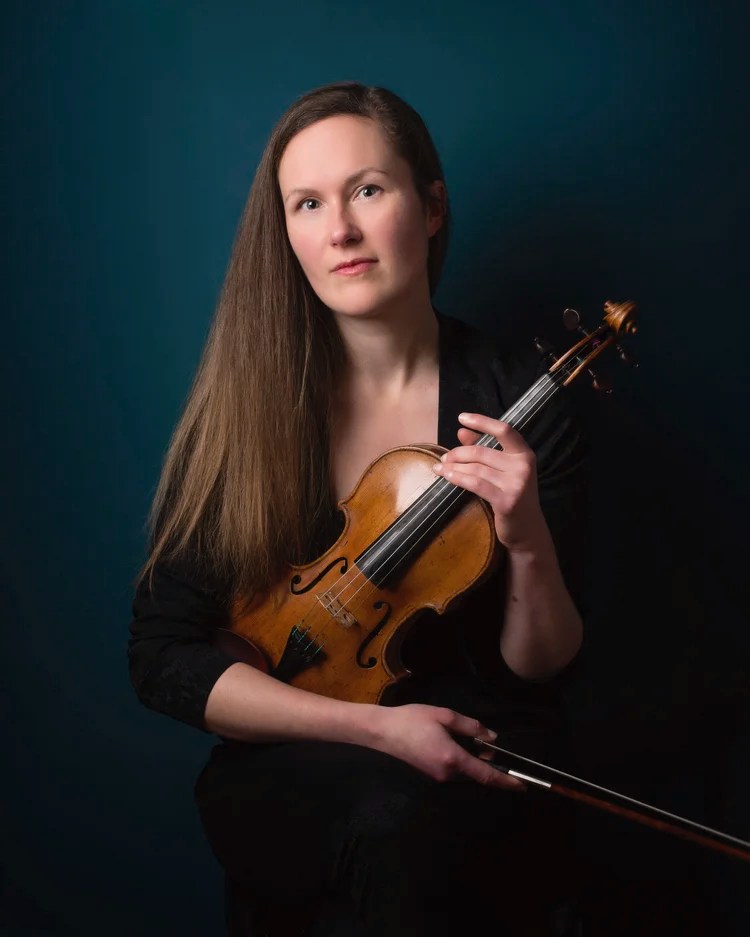
reposted by Ben Hogwood Photo Zoe Beyers leading the English Symphony Orchestra (c) Michael Whitefoot

The renowned English Symphony Orchestra (ESO), under their principal conductor Kenneth Woods, is to make a highly anticipated return to Malvern Theatres, Worcestershire on Wednesday 12 November at 7:30pm with a programme celebrating the adventurous spirit and playful energy of the 1920s, as part of their Autumn-Winter Residency.

LIVELY SPIRIT OF THE ROARING TWENTIES

The evening will feature works by composers who captured the era’s lively spirit, including Erwin Schulhoff’s Suite for Chamber OrchestraDarius Milhaud’s The Ox on the Roof’ and Kurt Weill’s raucous cabaret songs, to be performed by the ESO’s first affiliate artist, soprano April Fredrick. The programme opens with the music of Joseph Haydn and a performance of his Symphony No. 60 entitled The Absent-Minded Gentleman, delighting in the composer’s celebrated wit and humour.
 
Kenneth Woods, Artistic Director and Principal Conductor of the ESO, introduces the programme: “Erwin Schulhoff’s suave Suite for Chamber Orchestra takes listeners on a guided tour of 20s dance crazes, from the shimmy to the tango. Milhaud’s zany ballet score The Ox on the Roof was inspired by the comedy of Charlie Chaplin and the dance music of Brazil, while Kurt Weill’s songs reflect life in and around the cabaret scene in all its humour and sensuality. The programme opens with Haydn’s Symphony No.60, The Absent-Minded Gentleman, quite possibly the funniest and most surreal symphony ever composed.”

ENGLISH SYMPHONY ORCHESTRA – MALVERN RESIDENCY

Wednesday 12 November 2025, 7.30pm
Malvern Theatres Grange Road, Malvern, Worcs. WR14 3HB
English Symphony Orchestra: The Joker’s Wild – Mischief in Music
Haydn Symphony No. 60 (‘Il Distratto’) in C
Weill Cabaret Songs
Schulhoff Suite for Chamber Orchestra
Milhaud The Ox on the Roof

April Fredrick (soprano), English Symphony Orchestra / Kenneth Woods

For more information visit the Malvern Theatres website

Published post no.2,708 – Tuesday 4 November 2025

On Record – MahlerFest 36 & 37: Mahler & The Mountains: Kenneth Woods conducts Symphony no.4 & selections from Des Knaben Wunderhorn

April Fredrick (soprano), Brennen Guillory (tenor – Trost im Unglück, Der Tambourg’ sell; Revelge), Colorado MahlerFest Orchestra / Kenneth Woods

Mahler
Symphony no.4 in G major (1892; 1899-1900)
Des Knaben Wunderhorn: Lied des Verfolgten im Turm; Des Antonius von Padua; Fischpredigt; Trost im Unglück; Rheinlegendchen; Der Schildwache Nachtlied; Der Tambourg’sell; Revelge

Colorado MahlerFest 195269364564 [two discs, 89’22”]
Producer Jonathan Galle Engineer Tim Burton
Live performances at Macky Auditorium, Boulder, Colorado, 20 May 2023 (Des Knaben Wunderhorn), 19 May 2024 (symphony no.4)

Reviewed by Richard Whitehouse

What’s the story?

Recorded coverage of Colorado’s MahlerFest continues with these performances taken from the past two editions, duly confirming the significance of this event in the annals of Mahler interpretation and the increasing excellence of the orchestral playing under Kenneth Woods.

What are the performances like?

It may be the shortest of his cycle and the one which initially gained his music acceptance in the UK and US, but Mahler’s Fourth Symphony received as rough a reception as any of his premieres and it remains a difficult work fully to make cohere. While he undoubtedly has its measure, Woods might have pointed up those expressive contrasts in its opening movement a little more directly; the music only finding focus with a development where the emotional perspective opens out to reveal an unforeseen ambiguity. The remainder is unfailingly well judged, while the scherzo impresses through a seamless transition between the sardonic and the elegance of its trio sections. Alan Snow sounds just a little tentative with his ‘mistuned’ violin, but the unexpected panorama of enchantment prior to its coda is meltingly realized.

At just over 20 minutes, the Adagio feels relatively swift (surprisingly so), even if Woods is mindful never to rush its unfolding double variations and what becomes a contrast between intensifying expressive states whose Beethovenian antecedent is not hard to discern. If the climactic ‘portal to heaven’ lacks little in resplendence, it is that hushed inwardness either side such as sets the seal on a reading of this movement to rank among the finest in recent years. Nor is its segue into the finale other than seamless – Mahler having realized that an earlier vocal setting was the natural culmination to where his symphony had been headed. Suffice to add that April Fredrick’s contribution is of a piece with Woods’s conception in its canny mingling of innocence and experience prior to an ending of deep-seated repose.

The second disc features seven songs taken from Mahler’s settings of folk-inspired anthology Des Knaben Wunderhorn. April Fredrick is truly in her element with a Rheinlegendchen of winning insouciance and a Des Antonius von Padua Fischpredigt of deftest irony. Brennen Guillory comes into his own with the final two numbers, Der Tamboursg’sell distilling the darkest humour as surely as Revelge conveys that innate fatalism behind the resolve with which the soldier meets his destiny. Woods provides an astute and sensitive accompaniment.

Does it all work?

Yes, insofar as the collection of folk-inspired poetry proved central to Mahler’s evolution as both a song and symphonic composer. It might have been worthwhile to include the original version of Das himmlische Leben, not least as its appreciably different orchestration shows just how far the composer’s thinking had come during eight years, but the present selection is nothing if not representative. Hopefully those Wunderhorn songs not featured will appear on a future issue from this source, maybe in tandem with the Rückert songs of the next decade.

Is it recommended?

Yes it is. The symphonic cycle emerging from MahlerFest is shaping up to be a significant addition to the Mahler discography, with the latest instalment no exception. Hopefully this year’s account of the Sixth Symphony will find its way to commercial release before long.

Listen / Buy

For further purchase options, visit the MahlerFest website – and for more information on the festival itself, click here. Click on the names for further information on conductor Kenneth Woods, soprano April Fredrick and tenor Brennen Guillory

Published post no.2,681 – Wednesday 8 October 2025

On Record – MahlerFest XXXVII: Kenneth Woods conducts Richard Strauss: Eine Alpensinfonie

Colorado MahlerFest Orchestra / Kenneth Woods

Richard Strauss Eine Alpensinfonie Op.64 (1911-15)

Colorado MahlerFest 195269359249 [49’47”]
Producer Jonathan Galle Engineer Tim Burton
Live performance at Macky Auditorium, Boulder, Colorado, 18 May 2024

Reviewed by Richard Whitehouse

What’s the story?

With its underlying concept that of Mahler and the Mountains, this 37th edition of Colorado MahlerFest was probably the most ambitious yet. As was reflected in those works featured at its main orchestral concerts, and not least this performance of Richard Strauss’s An Alpine Symphony.

What’s the music like?

This being its composer’s final large-scale orchestral piece is not fortuitous, as it concludes a sequence of symphonic works stretching back some 35 years to his Symphony in D minor. Strauss may subsequently have abandoned the symphony for the tone poem, but these latter became increasingly symphonic in formal scope or expressive density with the present work bringing full circle a process as could hardly be resumed given the tonal retrenchment of his idiom henceforth. An Alpine Symphony represents an impressive and a defining culmination.

Although it nominally outlines a day’s ascent then descent in the Bavarian Alps (actually the Heimgarten), this work is equally the ‘journey of a life’ duly articulated through an extended sonata-form design. It is this latter aspect which emerges at the forefront of Kenneth Woods’ interpretation – one which unfolds cohesively and, most important of all, organically out of then back to its evoking of Night. The crescendo of activity through to Sunrise then The Ascent is keenly maintained, with those expository episodes that follow not lacking scenic immediacy or formal impetus. Neither is the ensuing developmental sequence underplayed on route to the emotional crux of On the Summit then Vision: music, it might be added, whose grandiloquent expression is shot through with a knowledge of its imminent demise.

What goes up must inevitably come down: the transition into the reprise is finely handled in terms of its encroaching Elegy, though momentum does falter slightly in the recapitulatory phase of Storm and Descent. Not that the Colorado MahlerFest Orchestra is found wanting as regards its commitment; more likely, the clear if somewhat confined acoustic of Boulder’s Macky Auditorium is not able to encompass the sheer volume of sound effected in this phase. Woods nevertheless heads into Sunset with requisite poise and if the coda that is Ausklang – a term more or less untranslatable but which approximates to ‘catharsis’ – is just a little too passive, its rapt recollections of Wagner and Mahler are eloquently inferred. As is the return to Night, audibly linking into that from the opening for what becomes an indissoluble unity.

Does it all work?

Pretty much throughout. Once a piece reserved for special occasions, An Alpine Symphony is now among the most often recorded of Strauss’s orchestral works but while this performance cedes to others in terms of tonal opulence and visceral impact, it has relatively few peers as regards its symphonic credentials. A pity, incidentally, the performance of Schubert’s Death and the Maiden quartet from the first half, which Woods has elaborated from Mahler’s often sketchy arrangement for strings, could not have been included as to make this a two-disc set.

Is it recommended?

It is. The CD comes with a full listing of personnel on its rear inlay, and you can scan the QR code or click here for Kelly Dean Hansen’s detailed notes. Mahler’s Fourth Symphony from this edition will be issued separately.

Listen / Buy

For further purchase options, visit the MahlerFest website – and for more information on the festival itself, click here. Click on the name for further information on conductor Kenneth Woods

Published post no.2,665 – Monday 22 September 2025

On Record – Ken Woods and the Old Blue Gang – Silent Spike (Kenneth Woods)

by Richard Whitehouse

What’s the story?

Kenneth Woods issues the debut of his band The Old Blue Gang, less a concept album per se than themed reflections on a shameful while all too typical incident (then as now) of migrant workers who were first exploited then betrayed in the American West of some 150 years ago.

What’s the music like?

Best known as a conductor, notably at the helm of the English Symphony Orchestra for over a decade, Kenneth Woods also works extensively as cellist and guitarist. This latter career is showcased in Silent Spike, the first album with his band The Old Blue Gang, which affords a probing take on the largely forgotten role of Chinese immigrants involved in constructing the Transcontinental Railway line from California via Oregon to Washington. A tale of alienation, exploitation and ostracization which has lost none of its horrific impact over ensuing decades.

Opening track The Voyage emerges ‘Déjà Vu’-like into focus, its commentary about those coming to the New World with little or no expectation delivered in suitably deadpan fashion by Woods, whose searing guitar affords contrast with Joe Hoskin’s methodical yet ominous bass and Steve Roberts’s forceful yet flexible drumming. The arduous workload endured by the immigrants is vividly conveyed by the grunge-inflected Steel Stretcher, before Dead Line Creek puts musicians (and listeners) through their collective paces with its unsparing depiction of mass murder by the gang fronted by Old Blue – an outlaw whose reward is as much destructive as monetary. Much the longest track at 21 minutes and its evolution more instrumentally than narratively driven, this is alt-Americana at its most uncompromising.

It might have been preferable to sequence this epic after the next three tracks, each of them streamed as singles in advance of the album. Sundown Town evokes its intolerance with a fatalism redolent of Johnny Cash, intensified by Lilly White with its chilling recollection   of miners being deliberately incarcerated so they need not be paid. Ride the Rails provides a natural continuation with its tale of the immigrants being driven out of town by the under-employed during economic depression, who were (inevitably) acquitted of any wrongdoing. It remains for closing track Gather the Ghosts and Bones to inject a degree of empathy as it recounts the returning of remains of those who received burial in their native China – people otherwise known only through the handful of faded photographs that have come down to us.

Does it all work?

Indeed. Ensemble is unusually dense and layered for a three-piece outfit, though this does not mean excessive ‘noodling’ or wanton virtuosity; the playing being characterized by a restraint or even austerity such as fittingly underlines the grimness of the narrative and the austerity of its realization. Pertinent comparison, conceptually if not musically, can be made with Fairport Convention’s 1971 masterpiece ‘Babbacombe’ Lee – for all that this album touches, however obliquely, upon a redemptive quality understandably absent from what is encapsulated here.

Is it recommended?

Very much so. It hardly makes for comfortable listening, but Silent Spike is a plangent while resourceful treatment of a subject whose contemporary relevance cannot be gainsaid. It also offers intriguing pointers as to where The Old Blue Gang might be headed on future albums.

Listen / Buy

You can explore purchase options on the Kenneth Woods website

Published post no.2,662 – Friday 19 September 2025