The latest addition to ESO Digital, the online concert arm of the English Symphony Orchestra, is the world premiere performance of Wreck, the orchestral piece by Steve Elcock.
This is the concert Arcana’s Richard Whitehouse saw at the 2022 Elgar Festival, at the Malvern Theatres in Great Malvern. You can read his review here.
Described by its composer as ‘‘a message of salvation beyond despair, of consolation beyond grief’’, Wreck is performed by mezzo-soprano Kathryn Rudge, with the English Symphony Orchestra conducted by Kenneth Woods. Click here to go to the ESO website and watch the performance.
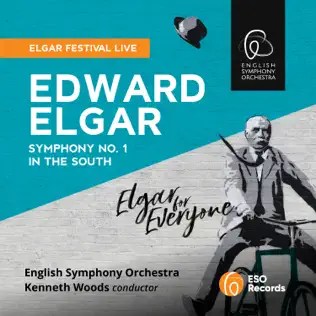
Elgar Symphony no.1 in A flat major Op.55 (1907-08)
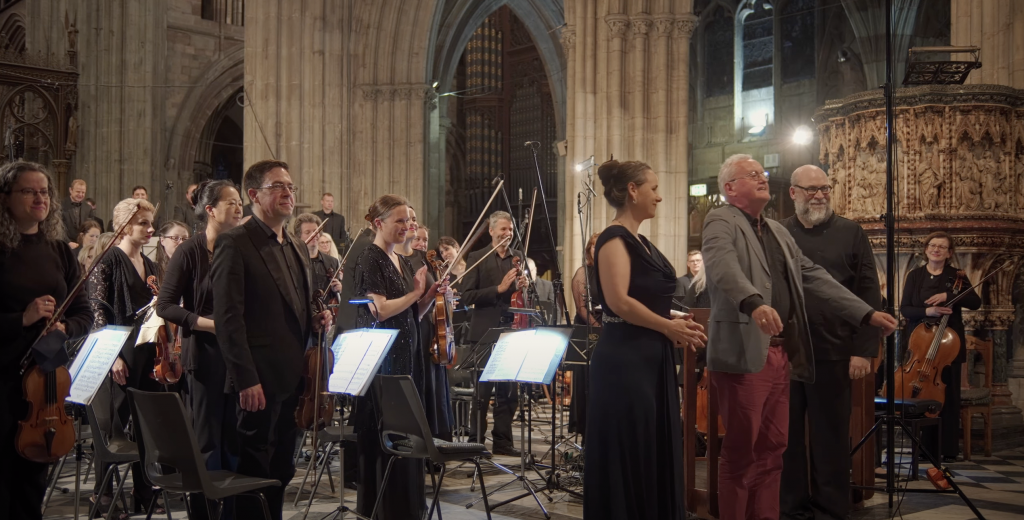
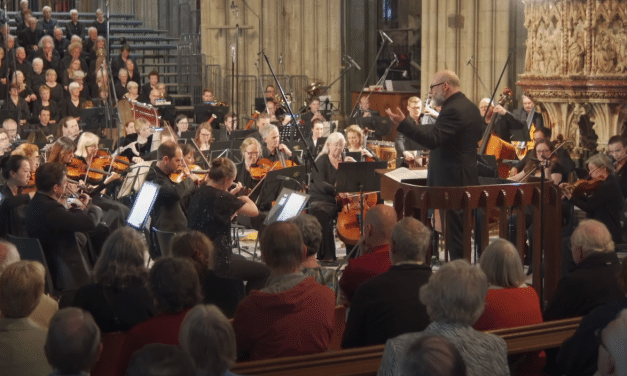
English Symphony Orchestra (leader Zoë Beyers) / Kenneth Woods
Filmed at Worcester Cathedral, Saturday 3 June 2023
Recording, editing and video direction by Tim Burton
Reviewed by Richard Whitehouse
The revival these past four years of the Elgar Festival has provided a boost to music-making in the Midlands, with the present account of that composer’s First Symphony a reminder of the English Symphony Orchestra’s prowess right across the spectrum of symphonic writing.
It may not have had the usual number of strings to complement the triple woodwind or brass, but the resonance of Worcester Cathedral ensured any such disparity was not evident in terms of internal balance. Not least an opening movement whose motto-theme was thoughtful while never indulgent, setting the tone for a main Allegro where expressive variety was never at the expense of its formal focus. Especially felicitous was a hushed transition into the reprise, and a coda which ably distilled the equivocal mood overall as it subsided into a ruminative calm.
Kenneth Woods was mindful to invest the scherzo and its trio with a consistency of pulse so, if the former felt a little reined-in at its return, the latter unfolded with an ideal blend of poise and wistfulness. Nor was that lengthy transition into the slow movement other than seamless as a harbinger of this Adagio’s understated if undeniable profundity, Woods duly negotiating its interplay of soulful main theme and wistful asides with unerring rightness through to the artless closing bars where the music seems not so much to cease as recede beyond earshot.
If the finale represents a falling-off of inspiration, it was not apparent here. Sombre yet shot through with expectancy, its introduction launched an Allegro whose alternating incisiveness and suavity held good during an impulsive development, then a transformation of the codetta whose pathos returned for an apotheosis where the motto-theme carried all before it. Not that these closing pages felt at all bombastic or even grandiloquent in import; rather, they set the seal on a work whose affirmation is the greater for its having been so purposefully attained.
An impressive performance as must have seemed even more so in the context of this concert, not that anyone hearing it via ESO Digital is likely to feel short-changed in emotional terms. Hopefully more performances from the Elgar Festival will be made available at this platform.
Mahler Symphony no.1 in D major (1887-8, rev, 1898) Mahler arr. Schoenberg Lieder eines fahrenden Gesellen (1884-5, arr. 1920) Mahler Blumine (1884, rev. 1889)
Colorado MahlerFest 195269164287 [79’02”] Live performances on 18 May 2019 (Lieder eines fahrenden Gesellen), 19 May 2019, Macky Auditorium, Boulder, Colorado
Reviewed by Richard Whitehouse
What’s the story?
Recorded representation of the current MahlerFest era continues to grow with this release on CD (previously available as a download) of the First Symphony with related pieces, given at its 32nd edition and what was the fourth such event with Kenneth Woods as artistic director.
What’s the music like?
What was doubtless intended to inaugurate a chronological traversal began in 2019 with this performance of the First Symphony, the first to be heard in the critical edition published that year by Breitkopf & Härtel. Woods has written about this extensively at his website [Ken on the Great Mahler Debate of 2019 | Kenneth Woods – conductor]: suffice to add the numerous corrections and textural amendments enhance that fuller and more stratified orchestral sound such as Mahler favoured in 1899 when compared with earlier versions from 1889 and 1893.
Interpretatively, this performance is a satisfying one with few overt surprises but no obvious idiosyncrasies. Any lack of atmosphere during the first movement’s mesmeric introduction is offset by its easeful if never uneventful continuation – thus a subtly differentiated exposition repeat, then stealthy marshalling of expressive tension to a coda whose joyousness is rightly kept within limits. The scherzo is robust yet propulsive and the trio even finer in its unforced suavity, while the funeral march never over-inflects its Klezmer elements unfolding from the ominous and ironic, via gentle repose, to a closing fatalism. Woods succeeds better than most in holding together the unwieldy finale, allowing due emotional space for the recall of initial ideas that is its sure highlight, and the ensuing apotheosis lacks nothing in blazing affirmation.
Included as an encore is Blumine, the ‘romance’ salvaged from earlier incidental music which formed part of this symphony until being jettisoned in 1894 – here emerging with its elegance and pathos devoid of wanton sentiment. The actual concert continued with Korngold’s Violin Concerto then Beethoven’s Third Leonora Overture reorchestrated by Mahler, but the present release opens with a performance from the previous day’s concert of Lieder eines fahrenden Gesellen. This is heard in a chamber arrangement as supervised by Schoenberg for the 1920 season of his Society for Private Musical Performances, its textural transparency underlining the soulfulness then buoyancy of its opening two songs. If the (over-wrought?) drama of the third song is under-projected, the wistful radiance of its successor comes across unimpeded.
Does it all work?
Indeed it does, overall. Mahler symphonies may have been performed and recorded by a host of international orchestras, but that of the Colorado MahlerFest lacks nothing in commitment or tenacity; any lack of atmosphere and finesse owes more to the clear if confined acoustic of Macky Auditorium than absence of quiet playing or overriding of dynamics. Joshua DeVane is a thoughtful exponent of the song-cycle, at his best in the restrained inwardness of its outer numbers, while the ensemble drawn from the CMO makes a persuasive case for this reduction.
Is it recommended?
It is. The orchestral playing may have grown in conviction with each new instalment, but this is a notable statement of intent for MahlerFest under Woods’s direction. That the 33rd edition had to be scaled down then presented online had little effect on the resolve of those involved.
Buy
For further purchase options, visit the MahlerFest website – and for more information on the festival itself, click here. Click on the names for further information on conductor Kenneth Woods and soloist Joshua DeVane
Musgrave Phoenix Rising (1997) Mahler Symphony no.2 in C minor ‘Resurrection’ (1888-94)
Colorado MahlerFest 195269301194 [two discs, 104’02”] Live performances on 21 May 2023, Macky Auditorium, Boulder, Colorado
Reviewed by Richard Whitehouse
What’s the story?
Last year’s edition of MahlerFest continued its latest, not-quite-chronological traversal of the symphonies with the Second – appropriately coupled on this release (as in the concert) with a work such as considers ‘resurrection’ from a very different while no less relevant perspective.
What’s the music like?
Six years in the writing, Mahler’s Second Symphony fairly laid the basis for his reputation as a composer at its Berlin premiere in 1895. It is a measure of this performance that it captures something of the shock or excitement no doubt in evidence back then, not least in an opening movement with Kenneth Woods notably more interventionist tempo-wise as compared to that of the Third Symphony a year before. What emerges is imposing but never diffuse, at its most gripping in that baleful lead-in to a development whose terseness duly accentuates its impact, with the pathos of the second subject on its reprise making the coda’s sardonic recessional the more acute. After which, the second movement feels the more enticing through its alternation of warm sentiment with capering animation while heading to a conclusion of beatific repose.
There is no lack of incident in a scherzo whose glancing irony is leavened yet not lessened by its trios, the first as soulful with its lilting trumpets as the second is ominous in its import; but not before Stacey Rishoi has characterized the Urlicht setting with rapt inwardness. What to say about the finale other than, while this may not be the most overwhelming take on its vast fresco, it is matched by relatively few as regards an organic unfolding that sees the movement whole. Its contrasting elements here fuse with unforced cohesion to a fervent rendering of the chorale episode then on to a surging Toten-marsch – the kinetic momentum carried through to a methodical reprise of earlier ideas, then a rendering of Klopstock’s text (much altered by the composer) as only grows in intensity before the majestic affirmation of its closing pages.
As the ‘first half’, Thea Musgrave’s Phoenix Rising provides an ideal complement. The much esteemed (latterly more in the US than the UK) nonagenarian has written often for orchestra, but seldom with such immediacy than in a piece whose formal and expressive trajectory feels nothing if not symphonic in its progress. Comparison with the 2016 studio recording by BBC National Orchestra of Wales and William Boughton (Lyrita SRCD372) confirms that, passing tentativeness in ensemble excepted, Woods’s reading demonstrably makes more of this aspect.
Does it all work?
Yes, pretty much always. As on previous releases in this ongoing Mahler cycle, the Colorado MahlerFest Orchestra punches appreciably above its weight in music which should never fall prey to wanton virtuosity. The unyielding acoustic of Macky Auditorium is less an issue than before, with the finale’s offstage brass adeptly managed. April Fredrick brings her customary eloquence to bear on this movement, and the Boulder Concert Chorale – as prepared by Vicki Burrichter – rises to the occasion with notable fervency as this work reaches an ecstatic close.
Is it recommended?
It is. There have been too many superfluous Mahler cycles, but this traversal is shaping up as one of the most worthwhile and more than the memento of a memorable occasion. Hopefully such standards will be maintained by the Sixth Symphony as part of next year’s 37th edition.
Nimbus NI6446 [56’24’’] Producer and Engineer Phil Rowlands Recorded 28 July 2021 (Symphony), 26 May 2022 (Violin Concerto) at Wyastone Concert Hall, Monmouth
Reviewed by Richard Whitehouse
What’s the story?
The English Symphony Orchestra and Kenneth Woods add to their much lauded 21st Century Symphony Project with this release devoted to Steve Elcock (b.1957), juxtaposing two major works which confirm his standing among the leading European symphonists of his generation.
What’s the music like?
Both works heard here only gradually assumed their definitive form. Composed at stages over almost a decade, the Violin Concerto marks something of a transition between less ambitious pieces for local musicians and those symphonic works which have come to dominate Elcock’s output. Its initial Allegro vivo is a tensile sonata design whose rhythmic energy is maintained throughout, with enough expressive leeway for its second theme to assume greater emotional emphasis in the reprise. There follows a Molto tranquillo whose haunting main theme, at first unfolded by the soloist over undulating upper strings in a texture pervaded by change-ringing techniques, is a potent inspiration. A pavane-like idea soon comes into focus while the closing stage, reaching an eloquent plateau before it evanesces into silence, stays long in the memory. The short but eventful finale is a Passacagliawhose theme (audibly related to previous ideas) accelerates across five variations from Andante to Presto, before culminating in a heightened cadenza-like passage on violin and timpani then a peremptory yet decisive orchestral pay-off.
The Eighth Symphony has its antecedents even further back, having begun as a string quartet in the early 1980s, though it continues those processes of evolution and integration central to the seven such works which precede it. It reflects the impact of the Sixth Symphony by Allan Pettersson (still awaiting its UK premiere after 58 years), but whereas that epic work centres on fateful arrival, Elcock’s single movement is more about striving towards a destination that remains tantalizingly beyond reach. Numerous pithy motifs are stated in the formative stages, as the music alternates between relative stasis and dynamism before being thrown into relief by the emergence (just before the mid-point) of a trumpet melody that goes on to determine the course of this piece as it builds inexorably towards a sustained climax then subsides into a searching postlude. Overt resolution may have been eschewed, yet the overriding sense of cohesion and inevitability duly outweighs that mood described by the composer as ‘‘one of desperation in the teeth of impending catastrophe’’ which, in itself, becomes an affirmation.
Does it all work?
Certainly, given both works receive well prepared and finely realized performances – notable for the way Elcock’s demanding yet idiomatic string writing is realized with real conviction. The concerto is a tough challenge for any soloist and one Zoë Beyers meets with assurance – its close-knit interplay of soloist and orchestra brought off with admirable precision, and its occasional modal subtleties rendered as enrichments of the tonal trajectory. Elcock has been fortunate in his recorded exponents, and this new ESO release is emphatically no exception.
Is it recommended?
Indeed, and good to hear that, as the ESO’s current John McCabe Composer-in-Association, Elcock will feature on a follow-up issue of his pieces Wreck and Concerto Grosso, along with the recent Fermeture. For now, this latest release warrants the strongest of recommendations.