
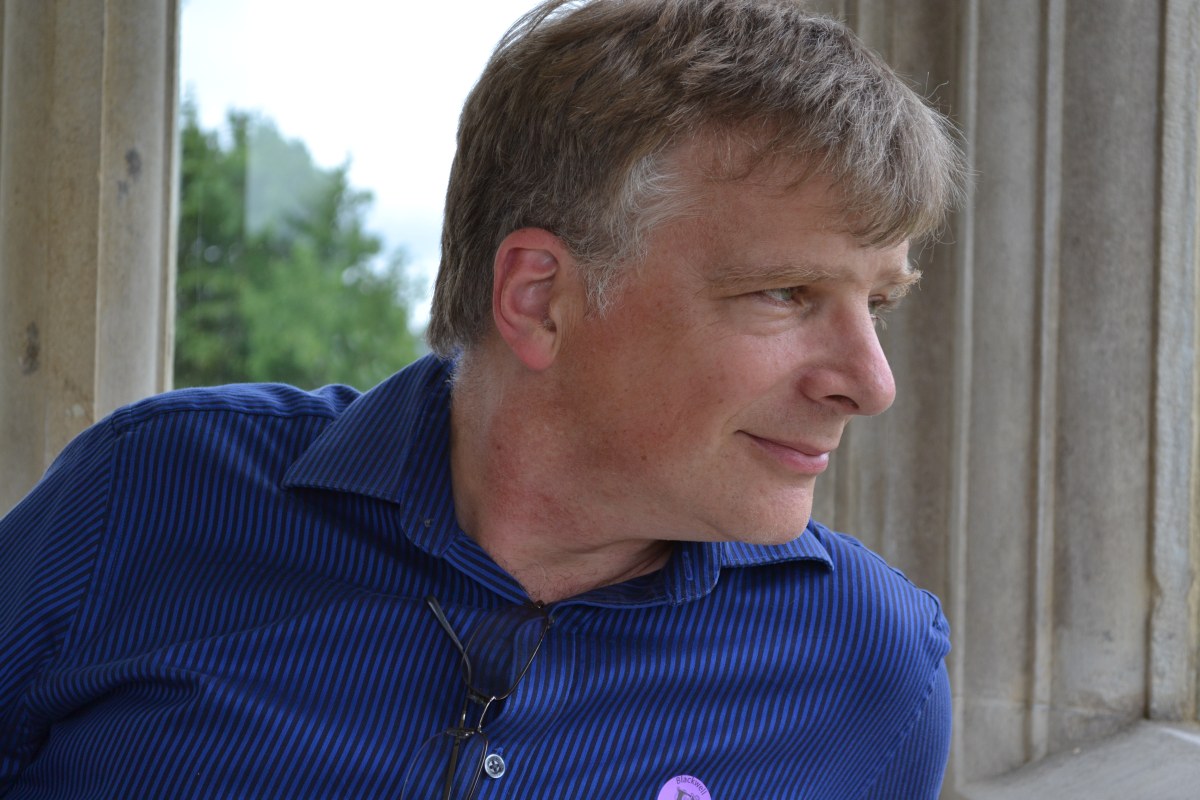
Roberts Balanas (electric violin, below), Ealing Symphony Orchestra / John Gibbons (above)
Bernstein orch. Kostall & Ramin Symphonic Dances from West Side Story (1957 arr. 1961)
Luq Electric Violin Concerto ‘Machina Humana’ (2023-24) [World Premiere]
Coleridge-Taylor Valse de la reine Op.22/3 (1899)
Bliss A Colour Symphony Op.24 (1921-22, rev, 1930)
St Barnabas Church, Ealing, London
Saturday 10 May 2025
Reviewed by Richard Whitehouse Picture of Roberts Balanas (c) Kiril Kozlov
Another typically enterprising concert by the Ealing Symphony Orchestra and its longstanding music director John Gibbons, featuring the first performance (albeit not designated such) of a major work for electric violin and pieces from a diverse trio of British or American composers.
It might have been orchestrated by regular collaborators Irwin Kostall and Sid Ramin, but the Symphonic Dances from Leonard Bernstein’s West Side Story is as characteristic of the latter’s idiom as it is representative of his most successful musical. Rhythmically a little straightlaced in the Prologue, the performance audibly hit its stride with a Somewhere of melting pathos then a vivacious Scherzo leading to an impulsive Mambo, before the insouciant Cha Cha and ominous fugal Cool presaged a visceral Rumble then a Finale of heartfelt eloquence.
Lauded for her work with electronics, Spanish composer Ángela Luq evidently had no qualms when tackling a full-scale concerto for electric violin. Comprising four contrasted movements, Machina humana duly exploits those timbral and expressive possibilities of its solo instrument – whether in the intricate rhythmic dialogues of its opening Machina, the lucid textures and sensuous harmonies of Sueño (Dream), the impulsive conflict between soloist and orchestra of Animal, then the surging emotions of the final Amar (Love). Musical content may have lacked memorability, with the work rather falling short of its ambition (at least as expressed in the composer’s programme note), but the virtuosity or finesse of Roberts Balanas in realizing this innovative project was unarguable, with the Ealing SO audibly relishing its involvement.

No doubt this piece will secure even greater attention when soloist, orchestra and conductor tour it to Latvia in due course. Maybe on that occasion Gibbons will take the opportunity to give what would likely a first hearing there of Valse de la reine by Samuel Coleridge-Taylor. Third in a sequence of Four Characteristic Waltzes, this is a reminder that its composer was highly adept at ‘light’ music; its halting gait and its affecting lyricism to the fore in what was a welcome revival and a pertinent reminder of his legacy at the time of his premature death.
It also made a telling entrée into A Colour Symphony by Arthur Bliss. This 50th anniversary-year of his passing has led to a notable upsurge in performance and not least of what remains his best-known orchestral work. Whether or not Gibbons has previously conducted it, he had the measure of this piece. Purple made for a thoughtful yet never turgid prelude; one whose stately processional found immediate contrast in the alternate impetus and effulgence of the scherzo that is Red. Nor was there any underplaying of that ambivalent and even ominous element which underpins the outwardly placed unfolding of Blue, a slow movement which leads effortlessly into the finale that is Green with its intricately arrayed double-fugue that builds to a peroration whose outcome is a true declaration of intent thrillingly conveyed here.
An impressive performance, then, which once again confirmed Gibbons’s prowess across the broad spectrum of British orchestral music. Hopefully the Ealing SO will be able to include more Bliss in future programmes, this being music it had clearly taken to its collective heart.
Published post no.2,541 – Thursday 22 May 2025


 Arcana.fm