The first movement of the Sinfonietta, by Leoš Janáček (born on this day in 1854):
The Sinfonietta is a thrilling orchestral work, begun with a powerful brass fanfare but containing five incident-packed movements.
How does it work?
The main melody of the first movement Fanfare is the basis for Emerson, Lake & Palmer’s song, but in his keyboard part Keith Emerson refers to other parts of the work.
Then, on his solo from 2’40”, Emerson departs from Janáček’s blueprint with a characteristically incisive solo, backed by a virtuosic drum track. From 3’25” the style broadens to include explicit references to J.S. Bach, the Allemande of his French Suite no.1 in D minor:
What else is new?
You can hear the whole of the Sinfonietta below, in a thrilling performance from the Vienna Philharmonic Orchestra under Sir Charles Mackerras, in a recording made in 1980:
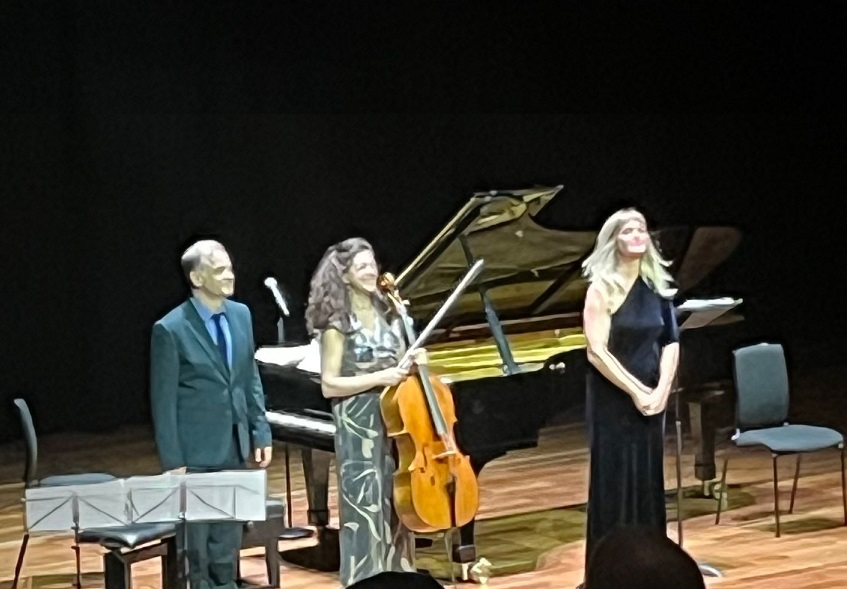
Ruby Hughes (soprano), Natalie Clein (cello), Julius Drake (piano)
Schubert arr. Jones Der Hirt auf dem Felsen (The Shepherd on the Rock) D965 (1828) Kodály Sonatina for cello & piano (1922) Tavener Akhmatova Songs: Dante, Boris Pasternak, Dvustishie (Couplet) (1993) Brahms 2 Songs Op.91 (1884) Trad arr. Britten I wonder as I wander (1940-41), At the mid hour of night (Molly, my dear), How sweet the answer (The Wren) (both 1957) Deborah Pritchard Storm Song (2017) Janáček Pohádka (Fairy tale) (1910, revised 1923) Ravel Kaddisch from 2 Mélodies hébraïques (1914) Bloch From Jewish Life (1924) Schubert Auf dem Strom (On the river) D943 (1828) (Encore) Berlioz La Captive
Queen Elizabeth Hall, London, 27 June 2025
by John Earls. Photo credits (c) Philip Sharp (above), John Earls (below)
Two of the most affecting sections of Ruby Hughes’ excellent 2024 album with the Manchester Collective End of My Days are three of John Tavener’s Akhmatova Songs (Dante, Boris Pasternak and Couplet) and Maurice Ravel’s Kaddish (from 2 Mélodies hébraïques).
These also featured to dramatic effect in this fascinating concert programme of Schubert and Other Folksongs spanning two centuries, where Hughes was joined by Natalie Clein (cello) and Julius Drake (piano).
In this performance the Tavener song miniatures were performed for voice and cello and were at turns powerful, beautiful and urgent across their nine-minute duration. The prolonged silence from the audience afterwards was noticeable. Ravel’s lament-like Kaddish, this time for voice and (sparse) piano, was similarly respectfully performed and observed.
There were non-vocal pieces for cello and piano where Clein and Drake displayed what a well matched duo they are. Zoltán Kodály’s Sonatina was luminescent, Leoš Janáček’s Pohádka absorbing (not least the cello bowing and pizzicato) and Ernest Bloch’s From Jewish Life was both lovely and mournful.
But this was a concert where Ruby Hughes’ amazing voice was to the fore but often in an understated, but no less impactful way. The captivating trio of Benjamin Britten folksong arrangements with their minimal piano trills were a case in point.
The trio performances were also impressive in their delivery and range. Brahms’ 2 Songs (Op.91) were both gorgeous, while Deborah Pritchard’s Storm Song (from 2017, the most recently written piece) was powerfully unnerving between its haunting start and end (the composer was in the audience to take a well deserved bow).
The concert was bookended by two songs written by Franz Schubert shortly before his death in 1828 at the age of just 31. As David Kettle remarks in his excellent programme notes, to call them simply songs is to do them a disservice. Der Hirt auf dem Felsen (The Shepherd on the rock), arranged by Peter Jones for voice, cello (replacing the clarinet) and piano, traversed a journey of yearning and joy that was both delicate and impassioned. The closing Auf dem Strom (On the river) saw Hughes capturing the drama convincingly throughout.
An encore of Berlioz’s La Captive concluded this concert that combined fascinating and thoughtful programming with performances of beautifully judged expression.
Janáček Violin Sonata in G sharp minor JW VII/7 (1913-15, rev. 1916-22) Enescu Violin Sonata no.3 in A minor Op.25 ‘Dans le caractère populaire roumain’ (1926) Barry Triorchic Blues (1990, rev. 1992) Beethoven Violin Sonata no.9 in A major Op.47 ‘Kreutzer’ (1802-03)
Wigmore Hall, London Saturday 28 September 2024
Reviewed by Richard Whitehouse
The duo of Alina Ibragimova and Cédric Tiberghien has offered some memorable recitals at Wigmore Hall during the past few seasons, with this evening’s typically diverse programme ranging over almost two centuries of compositions for the combination of violin and piano.
A first half of complementary opposites began with the Violin Sonata by Janáček. Ensuring cohesion across its four highly contrasted movements is no easy task, but the present artists succeeded admirably in this respect. Thus, the opening Con moto had an edgy ambivalence which was allayed in the Ballada – its relative repose and expressive warmth infused with a nostalgia as likely reflects the composer’s youth (and may indeed derive from one of those long-lost sonatas written while studying in Leipzig and Vienna 35 years earlier). Despite its marking, the Allegretto is a tensile scherzo whose frequently combative interplay was much in evidence here; the final Adagio then pivoting between stark plangency and a heightened eloquence which subsided into an ending whose muted regret was unmistakably to the fore.
Whatever the conceptual or aesthetic gulf between them, Enescu’s Third Sonata followed on with some inevitability. This was inspired by and recreates without quoting traditional music, as its subtitle duly indicates, and Ibragimova was alive to the musing inwardness of an initial Moderato whose ‘malinconico’ consistently undercuts any formal or expressive resolution up to a close where the songful and dance-like themes disperse into silence. The highlight was a central Andante of sustained though unforced intensity, its improvisatory aspect a stern test of coordination violinist and pianist met head-on. Almost as compelling, the final Allegro lacked a degree of inevitability in its unfolding – Tiberghien’s superbly articulated pianism less than implacable at the close, for all that Ibragimova conveyed its ominous ecstasy in full measure.
Beginning life as a test-piece for solo piano and adapted for numerous media, Triorchic Blues is Gerald Barry at his most uninhibited and would have made an ideal encore in this context – but its ever more scintillating opposition of instruments was not out of place after the interval.
This second half ended with the grandest of Beethoven’s violin sonatas, its ‘Kreutzer’ subtitle misleading yet indicative of this music’s inherent virtuosity. Ibragimova and Tiberghien made an impressive cycle of these works for the Wigmore’s own label, so it was surprising to find them at slightly below their best here. Not in the central Andante con variazioni, its judicious fusion of slow movement and scherzo rendered with unfailing poise and an acute sense of the profundity drawn out of so unassuming a theme. Yet, after its suitably arresting introduction, the first movement lacked drama – the duo playing down its rhetoric not least in a less than impulsive coda. The relentless tarantella-rhythm that underpins the finale felt similarly reined in with, again, too little of an emotional frisson as this music vividly reinforces the home-key.
What was never in doubt was their quality of playing individually and collectively, making one anticipate future recitals by these artists which will hopefully find them exploring more of that extraordinary corpus of music for violin and piano of the early and mid-20th century.
Kaprálová Military Sinfonietta Op.11 (1937) [Proms Premiere] Dvořák (ed. Kurz) Piano Concerto in G minor Op.33 (1876) Janáček Glagolitic Mass (1926-8)
Mao Fujita (piano); Corinne Winters (soprano), Vella Adamova (mezzo-soprano), David Butt Philip (tenor), Brindley Sharratt (bass), Christian Schmitt (organ), Prague Philharmonic Choir (choir-master Lukáš Vasilek), Czech Philharmonic Orchestra / Jakub Hrůša
Royal Albert Hall, London Wednesday 28 August 2024
reviewed by Richard Whitehouse Photos (c) Andy Paradise
Their previous Prom having set the bar high as regards playing or interpretation, Jakub Hrůša and the Czech Philharmonic Orchestra equalled and maybe even exceeded it with a programme which once more ranged widely over what might be thought the ‘golden age’ of Czech music.
The career of Vítězslava Kaprálová (1915-40) represents one of those great ‘what ifs’ in 20th century music and works such as Military Sinfonietta confirm her already distinctive idiom. Despite involvement with Martinů, this is redolent more of interwar French music – notably Roussel – in its alternating between the extrovert and the ruminative; relative extremes held in check by ingenious adaptation of the four-movements-in-one design that draws maximum variety from its material while sustaining a cumulative momentum through to a return of the main theme for a powerful but never bombastic apotheosis. The CPO certainly relished these strongly drawn expressive contrasts, and Hrůša kept it on a tight though never inflexible rein with the sizable groups of woodwind and brass duly given their collective head at the close.
Although it has come in from cold over recent decades, Dvořák’s Piano Concerto remains an anomaly – akin to one Mendelssohn or Chopin might have written had they lived into the mid -Romantic era. Numerous pianists have returned to the demanding if unidiomatic solo part as its composer left it, but Mao Fujita (above) opted for that edited by pianist Vilém Kurz which enjoyed favour across much of the last century. Musically the piece remains much the same – opening with an extensive Allegro trenchant and yielding, but with surprisingly little of a Czech tinge to its melodic or rhythmic content. Fujita delivered a confident traversal, then brought limpid poetry to the Andante with Hrůša’s accompaniment of the subtlest. They duly made the most of the final Allegro’s driving impetus and soulful poise, prior to its lively and decisive close.
Despite early advocacy from Henry Wood, Janáček’s Glagolitic Mass only established itself at the Proms half a century after the composer’s death. Recent seasons have brought varying versions of what Janáček (might have) intended, but Hrůša chose the standard edition with a reading of blazing conviction right from the stentorian brass of its ‘Introduction’. Compact in size but forthright in tone, the Prague Philharmonic Choir brought pathos to the ‘Kyrie’ then fervency to the ‘Gloria’ with Corinne Winters and David Butt Philip fearless in their response.
More than usually a fulcrum around which this work revolves, the ‘Credo’ evinced an almost narrative dimension in its journey via speculation and ambiguity to a conclusion – typified by Brindley Sherratt’s eloquence – of radiant certainty. This carried over into the ‘Sanctus’ both sensuous and capricious, Bella Adamova making the most of her ensemble contribution here then in the ‘Agnus Dei’ whose intimation of doubt is brusquely denied by the ‘Postludium’ – a vigorous workout for solo organ in which Christian Schmitt (above) decisively assumed the limelight.
It remained for the ‘Intrada’ to round off proceedings with its pounding timpani and exultant trumpets – so setting the seal on a memorable concert which, as with its predecessor, is likely to prove a highlight of this Proms season: music-making as it can and should be experienced.
Orsino Ensemble [Adam Walker (flute), Nicholas Daniel (oboe), Matthew Hunt (clarinet), Amy Harman (bassoon), Alec Frank-Gemmill (horn), Peter Sparks (bass clarinet)]
Britten Movement for wind sextet (1930) Reicha Wind Quintet in E flat major Op.88/2 (1811) Janáček Mládí (1924)
Wigmore Hall, Monday 5 June 2023 1pm
by Ben Hogwood
This attractive programme of works for wind ensemble began with a rarity.
Benjamin Britten seldom wrote for wind – a shame, since his writing for the instrumental family as soloists or in an orchestral context is remarkably assured. The Movement for Wind Sextet performed here by the Orsino Ensemble is thought to have been a response to Janáček’s Mládí – and is scored for the same forces. This account was shady and elusive to begin with, reflecting its elusive melodic and harmonic figures. There was beautiful control from Nicholas Daniel’s oboe solo before a quicker section featured some lovely ‘burbling’ sounds from the clarinets, oboe and flute pushing for the higher reaches. Ultimately this piece remains beyond reach, an intriguing if slightly frustrating sign of what might have been had Britten committed more wholeheartedly to the wind ensemble.
It made a welcome change to hear the music of Anton Reicha. Born in Bohemia in 1770, Reicha – a flautist – soon found himself leading the court orchestra in Bonn, where his musicians included a certain viola player named Beethoven. Moving on to Paris, Reicha taught at the Conservatoire, where his pupils included Berlioz, Franck and Liszt. In spite of these big-name links, his own music is not heard as often as it should be. He did however write prolifically for wind ensemble, completing 24 accomplished quintets, which are among his most-heard compositions.
The Wind Quintet in E flat major is a particularly attractive example, and received the ideal performance here. The Orsino Ensemble began with a brightly voiced Lento, with the added plus of Amy Harman’s characterful bassoon in the lower register as the ensuing Allegro began. This provided the impetus for the ensemble to exchange attractive melodies, enjoying the beautiful sonorities a wind ensemble can create. The Menuetto had a lovely lilt to its triple time, with busy inner parts to support the genial melody. The third movement also had a winsome lilt to its rhythmic profile, albeit a good deal slower – and with lovely operatic solos from oboe and clarinet. The perky last movement added humour to the mix, with some thoroughly enjoyable interplay, delivered here with virtuosity and style.
Janáček’s sound world is immediately different to those around it – as is the case with the intriguing wind sextet Mladi. Written as a ‘memoir of youth’, and composed around the same time as his masterpiece The Cunning Little Vixen, the work looks back to a childhood in Hukvaldy. Premiered in Brno in 1924, it was first performed in Britain – at the Wigmore Hall in front of the composer – in 1926.
The conflicting accounts of youth, refracted through the mind of a 70 year-old composer, are fascinating to the ear, with joyful moments tempered by unexpected, melancholic asides. There is however an underlying positivity running through the music.
The Orsino Ensemble enjoyed the raucous folk-based tunes along with the doleful asides that are such a characteristic of his work. The rich shades of colour were ideally exploited. Shadows lengthened over the second movement, depicting the composer and his mother parting at a train station. The third movement had the vigour of youth, with some sparky themes, while there was a motoric element to the last theme, generated by the horn – before more complementing aspects of joy and melancholy.
This was a very fine concert, with an encore dedicated to the recently passed Kaija Saariaho. Nicholas Daniel introduced the second of Oliver Knussen’s 3 fantasies for wind quintet, preceded by the poem How Sweet To Be A Cloud, part of the composer’s Hums and Songs of Winnie-the-Pooh. The sonorities we heard here were unexpectedly true to Saariaho’s sound world, and formed a characteristically striking memorial.
For more livestreamed concerts from the Wigmore Hall, click here




 Arcana.fm