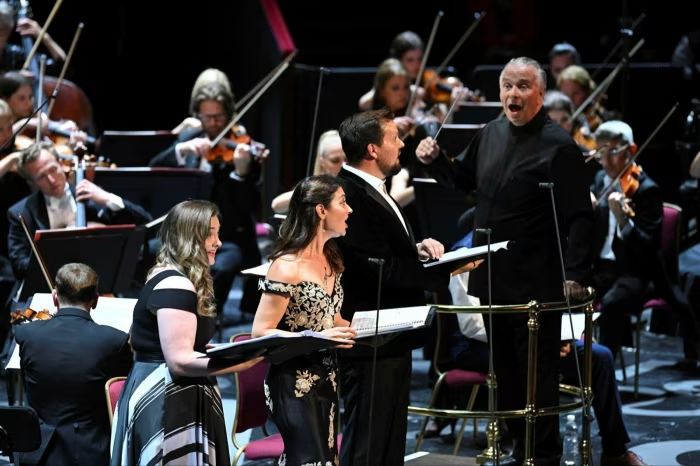
In concert – Soloists, London Philharmonic Choir, BBC Symphony Chorus & Orchestra / Sir Mark Elder @ BBC Proms: Delius: A Mass of Life

Jennifer Davis (soprano), Claudia Huckle (mezzo-soprano), David Butt Philip (tenor), Roderick Williams (baritone), BBC Symphony Chorus, London Philharmonic Choir, BBC Symphony Orchestra / Sir Mark Elder

Delius Eine Messe des Lebens (A Mass of Life) (1898; 1904-05)

Royal Albert Hall, London
Monday 18 August 2025

Reviewed by Richard Whitehouse Photos (c) BBC / Chris Christodoulou

There could be few venues better suited to Delius’s A Mass of Life, in its conceptual ambition and emotional opulence, than the Royal Albert Hall and this evening’s performance, only the third at these concerts and the first in 37 years, undoubtedly made the most of these qualities.

Despite the tragedy of his ultimate breakdown and ensuing incapacitation, Friedrich Nietzsche was considered a liberator in terms of a guiding philosophy with its emphasis on free will and rejection of conventional mores. Such appeal could hardly have been greater than on Frederick Delius, his largest concert work setting substantial extracts from Also sprach Zarathustra in a way that feels never judgemental and is only rarely overreaching. Much of the time its music has a detached and meditative aura whose inward intensity needs to be sustained accordingly.

That this account did so was owing to Sir Mark Elder, his advocacy already manifest in the finest modern recording (LAWO) as came across just as strongly and often more so here. Certainly, the longest sections were effortlessly paced – whether that beguiling interplay of longing and anticipation in In dein Auge which becomes the still (while never static) centre of Part One, or that extended sequence of Part Two taking in the scenic evocation as is Lasst vom Tanzen ab then the pantheist contemplation of Heisser Mittag schläft which is surely the expressive highpoint. Not that the dramatic openings of each part were under-characterized – the driving energy of O du mein Wille! setting the course for one as vividly as did the rousing Herauf! Nun herauf, with its orchestral prelude Auf den Bergen meltingly rendered, for the other.
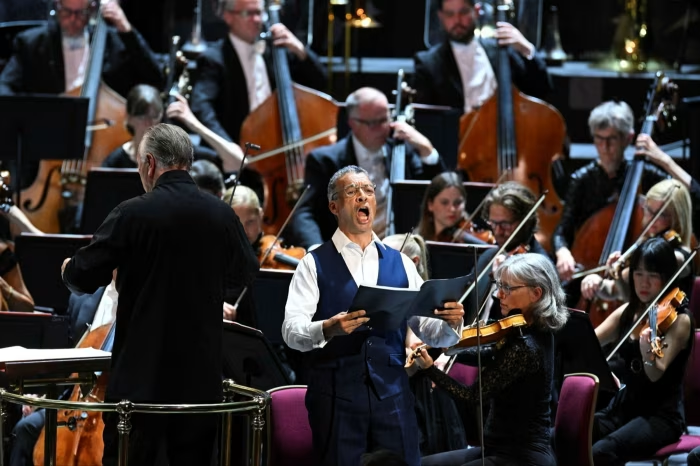
This may be regarded mainly as a choral work, but the importance of its vocal parts is never to be gainsaid. Above all, that of the baritone who assumes the role of Zarathustra in his gradual incline to enlightenment and in which Roderick Williams (above) was consistently at his best – hence the infectious Erhebt eure Herzen and assertive Wehe mir! then, subsequently, the alluring eloquence of Süsse Leier! and will to action of Gottes Weh ist tiefer. If this is the solo role as brings focus or unity to the whole, the others afford textural and expressive enhancements aplenty – Jennifer Davis as capricious and Claudia Huckle as confiding as David Butt Philip was assertive in their respective contributions. All three singers brought out the youthfulness or naivety which are crucial to this work’s underlying journey from innocence to experience.
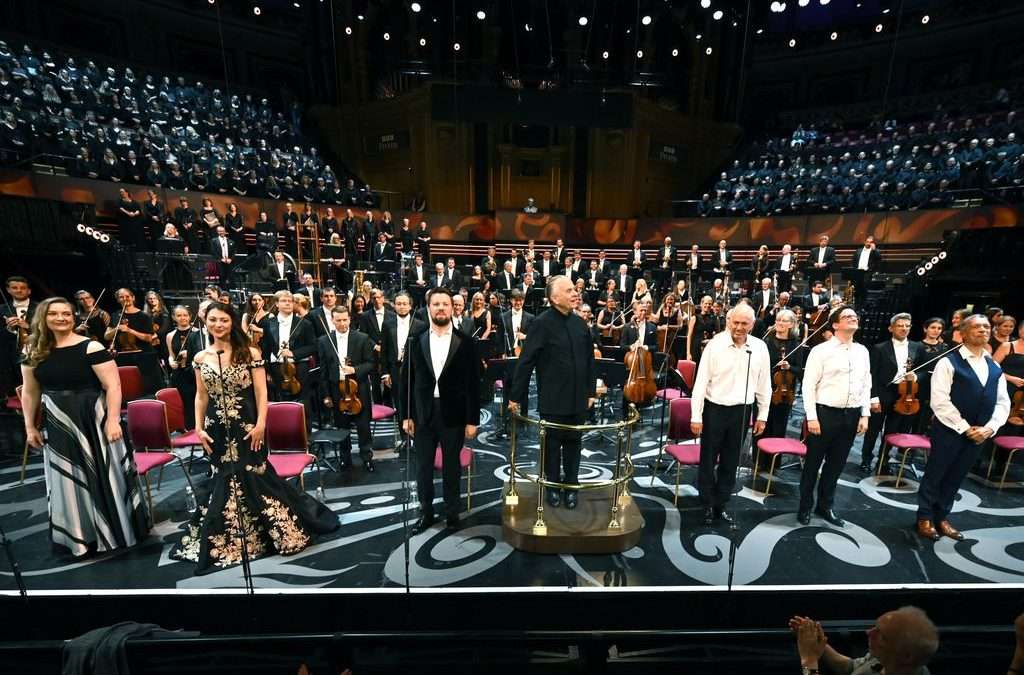
Any doubt a relative disparity in numbers of female and male singers would be detrimental to choral balance was groundless – Elder drawing a vividness but also delicacy of response from those combined BBC Symphony and London Philharmonic forces, while the BBC Symphony Orchestra was rarely less than galvanized whether in complex tuttis or the artless writing for solo woodwind that informs the latter stages. Delius’s orchestration rarely ‘plays itself’ but it conveys a lustre and translucency which could not be mistaken for that of another composer.

A near-capacity audience seemed as attentive to this as it was affected by the final Kommt! Lasst uns jetzt wandeln!, with its build-up to an ecstatic apotheosis then swift dispersal into silence: setting the seal on a memorable interpretation of this all-encompassing masterpiece.

You can listen back to this Prom concert on BBC Sounds until Sunday 12 October – or listen to the recent recording from Sir Mark Elder, with soloists, the Collegium Musicum Choir, Edvard Grieg Kor, Bergen Philharmonic Choir and Orchestra on Tidal below:

Click on the artist names to read more about soloists Jennifer Davis, Claude Huckle, David Butt Philip and Roderick Williams, the London Philharmonic Choir, BBC Symphony Chorus and BBC Symphony Orchestra, and conductor Sir Mark Elder. Click also for more on the Delius Society and the BBC Proms

Published post no.2,632 – Wednesday 20 August 2025

Arcana at the Proms – Prom 23: Benjamin Grosvenor, Rodolfus Choir, London Philharmonic Chorus & Orchestra / Edward Gardner – Busoni & Rachmaninoff

Rachmaninoff Symphonic Dances Op.45 (1940)
Busoni Piano Concerto in C major Op. XXXIX (1902-4)

Benjamin Grosvenor (piano), The Rodolfus Choir (men’s voices), London Philharmonic Choir (men’s voices), London Philharmonic Orchestra / Edward Gardner

Royal Albert Hall, London
Monday 5 August 2024

reviewed by Richard Whitehouse Photos (c) Andy Paradise

This centenary of Busoni’s death has not thus far seen a great deal of activity in the UK, so it was gratifying to find the Proms scheduling his most (in)famous work – the Piano Concerto tonight receiving its second performance at these concerts, 36 years to the day after its previous outing.

Back then, the first half featured Beethoven’s Fourth Symphony and a more apposite coupling than Rachmaninoff’s Symphonic Dances. Now firmly ensconced in the orchestral repertoire, it remains a stern test the London Philharmonic Orchestra did not quite meet on this occasion – despite such felicities as Martin Robertson’s eloquent alto sax in the first movement and Edward Gardner’s conjuring of a tangible malevolence in its successor. Impulsive but erratic in its outer sections, the finale’s evocative central span had a superficial quality typical of this performance overall.

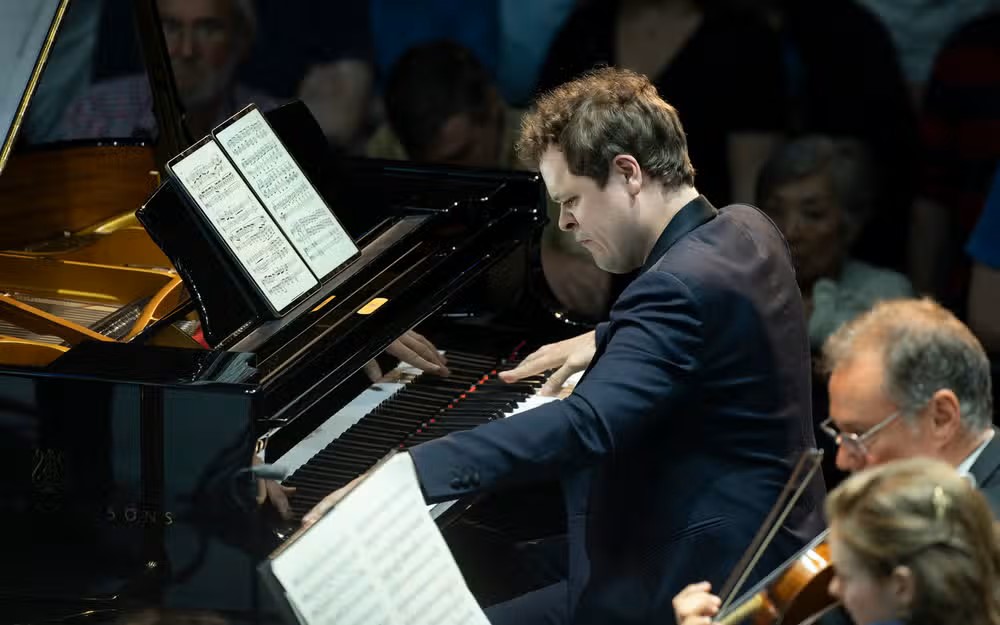
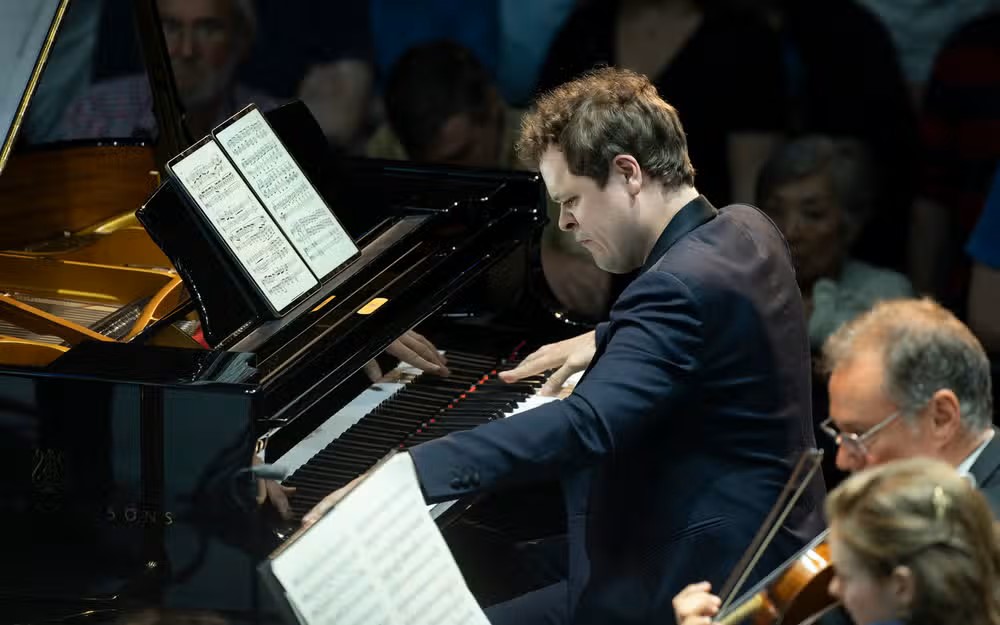
This was not the case in the Busoni. Benjamin Grosvenor (above) might not the first name who comes to mind for this concerto but, having already given performances in Reykjavik and Berlin, he was audibly attuned to an idiom not as elusive as often supposed in its canny amalgam of the Germanic and Italianate, while his playing was fully equal to its technical demands. That he is not a pianist looking to confront the orchestra head on ensured a more than usually close-knit coordination with players and conductor, which was almost always to the benefit of this piece.

Not least in Prologo e Introito, its orchestral introduction enticingly shaded by Gardner with Grosvenor integrating his unequivocal entry into what are essentially variations on the theme at the outset. Few pianists have weighted Busoni’s complex chords or his intricate harmonies with such translucency, not least the end of this movement where piano and orchestra melded to spellbinding effect. Straight into Pezzo giocoso, its capricious outer sections framing one of stealthy ambivalence as perceptively rendered as was that spectral angularity near its close.

Grosvenor managed the rare trick of making Pezzo serioso simultaneously cumulative and cohesive. He duly channelled the slow-burning momentum of its introduction into the rolled chords of its barcarolle-like first part – Gardner sustaining impetus across its successor to an imperious climax, during which the soloist never risked being obliterated. The lead-in to its third part had a poise equal to that at the end, where subtle rhythmic contrasts between piano and timpani against undulating strings had an enfolding calm to diffuse any lingering tension.

A general pause for retuning, then All’italiana burst forth – the underlying tarantella rhythm a springboard for its motley succession of vernacular elements initially humorous and latterly uproarious, held in check by the scintillating give-and-take of soloist and orchestra. Grosvenor almost topped these shenanigans with his electrifying cadenza – after which, Gardner prepared admirably for Cantico in which male voices (above) hymned Allah’s praises with mounting fervour; Grosvenor a largely passive observer until he belatedly returned for the headlong signing-off.

Quite a performance, then, that will hopefully be released commercially. Did Busoni offer an encore at that Berlin premiere? It could not have been more suitable than J.S. Bach’s Prelude in E minor BWV855, transposed and arranged by Alexander Siloti – three minutes of balm bringing us gently down to earth.

For more on this year’s festival, visit the BBC Proms website – and to read more on the artists involved, click on the names: Benjamin Grosvenor, Edward Gardner, The Rodolfus Choir, London Philharmonic Choir and the London Philharmonic Orchestra

Published post no.2,264 – Thursday 5 August 2024

Arcana at the Proms – Prom 23: Thoughts on Busoni’s Piano Concerto

Benjamin Grosvenor (piano), The Rodolfus Choir, London Philharmonic Choir, London Philharmonic Orchestra / Edward Gardner

Royal Albert Hall, London
Monday 5 August 2024

by Ben Hogwood Photo (c) Andy Paradise

A full review of Prom 23 will follow from Richard Whitehouse, but I wanted to register some thoughts on my first live encounter with one of the most extraordinary piano concertos you could ever hope to hear.

In the last few months pianist Benjamin Grosvenor has taken Ferruccio Busoni’s Piano Concerto on something of a concert tour, and has written of his love and admiration for the piece in a Guardian article, which proves a helpful guide for anyone not fully attuned to the piece.

The centenary of Busoni’s death falls this year, hence the first appearance of this piece at the Proms in 36 years, since a memorable occasion when Peter Donohoe squared up to the solo part in the company of the BBC Symphony Orchestra and Mark Elder. Oh, and the BBC Singers – for this work, unbelievably, has a male chorus in the finale, singing “Lift up your hearts to the Power Eternal”, a hymn to Allah from Adam Oehlenschläger’s Aladdin. Busoni’s quote in the score at this point is that “The Pillars of Rock begin to make soft and gentle music.”

Yet even before we got to that fifth movement the extraordinary power and individuality of Busoni’s music was shining through. The London Philharmonic Orchestra under Edward Gardner had a big part to play here, setting the scene in the Prologo e introito as though we were standing in a cathedral, awestruck at the architecture but still taking in a new sight with each about turn.

Grosvenor’s interpretation of his part was balletic, and the music really danced – swooping down from the heights or bubbling up from the depths, the pianist finding remarkable clarity in even the most complex passagework. Busoni, a formidable concert pianist himself, really tests his soloist, but retains a well-judged balance between piano and orchestra. Grosvenor and Gardner somehow found this equilibrium in the notoriously tricky acoustics of the Royal Albert Hall, where from the arena you could hear the clear communication of Busoni’s ideas. The orchestra were superb here – percussion ideally balanced, strings and wind interacting with the piano cleanly and the brass sensitively placing their chorale interventions. The clarinet and viola solos in the second movement had all the room they needed, while the orchestral colour that appears so unexpectedly and vividly in this work was richly shaded.

And what of the piece itself? In many ways it was like listening to a progressive rock album from the 1970s, which in itself is extraordinary when you think the Piano Concerto was completed in 1904. The sheer scope of Busoni’s imagination knew no bounds, then – taking on board more obvious influences from Bach, Beethoven, Chopin and Liszt, while using harmonic techniques to remind us that we were now in the age of Sibelius, Elgar and even Schoenberg.

The fourth movement was perhaps the most remarkable in this performance. With the gargantuan third completed, a kind of meditation in four parts, Busoni summons even greater invention for a Tarantella of remarkable energy, the solo part whirling round in a circle and brilliantly played here by Grosvenor. Just as it seemed all possibilities had been exhausted, the appearance of the male chorus was a masterstroke, their sonorous tones floating above much of the audience in the Royal Albert Hall. They leant a whole new dimension to the work, meaning that even those who might have been struggling 55 minutes into a piece found the new impetus and energy in Busoni’s exultation.

If you have not yet encountered this extraordinary piece I encourage you to without delay – but don’t stop there, for Busoni’s solo piano output, while very different, has many riches to impart in a fraction of the time. First, though, you have to try the Piano Concerto. It will knock your socks off!

You can listen to this concert on BBC Sounds – with the Busoni Piano Concerto beginning at 1:03:55. For more on this year’s festival, visit the BBC Proms website

Published post no.2,263 – Wednesday 7 August 2024

BBC Proms 2023 – Soloists, London Philharmonic Choir and Orchestra / Gardner – Ligeti & Richard Strauss

Prom 36 – Jennifer France (soprano), Clare Presland (mezzo-soprano), Edvard Grieg Kor, London Philharmonic Choir, Royal Northern College of Music Chamber Choir, London Philharmonic Orchestra / Edward Gardner

Ligeti Requiem (1963-5); Lux aeterna (1966)
Richard Strauss Also sprach Zarathustra Op.30 (1896)

Royal Albert Hall, London
Friday 11 August 2023

by Richard Whitehouse photos by Mark Allan / BBC

There did not seem any more concrete reason to build a Prom around the music from Stanley Kubrick’s film 2001: A Space Odyssey other than this being the 55th anniversary of its release, but it at least offered an opportunity to revive one of the last century’s defining choral works.

Much has been made of a then avant-garde composer writing a piece based on a seminal text from the Christian liturgy, but centenary composer György Ligeti’s Requiem is anything but beholden to tradition. Focussing on what would normally constitute the first half of the Requiem Mass itself skews the textual imagery away from any hope of attaining ‘eternal rest’ – the four movements duly proceeding from a sombre Introitus in which the music’s conceptual vastness along with its expressive extremes are laid bare. The Kyrie is the most (in)famous part – emerging in two successive and cumulative waves of micropolyphony both overwhelming and disorientating, not least when rendered with the poise and precision that the combined choirs summoned in the Albert Hall’s expanse. Inevitably, the terror of the infinite gives way to that of the absurd.

Hence the Dies irae sequence, designated On the Day of Judgement and a veritable tour de force of choral outbursts with vocal interjections; Clare Presland’s ominous intoning tellingly offset by Jennifer France’s stentorian pronouncements, with the wind and brass of the London Philharmonic Orchestra visceral in their contribution under the attentive guidance of Edward Gardner. Neither did the Lacrimosa lack gravitas, the soloists musing eloquently if wearily against a stark instrumental backdrop whose essential emptiness carries through to the close.

While not intended as a continuation of the larger work, Lux aeterna still makes for a viable resolution in its undulating yet never static textures such as conjure the presence of ‘eternal light’ without any concomitant spiritual aspect. Set high-up in the gallery, to the right of the platform, the Edvard Grieg Kor evinced a faultless intonation along with a tangible sense of the music’s timelessness – though this piece would maybe have been better placed after the Ligeti instead of before the Strauss, not least as there was no segue between the latter works.

Also sprach Zarathustra was, of course, elevated to a new level of public recognition after its Introduction had been utilized as fanfare in Kubrick’s film, and a less than thrilling rendition here at least ensured this Sunrise could not pre-empt the remainder in Strauss’s free-ranging overview of Friedrich Nietzsche’s influential tract. On fine form overall, the various sections of the LPO relished their passages in the spotlight, reminding one that this piece is as much a ‘concerto for orchestra’ before its own time as the musical embodiment of human aspiration. Pieter Schoemann audibly enjoyed setting The Dance Song in motion and while others have made its climax more intoxicating, Gardner brought a rapt serenity to the Night Wanderer’s Song such as made the tonal equivocation of those final bars the more acute and intriguing.

Numerous recent Proms have followed the second-half work with an ‘official’ encore and, while this practice is not always justified, the inclusion tonight of a certain waltz by another Strauss would have extended the 2001 concept still further and effected a more definite close.

For more on the 2023 BBC Proms, visit the festival’s website at the BBC. Meanwhile click on the names for more information on artists Jennifer France, Clare Presland, the London Philharmonic Orchestra and conductor Ed Gardner. For more on Ligeti, head to this dedicated website