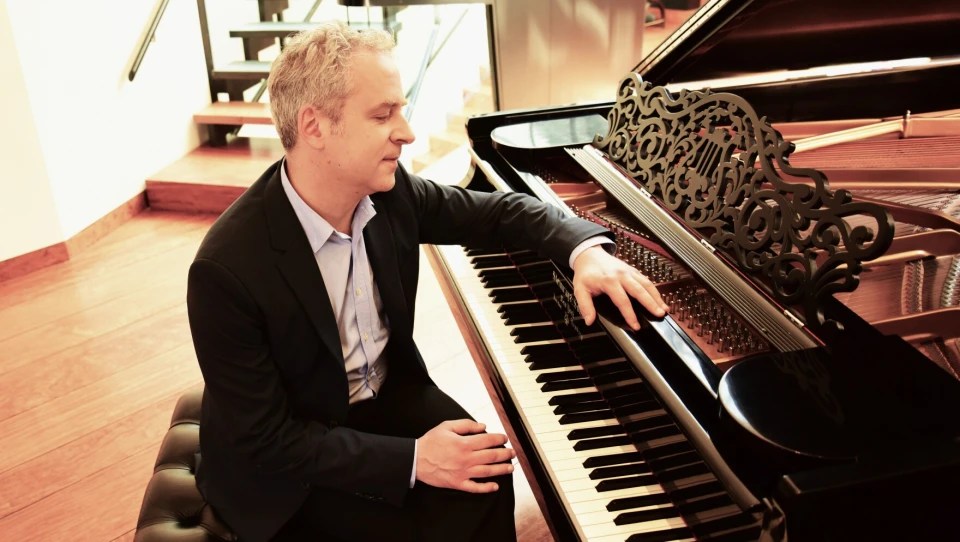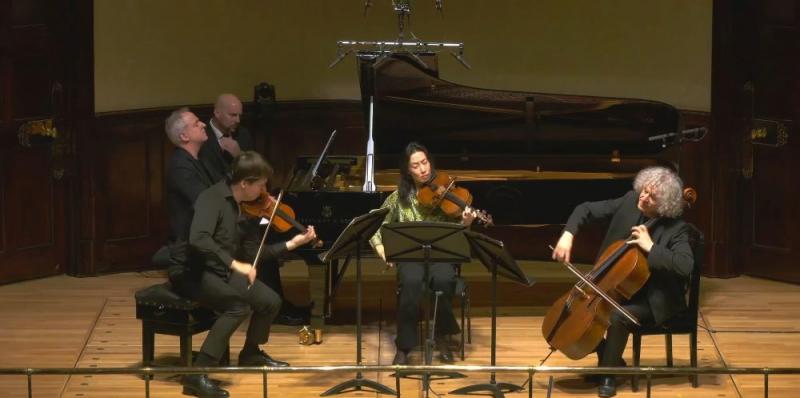
In concert – Steven Isserlis and Friends – Fauré at the Wigmore Hall (4)

Steven Isserlis (cello) – with Joshua Bell, Irène Duval (violins), Connie Shih, Jeremy Denk (pianos), Quatuor Agate [Adrien Jurkovic, Thomas Descamps (violins), Raphaël Pagnon (viola), Simon Iachemet (cello)]

Fauré Cello Sonata no.1 in D minor Op.109 (1917)
Enescu Violin Sonata no.2 in F minor Op.6 (1899)
Fauré Piano Trio in D minor Op.120 (1922-3)
Ravel String Quartet in F M35 (1902-03)

Wigmore Hall, London
Monday 4 November 2024

Reviewed by Richard Whitehouse Picture (c) Wigmore Hall Trust

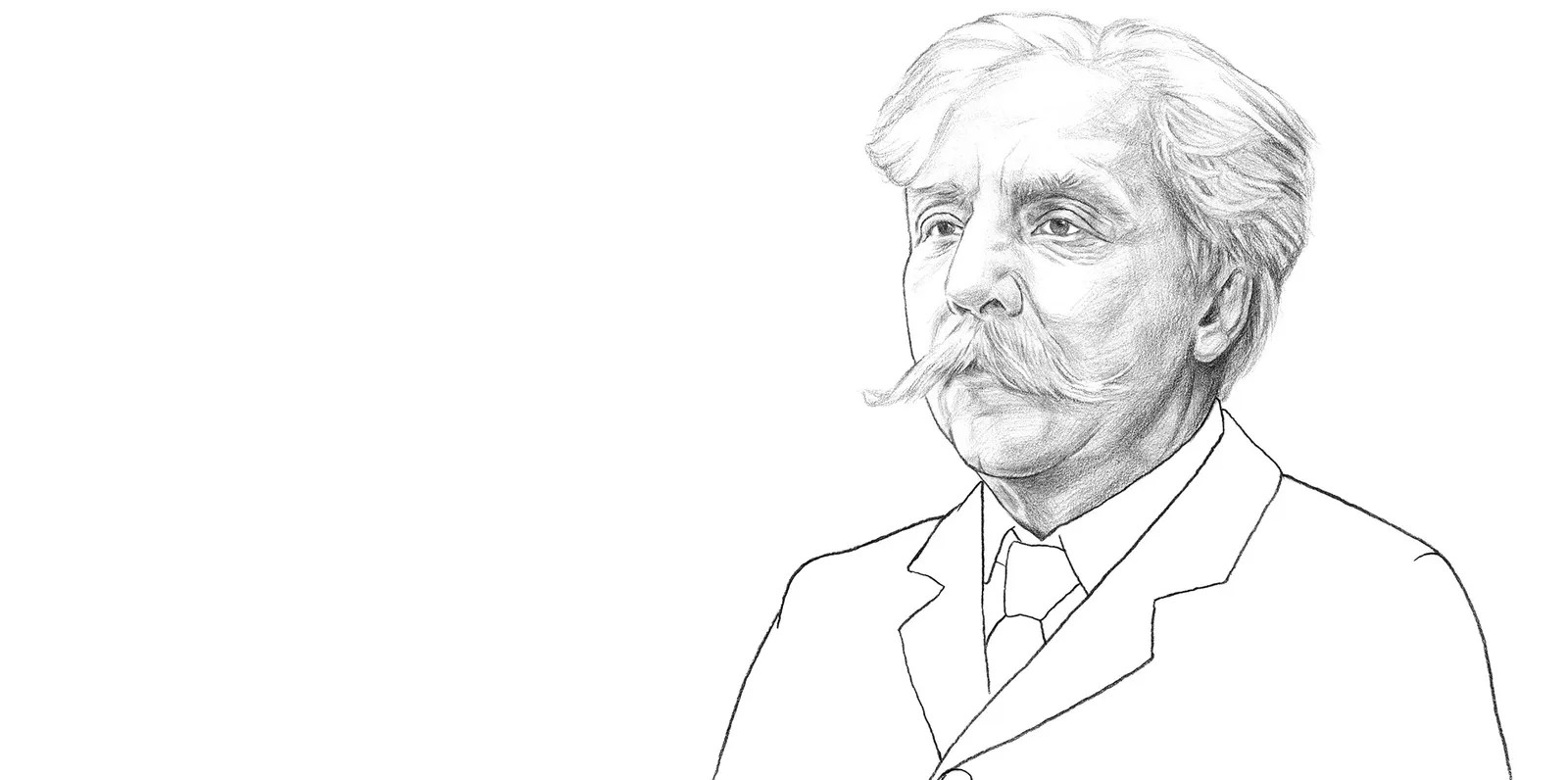
Tonight’s instalment of the Wigmore Hall series focussing on Fauré’s larger chamber works was also the most cohesive in its alternating two of the composer’s late pieces with formative ones by Enescu and Ravel for what was a fascinating programme of echoes and anticipations.

While not necessarily the weakest of those works played in this series, Fauré’s First Cello Sonata is the least remarkable – the melodic content reduced to barest essentials such that its main motifs can verge on the anonymous. That said, its opening Allegro is a model of formal economy and expressive restraint, Steven Isserlis and Connie Shih being no less perceptive in the pensive musing of its central Andante or the urbanity of a final Allegro whose ‘commodo’ aspect was always evident. Less may not always be more, but it is rarely less than appealing.
Less often heard than its successor, Enescu’s Second Violin Sonata is no less significant. Its composer’s first masterpiece, much of the fascination lies in the degree to which its melodic ideas evolve across and between each of the three movements for a potent demonstration of motivic unity. This was something Irène Duval conveyed in ample measure, yet without ever neglecting that reticent or sometimes ominous quality characterizing much of its content – at least until the quixotic finale channels these diverse elements towards a resolution achieved almost despite itself. Throughout, Jeremy Denk’s pianism was a model of lucidity and poise in a performance which went all the way in confirming this work as one of the three greatest masterpieces by a teenager – the other two being written 74 years earlier, then 72 years later. (presumably Mendelssohn’s Octet and a piece to be confirmed! – ed)

Fascinating how much Enescu’s precocity resembles Fauré’s maturity in what was the latter composer’s penultimate work. Compact almost to a fault, the Piano Trio is dominated in all respects by a central Andantino whose melodic eloquence has intensified almost to the point of ecstasy by its close, not least as rendered by Joshua Bell, Isserlis and Denk in what was a near-ideal performance. Succinctness almost gets the better of the outer movements, though it would be churlish not to acknowledge the tensile energy of its opening movement and the exhilaration of a finale whose element of syncopation marks Fauré’s nearest approach to the jazz idiom. Interesting as it is to hear this piece with clarinet as was originally intended, its interplay of violin, cello and piano is no less inevitable than in the parallel work by Brahms.

The well-regarded Quatuor Agate duly took the stage for Ravel’s String Quartet, evidently a work for which Fauré expressed only muted enthusiasm. Superbly played though a little self-regarding interpretively, this account was at its best in its latter stages – the inward rapture of its slow movement in pointed contrast to the volatility and ultimate decisiveness of its finale. The opening movement at times verged on expressive inertia and the scherzo’s deft humour was rather self-conscious, but the overall conviction of this performance still came through. Seemingly the Agate will not be playing Fauré’s String Quartet which forms the culmination of tomorrow’s concert and of this series; one that also includes the Second Cello Sonata and music written in tribute to a composer whose greatness could hardly be doubted now as then.

You can watch the concert below, thanks to the Wigmore Hall YouTube channel:

For more information on the Fauré series, visit the Wigmore Hall website – while you can also read Arcana’s interview with Steven Isserlis about the French composer

Published post no.2,354 – Wednesday 5 November 2024

Arcana at the Proms – Prom 43: Paul Lewis, CBSO / Kazuki Yamada – Ravel, Mozart, Holmès & Mussorgsky / Wood

Ravel Ma mère l’Oye – suite (1910-11)
Mozart Piano Concerto No. 27 in B flat, K595 (1790-91)
Holmès La Nuit et de l’Amour (1888)
Mussorgsky arr. Wood Pictures at an Exhibition (1874, orch. 1915)

Paul Lewis (piano, above), City of Birmingham Symphony Orchestra / Kazuki Yamada

Royal Albert Hall, London
Thursday 22 August 2024

reviewed by Ben Hogwood Photos (c) Sisi Burn

A colourful Prom from the CBSO this year, reaching a deafening climax with Proms founder Sir Henry Wood’s arrangement of Mussorgsky’s Pictures At An Exhibition. More of that anon, but the orchestra, under principal conductor Kazuki Yamada, began with music by Ravel – whose orchestration of the Mussorgsky we tend to hear.

Mother Goose was cool to the touch but given a winning performance, Ravel’s colours spread across the orchestra as the music came to life. The CBSO strings were elegant and refined, leaving the starry moments to the woodwind, who excelled – particularly the gruff contrabassoon in Conversation of Beauty and the Beast, winningly played by Margaret Cookhorn. The hues of the closing The fairy garden were ideal, too – though Yamada’s decision to bring the music to a near standstill before the final, wondrous tune won’t have been to all tastes, no matter how skilfully it was achieved.

Elegance was the watchword for Paul Lewis’s Mozart, too – a thoughtful and graceful account of the composer’s last piano concerto, published in his final year but thought to have begun three years prior. This is Mozart in relatively subdued form, but still cracking a smile in the attractive first movement. Soloist and orchestra took a little while to align within the Royal Albert Hall acoustic, but once they did the first movement dialogue, complete with Mozart’s own cadenza, was fluent and balletic. The slow movement lullaby was a treat, Lewis with stylish phrasing of the melodies, while the finale enjoyed its lightfooted dance, a theme so simple and yet so memorable; classic Mozart.

Following the interval we heard the brief but romantic La Nuit et de l’Amour by Augusta Holmès, a pupil of César Franck whose music was appearing at the Proms for the first time. It was a charming miniature with a memorable tune, whose presence shone through. It acted as an upbeat to Sir Henry Wood’s arrangement of Mussorgsky’s tour through the gallery, a version predating the celebrated Ravel by seven years.

Unlike the Frenchman, Wood goes for broke on several occasions during Pictures At An Exhibition. His decision to include only the first Promenade, where Mussorgsky describes his observer walking around the exhibition, means the pictures are a little squashed together, but in this performance the dramatic impact was heightened. Gnomus was frankly terrifying, while The Old Castle was headed by a sensitive and touching euphonium solo; Becky Smith projecting beautifully from the gallery.

Wood’s version is brassy on occasion, and the CBSO players excelled – as did the wind and percussion, whose unpredictable interventions had the audience jumping on several occasions! They were a feature of Bydlo, the old carriage rumbling into action with all its bells rattling, the lower strings and brass in deep toil. Nothing quite prepared the throng for the final Great Gate of Kiev, however – not even the sinister outlines of the preceding Baba Yaga. The gate itself came slowly into view, the toll of the nine bells of the Liverpool Philharmonic bells up in the gallery both solemn and unexpectedly chilling. Soon all notions of reserve were brushed aside, however, Wood’s orchestration demanding the nine bells at full volume – delivered in a brilliant peal from the gallery by Graham Johns. However – from the arena at least – they did rather swamp the combined forces of the orchestra and organ, who were barely audible at times.

Excesses like these no doubt helped Emerson Lake and Palmer in their decision to arrange Pictures for rock group in 1971 – and certainly had a positive impact on the Proms audience, who were thrilled by the drama and the sheer volume. So too was Yamada, who had already been dancing on the podium, but as the Gate reached its tremendous conclusion he pivoted to urge the audience into applause, long before the final chord had rung out. How refreshing to see a conductor living in the moment, reading the occasion and the audience, and crowning a memorable Prom with shattering, exhilarating noise.

The playlist below collects the music from this concert, including the only available recording of the arrangement of Pictures At An Exhibition by Sir Henry Wood:

Published post no.2,283 – Saturday 24 August 2024

In concert – Paul Lewis, CBSO / Kazuki Yamada: Ravel, Mozart, Holmès & Mussorgsky / Wood

Paul Lewis (piano, above), City of Birmingham Symphony Orchestra / Kazuki Yamada

Ravel Ma mère l’Oye – suite (1910-11)
Mozart Piano Concerto No. 27 in B flat, K595 (1790-91)
Holmès La Nuit et de l’Amour (1888)
Mussorgsky arr. Wood Pictures at an Exhibition (1874, orch. 1915)

Symphony Hall, Birmingham
Wednesday 21 August 2024

Reviewed by Richard Whitehouse

Although the CBSO has not put on its own Proms season for many years, a concert featuring the programme for its annual Proms appearance has been a regular fixture and this evening’s event proved to be much more than merely a ‘dry run’ for tomorrow’s Royal Albert Hall date.

Despite the timing, this was indeed the suite as orchestrated by Ravel from his Mother Goose piano duets before being expanded into a ballet. It took a while to get going – Pavane of the Sleeping Beauty feeling impassive and Little Tom Thumb enervated, yet Laideronette had the requisite playfulness. Conversations of Beauty and the Beast was ideally poised between whimsy and pathos, before The Enchanted Garden concluded this sequence with an inward rapture made more so thanks to its exquisite contribution from leader EugeneTzikindelean.

Paul Lewis must have played Mozart’s 27th Piano Concerto on innumerable occasions (and several times with the CBSO) but his perspective constantly varies. The opening movement had a spaciousness resulting in an unusually moderate Allegro, albeit never at the expense of a subtly incremental intensity unerringly sustained through to a cadenza of limpid eloquence. Even finer was the Larghetto – dependent, as with much of Mozart’s late music, on what the performer brings to it; here yielding a serenity informed by not a little fatalism. After which the finale provided an ideal complement in its buoyancy and unforced humour, leading into a cadenza (how fortunate Mozart’s own have survived) of pensive understatement, then a coda launched with a guileless interplay of soloist and string that set the seal on this performance.

Opening the second half was Augusta Holmès’s La Nuit et l’Amour – actually, an interlude from Ludus pro Patria, her ‘Ode-Symphonie’ which, even if it might not sustain the present piece’s enfolding passion, should certainly be worth at least a one-off hearing in its entirety.

In Henry Wood’s orchestration, Mussorgsky’s Pictures at an Exhibition proved a highlight of last season. Wood retains only the first appearance of the Promenade but is not unfaithful to the original’s essence. Hence the shock-horror of Gnomus, sombre aura of The Old Castle with its baleful euphonium, playful insistence of The Tuileries or fatalistic tread of Bydlo with its evocative percussion. The whimsical Ballet of the Unhatched Chicks contrasts with the grim realism of Samuel Goldberg and Schmuÿle or the frantic bustle of The Market at Limoges.

Respighi surely took note of this glowering Catacombs with its plangent recollection of the promenade refrain hardly less effective than in Ravel, and while Baba Yaga is unnecessarily curtailed here, its sudden dispersal more than prepares for the crescendo of offstage bells that launches The Great Gate[s] of Kiev. This set the tone for a realization which, if its opulence borders on overkill, could not prevent the CBSO from projecting Wood’s cinematic sonics to the maximum. Those present once again erupted during that echoing resonance at its close.

Quite a way, then, to end an impressive performance and memorable concert. Kazuki Yamada and the orchestra will be doing it all over again tomorrow evening at their Prom, at which this orchestration of the Mussorgsky will be heard in the environs as envisaged by its orchestrator.

The playlist below collects the music from this concert, including the only available recording of the arrangement of Pictures At An Exhibition by Sir Henry Wood:

For details on the 2024-25 season A Season of Joy, head to the City of Birmingham Symphony Orchestra website. Click on the names to read more about pianist Paul Lewis and chief conductor Kazuki Yamada

Published post no.2,279 – Friday 23 August 2024

In concert – Jeremy Denk, CBSO / Kazuki Yamada: Gershwin, Clyne, Ravel & Mussorgsky / Wood

Jeremy Denk (piano, above), City of Birmingham Symphony Orchestra / Kazuki Yamada

Gershwin An American in Paris (1928)
Clyne ATLAS (2023) [CBSO Co-Commission: UK Premiere]
Ravel Pavane pour une infante défunte (1899, orch. 1910)
Mussorgsky orch. Wood Pictures at an Exhibition (1874, orch. 1915)

Symphony Hall, Birmingham
Wednesday 1 May 2024

Reviewed by Richard Whitehouse

This evening’s concert by the City of Birmingham Symphony Orchestra may have taken its overall title from the final work, but ‘pictures’ were everywhere in evidence and not merely those ‘at an exhibition’ – not least with Kazuki Yamada as enthusiastic as ever at the helm.

While it loses out to his Rhapsody in Blue in the popularity stakes, Gershwin’s An American in Paris is surely the most successful of his orchestral pieces for matching its immediacy of imagery to a resourceful structure. Encouraging the CBSO to a bracing response in the outer sections, and with Jason Lewis’s nostalgic trumpet initiating that pathos-laden central phase, Yamada secured a response whose full-on expression was offset by too sectional an approach – the music proceeding in a stop-start fashion rather than unfolding organically as it should.

Over recent years, the New York-based Anna Clyne has emerged among the leading British composers of her generation, with this first UK hearing for her piano concerto ATLAS keenly anticipated. Inspired by the eponymous and epic collection of the artist Gerhard Richter, this likewise falls into four ‘volumes’ rather than movements, which also underlines their relative formal freedom. Certainly, the ingenious interplay between soloist and orchestra is a tough challenge which Jeremy Denk met head-on – whether in the coursing energy then yielding eloquence of the opening Fierce, alluring textural overlaps of Freely, intimate, the lilting nonchalance of Driving or cumulative activity of the final Transparent with its surge to an emphatic close that (as with this work overall) was capricious and allusive in equal measure.

Doubtless motivated by Denk’s coruscating virtuosity, the CBSO gave its collective all in a work which (rightly) appealed to those present – the pianist responding with his deft take on the Heliotrope Rag co-written by Scott Joplin and the tragically short-lived Louis Chauvin.

After the interval, a rare moment of calm – Ravel’s Pavane for a Dead Princess given with a studied if never stolid grace, Elspeth Dutch’s horn and Katherine Thomas’ harp enhancing its appeal. As with Fauré’s Pavane, this is ideal music for opening the second half of a concert.

And so, to Mussorgsky’s Pictures at an Exhibition – heard here in the orchestration by Henry Wood which preceded and was duly superseded by Ravel’s. Wood is more interventionist, not least by reducing the recurrent ‘Promenade’ to a stealthy introduction, but not necessarily less faithful to the piano work’s spirit – hence the scabrous immediacy of Gnomus, sombre aura of The Old Castle (Andrew McDade’s tuba balefully intoning on high above stage-right), or fatalistic tread of Bydlo with its evocative percussion. Respighi was probably taken by this glowering depiction of Catacombs with a ghostly recollection of the promenade hardly less effective, and if Baba Yaga gets summarily curtailed here, the crescendo of bells launching The Great Gate[s] of Kiev set the tone for a treatment whose opulence borders on overkill.

Not that this inhibited the CBSO from projecting Wood’s organ-clad texture to the maximum, to the enthusiasm of an audience that erupted in the lingering resonances at its close. Quite a way to end an impressive performance, and a memorable concert, on a day that saw Yamada become this orchestra’s Music Director and the CBSO launch ‘A Season of Joy’ for 2024/25.

Click on the link to read more on the current CBSO concert season, and also to read about the recently announced 2024/25 programme. Click on the names for more on pianist Jeremy Denk, conductor Kazuki Yamada, and composer Anna Clyne

Published post no.2,168 – Saturday 4 May 2024

Playlist – celebrating Mother’s Day

Today is Mothering Sunday in the UK – and here is a playlist celebrating mothers.

We begin with a touching suite for piano by Josef Suk. About Mother is dedicated not to his own mother but for his children about their mother, his wife Otilie Dvořák. Then we continue with a famous song from Suk’s father-in-law, Antonin Dvořák, Songs My Mother Taught Me.

Taking the theme a little loosely we move on to Ravel, and his delectable ballet Ma mère l’oye (Mother Goose) – evidence of the French composer’s beautiful writing for orchestra.

Finally something of an English rarity, Cecilia McDowall setting the Magnificat (the song of Mary, Mother of God) for chorus and orchestra. It is a striking piece with which to end.

I hope you enjoy!

This playlist is dedicated to the memory of my aunt, Angela – who passed away on Thursday. It is also posted in mind of her sister – my own mother Coralie (above), whose musical influence on my own life I celebrated on Arcana here.