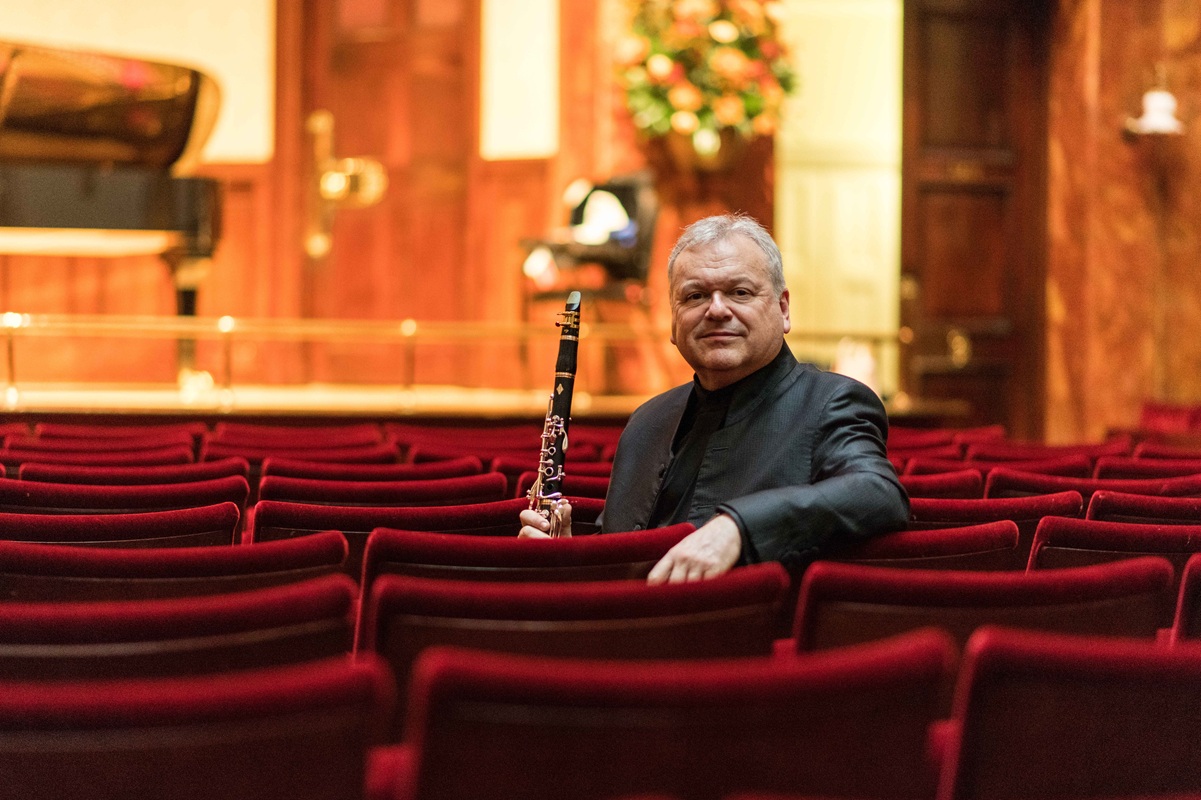
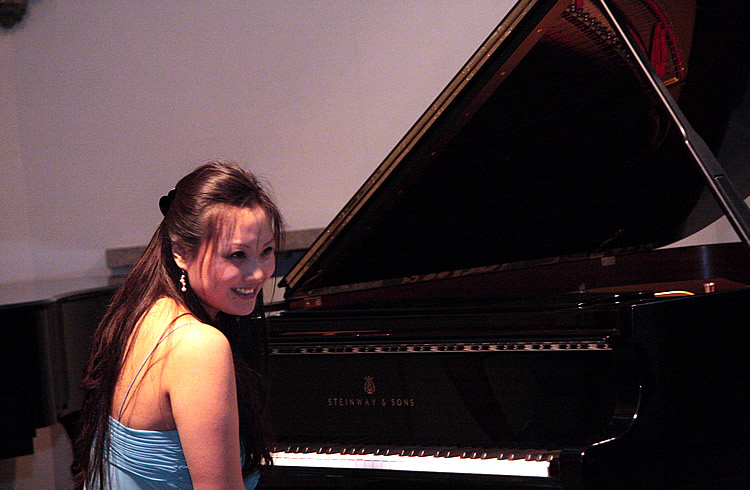
Michael Collins (clarinet, above), Wu Qian (piano, below)
Finzi 5 Bagatelles Op.23 (1920-9) Martinů Sonatina for clarinet and piano (1956) Milhaud Duo Concertante Op.351 (1956) Tailleferre Arabesque (1973) Cooke Clarinet Sonata in B flat (1959)
Wigmore Hall, London Monday 9 March, 1.05pm
Reviewed from the online broadcast by Ben Hogwood Photo of Michael Collins (c) Jack Lewis Williams
This was the first public appearance for Michael Collins and Wu Qian as a duo, yet together – on BBC Radio 3’s Lunchtime Concert at least – they displayed an easy familiarity, suggesting a partnership of a longer vintage.
They began with five much-loved miniatures from Gerald Finzi, often heard in isolation on rival radio stations. Collins and Qian enjoyed the bustling counterpoint of the outer Prelude and Fughetta movements, but the emotional heart of the set lay in the lovingly phrased Romance and Forlana, whose lilting rhythms were persuasively played, and the solemn Carol. The downbeat mood, inhabited from wartime struggles, was especially pertinent, though the Fughetta gave the music renewed energy in this performance.
Martinů’s Clarinet Sonatina is a late work, completed during a brief second stay in New York. The Czech composer was used to relocating at short notice on account of Nazi invasions of his homeland and Paris, but this brief second trip to America was an ultimately unsuccessful career move. The Sonatina inhabits the composer’s restlessness, looking longingly across the Atlantic towards Paris. This was captured by Collins and Qian in the bare piano octaves and reflective melody of the Andante, while the finale found greater conviction of feeling.
While Martinů pined for the French capital, Darius Milhaud was writing his Duo Concertant as a competition piece for his Paris Conservatoire students. Milhaud rarely outstays his welcome, and the piece was wrapped up with typical humour and a heartfelt central episode, gracefully played. Meanwhile the Arabesque of Milhaud’s fellow ‘Les Six’ member, Germaine Tailleferre, was a softly undulating dance that proved restrained yet elegant.
The English composer Arnold Cooke acquired a continental edge to his music thanks to a period of study with Paul Hindemith in the 1920s. His compositions for clarinet were written for Franz Reizenstein, also a pupil of Hindemith, and include a concerto and quintet. The airy first movement of the Clarinet Sonata in B flat – written deliberately without major or minor key labelling – was similarly elusive, its questioning line thoughtfully phrased by Collins in a satisfying balance with Qian.
The strident second movement is laced with humour which Collins was keen to bring out, before a probing slow movement with private asides from the clarinet hints at darker thoughts, particularly in its low burbling notes from the instrument near the end, suggesting a watery contemplation. The Finale swept these thoughts aside, making demands on Collins’ agility with the wide range of its thematic material, common across the work. The music dipped and weaved its way through a number of entertaining figures, plumping resoundingly for the major key in a hugely satisfying coda.
You can listen to this concert on BBC Sounds until 9th April.
Paul Wee is a true one-off. An in-demand commercial barrister by day, he is also an extraordinary pianist, capable of taking on some of the most demanding pieces in the repertoire. The combination of a passion for his art and thirst for a challenge has led to award-winning recordings of the music of Thalberg and of Beethoven arranged by Liszt, both for the BIS label.
Yet arguably his greatest recording achievement to date concerns the music of Charles-Valentin Alkan, the 19th-century French composer who was one of the great virtuosos of his day. Wee has mastered two massive works by the composer – his Symphony for Solo Piano and the Concerto for Solo Piano. The latter will form an entire lunchtime concert with which he will make his eagerly anticipated Wigmore Hall debut, on Saturday 15 June. A tempestuous hour of music lies ahead – so while he flexes his muscles in preparation, Arcana managed to get some time with him to explore not just Alkan but a number of other irons he has in the fire.
Firstly, Paul recalls vividly his first encounter with Alkan’s music. “It was when I was in high school, in New York City”, he says. “I heard a live recording of Marc-André Hamelin playing the Symphony for Solo Piano, and I was awestruck immediately!”
His decision to take on the concerto was inspired by similar feelings. “I was immediately taken by the Concerto for Solo Piano when hearing it for the first time: it’s an astonishing musical construction, which makes an extraordinary and unforgettable impact. I didn’t know of any other work like it in the repertoire and knew that I had to give it a go myself.”
The piece is notorious for the demands Alkan makes on the performer, but as Wee confirms the rewards are greater still. “The technical challenges are reasonably self-evident; in the numerous passages where Alkan is displaying the ‘virtuosity’ of the (virtual) ‘soloist’, the writing – whilst always remaining very idiomatic and practical, characteristically for Alkan – can sometimes approach the limits of conventional pianism”, he says. “The emotional (or musical) challenges are mainly twofold: first, bringing to life the (extraordinarily theatrical) drama and rhetoric in the second movement Adagio; and second, maintaining the intensity of the Concerto’s narrative arc across its 50-minute wingspan. But when these challenges are met, it makes for one of the most incredible experiences that the piano repertoire has to offer.”
Wee has recorded the concerto for BIS, an album released in 2019. Has his view of the piece changed since then? “Yes – in relation to both the Concerto’s sound world, and also its pacing, especially in the Allegro assai. As ever it’s difficult to explain this in words, so the best thing for anybody interested is to come and hear it live!”
Alkan is a composer who inspires great dedication among his fans, and Wee considers the elements of his music that lead to these feverish reactions. “I think it is the sheer power and quality of his finest works, which offer extraordinary experiences quite unlike anything else that the 19th century has to offer. The fact that Alkan and these works are not as widely known as they should be can often lead to fans of Alkan’s music to (rightly!) encourage others to discover this music for themselves. That’s exactly what I hope to be doing myself when bringing the Concerto to Wigmore Hall.”
Anyone approaching Alkan’s music for the first time is in for a treat. “It depends on what work they are hearing. If the Concerto, they should prepare themselves for an epic, but nevertheless very accessible, musical narrative; a very wide variety of pianistic experiences, from some of the greatest heights of 19th-century virtuoso piano writing, through to tender intimacy and lyricism, with much quasi-operatic dramatic intensity and rhetoric along the way. Overall, the listener should prepare themselves for the extraordinary cumulative impact of the work, which builds across all three movements and which in a good performance can be utterly overwhelming.”
Presenting this work in the Wigmore Hall is something of a dream for Wee, who recalls his most memorable musical experiences in the venue. “Wigmore Hall is probably my most visited concert venue, and my own personal highlights reel would be too long to list in full! But some illustrative examples would have to include recitals by Marc-André Hamelin playing Haydn, Mozart, Liszt, Fauré, and Alkan in November 2009; Benjamin Grosvenor playing Mendelssohn, Chopin, Ravel, and Liszt in June 2016; and Mark Padmore and Paul Lewis in Schubert’s Winterreise in June 2022.”
Expanding from Alkan, Wee has somehow found time to discover and record concertos by two names unfamiliar to many devotees of classical music – Adolph von Henselt and Hans von Bronsart (above). It is another addition to his small but formidably constructed discography for BIS – and not a recent discovery, either. “I discovered the Henselt in my teens,”, he says, “after reading about it in books by Harold Schonberg and David Dubal, and seeking out recordings by Raymond Lewenthal and Marc-André Hamelin. I came to the Bronsart later, after being captivated by Michael Ponti’s recording of the slow movement.”
The recordings Wee mentions were made with a symphony orchestra, but for the new album he is paired with the Swedish Chamber Orchestra, under Michael Collins. “One of the greatest difficulties of the Henselt lies in making the piano part, with all of its detailing and intricacies, audible over the sound of the orchestra”, he explains. “In nearly all cases, large swathes of the passagework (especially in the finale) are simply swallowed and inaudible beneath the weight of a modern symphony orchestra. In teaming up with the Swedish Chamber Orchestra for this recording, I think we have been able to present a different view of the Henselt in particular, which presents Henselt’s (quasi-Mendelssohnian) piano writing with a new immediacy and clarity, whilst maintaining power and heft where needed. Of course, the Swedish Chamber Orchestra is not just any old chamber orchestra; it has a particular reputation for being “the chamber orchestra that can sound like a symphony orchestra”, and I think that anybody hearing (say) the opening tutti of the Bronsart Concerto will be astounded by the vigour and intensity that the Swedish Chamber Orchestra brings to the proceedings. I think they have been the perfect partner for this recording.”
He continues to move forward with recording plans…“but as there are still a few moving pieces here and there, all I will say for now is to watch this space. But my future recording plans with BIS are very exciting, and I’m looking forward to sharing them when I can say more…”
Looking further afield, what other music would he like to explore? “The list is far too long: the piano literature is so wide and so rich, and I find many things to love in nearly every one of its corners. In addition to that, the music that I might want to play and enjoy for myself will not necessarily be the same as the music that might be thought to sell well if I were to record it. So there are many dimensions to this question, which do not necessarily interrelate. Again, I think that all I can say is that there are some very interesting projects in the pipeline, so watch this space!”
In the meantime he will continue with his two complementary disciplines. “Absolutely: I have no desire to give up my legal career and become a full-time musician. I enjoy my work as a commercial barrister; it’s challenging, constantly stimulating, and ultimately very satisfying. On the musical side, I wouldn’t be averse to playing a few more concerts here and there, but probably nothing more than that. I wouldn’t ever want for the piano to become my day-to-day life. I am much happier with the piano being my escape from everyday life, which (for me) is my career at the Bar.”
He expands on how the two very different elements of his life are complementary. “The most important factor is that each presents an escape from the other. When my legal practice is especially demanding (which, as any lawyer will tell you, can frequently be the case), I can take a quick 5- or 10-minute time-out at the piano, and for that window, I am completely disconnected from the strains and stresses of the law: I return to my desk refreshed. In the other direction, my legal career has helped me hugely as a pianist by (perhaps paradoxically) ensuring that the piano is not my day-to-day life, as I mentioned above. Whenever I sit down at the piano, it’s never out of obligation, but out of joy. These days I have a completely different relationship with the instrument than what I used to have when I thought (as a teenager) that I wanted to be a concert pianist. I think the freedom that underpins my relationship with the piano these days has been essential in making me the pianist that I have become.”
Finally, he considers the music he anticipates seeing as a concertgoer this year – when time allows. “As it happens, this year I am going to far fewer concerts than usual, given the demands of family life (our second daughter was born in December and is just six months old). So I’m often going to concerts at shorter notice than usual. That said, I’m hoping to see Benjamin Grosvenor in the BusoniConcerto at the Proms, and I have Igor Levit’s September 2024 recital in my diary, where he’ll be playing the Liszt transcription of Beethoven’s Seventh Symphony: these are fabulous transcriptions that should be played in concert far more frequently, so I’m delighted to see him bringing this to London. I’m also planning to see Nikolai Lugansky at Wigmore Hall in December 2024, where he’ll be playing (among other things) his own stunning transcription of scenes from Götterdämmerung. I’m sure there will be many other concerts along the way!”
For information on Paul’s Wigmore Hall debut, on Saturday 15 June at 1pm, click on this link. You can read more about Paul at his website, and explore his discography at the Presto website
Michael Collins (clarinet), BBC Concert Orchestra / Martin Yates
Carwithen Suffolk Suite (1964) Delius Idyll de Printemps, RTVI/5 (1889) Stanford Clarinet Concerto in A minor Op.80 (1902) Vaughan Williams Richard II: A Concert Fantasy (1944) [World Premiere Performance] Holst Symphony in F major H47 ‘The Cotswolds’ (1899-1900)
The Abbey, Dorchester-on-Thames Friday 25 May 2024
Reviewed by Richard Whitehouse
This latest edition of the English Music Festival, also the first to take place entirely within the spacious ambience of the Abbey at Dorchester-on-Thames, began with the customary concert from the BBC Concert Orchestra and Martin Yates. As conceived for amateur players, Suffolk Suite by Doreen Carwithen feels nothing if not resourceful – whether in the regal opulence of Prelude, evocative poise of Orford Ness then the alternately rumbustious or genial humour of Suffolk Morris; the martial tread of Framlingham Castle bringing about a resolute close.
Recent years have seen renewed interest in Delius’ early orchestral work, Idylle de Primtemps an appealing instance of the composer harnessing Nordic influences to the impressionist style then emerging in his adopted home of Paris – resulting in this short yet atmospheric tone poem.
It was enticingly given by the BBCCO, which then partnered Michael Collins (above) for a revival of the Clarinet Concerto by Stanford. As with numerous concertante works from the period, this is a three-movements-in-one design. The preludial Allegro introduces two main themes, their development continued (albeit understatedly) in a central Andante that unfolds with mounting eloquence, before the final Allegro brings a transformed reprise of the initial themes on route to its decisive ending. As with the First Cello Concerto of Saint-Saëns or the Violin Concerto of Glazunov, this is a piece the accessibility of whose idiom belies the ingenuity of its formal thinking or appeal of its ideas, and Collins (who evidently last played the piece four decades ago) brought subtlety and insight to music which ultimately delivers more than it promises.
These EMF opening concerts regularly feature first performances, and this evening brought that of the ‘Concert Fantasy’ as adapted by Yates (above) from Vaughan Williams’ incidental music to a production of Richard II for a BBC radio production and subsequently shelved. As might be expected, this abounds in allusions to earlier VW works from the period (notably Job and the Fifth Symphony), but the skill by which the composer reflects salient events in Shakespeare’s play and ease with which these fuse into a relatively continuous whole is its own justification.
It made sense to feature a major work by Holst in this, the 150th anniversary-year of his birth as well as the 90th of his death, with his Cotswolds Symphony certainly a welcome inclusion. If the weight and intensity of its second movement, Elegy (In Memoriam William Morris), rather dwarfs those other three, this is less an issue when the overall sequence was as astutely balanced as here. Yates secured a keen response in the opening Allegro, the personality of its ideas here outweighing any short-windedness, while there was no lack of verve and grace in the Scherzo or of animation in the Finale. That Elegy, though, is the real highpoint and the BBCCO did not disappoint with the sustained plangency of its playing. Numerous of Holst’s early pieces qualify as his primary achievement pre-Planets and this is arguably the greatest.
It duly rounded-off a fine opening to this year’s EMF. Maybe a future such occasion could see the revival of Stanford’s once popular Third ‘Irish’ Symphony or, even more pressingly, the first hearing for over a century of Holst’s doubtless unfairly derided suite Phantastes?
Here is a nod in the direction of the English Music Festival, returning next month for 2024. For the first time, all festival events will be held in Dorchester-on-Thames. The concerts will take place in Dorchester Abbey, while the talks will be held in the historic Village Hall. The details, copied from the press release, are below:
The seventeenth annual English Music Festival (EMF) returns to Dorchester Abbey, Oxfordshire from Friday 24 May until Bank Holiday Monday 27 May 2024. Celebrating anniversaries of two of Britain’s greatest composers across the event, the opening concert, given by the BBC Concert Orchestra and conductor Martin Yates, features Stanford‘s Clarinet Concerto with soloist Michael Collins, and Holst‘s ‘Cotswold’ Symphony. Vaughan Williams’s ‘Richard II’ Concert Fantasy is given a World Premiere, alongside works by Doreen Carwithen and Frederick Delius. Orchestral, chamber and choral concerts continue throughout the weekend.
The English Music Festival celebrates the brilliance, innovation, beauty and richmusical heritage of Britain with a strong focus on unearthing overlooked or forgottenmasterpieces of the late-nineteenth to mid-twentieth century.
“Each year audience feedback proclaims the latest EMF the best yet and we are delighted to be able to continue developing and improving our now much-loved Festival”, says Em Marshall-Luck, Festival Founder-Director. “This year’s is typical EMF programming, in the range from solo piano recitals to full orchestra and choral concerts, and from early music through to contemporary, while we retain our focus on the EMF’s raison d’etre, those overlooked and forgotten works by British composers of the Golden Renaissance.
“We are delighted to have been able to attract top performers from abroad, with musicologist, tenor and English-music expert Brian Thorsett joining us from the USA and brilliant pianist Peter Cartwright from South Africa, where the EMF has a collaboration with the University of Witswatersrand in Johannesburg. I am particularly looking forward to their concerts, as well as-in particular-the Vaughan Williams premiere with the BBC Concert Orchestra, and the first modern performance of a gorgeous work by Sir Thomas Armstrong, as well as pianist and Radio 3 presenter, Paul Guinery‘s late-night recital, which celebrates the release of his third disc of Light Piano Music for the Festival’s own record label, EM Records.” The works of Gustav Holst (1874-1934) have been at the heart of Founder-Director Em Marshall-Luck’s programming at the EMF and remain a perennial favourite amongst audiences, with many memorable performances of the composer’s often overlooked major works having been given, as well as recorded by the Festival’s independent recording arm, E M Records. This year, the composer’s early Symphony, ‘The Cotswolds’, takes centre stage.
One of the leading musicians of his generation – as performer, conductor, composer, teacher and writer, Charles Villiers Stanford (1852-1924) had a profound effect on the development and history of English music. In addition to the Directorship of the Royal College of Music, amongst other august musical establishments, and his influence on several generations of composition students who went on to became household names, Stanford was a prolific composer, completing seven symphonies, eight string quartets, nine operas, more than 300 songs, 30 large scale choral works and a large body of chamber music.
The centenary of his death this year provides an opportunity for evaluation of some works from the large canon that have fallen under the radar. For the EMF’s opening concert, there will be a rare performance of Stanford’s Clarinet Concerto featuring one of today’s leading exponents of the instrument, Michael Collins.
WORLD PREMIERES
First performances include the World Premiere of Ralph Vaughan Williams’s ‘Richard II’ Concert Fantasy; the complete incidental music the composer was commissioned to write for Frank Benson’s 1912-13 production at Stratford, which will be performed by the BBC Concert Orchestra under Conductor, Martin Yates.
Vaughan Williams first discovered Shakespeare as a child when he was given the complete edition by his relative, Caroline Darwin, and ‘Richard II’ become a favourite. The composer took Shakespeare’s many references to English folk-ballads as supporting his own ‘national’ approach to music, saying “Shakespeare makes an international appeal for the very reason that he is so national and English in his outlook.” He went on to set and write over 20 Shakespeare texts and incidental music, often using folk-songs and ballads, and the well-known ‘Greensleeves’ appears in ‘Richard II’.
CHORAL CELEBRATIONS
The EMF regularly showcase live choral music. This year The Godwine Choir and Holst Orchestra conducted by Hilary Davan Wetton bring a programme of popular favourites to Dorchester Abbey, including a first modern performance of Edward Elgar’s ‘Give Unto the Lord’, and Excalibur Voices perform works by Coleridge-Taylor, Milford, Dyson, Bainton, Walford Davies and others.
INTERNATIONAL APPEAL
Returning to the EMF is South African pianist Peter Cartwright, who joins violinist Rupert Marshall-Luck in recital to perform works by Holst, Farrar, Stanford, Bliss and Howells.
American tenor Brian Thorsett and pianist Richard Masters, who enjoy a particular association with British music, are making their first appearance at the EMF with a programme of Finzi, Ireland, Frank Tours and Somervell.
RELAXED LISTENING
John Andrews raises the baton for the English Symphony Orchestra in a programme of works by Finzi, Delius, Howells, Milford, Dyson and Warlock, while Piano Trio, Ensemble Kopernikus, performs Delius, Holst, Rebecca Clarke, John Ireland and Percy Hilder Miles. Pianist and British music specialist, Phillip Leslie, performs works by Rawsthorne, Bowen, Dyson, Leighton, and John Ireland’s masterpiece, ‘Sarnia’.
Rosalind Ventris and Richard Uttley will be performing works for viola and piano including Rebecca Clarke’s Viola Sonata. Rosalind’s album ‘Sola’ is currently nominated for a BBC Music Magazine award in the 2024 ‘Premiere’ category.
Always a popular fixture, late-evening recitals are a special feature of the EMF, with the ancient warmth of Dorchester Abbey providing the perfect setting for audiences to relax in and enjoy a performance from The Flutes & Frets Duo – Beth Stone (historical flutes) and Daniel Murphy (lute; theorbo and guitar), and for a discovery of the lighter side of British composers when pianist Paul Guinery returns to the keyboard. Informative talks include those on anniversary composers, Stanford and Holst, as well as Farrar and Bliss.
This year, the Festival is remaining in Dorchester-on-Thames for the duration of the long weekend.
FURTHER INFORMATION
Further information including the full programme is available on the EMF’s website
Tickets go on sale via the website from 22 March (8 March to Festival Friends) and by means of a postal booking form. Full Festival and Day Passes are also available. Tickets for individual concerts will be available on the door, subject to availability
Arnold Commonwealth Christmas Overture Op.64 (1957) Clarinet Concerto no.1 Op.20 (1948) Divertimento no.2 Op.24 / Op.75 (1950) Larch Trees Op.3 (1943) Philharmonic Concerto Op.120 (1976) The Padstow Lifeboat Op.94a (arranged for orchestra by Philip Lane)
BBC Philharmonic Orchestra / Rumon Gamba
Chandos CHAN20152 [68’50″’] Producers Brian Pidgeon and Mike George Engineers Stephen Rinker, Richard Hannaford and John Cole Recorded 5 & 6 December 2019, 29 July at MediaCity UK, Salford
Reviewed by Ben Hogwood
What’s the story?
This collection of six pieces from Sir Malcolm Arnold’s composing career stretches from one of his first published pieces, Larch Trees, to one of his last, the Philharmonic Concerto. Both were written for the London Philharmonic Orchestra, for whom he played trumpet from 1941 until 1948, and with whom he maintained a close association as a composer.
In between these pieces Chandos have chosen a satisfying mix of styles to reveal Arnold as a multi-faceted composer, not just the humourous one of which we hear most. That side of his writing is happily celebrated through The Padstow Lifeboat and the Divertimento no.2 for orchestra reveals the happiness he found through writing for children and young people, being young at heart himself.
The Commonwealth Christmas Overture finds Arnold in commission mode, called upon to write the music for Royal Prologue: Crown and Commonwealth, a programme narrated by Sir Laurence Oliver to preface the 25th Christmas speech by a ruling monarch. Completing the collection is the first of many concertos from Arnold’s pen, and the first of two for clarinet.
What’s the music like?
Chandos have already presented us with a good deal of Sir Malcolm Arnold’s music, and this is further enhanced by a programme giving us first recordings and revealing each side of the composer’s personality.
The Commonwealth Christmas Overture gets proceedings off to a suitably ceremonial start, with plenty of bluster and high jinks, all buoyed by colourful percussion. The influence of William Walton is immediately evident, for the main theme has more than a little in common with his own ceremonial march Crown Imperial, but Arnold goes on to develop it in his own inimitable way.
The Clarinet Concerto is a compact piece, deft and slightly bluesy in the outer movements but pausing for meaningful reflection in the Andante, the emotional centre of the work.
The Second Divertimento, long thought lost, is a fun piece where a lot happens in nine minutes! Using a traditional-sounding structure, Arnold has a lot of fun with the bracing Fanfare, atmospheric Nocturne and grand Chaconne, harnessing the power of the large orchestra.
The two pieces for the London Philharmonic are next, and are vividly contrasting pieces of work. Larch Trees is an evocative musical sketch, reminiscent of Moeran in the way it pans out over the rugged terrain of northern England, while also confiding intimately in its listeners through the woodwind. The Philharmonic Concerto is more obviously noisy and confrontational, this late work utilising the dissonance which will be noted by those familiar with Arnold’s later symphonies. This is not comfortable music but it is brilliantly written, challenging the orchestra to throw off their shackles. The probing violin lines of the Aria offer a chance for deeper reflection.
Finally The Padstow Lifeboat, one of Arnold’s brass band treasures, with its persistent ‘wrong note’ which warns all shipping. It makes for the ideal sign-off.
Does it all work?
Yes, and wonderfully so. Rumon Gamba has enjoyed a long and fruitful association with Arnold’s music and comes up trumps here, leading the BBC Philharmonic Orchestra in some characterful and personal accounts. Arnold could hardly wish for better advocacy and understanding, the conductor charting his youthful prowess in Larch Trees, whose softer contours benefit from excellent recording by the Chandos engineers.
The Clarinet Concerto no.1 is brilliantly played by Michael Collins, negotiating the wide leaps of the solo part with aplomb, while responding with grace in the soulful slower sections. The strings of the BBC Philharmonic exploit the depths of the darker slow movement, its temperature appreciably colder by the end.
Is it recommended?
Enthusiastically. This is an anthology that will appeal to seasoned Arnold listeners, for its mix of the familiar and a curio or two, while it is also the ideal place for those new to the composer. If you are after some music to combat the onset of January, you have come to the right place!
Listen
Buy
For more information and purchasing options on this release, visit the Chandos website





 Arcana.fm