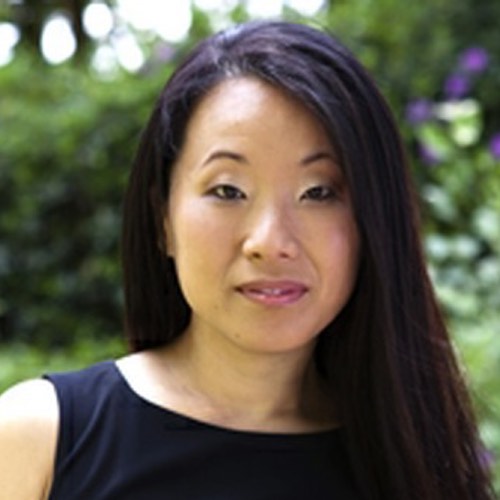
Jong-Gyung Park (piano, below), Tonbridge Philharmonic Orchestra / Oliver Cope (above)
Tchaikovsky Romeo & Juliet Fantasy Overture (1869, rev. 1880) Rachmaninov Rhapsody on a Theme of Paganini Op.43 (1934) Brahms Symphony no.4 in E minor Op.98 (1884-5)
Chapel of St Augustine, Tonbridge School, Tonbridge Saturday 22 February 2025
Reviewed by Ben Hogwood Photos of Oliver Cope, Chapel of St Augustine (c) Ben Hogwood
This was the first concert for the Tonbridge Philharmonic Orchestra under their interim musical director Oliver Cope, in the position while current incumbent Naomi Butcher is on maternity leave. On this evidence he has quickly built a rapport with the orchestra, already in fine fettle under Butcher’s recent direction. On this occasion they responded with a memorable concert of Romantic favourites, given in the spectacular setting of the Chapel of St Augustine in Tonbridge School.
It is easy to take Tchaikovsky’s inspiration for granted, for his storytelling and melodic gifts are so abundant that his best music flows irrepressibly. Such is the case with the Romeo & Juliet Fantasy Overture, in spite of the two revisions required for its composer to be fully satisfied. Cope was an athletic presence on the podium as the orchestra responded with a dramatic account of the lovers’ story, the sword duel between Mercutio and Tybalt particularly vivid, while the soaring love theme tugged at the heartstrings. With fire and brimstone, and crisp ensemble playing, this performance lit the touch paper at the start of the evening.
If anything, Rachmaninov’s Rhapsody on a Theme of Paganini was even better. This was because Jong-Gyung Park (above), the popular rehearsal pianist with the Tonbridge Philharmonic Choir, delivered a sparkling account of the theme and its 24 variations. Cope threw down the gauntlet with a brisk tempo, yet Park rose to the challenge by taking control of even the quickest exchanges. There was an instinctive flow through the first six variations, the mood acquiring an appropriate chill as the Dies Irae was introduced in the seventh. From here the music travelled down darker roads, though still found time for a baleful sixteenth variation, before a shiver could be felt in the air as the seventeenth took hold. The famous eighteenth variation was lovingly delivered, before a flight to the finish that saw Park dazzle with her virtuosity, never losing sight of the whole picture.
To complete a challenging program, Brahms’s Symphony no.4 – and after initial hesitation, a convincing interpretation revealing this work’s unique bridges to the past – notably Bach – and the future, with Schoenberg on the horizon. There was an attractive open-air quality to much of the orchestra’s music making, with the second movement becoming a spring-like counterpart to the obdurate first. The scherzo built on this, dancing with a smile on its face. Flautist Rebecca Rees led a fine woodwind section in the second movement, where the horns, led by Paul Kajzar, were suitably fulsome. They were to prove critical to the success of the finale as the passacaglia developed, capping a performance with serious outlines but shot through with bursts of optimism suggesting Brahms still had a great deal to be thankful for later on in life. It put the seal on an extremely impressive concert.
Recital Hall, Royal Birmingham Conservatoire, Birmingham Monday 17 & Tuesday 18 February 2025
Reviewed by Richard Whitehouse
Royal Birmingham Conservatoire has put on some notable extended events over recent years, the latest being Best of British – a two-day retrospective of piano music from UK composers past and present, all performed by current, former and associated musicians of this institution.
Monday lunchtime centred on composers ‘Made in Birmingham’, beginning with the Second Sonata of John Joubert. His three such works encompass almost his whole maturity, of which this is the longest – taking in a cumulatively intensifying Allegro, volatile Presto with a more equable trio, then a finale whose fantasia-like unfolding culminates in a powerful resolution. Rebecca Watson was a sure and perceptive exponent. Dorothy Howell’s Toccata was given with verve by Rufus Westley, with Christopher Edmonds’ Prelude and Fugue in G elegantly rendered by Ning-xi Wu. Chiara Thomson was dextrousness itself in Howell’s Humoresque, then Zixin Wen found quixotic humour in her Spindrift, before John Lee and Ruimei Huang enjoyed putting Joubert’s early and engaging Divertimento for piano duet through its paces.
Monday afternoon opened with Frank Bridge – his Three Lyrics given by John Lee with due appreciation of their keen insouciance, as too the menacing aura of his much later Gargoyles. Established as the pre-eminent English art-song composer of his generation, Ian Venables is no less adept in combining violin and piano – witness the expressive poise but also rhythmic impetus of his Three Pieces, to which RBC alumni Chu-Yu Yang and Eric McElroy were as emotionally attuned as they were in plumbing the expressive depths of Gerald Finzi’s Elegy.
Next came John Ireland – his imposing if somewhat discursive Ballade finding a committed advocate in Roman Kosyakov, who had no less the measure of his atmospheric Month’s Mind with its undertones of Medtner. Yinan Tong proved suitably alluring in The Island Spell (the first of Ireland’s Decorations), while Ruimei Hang conveyed elegance as well as playfulness in Bridge’s Three Sketches. Expertly partnered by Sarah Potjewijd, clarinettist Jamie Salters steered an insightful course through the diverting formal intricacy of Ireland’s Fantasy Sonata.
Monday evening commenced with further Ireland in ‘Phantasie’ mode – his First Piano Trio finding a productive accord between its Brahmsian inheritance and his own, subtly emerging personality at the hands of violinist Roberto Ruisi, cellist Nicholas Trygstad and pianist Mark Bebbington. They were joined by violinist Shuwei Zuo and violist Jin-he Huang in Venables’ Piano Quintet, among the most substantial and certainly the best known of his chamber works. Its opening Allegro is preceded by an Adagio whose acute pathos underlies the robust energy of what follows, before a Largo such as takes in the capriciousness of its scherzo-like central section without disrupting its soulful discourse; while the finale’s animation is not necessarily resolved by its slow postlude, a sense of this music come affectingly full circle is undeniable.
The second half found these artists in a performance of Sir Edward Elgar’s Piano Quintet doing full justice to a work which, whatever its eccentricity of form and content, is worthy to stand beside any of his mature masterpieces. How persuasively they elided between the haunting ambivalence of the first movement’s introduction and its trenchant Allegro, with the central Adagio gradually emerging as a statement of great emotional import, then the final Allegro building inevitably to an ending of fervent affirmation. Memorable music-making indeed.
Tuesday lunchtime brought more ‘Made in Birmingham’. Michael Jones gave an interesting overview of his teacher Christopher Edmonds, two more of whose Preludes and Fugues – the elegance of that in E then the rapture of that in A – preceded his Aria Variata which, inspired by wartime experiences in the Crimea, channels the influences of Scriabin and Cyril Scott to personal ends. Zoe Tan teased out unity from within the diversity of Howell’s appealing Five Studies, before Duncan Honeybourne gave of his best in the Third Sonata written for him by Joubert. Inspired by lines from Thomas Hardy on the innate futility of the human condition, its three movements unfold an inevitable trajectory from aggression, through compassion, to a resolution more powerful for its inherent fatalism. A fine piece and performance to match.
Tuesday afternoon brought a varied programme in terms of style and media. Chian-Chian Hsu was alive to the limpid poise of Frederick Delius’s Cello Sonata, while otherwise leaving her attentive pianist Charles Matthews to set the interpretive parameters. Honeybourne was then joined by Katharine Lam in the Sonata for Two Pianos by Andrew Downes – whose subtitle A Refuge in times of trouble indicates the ominous unease, shot through with a consoling warmth, that pervades these three, lucidly designed movements by its underrated composer.
Jing Sun gave her own, attractive take on Bridge’s Rosemary (second of his Three Sketches) – before which, Ren-tong Zhao and Jake Penlington offered an unexpected highlight in Ralph Vaughan Williams’ Fantasia on a Theme of Thomas Tallis as stylishly arranged for two pianos by Maurice Jacobson. A not inconsiderable composer, the latter was represented by his quirky Mosaic with Zijun Pan and Julian Jacobson as fluent duettists; Julian returning for his Piccola musica notturna that feels more Busoni than Dallapiccola, if a haunting study in its own right.
Tuesday evening consisted of four notable works. Daniel Lebhardt opened proceedings with Joubert’s First Sonata, this tensile single movement fusing a variety of ideas into an eventful and, above all, cohesive whole through a masterly formal and motivic development. Not that Ethel Smyth’s Second Sonata was lacking such cohesion and if its three movements, arrayed in the expected fast-slow-fast sequence, seemed indebted to the pianistic idiom of Schumann more than that of Brahms, the unbridled rhythmic elan of its opening Allegro (set in motion by a no less forceful introduction), the gently enfolding harmonies of its central Andante (a ‘song without words’ in spirit), then its impulsive final Presto as surges to an aptly decisive close needed no apology. Just the sort of piece that is worth revival at a festival such as this.
As equally was Howell’s Piano Sonata, its more understated and equivocal emotion no doubt representative of a very different persona and one which Rebecca Watson duly brought out – whether the eddying motion of its initial Moderato, intimate calm of its central Tranquillo, or mounting resolve of its final Allegro to a (more or less) decisive close. Yun-Jou Lin rounded things off with Sarnia – An Island Sequence that is arguably Ireland’s most successful such piece for its keenly evocative quality, as was conveyed here though her scintillating pianism. Quite an embarrassment of riches, but one which came together effectively in performance – thanks not least to Mark Bebbington in his curating of the event. It hardly needs adding that there is an abundance of this music for a ‘Best of British, Part Two’ on some future occasion.
For artist and repertoire details in listing form, head to the Royal Birmingham Conservatoire website – clicking here for Day One and here for Day Two
Hyeyoon Park (violin, above), City of Birmingham Symphony Orchestra / Alexander Shelley (below)
Gershwin An American in Paris (1928) Price Violin Concerto no.2 in D minor (1952) Price arr. Farrington Adoration (1951) Ravel Le Tombeau de Couperin (1914-17, orch. 1919) Stravinsky The Firebird – suite (1910, arr. 1919)
Symphony Hall, Birmingham Thursday 20 February 2025 (2:15pm)
Reviewed by Richard Whitehouse
Although he holds major posts in Canada and Naples and has a longstanding association with the Royal Philharmonic, Alexander Shelley seems not previously to have conducted the City of Birmingham Symphony Orchestra, and this afternoon’s concert made one hope he will return soon.
An American in Paris was a tricky piece with which to open proceedings, but here succeeded well on its own terms. Somewhere between tone poem and symphonic rhapsody, Gershwin’s evocation of a compatriot (maybe himself?) not a little lost in the French capital was treated to a bracingly impulsive and most often perceptive reading. A slightly start-stop feel in those earlier stages ceased well before Jason Lewis’s eloquent though not unduly inflected take on its indelible trumpet melody, with the closing stages afforded a tangible sense of resolution.
Much interest has centred over this past decade on the music of Florence Price – the Chicago-based composer and pianist, much of whose output was thought lost prior to the rediscovery of a substantial cache of manuscripts in 2009. One of which was her Second Violin Concerto, among her last works and whose 15-minute single movement evinces a focus and continuity often lacking in her earlier symphonic pieces (not least a Piano Concerto which Birmingham heard a couple of seasons ago). Its rich-textured orchestration (but why four percussionists?) is an ideal backdrop for the soloist to elaborate its series of episodes commanding, ruminative then impetuous, and Hyeyoon Park made the most of her time in the spotlight for an account that presented this always enjoyable while ultimately unmemorable work to best advantage.
The concerto being short measure, Park continued with an ideal encore. Written for solo organ, Price’s Adoration was given in Iain Farrington’s arrangement that brought out its elegance and warmth, if also an unlikely resemblance to Albert Fitz’s ballad The Honeysuckle and the Bee.
After the interval, music by composers from whom Gershwin had sought composition lessons when in Paris. Orchestral forces duly scaled down, Ravel’s Le Tombeau de Couperin was at its best in a deftly propelled Forlane, the alternation of verses with refrains never outstaying its welcome, then a Menuet whose winsome poise – and delectable oboe playing from Hyun Jung Song – emphasized the ominous tone of its central section. The Prélude was a little too skittish, while a capering Rigaudon was spoiled by an excessive ritenuto on its final phrase.
Interesting how the 1919 suite from Stravinsky’s The Firebird has regained a popularity it long enjoyed before renditions of the complete ballet became the norm. Drawing palpable mystery from its ‘Introduction’, Shelley (above) secured a dextrous response in Dance of the Firebird then an alluring response from the woodwind in Khovorod of the Princesses. Contrast again with the Infernal Dance of King Kashchei, even if its later stages lacked a measure of adrenalin, then the Berceuse had a soulful contribution by Nikolaj Henriques and fastidiously shaded strings. Hardly less involving was the crescendo into the Finale, started by Zoe Tweed’s poetic horn solo and culminating in a peroration with no lack of spectacle. It made an imposing end to this varied and cohesive concert, one that confirmed Shelley as a conductor with whom to reckon.
As part of Arcana’s 10th birthday celebrations, we invited our readers to contribute with some of their ‘watershed’ musical moments from the last 10 years.
Editor Ben Hogwood, after much consideration, has chosen a piece of immersive ambience from the Pacific coast.
“Getting to know new music is one of life’s joys – but it does bring with it a danger that the listener does not return to their successes as often as they might or should do. When I was thinking through my musical highlights from the last 10 years it was difficult to bring one specific artist or event to mind. There have been several from my work elsewhere, writing for musicOMH – discovering Bruce Hornsby’s new direction, or following the music of Erland Cooper and its Orcadian connections. Western classical music has provided some memorable moments too, few more so than Sir Simon Rattle conducting Mahler at the BBC Proms.
Yet the one I settled on for Arcana’s 10th anniversary is a thread running through the site’s whole decade, my love of the extraordinary music of Loscil. This is the alias used by Scott Morgan, a Canadian who lives in Vancouver, British Columbia – and whose music is like none other.
Perhaps it’s the fact I have been to Vancouver on several occasions, visiting relatives, that I feel such a strong connection to Loscil’s music. But there is something primal about it that really tugs not just at the heart but at the very fibre of our being, a connection formed between music and the earth. It is the deepest ambience you can imagine in music, an extraordinary achievement when you examine the relatively simple tools used in its construction.
The best example for this is the third section of the Equivalents album from 2019 – a timeless wonder that is deep as the ocean, as wide as the sky. There are clouds on the horizon, and the music paints all these and more in its extraordinary span.
In a memorable interview for Arcana, Scott summed it up. “There is a way of using the creative process and the creation of music to express that which you can’t express in other ways, and that’s what ends up coming out a lot of the time.” Later he noted, “a lot of my work accidentally plays with the spectrum between the natural world and the industrial world…ultimately I think I’m after some sort of balance of what it is to be human, and what it is to be human inside of this natural world we live in.”
I saw Scott perform this music live, at Rich Mix in the heart of Shoreditch – and it was only seconds before we were transported away. In my head I was stood on a beach at the far west of Vancouver Island, experiencing the weather with all its primal force.
You can listen to the album on Tidal below:
Published post no.2,439 – Saturday 8 February 2025
Isabelle Faust (violin, above), City of Birmingham Symphony Orchestra / Kazuki Yamada (below)
Bartók Dance Suite BB86a (1923) Shostakovich Violin Concerto no.2 in C sharp minor Op.129 (1967) Yashiro Symphony for Large Orchestra (1958) [UK Premiere]
Symphony Hall, Birmingham Wednesday 5 February 2025
Reviewed by Richard Whitehouse Picture of Isabelle Faust (c) Felix Broede
It may not have been a popular programme, but tonight’s concert by the City of Birmingham Symphony Orchestra drew a pretty decent attendance in music clearly to the liking of music director Kazuki Yamada, who duly gave of his best for what proved a memorable evening.
Often seen as a breakthrough work in terms of its fusing indigenous musical expression with Western formal conceits, Bartók’s Dance Suite makes an ideal concert-opener. At its best in the rhythmic propulsion or harmonic astringency of the second and third dances, the present account felt a touch inhibited elsewhere; Yamada making overmuch of rhetorical pauses that should motivate rather than impede ongoing momentum. Not that this precluded a forthright response from the CBSO, pianist James Keefe making the most of his time in the spotlight.
Although not now the rarity it once was, Shostakovich’s Second Violin Concerto will always lag behind its predecessor as to performance. Coming near the outset of its composer’s final decade, its inwardness and austerity belie its technical difficulties – though these latter were rarely an issue for Isabelle Faust, who kept the initial Moderato on a tight if never inflexible rein so its demonstrative outbursts and speculative asides were more than usually integrated. Even finer was the central Lento, muted anguish finding potent contrast with plangent solo passages, and a closing contribution from horn player Elspeth Dutch of subdued pathos. Nor was the final Allegro an anti-climax, Faust drawn into engaging confrontation with timpani and tom-tom then heading to a denouement with more than a touch of desperation in its hilarity.
Inquiring listeners may have encountered a recording in Naxos’s Japanese Classics series of a Symphony by Akio Yashiro (1929-76). One of the first group of Japanese composers to study in Europe after the Second World War, his limited yet vital output witnesses a determined and distinctive attempt to fuse certain native elements with the more radical aspects of timbre and texture stemming from the West. Messiaen (with whom he studied) is audible in the fastidious harmonies of this work’s Lento that, building from pensive melodies on flute and cor anglais into a threnody of real emotional power, is its undoubted highlight. Otherwise, the music feels more akin to that of André Jolivet (whose three symphonies deserve revival) in its abundant orchestral colour and predilection for rhythmic ostinatos that galvanize the musical argument.
Such is evident in the implacable unfolding of a Prelude whose motivic ideas secure a more purposeful accord in the ensuing Scherzo, while the finale draws upon the slow movement’s intensity as it expands over successive waves of activity to an impetuous Allegro of no mean velocity prior to a seismic, even brutal peroration. Whatever its intermittent lack of subtlety and cohesion, Yashiro’s Symphony remains an imposing musical edifice such as makes one regret that the composer never managed to pen its successor during his subsequent 18 years.
It certainly found the CBSO at its collective best, so making one hope that Yamada (above) might yet schedule pieces by such as Toshiro Mayuzumi or Sadao Bekku. His next concert has a rather more familiar symphony by Tchaikovsky in the orchestra’s annual Benevolent Fund Concert.





 Arcana.fm