
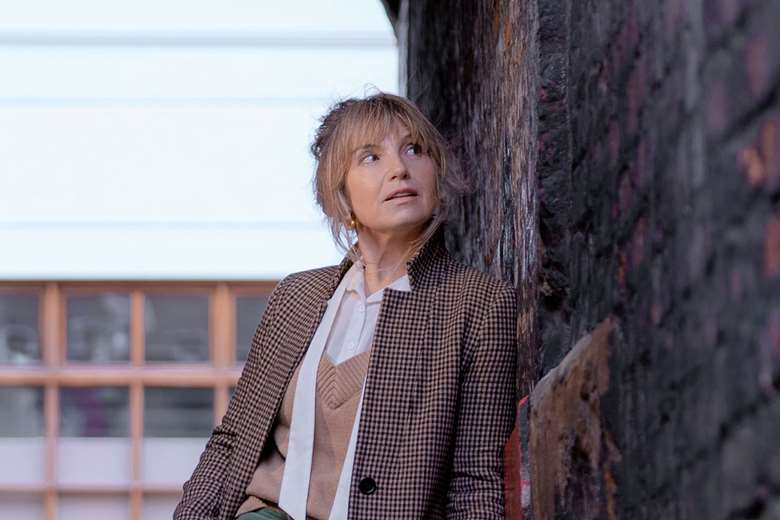
Talking Heads: Claire Booth

The leading British soprano talks to Ben Hogwood about her duo of new albums celebrating the music of Schoenberg, as well as a fascinating career that touches on Mussorgsky and her meaningful friendship with Oliver Knussen. Photos (c) Sven Arnstein (above), Mark Allan (Oliver Knussen)

It is no understatement to state that Claire Booth is a national singing treasure. She would be too gracious to admit this, but the British soprano has played a leading role in classical music on these shores, particularly in league with composer and conductor Oliver Knussen as a leading exponent of new compositions.

Yet Booth’s pioneering spirit extends to music of the classical canon, and after Knussen’s sad death in 2018 her work has continued apace. In 2024 she has included a special emphasis on the music of Arnold Schoenberg, 150 years on from the composer’s birth. His music remains a challenge today – but as Booth revealed in an enjoyably candid chat, it is a challenge well worth accepting for the performer and ultimately the listener.

Before we discuss Booth’s new Pierrot Portraits album on Onyx Classics, where she is joined by Ensemble 360 to put Schoenberg’s melodrama Pierrot Lunaire in the context of composers inspired by the Pierrot, I ask her if she can remember her first encounter with Schoenberg’s music. It turns out to be a milestone she will never forget. “The first time I did Pierrot Lunaire, which was the first piece of Schoenberg that I did, was with Pierre Boulez at the Lucerne Festival. I was a young artist on the inaugural Festival Academy. The first year that they did that was just the Ensemble Intercontemporain and Pierre Boulez. Every instrumentalist had one student, so there was basically a student ensemble, the Ensemble Intercontemporain, Pierre Boulez and Hilary Summers, who was effectively the singing consultant. I was the student singer, so Pierre Boulez basically taught me Pierrot Lunaire! I sort of went, bowed at his feet and said, “Sprechtgesang – how do you do it?”, thinking this is the master of 20th century composition, I’ll get this incredible insight – and he must have been about 70, I suppose, and he just looked at me and said, “You sing a bit, you speak a bit. That’s it.” And actually, he’s so right – because you just learn it like any other piece of music, and you do sing a bit and speak a bit! How you do that is up to you. Like a lot of very, very good musicians, they’re very keen to leave it up to the performer. He wasn’t a micromanager,  and when you’re working with really good people they assume you’re as good as them – I mean, the nice ones do. So he just let me get on with it, and those were the parameters.”

Does the straightforward approach remove a temptation to micromanage Pierrot Lunaire itself? “That’s interesting, because you definitely need to put a lot of time in, and by that, you might think, “Gosh, I’m micromanaging this”. But I can think of any Mozart aria that actually, if you pull it apart, you are micromanaging how you are working. There is a certain sense of micromanagement, but there’s quite a negative connotation with that phrase. With Schoenberg’s music people often get stuck in the realm of thinking very carefully and complexly, but ultimately we do that with all repertoire. After that, we free ourselves up and employ our musicality and our professionalism. Once you get to that stage with Pierrot, then it does feel very innate and characterful, you just have to have done the groundwork.”

Booth has worked with one of Pierrot’s legendary interpreters. “I remember Jane Manning told me, in the way that only Jane could, that she had given the most accurate rendition of the piece ever. She’s absolutely right that there is no excuse not to be accurate pitch-wise, but if you listen to someone like Erwin Schrott do Don Giovanni, when he’s singing the recitatives, he’s not caring about the individual notes – but there’s no way he doesn’t know the notes. He’s inhabiting it completely, and it’s such a wonderful way of listening to the freedom of it. You don’t want to get bogged down in the micromanagement of accuracy. You have to be accurate, but then you get to the next level.”

Schoenberg’s detail of colour in the score reaches descriptive heights with the voice and ensemble, colours that present themselves afresh with each listen. “Absolutely. Obviously there were other vocal pieces before Pierrot Lunaire that employed instruments, but I think Schoenberg really did break up the rule book in how he uses the instrumentalists and voice as one. You’ve got five instrumentalists playing eight instruments, and the singer playing three characters and the narrator in a myriad of different emotional states. The palette is so deft that if the performer understands the text in us, it’s a complete gift. The orchestration is so brilliantly witty, clever, charming and poignant – you know, there are echoes of Bach, Mozart, and elegiac and even aggressive qualities to it. Like all the best music there are no extraneous notes, and his decision to play the note in a certain way is just consummate to me. When people come to this new as an audience member, you might be thinking, “What have I let myself in for?” Within five minutes, though, you are in this sound world, and audiences delight in the sheer virtuosity of the world. As a performer you just have to dive right in, and if you really believe in what is written, it’s just mind blowing!”

Booth has also been recording Schoenberg’s early songs with pianist Christopher Glynn, in a compelling Expressionist Music album released earlier this year on Orchid Classics. It reveals the remarkable breadth to their compositional style. “When you listen to pop music you have the Coldplay sound, the U2 sound, and it’s their thing. But one of the reviews of the Expressionist Music disc said it sounds a bit like Mahler or Brahms. Well, what’s wrong with that? These were people in the musical, historical pedigree that he loved and revered. Why wouldn’t his sound world sound like that? I think one reviewer was almost disappointed that it didn’t all sound like Schoenberg. And you’re like, “What is Schoenberg? Is it a kind of construct that we’ve decided is difficult, atonal?” I think an audience’s appreciation of tonality and atonality now is different than it would have been 40 years ago. We’ve all listened to a lot more music, we don’t hear the jarring qualities that atonality maybe heralded within us. My granny might still think it sounds a little bit risque, but, I think we’re much more open to his world anyway.”

She adds some context. “It’s so important, I think, for everyone to recognize that Schoenberg was a product of his time. He didn’t just parachute in with a pistol aiming to blow a hole in everything. He was absolutely continuing as he felt the tradition, but in the way that the expressionist movement, was going he was continuing a movement by forward motion, taking things on a step. You’ve got folk songs, cabaret songs, love songs – he clearly was a man fascinated by a lot of different aspects of life, you know? He had enormous depth and breadth, and that comes across in his vocal music, in terms of his poetry choices. It also comes through in knowing the man – he was friends with Kandinsky and a tennis partner with Gershwin. The guy was a hoot!”

Booth has been working with the Arnold Schoenberg Center in Vienna – a fascinating resource and museum dedicated to the composer, where it is possible to witness a full scale mock-up of Schonberg’s Hollywood apartment. “I’ve been in touch with them over the last year”, she says, “and we’re going to sing there in December and stay in the apartment. We’re really delighted to have that sort of immersion. Even when you go on the website, with the amount of archival material, you can really geek out on it! I think it’s a shame that he’s been so synonymous with all that is difficult and complex about music when there are composers that have come since Schoenberg that have been far more impenetrable. He’s maintained this aura of unapproachability, which you see in the reticence of festivals and promoters to put on his music, even in this 150th anniversary year, which I just don’t think is justified. So it’s wonderful to get opportunities to be reminded of kind of the breadth of his interests, and how he was a complete part of the kind of wider artistic movement in the 20th century. He’s such a towering figure!”
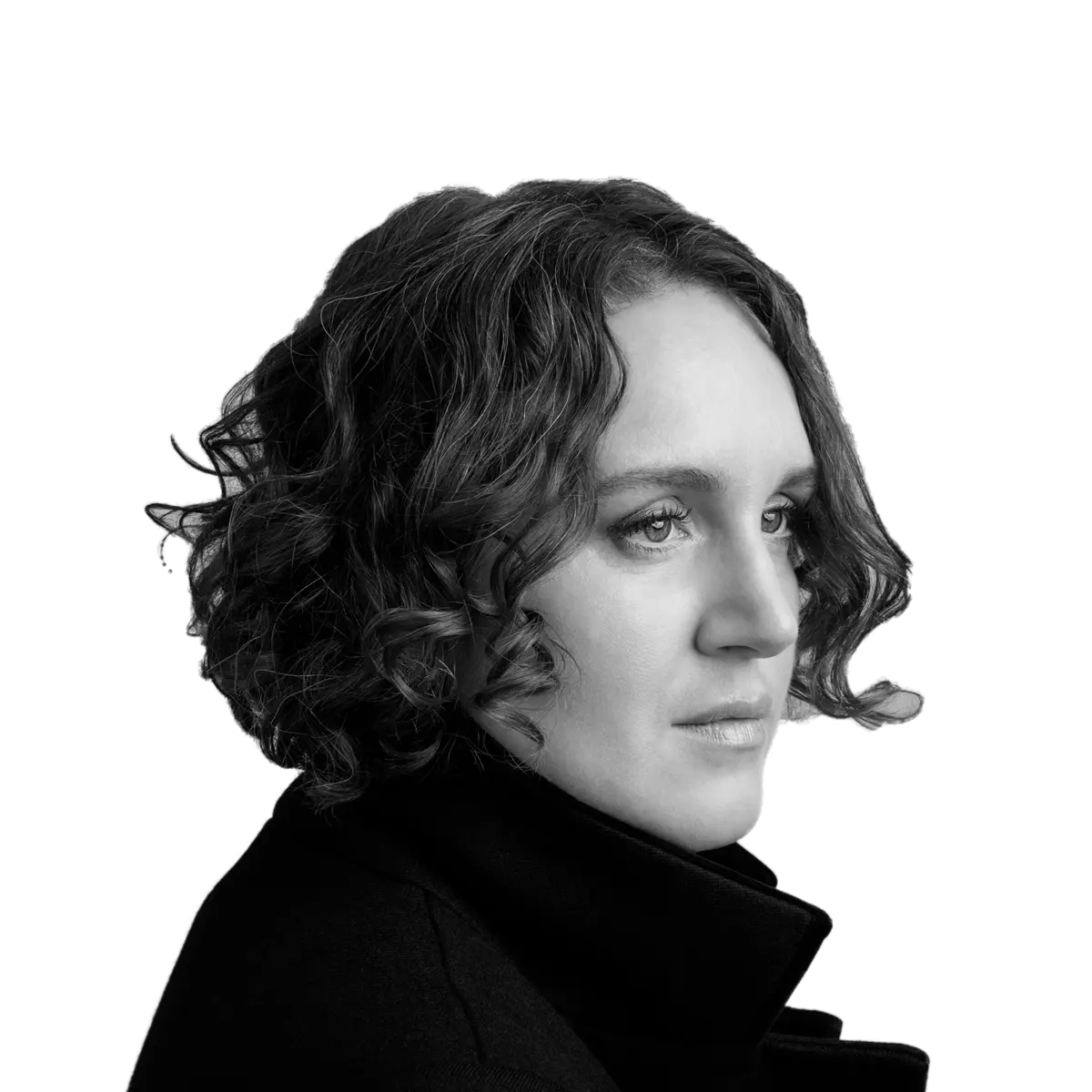
Booth has explored a vast amount of new music in her performing career to date. Is there the same thrill of discovering new music as there was with Schoenberg? A prime example is Helen Grime’s Folk, a setting of verse by Zoe Gilbert for soprano and orchestra which she is preparing for performance as we talk. “I think that’s what’s so great about music. I am so on the back foot – in my first lesson at college, I heard this piece of music, and I lent to the next person and said, “This is the theme music to Trading Places!” And she said, “No, it’s the Overture to The Marriage of Figaro!” I know so little about music that I am still discovering so much now – the joy of discovering new music that’s in the canon, together with new music that’s being written now.” If what your question is leading to is the same kind of craft in new music as in Schoenberg then Helen (above) is a wonderful affirmation of that.

You can listen to Helen Grime’s Folk, performed by Booth with the BBC Scottish Symphony Orchestra under Ryan Wigglesworth, on BBC Sounds

Booth elaborates on Grime’s qualities. She’s such a craftswoman, and such a great orchestrator. Not for nothing was Oliver Knussen such a big champion of her in her early days, and that’s one of the reasons we got to know each other. It feels special to be kind of continuing Ollie’s work with the composers he loved and rated, because he was such a meaningful figure to me. I wouldn’t want to speak too broadly about compositional trends in general. I think I’m very fortunate that I get to sing an awful lot of music by people that I particularly love. It’s easier to believe in music that you have an immediate connection to, and I’m lucky to have that. As a singer I’ve still got so much to learn, repertoire wise, and I’m still so curious in that.”

She cites her exploration of the songs of Mussorgsky, in league with her regular pianist Christopher Glynn. “I’d heard a couple of songs, but what an absolute deep dive. You wouldn’t think of him as a song composer! We know Songs And Dances of Death, but, that’s a group of five – and he wrote 60-70 songs! There are some absolute beauties in there, and no extraneous notes. His brilliant use of pace and orchestration – with only the piano – and the wonderful opportunities for female protagonists in his songs, which doesn’t come through so clearly in his operas. As a curious artist, that’s just brilliant. Five years ago I didn’t know any of that, and now I’m a bit of a guru. I think my love of music has maintained my curiosity for the repertoire that’s already out there, and hopefully that’s a way of marrying the two.”

Booth is struck by Mussorgsky’s originality. “When you listen to this writing, you think it’s Mahler or Wolf, and this guy was writing these songs in the 1840s-1850s. He really was ahead of his time. Ollie always did the Stokowski orchestration of Pictures at an Exhibition, with lots of bells! I think purists would say it’s less sophisticated than the Ravel, but there’s an earthiness and a gravitas to it, a sort of ridiculous element which he doesn’t shy away from. The piece is such a smorgasbord, and that’s the word I’ve tried to use with a lot of these retrospectives, and with Schoenberg too. It’s wonderful to be able to advocate for a composer’s breadth, because I think people have one or two pieces by somebody that they like, and that’s great, but that can lead to other things.”

With that in mind, the Pierrot Lunaire album places Schoenberg’s work in the context of a number of different and fascinating responses to the central character. “When you look at versions of Pierrot Lunaire, it’s always intriguing as to what people put it with. Usually it’s with another Second Viennese School composer, and I definitely didn’t want that. It did seem the figure of Pierrot himself is such a magnet for creatives. Schoenberg wasn’t even the only one to set the Hartleben translation.”

Joseph Marx went in a completely different musical direction to Schoenberg. Kowalski, another Jewish composer of the early 20th century, was actually a lawyer who advocated for Schoenberg when he was having a problem with one of his publishers. He’s done 12 settings of those heart labor poems, but they’re not the same as the ones Schoenberg did. So even with Pierrot Lunaire, we think of it as this seminal work, and it’s wonderful to see how other people have set it. It’s nice to give people a taste of what other composers thought – and even with the Korngold aria, it is this beautifully elegiac piece and so haunting. It’s the ability of the Pierrot character to be so permeable. It’s called Portraits for a reason I suppose, we wanted to present as many different angles as possible.”

We move on to the demands Schoenberg makes on the voice itself. With such a wide range of dynamics and pitches, does the voice need special preparation? “I’ve always done quite a lot of different repertoire concurrently, and I do remember a performance of Pierrot Lunaire where I performed some Handel arias two days later, and I definitely suffered. I remember thinking I would have to schedule these things a bit better. As I’ve gone on in my career, without blowing my own trumpet, I find increasingly that it doesn’t seem to cost any more than singing anything else. I mean, I did some Mozart concert arias in Prague recently, 20 minutes of singing, and I was bloody knackered! If you can get past the complexity of the score and be quite a seasoned interpreter, there is a freedom that comes with knowing something incredibly well, which then allows you to give just the right amount. I’m doing various ‘Pierrots’ this season, and some of them will be next door to singing Debussy, Marx, these other vocal styles – and obviously you need to be ready for both, otherwise you’re short changing the audience.”

Talk turns again to the much-loved Oliver Knussen. What sort of legacy has he left with Claire, and more widely, with British music? “Happily, I’m part of a large family of people who spent time with Ollie and who he was a massive influence on. When I think about Ollie, and his music making, I think of incredible standards and incredible kindness – which extended to nurturing, sponsorship and facilitating of others’ work. He always put his own compositions second, and he really wanted to facilitate others music. He got to know Harrison Birtwistle, reasonably late in his life, but part of that was because I think he felt really second best to Harry, and he was a bit embarrassed. I heard him say he felt his music wasn’t well crafted enough.”

Humility was one of Knussen’s standout qualities. “He was incredibly modest. I was the recipient of so much of his listening, and I suppose the legacy is that I would like to achieve those same exacting standards in my work, the absolute knowledge about and love of the music, and musicality of a properly high standard. As a professional creative, it matters to me, and it mattered to him hugely. The commission with Helen Grime and also Zoe Martlew, this year, who was also an incredibly close friend of Ollie’s, means a lot. When I am involved I do try to remember kind of that Ollie was so generous in his time to advocate for others work. I like to think that he’d be pretty chuffed that I was working with Helen and Zoe in this way. I think he’ll be having a chuckle when Helen’s piece comes to life!”

She goes into more detail. “Ollie worked with quite a small number of musicians over and over, and the rehearsal process was very positive and open and facilitory. I’ve worked with plenty of eminent musicians where the room is not necessarily positive and quite dictatorial and exacting, and now my job is to deliver when somebody wants to be exacting. I really appreciated Ollie’s understanding that if you have booked the right people, they’re going to be good. Treating people with respect and confidence begets that, and having a positive vibe in the room might sound like an obvious thing, but it’s amazing how often that doesn’t happen. In today’s world there’s a lot of talk about this stuff, but I wouldn’t say that people have nailed how to do it. With Ollie, with his potentially intimidating presence, both physically and musically, he was always incredibly respectful and facilitating off of the artists that he worked with. So I hope that if I could generate half of the vibe that he did, I think I’m going the right direction.”

You can explore purchase options by clicking on the links for Pierrot Portraits and Expressionist Music. Claire will perform Pierrot Lunaire twice in November – click for ticket options for Pierrot in the Moonlight on Saturday 2 November at the Classhouse International Centre for Music, and on Thursday 21 November at the Royal Welsh College of Music and Drama, and also for her multi-composer Wigmore Hall recital with pianist Jâms Coleman on Friday 29 November.

BBC Proms – Pierre-Laurent Aimard, Mahler Chamber Orchestra / Sir George Benjamin : Knussen, Ravel & Benjamin

george-benjaminPierre-Laurent Aimard (piano), Mahler Chamber Orchestra / Sir George Benjamin

Knussen The Way to Castle Yonder Op.21a (1988-90)
Purcell
(transc. Benjamin) Three Consorts (1680) [World premiere]
Ravel
Piano Concerto in G major (1929-31)
Benjamin
Concerto for Orchestra (2021) [BBC co-commission: World premiere]

Royal Albert Hall, London
Monday 30 August 2021

Written by Richard Whitehouse; pictures BBC / Chris Christodoulou

The cancellation of last year’s Proms meant the loss of several pieces by George Benjamin in recognition of his 60th birthday. Tonight’s concert, featuring the Mahler Chamber Orchestra with whom this composer-conductor has often collaborated, provided something of a redress.

The programme (its hour-long duration not unreasonably given without interval) began with The Way to Castle Yonder, a brief yet potent ‘potpourri’ from Oliver Knussen’s second opera Higglety Pigglety Pop! as amply conveys the aura of winsome yet ominous playfulness that suffuses the larger work. While they enjoyed a 40-year friendship, Benjamin’s own aesthetic is appreciably removed from that of the older composer so that a detachment, even aloofness was evident – without, however, detracting from this music’s always deceptive whimsicality.

Transcriptions of Renaissance and Baroque sources have been a mainstay of post-war British music, Three Consorts following an established pattern with Benjamin’s take on these Purcell miniatures underlining their intricate textures and piquant harmonies. The (to quote Benjamin) ‘‘visionary moment of harmonic stasis near the middle’’ of In nomine 1 went for little, with the ‘‘mesmerising intersection of line and harmony’ in Fantasia 7 effecting a Stravinskian objectivity, but the understated humour of Fantasia upon One Note was tellingly delineated.

Pierre-Laurent Aimard then joined Benjamin and the MCO in a performance of Ravel’s Piano Concerto in G major that, though it had precision and refinement in abundance, was almost entirely lacking in the qualities that define this music’s essential persona. The opening Allegramente evinced a desiccated manner with such as the blues-inflected coyness of its transitions or the heart-stopping stasis prior to the reprise of the second theme going for little, while the central Adagio took on an all-enveloping inertia as it unfolded – the inward rapture of its expressive apex then the pathos of its ensuing cor anglais dialogue all too enervated in their repose. The closing Presto drew an incisive response from pianist and orchestra alike, but here again any sense of this music’s more provocative demeanour was absent from the prevailing stolidity.

Aimard returned for an animated reading of Benjamin’s early Relativity Rag which provided an admirable entree into the world premiere of the latter’s Concerto for Orchestra. Unfolding as a continuous span (a pause just past its mid-point may be structurally meaningful) across a little over 15 minutes, this is typical of Benjamin’s recent music in its systematic – but rarely predictable – formal trajectory and alluring emotional reticence. The various instruments are highlighted singly or in groups in what becomes an intensifying progression, albeit without a tangible momentum, to a climax which brings first violins to the fore, before subsiding into a close of serene equivocation. Superbly realized by the MCO, for whom it was written, this is a thoughtful addition to a genre in which ‘display’ has all too readily become the watchword.

One final thought – at his untimely death, Oliver Knussen had several large-scale orchestral works in progress and maybe even nearing completion. Might it not still be feasible to bring at least one of the pieces to performance? The UK music scene would be all the richer for it.

You can find more information on the BBC Proms at the festival’s homepage. Click on the composer’s names for more information on Sir George Benjamin, and on the performers’ names for more information on Pierre-Laurent Aimard and the Mahler Chamber Orchestra.

Talking Heads: Augusta Read Thomas

Augusta Read Thomas (picture (c) Anthony Barlich)

On an autumnal day, Arcana has time with composer Augusta Read Thomas, known affectionately as ‘Gusty’ to her friends. The nickname is more than appropriate, since Gusty is speaking to us from her Chicago home. In a year that has been testing at best, she has taken the time to talk through her new album The Auditions, released by Nimbus in October. The collection proves an ideal introduction to her music, including as it does pieces for brass quintet, carillons and a ballet score for ensemble, The Auditions – of which more later.

Our interview subject is bubbly, engaging and intensely focused – rather like her music. The bubbly aspect is in part related to the recently announced result of the US presidential election. “The year has been so out of body, as we both know in lots of ways, but I’m so happy about Biden and Harris. Then we hear about Pfizer and the vaccines, and as such I feel better. In Chicago we’ve been having record temperatures, and it’s been 75 degrees, like a July day! It has been perfectly sunny, day after day after day, the best November weather I can remember in 30 years, which is definitely a bonus. Right now it’s insanely beautiful outside!”

Is her work as a composer affected by the weather? “Yes, I think so – not so directly as writing dark music on a rainy day, but I do feel that the sun is really a giver of energy. I mean that globally, over a lifetime, not a day-to-day thing. There is energy from the sun that I feel. I don’t know how it translates into the music, but it is a real feeling in my body. For instance, sometimes in my little apartment there is a slant of sun that comes through and I’ll move my chair to sit in it. It feels so beautiful to be having that sunlight and then the slant is moving, so you move the chair a little bit. Then it goes beyond the window, but I will gravitate to sunlight!” The Auditions release encounters different forms of light as you journey through it. “Absolutely. I think that nature is really a great teacher. If you’re going to write a piece of music, you should just look at a tree, and it will tell you a lot. Look at the snowflakes and all the differences in their swirls, then a flower, or a garden – or even DNA, the way that cells reproduce; the ocean. I’ve been telling my students this for decades – look outside, there’s a great teacher right there in the window. It’s really true. If you were to go to my website and just read titles of my works on the alphabetical index, a lot of them are to do with the sun, the moon, nature or spirituality. It is the perfume of my whole catalogue. This CD has evocations of light, or ripple effects like those in the ocean. It is like the caprice of birds, and their beauty – the difference between hummingbirds, flying from the north all the way to the south, and the majesty of the swans.”

We move on to discuss the ballet itself. The Auditions is the idea of moving from this other spiritual space, which is the arcs nos. 1,3, 5 and 7 of the auditions, and then these very earthy, playful jazzy bits. It is like going from the cosmos down to the earth and then back up in the ending. You definitely feel the rise in those arcs. The ballet is modelled on the instrumentation used by Copland’s Appalachian Spring. “It was the 75th anniversary of Appalachian Spring”, she confirms, “and the commission was for an anniversary ballet, with the Martha Graham Dance Company set and costumes, which was amazing. Her choreography for Appalachian Spring was very stylized and of its time – a period piece which was wonderful and absolutely fabulous. Then there was an intermission and then The Auditions. I had to use more or less the same instrumentation, and I added the percussion, a trombone, and a saxophone, so that when you got to my piece it was like smelling a different kind of like world right away. The dance company has many bookings for the show with the two together, but of course they all got postponed. They are touring the show though.”

The list of composers commissioned by the Martha Graham Dance Company is a roll call of some of the 20th century’s finest. “Martha Graham really had a tradition of working with living composers”, she says, “and some great works exist in repertoire because of it. I feel really fortunate to have been receiving this commission. I spent a year on the piece – it’s so detailed, nuanced and sculpted in terms of the form. I worked really closely with the choreographer. In parentheses, there’s a broadcast going out to New York on Sunday night. One of them is going up on my website today, so a lot of people will be able to actually see what the dancing was like. I love it, and wish I could send it over!”

That must be a boon in these times where performances have been scarce or even non-existent. “Absolutely”, she agrees. “One of the other pieces on the disc is Plea For Peace, and there is a version where the solo is played by flute, trumpet and violin. That version just aired on 55 television stations all over the country! That’s a big deal in America, to have things out on the television, but in a pandemic it’s just golden.”

Read Thomas studied with two figureheads of 20th century classical music, Oliver Knussen and Pierre Boulez. “I believe that Oliver Knussen is an ‘A’ list composer”, she says affectionately. “I would put Chopin and Debussy and Ravel on that list, all the greats. I want to say that as loud as possible and I also think, amazingly, he was a great conductor and teacher – he was unbelievable. All of that stems from the central core of being a great musician. Very few people are both – you have some conductors who compose OK, and then you have some composers who conduct, but he was both.”

She fondly remembers their meeting. “When I was in second year college in America, I would have been 21-22 say, he heard a bunch of my music. He invited me to be a fellow at Tanglewood, which in America is a very big deal. So, I was at least ten years younger than the other fellows. We would go through my scores and we would sing the lines, and he taught me a lot about nuance and form and when he was very detailed. Then he brought me back for a second year at Tanglewood, because normally you’re only allowed to go once, and then a third year. I learned a lot from him, and then we continued our friendship. I commissioned his piece Requiem: Songs For Sue, and I brought him to the Chicago Symphony. I have a beautiful score he wrote to me and we would share CDs of people’s music. He did my Helios Choros with the Cleveland Orchestra and also the National Symphony, and he brought my piece In My Sky At Twilight to the Queen Elizabeth Hall with the London Sinfonietta. He just supported me over all those years, and in my little modest way I tried to support him too. We could speak on the phone for a long time about pieces of music. It was a friendship, but I do consider my teacher because in the time I had with him, he taught me a lot but I learned a lot from his music. I studied his music and I teach it too. He was just a great artist.”

Having been fortunate to see Knussen in concert at the Proms, with his visionary programming, it was clear how music was a sharing experience for him. “Totally”, she agrees. “Towards the end of his life, when he did the Scriabin Poem of Ecstasy, he called me up and said, ‘You’ve got to hear this!’ It had all the extra players and stuff, so of course I listened and then I listened again. And then after a step I listened again to that Prom. At the end he did the Piano Concerto by Phil Cashian. For many summers I taught at Tanglewood, and he was a frequent guest. A great, great person.”

Of Boulez, Read Thomas is similarly enthusiastic. “The Chicago Symphony invited me to be their composer in residence, and that came about because Boulez and Barenboim reportedly liked my music. I was young, and it was in the mid-1990s. I was 32 or something like that. Just before that I was commissioned to write a piece, called Words Of The Sea. It’s a four movement piece for orchestra, and it’s easy to find the audio of it. I sent in my manuscript on huge pieces of paper and rolled it, and Xeroxed it, rolled it into the tube and sent it off. I got a call saying they had sent it to Boulez with about twelve other pieces. Then about a month later they called up and said ‘Out of a pile of 12 he’s only going to play one…but it’s yours!’”

Boulez conducted the world premiere of Words Of The Sea, and the two met over the manuscript. “It was a great premiere”, she recalls, “and then that night we had this dinner party with the orchestra, and he turned to me and said he would like to commission another piece. So I did a piece called Orbital Beacons. He was so generous, like he bothered to look at my piece and program it, and it was around this that they invited me to be a composer in residence. He nominated me for a prize for the Siemens Foundation, which I won. It is a generous prize! Then he did the premiere of In My Sky At Twilight, and recorded it as well as taking it to Lucerne. There were lots of different projects.”

Read Thomas’ stories are given with great affection and gratitude. “What I liked about him, and also Knussen, is that they would play my tempos. They were both so precise. I remember with Boulez there was one little thing with In My Sky At Twilight, and he said, ‘I think you have the oboe as mezzo forte there, I think it should be mezzo piano.’ I looked, and said, ‘I think you’re right. So the whole group is sitting there and I remember he had this little box with his pens, so he went into his pen box and opened it, looked around and then he took out the red little red pencil. Then he went on to the score and crossed it out and changed it to mezzo piano. It was very precise, and all about getting it right. The players loved him. They played perfectly and with such artistry. It was a teeny change but it was reflective of the fact that my scores are so detailed.” Knussen’s operating method were not too dissimilar. “Olly was also very precise. I remember when we did In My Sky At Twilight at the South Bank Centre, I said to him, ‘Ollie, it feels too slow – can we keep it going so many bars?’ He looked at me and said, ‘Let me think about it.’ Then, at the show, he did it slower! He came up to me afterward, and said ‘I did it slower! You see, it really works!’ He went with the musicality, and the harmonic rhythm of things.”

Moving back to The Auditions, we discuss the programming of the CD release itself. Was it tricky to get in the right order? “You’re absolutely right. I sat with the engineer and we tried it in lots of different ways. We decided to start with the brass quintet because it’s such a good performance, and it’s very hard! They make it sound easy, but it’s tricky – and it just blasts out of the machine. I’ve been listening to jazz my whole life, so while I am a classical composer, I speak a lot about jazz and my process is very full of improvisations and so forth. What I like about that is starting with be-bop. When you put it in a brass quintet, it’s like, ‘What’s going on?’ You know, there’s no other brass quintet that sounds like that piece, there are no folksong arrangements or church chorales. It’s pure protein in terms of material, a bite size thing that shows lots of different sides of me. The chords are jazz chords, but end up sounding like Stravinsky or Messiaen in this context, like Bebop meets Ravel.”

The next piece presents a contrast. “We thought after the intensity of that to go for the intimacy of Plea For Peace. It’s a beautiful recording, made by Chicago Symphony Orchestra members. You go into this other world, and for the contrast that seemed to be a good place to put that reflection.”

“It’s Ripple Effects next!” she says excitedly. This is a piece for 72 bells, and Renske Vrolijk’s wonderful picture above should be examined when listening to the piece, where each player is clambering over one another to get all the notes played in the final chord. “Some of those bells wouldn’t fit in my room!” she laughs. “One of the interesting things about this piece is that most carillon players play solo. They climb all the way up the tower and they sit there alone, they don’t see their audience, and by the time they get down whoever heard them as walked away. It’s very lonely, and there’s not much repertoire that’s not for solo carillon. Also, a lot of the repertoire is arrangements of a chorale or a song or something. What was really interesting to me was that the first version brought all those people together. The humanity made it very special for that instrument. The two player version is on this recording. It’s tricky, they’re going non-stop with their feet and hands. It multiplies in a way, it sounds like an orchestra in the way it goes, because of the way the bells ring. It’s such an interesting sound world, and again, like the brass quintet, there is no piece that sounds like that – it’s very singular in the carillon repertoire.”

While these pieces are for very different instrumental forces, Read Thomas notes the importance of a connecting thread. “I try to imbue all my pieces with the ‘Gusty’ personality, so if you hear a piece of mine you’re not going to say, ‘Oh well, that sounded like warmed-over minimalism, or retro movie music, or spectralism layer three. There are no categories, it’s just my music. With Plea For Peace, what’s interesting about that piece is it’s just a crescendo, but when you use a text, like post-Hiroshima, or an ancient poet, or a political figure, it narrows. When you make it just a vocalise, the piece means the same in South Korea as it does in North Korea, and as it does in Africa, Azerbaijan or Kansas. That was a big decision, to make it a vocalise, but I think it cuts so much deeper. It feels risky to do it, but in the deepest human way it is like a cry from the heart. While that piece is very total, I still think of it as very singular.”

The Auditions roll-call continues with Two Thoughts About The Piano, with Read Thomas effusive about her soloist. “Daniel Pesca was fabulous. His technical skills are outrageous, but he’s an artist, he sculpts the form as crescendos, and also the repeated notes are hard. He really did a great job. I appreciate his touch.” That is followed by Selene, arranged for percussion quartet and winds. “This is an arrangement that Cliff Colnot made”, says Read Thomas. “He took the string parts and put them in the winds, but the percussion parts are identical. I do think it works, there are certain things like when you get those bass clarinet and bassoons, it’s such a cool colour. I think it’s a very successful arrangement; the credit for it should go to him for the wind parts.”

From vivid experience, Read Thomas’s music consistently creates a picture in the listener’s mind. “One of the things that’s also really interesting to me in my practice and life, is how much, for example, Johann Sebastian Bach can fit into two minutes. If you take one movement of The Well Tempered Clavier, one of the Preludes and one of the Fugues – it’s two minutes, but there is a whole universe there. It starts and there’s just not a note out of place. I’ve really taken that to heart in my music, like the first movement of the Brass Quintet – four minutes is it, that’s all you need to paint the picture. We are matching the material to the duration, and to look at Bach’s Goldberg Variations, some of those movements are less than a minute, but there’s a whole universe there. I guess if I had to summarise, generally I’m a poet and not a novelist. I write shorter pieces with every word in place, every dash, every thought, and every line break to use a poetry metaphor, every adjective too. It’s only four minutes but that really interests me. This CD in a way brings out the poet side.”

The same tenets apply with music of longer duration. “The Auditions is a longer piece, but it still breaks down into much shorter sections”, she explain. “It is a kind of pure, protein poetry. You have to edit and sculpt move the comma, so to speak. I really believe that form conserves energy, and I say that to my students all the time. It’s three words but they’re very important. If you have the material and form that are allied, a four minute piece – like Plea For Peace – projects out to a universal statement that is 20 minutes, but you say it in a very short time. That kind of craft, for lack of a better word, I learned from Oliver Knussen. He was a miniaturist also, and so was Boulez. My main model would be Bach but those other two were the same.”

Our conversation pans out to consider the past year and all its challenges. Has it been difficult a a composer? “I will answer that in two layers, if you don’t mind”, she says thoughtfully. “The first layer is that I’m very mindful that we have a lot of people on this planet without shelter, water, healthcare and food, and so on. Also, in my opinion, the systemic racism is outrageous and should have been set right centuries ago. I would like to say loud and clear, that black lives matter. There is a whole social conscience side, and it is important to state that before I say number two, because they are very much interlinked. I think that when we look back in 10 years of what was created in COVID, there is going to be a burst of creativity, which is great. For me, typically, I travel every week. For 200 days a year I’m just zooming around all the time, and I’ve been doing that for 25 years. Then, all of a sudden, I stopped, and when I was cancelling travel and hotels I was thinking, ‘how did I do this?!’ To be honest with you I have been writing, non-stop, and have had enormous focus. It has been a huge boon. I’ve also continued with online teaching, so it has been really busy. I can’t wait to share what I’ve just made with people.” It is reassuring to hear a positive benefit to the imposed isolation, but not surprising when you consider the creativity such adversity can often inspire. “It is, but for me it’s not the adversity, because I’m really trying to help in whatever way I can. For 30 years I wish there was more than 24 hours in a day, and I typically work like 16 hours a day because I like to. I like to get at least eight or nine hours’ composing and then maybe five hours of teaching and then citizenship work. I think after this, with the whole work / home / travel thing, I think a lot will change for big corporations, and for artists. We realise now that certain things really can be done.”

Finally, I have to ask about the origins of Gusty’s nickname. She smiles warmly. “I have been called that since I was a little girl, because we had ten kids in the family and I was the tenth. Since I’ve been about two it was always my name. Then, as my life developed, then it seemed better for the public to have my formal name, which was fine given name at birth. So we just ended up using that. By coincidence the initials are A-R-T. It just fell into place!”

Augusta Read Thomas’s new release The Auditions is available on Nimbus Records. To listen to clips and for purchasing options, visit the Wyastone website. The composer’s own website contains a great deal of information behind the music, with multimedia and details of future performances. To read more, click here

Proms at … Cadogan Hall 8: Knussen Chamber Orchestra / Ryan Wigglesworth – A Tribute to Oliver Knussen

Knussen Chamber Orchestra / Ryan Wigglesworth (above)

Knussen …upon one note – Fantasia after Purcell (1995) (from 2:15 on the broadcast link below)
Birtwistle Fantasia upon all the notes (2011) (9:29)
Freya Waley-Cohen Naiad (2019, world premiere) (20:14)
Knussen Study for ‘Metamorphosis’ (1972, rev, 2018) (30:54)
Abrahamsen Herbstlied (1992, rev. 2009) (38:58)
Alastair Putt Halazuni (2012) (47:36)
Knussen Songs without Voices (1991-2) (tbc)

Cadogan Hall, Monday 9 September 2019

Reviewed by Ben Hogwood

You can listen to this Prom on BBC Sounds here

The BBC Proms’ 800-year odyssey of music over eight weeks at the Cadogan Hall reached the present day in the company of the UK’s newest orchestra.

The Knussen Chamber Orchestra took its bow at the Aldeburgh Festival this year. Created specifically in memory and celebration of Oliver Knussen (above), it is an ensemble for commission and festival appearances, unrestricted in the repertoire it will perform – in that way very much reflecting the approach of its dedicatee. Comprising orchestral principals and budding young talent, it also reflects Knussen’s ability to communicate with musicians regardless of their standing.

Knussen is still greatly missed, a towering figure in British music in the latter part of the 20th century and the 21st until now. Tales have emerged not just of his mentoring of young composers and influence on the established writers, but of a sparkling personality and wit, a dinner companion par excellence. As a conductor he made several richly inventive programmes for the Proms with the BBC Symphony Orchestra and the Birmingham Contemporary Music Ensemble, and as a composer his small but perfectly formed catalogue is required listening for any budding contemporary composer of today. Like the composers he adored, particularly Stravinsky and Webern, his is a musical language that speaks directly through an economy of means.

That much was immediately evident in the three and a half minutes of …upon one note – Fantasia after Purcell, which used the colours of clarinet, violin, cello and piano to lasting effect. Knussen moved the omnipresent middle ‘C’ – the ‘one note’ – around the parts effortlessly, enjoying the harmonic diversions possible around it and alternating solemnity with mischief. The piece proved both a homage to Purcell and a brief spark of invention, and was ideally weighted by the soloists.

Birtwistle’s Fantasia upon all the notes has potential for mischief in its title but is in effect a typically serious piece. Written for an ensemble of seven players this was led with authority by harpist Céline Saout, who effectively drove the piece through its initial jagged outlines. The colours available to Birtwistle were exploited through music of stern countenance, its few tender asides to be cherished as the exception rather than the rule. Only at the end, with little points of pitch from solo instruments, did the mood lighten.

In a charming conversation with BBC Radio 3 host Petroc Trelawny, Freya Waley-Cohen revealed Knussen’s qualities as a tutor and a ‘wonderful person’. Naiad (20:14 on the broadcast) was a fitting tribute, fulfilling Cohen’s description of reflections from the scales of fish and dew on a spider’s web with music that cast a rarefied light, such as the sun does this time of year. The attractive melodic cells rippled with a slight chill, piercing moments of clarity from the woodwind contrasted by fuzzier asides from the strings. Although Cohen’s description of a slow piece and a fast piece rubbing up together was more difficult to follow, that did not mar in the slightest an enjoyable and meaningful piece, whose last few bars had a lilting four-note melody that hung on the air, leaving an enchanted atmosphere in its wake.

Bassoonist Jonathan Davies then stepped forward for Knussen’s highly virtuosic Study for Metamorphosis (30:54), based on Kafka. There were some extraordinary sounds here, the composer exploiting the cartoon-like persona the bassoon can elicit but also reminding us of the instrument’s versatility, its ability to paint pictures both happy and sad. Davies was superb and clearly enjoyed the experience.

Hans Abrahamsen’s Herbstlied followed (from 38:58), an extended arrangement and combination of a Danish song and two J.S. Bach subjects from The Art of Fugue. This instrumental version was unexpectedly moving, its picture painting of leaves ‘falling as from far…’ most apt for the time of year and given a vivid account by the five players. The cor anglais of Tom Blomfield added a unique sourness to the tone, and the downward motion of the melodies indicated sorrow, but there was still a sweeter melancholy here that stayed with the listener long afterwards.

We moved into Alastair Putt’s wind quintet Halazuni (47:36) without a break. This was a less affecting piece, more calculated in its depiction of a spiral (its title is the Persian word for spiral) The colours of the instruments – flute, oboe, clarinet, horn and bassoon – were frequently attractive, and while the music did on occasion feel predetermined, there was a clear end goal.

The best was saved until last in the form of Knussen’s Songs Without Voices (not yet linked to the broadcast on BBC Sounds). A group of four pieces for an ensemble of eight players, the Songs use vivid colour combinations which bring the composer’s imagery to life. The melodies, though short, are incredibly meaningful.

The first three Songs are wordless settings of texts by Walt Whitman, starting with Winter’s Foil, which was alive with bird calls and blustery winds. As elsewhere Wigglesworth secured playing of great poise and personality, led with characteristic authority by violinist Clio Gould. Prairie Sunset showed off the colours of the ensemble both separately and in combination, before the delicate outlines of First Dandelion were revealed. ‘simple and fresh and fair’.

Finally we heard Elegiac Arabesques, Knussen’s tribute to Polish-English composer Andrezj Panufnik. This wove an incredibly poignant thread, suitable in its own way as a memorial to the composer-conductor commemorated with such grace and feeling here.

Listen

The music in this concert can be heard on Spotify below:

A playlist featuring works both composed and conducted by Oliver Knussen can be heard below. It includes …upon one note from this concert, though not the Songs Without Voices – which are in fact available on the Erato label:

Wigmore Mondays – Leila Josefowicz & John Novacek play Sibelius, Prokofiev, Knussen, Mahler and Bernd Zimmermann

Leila Josefowicz (violin), John Novacek (piano) (photo: Hiroyuki Ito for the New York Times)

Sibelius arr. Friedrich Hermann Valse triste (1903-4) (2:10-6:40)
Prokofiev Violin Sonata no.1 in F minor Op.80: 2nd movement Allegro brusco (1938-46) (6:45-13:21)
Knussen Reflection (2016) (15:17-23:44)
Mahler arr. Otto Wittenbecher Symphony no.5 in C sharp minor: 4th movement Adagietto (1901-2, arr. 1914) (25:45-34:00)
Zimmermann Sonata for violin and piano (1950) (34:51-48:11)

Wigmore Hall, London
Monday 21 January 2019

To hear the BBC broadcast through BBC Sounds, please follow this link

Commentary and Review by Ben Hogwood

On paper, this was a strange programme for an hour-long lunchtime recital at the Wigmore Hall. Yet that in itself is refreshing. Why should programming have to be conventional and fit a particular blueprint all the time? So while I may not have necessarily warmed to their choices initially, on reflection Leila Josefowicz and John Novacek gave us something different. There was a chance for those attending and listening on BBC Radio 3 to hear two very familiar pieces out of context, complemented by music such as the Zimmermann Violin Sonata that we may not have heard before.

Josefowicz and Novacek begin with a highly charged account of Valse triste (2:10 on the broadcast link), the third number from Sibelius’s Kuolema Suite. This is normally heard in the hands of a string orchestra, but the arrangement here – and the ardour with which Josefowicz plays the violin line – especially when doubled with the piano – brings a striking dimension to the piece.

It would have been lovely to hear Josefowicz and Novacek take on the whole of Prokofiev’s Violin Sonata no.1 in F minor Op.80, for this is a dramatic piece indeed with a chill to its writing that would have matched the weather outside. Sadly the second movement was all we had time for (from 6:45), and it felt disjointed outside of its familiar context, despite the passion invested in it by both performers.

Of far greater meaning was Oliver Knussen’s Reflection (15:17), one of his last completed works. Josefowicz was a close acquaintance of the composer, and he wrote his Violin Concerto of 2002 for her. The Reflection is not necessarily what you would expect, a reminder that not all reflections are calm and reflective. It begins urgently, the violin ascending before being joined by the bell-like sonorities of the piano. Some of the reflections are jagged, and most are urgent – and typically for Knussen there is a great deal of interest in the melodies and textures, a style that is compact and extremely listenable but also forward-looking. It finishes abruptly.

The excellent writer Paul Griffiths clearly had trouble finding any information on arranger Otto Wittenbecher, let alone anything to do with his version of the Adagietto from Mahler’s Symphony no.5. This famous excerpt transfers surprisingly well to the reduced forces here, helped by sumptuous tone and control from Josefowicz, whilst Novacek distils the orchestral parts into something surprisingly manageable. Played with soft affection, the main theme leaves its mark, even though the arrangement is taken at quite a quick pace.

The main work of this recital, Bernd Zimmermann’s Violin Sonata made a strong impact. In three concise movements, it manages to explore the outer realms of twelve tone writing without compromising its composer’s folk-inflected style. From the outset at 34:51 Josefowicz and Novacek carry the urgency of the piece as though it were hot in their hands. The inflections are reminiscent of Bartók but have a more jagged melodic style; the punchy percussive approach from the piano is similar however. The slow movement (39:00), is written in a 12-tone form (that is, each of the 12 pitches has to sound before it can be heard again). It is however surprisingly tonal, with its stress on the pitches of ‘C’ and ‘F sharp’ giving the music a restless base. The nocturnal scene again recalls Bartók but is resolutely Zimmermann’s own, with passionate lines from the violin. The busy third movement (44:07) revisits the mood of the first, with terse but meaningful statements from the duo.

As an encore the duo added Charlie Chaplin’s Smile (50:06) in an initially eerie, high-range arrangement made by Claus Ogermann.

Further Listening

Most of the music in this concert (with the exception of the Knussen) can be heard on the Spotify playlist below:

For further insight into Josefowicz’s clever programming, her disc with Novacek For The End Of Time provides ample evidence, bringing together works by Falla, Messiaen, Grieg and Bartók: