In concert – Matthew McKinney & Roelof Temmingh @ Bechstein Hall, London

Matthew McKinney (tenor), Roelof Temmingh (piano)

Program including songs by Robert and Clara Schumann, Richard Strauss. Full repertoire list at the bottom of this review

Bechstein Hall, London, 28 March 2025

by John Earls. Photo credit below (c) John Earls

Scottish tenor Matthew McKinney is the winner of the 2024 Kathleen Ferrier Awards and there was quite a sense of anticipation for this recital with pianist Roelof Temmingh at the suitably intimate Bechstein Hall.

Performance is of course the key element in voice and piano recitals such as this. But it is also exciting to be presented with a programme that has clearly been put together with such thought and care. Under the theme of Finding Freedom this programme consisted of two parts. The first was an alternating Clara and Robert Schumann affair, the second a more eclectic but no less engaging mix.

The Schumanns’ set consisted of rotating Clara and Robert Schumann songs neatly threaded together in a lovers’ exchange. It demonstrated not only the consideration and skill of the programming but the quality of Clara’s as well as Robert’s songwriting. McKinney’s singing was beautiful throughout.

The set also included two pieces of recited poetry, Afrikaans poet Breyten Breytenbach’s Red-breasted Dove and Rabindranath Tagore’s Unending Love, both of which deftly complimented the sentiment.

For the first half the audience was requested to save applause until the end of the set, entirely appropriate for the mood and respectfully observed. For the second half however McKinney advised “please do clap any time you want to”. And just as well as this was a much more varied affair including a couple of Robert Schumann solo piano pieces for Temmingh to shine.

Opening with Frank Bridge’s Love Went A-Riding it also included two Benjamin Britten songs, a forceful Batter My Heart (from The Holy Sonnets of John Donne) immediately followed by a tender Sonnetto XXX (from Seven Sonnets of Michelangelo), and a rendition of Tosti’s Marechiare that was full of brio and panache.

There then followed a lovely and affecting sequence. Rebecca Clarke’s I’ll Bid My Heart Be Still (originally composed for viola but ‘reimagined’ here for voice), Robbie BurnsAe Fond Kiss (McKinney unaccompanied) and Temmingh’s own Verjaarsdagbrief (Birthday Letter) based on a letter written by his grandfather to his grandmother and sang in Afrikaans by McKinney who then looped back to Ae Fond Kiss. The audience silence afterwards was marked and sincere.

The set concluded with a couple of well delivered Richard Strauss songs which led to the inevitable and deserved calls for an encore which McKinney admitted they didn’t have so we got a repeat of the magnificent Marechiare which was gratefully received.

Matthew McKinney and Roelof Temmingh performed the following repertoire:

Breytenbach Red-breasted dove
Clara Schumann and Robert Schumann songs interspersed:
Clara Ich stand in dunkeln Träumen Op.13/1, Liebeszauber Op.13/3, Volkslied, Lorelei,
Robert Der Nussbaum Op.25/3, Volksliedchen Op.51/2, Zwielicht Op.39/10, Kreisleriana Op.16/8 (solo piano), Mondnacht Op.39/5
Tagore Unending love
Clara Der Mond kommt still gegangen Op.13/4, Die stille Lotosblume Op.13/6
Robert Die Lotosblume Op.25/7, Widmung Op.25/1

Bridge Love went a-riding H.114
Weir Sweet Little Red Feet (from The Voice of Desire)
Robert Schumann Ritter vom Steckenpferd Op.15/9
Auden What’s in your mind, my dove, my coney?
Britten Batter my heart Op.35/2, Sonnetto XXX Op.22/3
Robert Schumann Vogel als Prophet Op.82/7
Tosti Marechiare
Clarke I’ll bid my heart be still (reimagined); Trad Scots Ae fond kiss
Temmingh Verjaarsdagbrief
Richard Strauss Befreit Op.39/4, Zueignung Op.10/1

John Earls is Director of Research at Unite the Union. He posts on Bluesky and tweets / updates his ‘X’ content at @john_earls

Published post no.2,489 – Sunday 30 March 2025

On Record – Orchestra New England, Orquesta Sinfónica de Navarra / James Sinclair – Ives: Orchestral Works (Naxos)

Ives
Four Ragtime Dances (1902-04, rev. 1916)
Fugue in Four Keys on ‘The Shining Shore’ (c1903)
The Pond (c1906, rev, c1912-13)
The Rainbow (first version, 1914)
An Old Song Deranged (c1903)
Skit for Danbury Fair (c1909, real. Sinclair)
The Gong on the Hook and Ladder or Fireman’s Parade on Main Street (c1911, rev. 1934)
Chromâtimelôdtune (c1923, real. Singleton)
Tone Roads – no.1 (c1913-14); no.3 (c1911/13-14)
Set of Incomplete Works and Fragments (ed. Singleton/Sinclair, 1974)
March no.2, with ‘Son of a Gambolier’ (c1892)
March no.3, with ‘My Old Kentucky Home’ (c1893)
March ‘The Circus Band’ (c1898-99, rev. 1932-33)
Arrangements (1896-97) – Schubert: Marche militaire in D, D733 No. 1 (1818). Schumann: Valse noble, Op. 9 No. 4 (1834-35). Schubert: Impromptu in C minor, D899 No. 1 (1827)

Orchestra New England, Orquesta Sinfónica de Navarra (arrangements) / James Sinclair

Naxos American Classics 8.559954 [75’43”]
Editions John Kirkpatrick, Jacques-Louis Monod, James Sinclair, Kenneth Singleton and Richard Swift
Producers Neely Bruce, Jan Swafford Engineers Benjamin Schwarz with Jonathan Galle and Gonzalo Noqué

Recorded 24/25 October 2023 at Auditorio Barañaín, Pamplona-Navarra, Spain (arrangements), 12-14 March 2024 at Colony Hall/Choate Rosemary Hall, Wallingford CT, USA

Reviewed by Richard Whitehouse

What’s the story?

Naxos continues its long-term series devoted to the orchestral music of Charles Ives with this volume of shorter pieces and arrangements, several of them recorded for the first time and conducted by James Sinclair, whose involvement with the composer now stretches back across 50 years.

What’s the music like?

Miniatures for a variety of forces are found right across the four decades of Ives’s composing and range from unformed experiments to perfectly realized exemplars of his idiom. Many of these were collated in the dozen or so Sets that Ives assembled at various stages in his career (recorded on Naxos 8.559917) while there are various others which resist any such compiling, and these can mostly be found here – often in critical editions prepared by a formidable team of Ives scholars, hence rounding out the picture of his creativity in the most immediate terms.

Written at the outset of the genre’s golden age, the Four Ragtime Dances neatly complement each other as regards form and content; elements from each finding their way into the second movement (The Rockstrewn Hills) from the Second Orchestral Set, which builds upon their anarchic humour accordingly. Following the shimmering polytonal ambivalence of the Fugue on ‘The Shining Shore’, the unworldly evocations The Pond and The Rainbow find Ives at his most intimate and confessional – as does the admittedly more genial An Old Song Deranged. Not so Skit for Danbury Fair, its inherent iconoclasm finding greater focus in the graphically descriptive The Gong on the Hook and Ladder or contrasting Tone Roads Nos. 1 and 3 which embody Ives’s thinking on indivisibility of life and music in the most uncompromising terms.

It was once thought Chromâtimelôdtune might be the missing Tone Road No. 2, yet this late and possibly incomplete piece is likely an acerbic response to the Modernism emerging from post-war Europe which seemingly preoccupied Ives in those twilight years of his composing. The three song-based Marches date from an earlier and ostensibly more carefree phase, their debunking couched in humorous terms, while the Set of Incomplete Works and Fragments is a judiciously conceived entity that should not have had to wait 50 years for its first recording. The orchestrations are from Ives’s study with Horatio Parker at Yale: that of Schubert’s First Marche Militaire and Schumann’s Valse noble (from Carnaval) are expert but anonymous, that of Schubert’s First Impromptu results in a ‘theme and variations’ of striking prescience.

Does it all work?

Yes, inasmuch that the effectiveness of these pieces largely depends on the conviction of their performers and, with Sinclair at the helm, this can be taken for granted. As can the excellence of Orchestra New England in repertoire it has often been playing for decades, and if Orquesta Sinfónica de Navarra might appear an unlikely choice for Ives’s undergraduate arrangements, it acquits itself admirably. The sound throughout is unexceptionally fine, and Sinclair’s own annotations are succinctly informative as to the genesis and context of some intriguing music.

Is it recommended?

Indeed, this is a necessary addition to a valuable series – hopefully to be continued before too long with recordings of the Fourth Symphony and Universe Symphony as partially realized by David Porter, of which Sinclair gave a memorable account at the Aldeburgh Festival in 2012.

Listen & Buy

For buying options, you can visit the Naxos website – or listen to the recording on Tidal below:

Click on the names for more information on conductor James Sinclair, Orchestra New England, Orquesta Sinfónica de Navarra and the Charles Ives Society.

Published post no.2,382 – Wednesday 4 December 2024

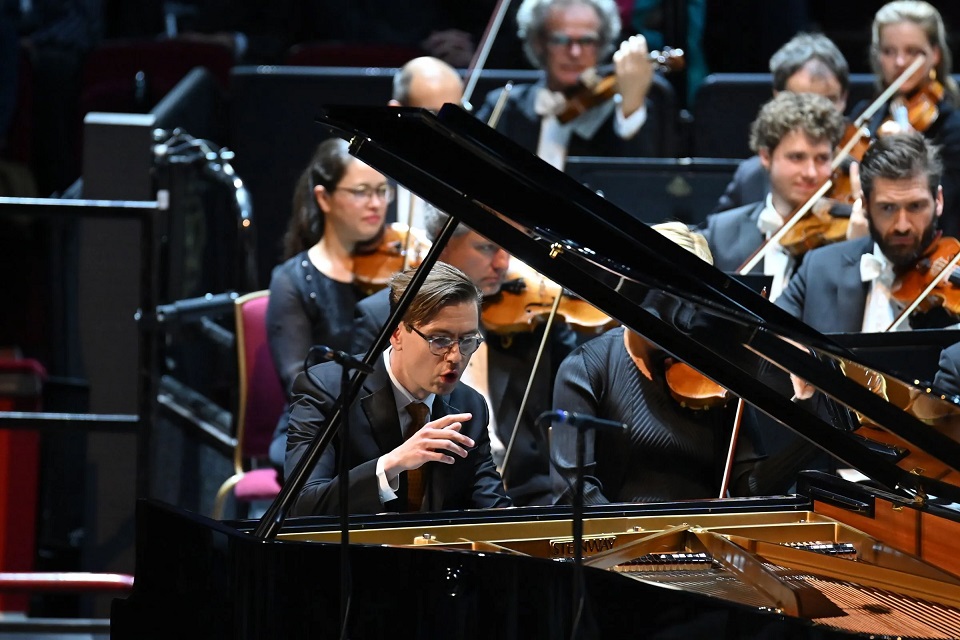
Arcana at the Proms – Prom 55: Vikingur Ólafsson, Berliner Philharmoniker / Kirill Petrenko – Schumann & Smetana

Schumann Piano Concerto in A minor Op.54 (1841-5)
Smetana Má vlast (1874-9)

Vikingur Ólafsson (piano), Berliner Philharmoniker / Kirill Petrenko

Royal Albert Hall, London
Saturday 31 August 2024

reviewed by Richard Whitehouse Photos (c) Chris Christodoulou

This first concert in its latest Proms visit by the Berliner Philharmoniker and chief conductor Kirill Petrenko featured a complete performance of Smetana’s Má vlast as the second half of a programme that, at barely the length of an average Mahler symphony, need not be unusual.

Few would, in any case, object to Vikingur Ólafsson tackle Schumann’s Piano Concerto in an account as dextrously articulated as it was unerringly proportioned. Not least an initial Allegro such as avoided any tendency to mid-tempo ‘drift’, those subtly contrasted themes building a cumulative impetus carried into the combative cadenza then a coda whose tensile energy was judged to a nicety by Petrenko. Some might have felt the Intermezzo too interventionist in its alternation of capriciousness and pathos, but absence of the cutesiness and cloying was more than its own justification and not least when that transition into the final Allegro had such an expectancy. Rhythmically supple with unwavering focus on its overall continuity, this set the seal on a reading whose technical finesse and interpretative insight ensured a riveting listen.

Ólafsson caused some stir at these concerts three years ago with Bach and Mozart concertos, and it was the former composer who provided the encore: the Adagio from the Fourth Organ Sonata (BWV528), transcribed here by August Stradel and rendered with understated poise.

More Czech music so soon after the Czech Philharmonic’s brace of Proms might have been too much of a good thing, but Petrenko’s Má vlast was very different from Jakub Hrůša’s in its lithe expression and streamlined textures. Nor was there was any lack of emotional depth – hence those earlier stages of Vyšehrad as it emerged eloquently on harps towards a fervent climax, its dramatic central section of a razor-sharp precision before subsiding into the main theme’s moving return. Vltava was scenically evocative and formally cohesive as it took in folk-dance, nocturnal landscape and treacherous rapids prior to its resplendent emergence in Prague, then Šárka unfolded its narrative of a matriarchal icon and her heroic demise with an impulsiveness that went into overdrive – without being overdriven – at its dramatic close.

It may be more generalized as to content, but the initial half of From Bohemia’s Woods and Fields is spellbinding as it conjures a pantheist ecstasy (in the process, anticipating Janáček and Minimalism) to which the BPO players were audibly attuned – Petrenko mindful not to overstate the relative blatancy of what follows. Most impressive, even so, were the final two stages whose gaunt rhetoric and granitic sound-world most often make for uneasy listening. Not here, however, as Petrenko gauged the motivic eddying of Tábor so that its underlying momentum held good through to the inevitable segue into Blaník. Emotional tension here was unremitting, the intensive interplay of Vyšehrad-theme with Hussite-chorale building to an apotheosis of Beethovenian power before letting loose for a coda of visceral exhilaration.

Its composite nature makes Má vlast difficult to sustain in performance, but there could be no doubt Petrenko managed this through his and the BPO’s acute yet never wanton control over every facet of the greater concept. A memorable performance and an impressive achievement.

You can get details about this year’s season at the BBC Proms website – and you can click on the names to read more about the Berliner Philharmoniker, their chief conductor Kirill Petrenko and piano soloist Vikingur Ólafsson

Published post no.2,289 – Monday 2 September 2024

In concert – James Ehnes, CBSO / Markus Stenz: Schumann Violin Concerto & Bruckner Symphony no.7

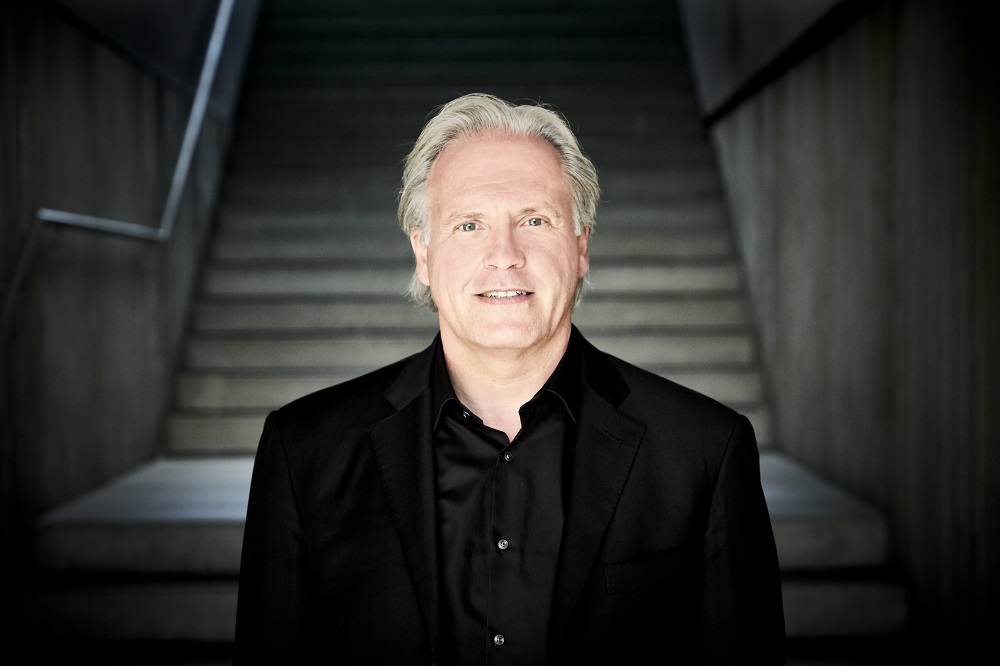
James Ehnes (violin, above), City of Birmingham Symphony Orchestra / Markus Stenz (below)

Schumann Violin Concerto in D minor WoO23 (1853)
Bruckner Symphony no.7 in E major WAB107 (1881-83, ed. Nowak)

Symphony Hall, Birmingham
Thursday 25 April 2024

Reviewed by Richard Whitehouse Picture of James Ehnes (c) Benjamin Ealovega, Markus Stenz (c) Kaupo Kikkas

His appearance here for performances of Mahler’s Second Symphony two years ago had made one hope that Markus Stenz might soon be invited back to the City of Birmingham Symphony Orchestra – such being so tonight for this outstanding programme of Schumann and Bruckner.

Although it now enjoys frequent hearing, Schumann’s Violin Concerto yet remains under the shadow of its eight-decade limbo after the composer’s mental breakdown then decision by its intended soloist Joseph Joachim to withhold performance. Only in 1937 was it given in public, since when it has gradually come to be regarded (as Yehudi Menuhin believed it would be) as the missing link between Beethoven and Brahms. Certainly, there was nothing tentative about James Ehnes’ advocacy, which proved as interpretively acute as it was technically immaculate.

Pacing the initial movement so that its earnest character never becomes unduly sombre is not easy, but Ehnes ensured its halting progress never felt effortful and Stenz drew textures of no mean luminosity from these modest forces. The slow movement seemed more eloquent for its listless pathos, with its terse transition into the finale astutely judged. Its underlying polonaise rhythm deftly inflected, this rather gauche rondo yielded an easy-going momentum in the call and response between soloist and orchestra, through to a conclusion both genial and resolute.

A memorable performance which reinforced Ehnes as among the most consistent (as well as undemonstrative) of present-day virtuosi – something that was no less evident in his account of the Third Sonata (‘Ballade’) by Eugène Ysaÿe which here made for a scintillating encore.

The UK has seen little of Stenz since his tenure with the London Sinfonietta during the mid-1990s, a pity given he has few peers among conductors of his generation in terms of Austro-German repertoire. Such was borne out by Bruckner’s Seventh Symphony – Classical in its lucidity of motion, Romantic in its frequently impulsive emotion. Not least an initial Allegro moderato that elided between its contrasting themes with unforced rightness, the abruptness of certain tempo changes (accentuated by his rare recourse these days to the Nowak edition) channelled into a coda of surging sublimity. Even finer was the Adagio for the inevitability with which this drew respectively elegiac and lyrical themes into a sustained traversal, via an exultant peroration (cymbal and triangle duly outdone by timpani), to a nobly resigned close.

The latter two movements can easily seem anti-climactic, but there was nothing understated about the Scherzo as Stenz heard this – the impetus and acerbity of its outer sections finding accord with a trio whose lilting poise was delectably pointed. As for the Finale, most succinct of Bruckner’s maturity, Stenz emphasized its expressive contrast between themes through his choice of tempi – while managing to mould these into a convincing unity before heading into a coda which revisits that of the first movement with blazing affirmation in the here and now.

The performance would not have made the impact it did without the CBSO playing at or near its best throughout – such Bruckner interpretation having few, if any, equals when it comes to live music-making. One can only hope conductor and orchestra will work together again soon.

Click on the link to read more on the current CBSO concert season, and on the names for more on violinist James Ehnes and conductor Markus Stenz

Published post no.2,161 – Saturday 26 April 2024

In appreciation – Maurizio Pollini

by Ben Hogwood. Picture (c) Matthias Bothor / DG

Yesterday we heard the sad news of the death of the great Italian pianist Maurizio Pollini, at the age of 82.

You can read a number of tributes to Pollini, by Barry Millington on the Guardian website and by HarrisonParrott, his agents.

Throughout his career Pollini recorded for Deutsche Grammophon, leaving a succession of remarkable recordings ranging from a famous early collection of the Chopin Etudes through to pioneering modern collections, with a landmark LP of works by Schoenberg and a 20th century collection of Stravinsky, Webern, Boulez and Prokofiev. The playlist below is a personal selection of favourites and a memory from seeing Pollini play Schumann‘s Fantasie in C major at the Royal Festival Hall.

Published post no.2,127 – Saturday 24 March 2024