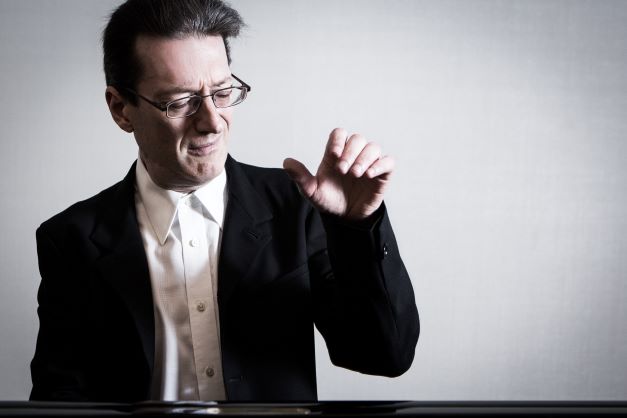
Throughout his career Pollini recorded for Deutsche Grammophon, leaving a succession of remarkable recordings ranging from a famous early collection of the Chopin Etudes through to pioneering modern collections, with a landmark LP of works by Schoenberg and a 20th century collection of Stravinsky, Webern, Boulez and Prokofiev. The playlist below is a personal selection of favourites and a memory from seeing Pollini play Schumann‘s Fantasie in C major at the Royal Festival Hall.
Carolyn Sampson (soprano, above), Joseph Middleton (piano, below)
Songs and piano music by Robert and Clara Schumann – full list at bottom of review
Wigmore Hall, London Wednesday 14 February 2024
by Ben Hogwood Photos by Marco Borggreve (Carolyn Sampson) and Sussie Ahlberg (Joseph Middleton)
This was a Valentine’s Day concert with a difference. No orchestra, no Romeo & Juliet – but rather an intimate presentation of a musical marriage, that of composer / pianists Robert and Clara Schumann, whose relationship has been increasingly under the microscope in the past few years.
This is a good thing, for when Robert and Clara married on 12 September 1840 the concept of equality within marriage, let alone classical music, was very different indeed. Robert, in the outpouring of song that he experienced in that year, completed the song cycle Frauenliebe und -leben, to poetry by Adelbert von Chamisso attempting a depiction of marriage from a woman’s perspective. It is certainly not how we recognise the institution of marriage today, which soprano Carolyn Sampson acknowledged in a Guardian article around the release of herAlbum für die Frau, the title of this concert, in 2021. In that article she put forward a strong case for continuing to sing the cycle, identifying with a good deal of the verse and even more of the music – but with her musical partner, pianist Joseph Middleton, she has recast the cycle.
Now the Schumanns’ marriage is given in four parts – love, marriage, parenthood and death – viewed through the prism of Frauenliebe but balanced through songs by Clara and Robert, or one of the latter’s piano pieces. Each song from the cycle had two accomplices, the context achieved through what must have been a painstaking selection process that, in this concert, bore much fruit. The coherent end piece was bisected by well-chosen text from the couple’s diaries and more.
With sadness inevitably looming towards the end it was a difficult structure for the duo to pitch, but they made it work through selections that made emotional sense and which, crucially, were harmonically linked. Sampson’s clarity of line was the clincher, her ability to carry not just a melody but the words with great diction, while the same could be said of Middleton’s phrasing, which as Sampson said in the introduction ‘could express what words cannot’. The postlude from Frauenliebe was the keenest example, exquisitely played.
The song cycle itself contained a great deal of emotion, especially in Du Ring an meinem Finger (You ring on my finger), where Sampson’s powerful crescendo was all-consuming. Clara’s songs proved the ideal complement, a little more Schubertian in style perhaps but harmonically more daring, often ending in suspension.
The first half included five settings of Rückert and felt slightly giddy in the intoxication of falling in love and wedded bliss, almost too good to be true – and so it proved, with the settings of Heinrich Heine bringing with them furrowed brows and family responsibilities, the music increasingly worrisome. Robert and Clara had eight children in all, and this section gave a glimpse of the weight of responsibility that would surely have left.
The masterstroke of this program, however, was not to finish with the end of the song cycle but to offer Robert’s Requiem, from his 6 Gedichte von N Laneu und Requiem Op.90, as a much-needed consolation, then the piano piece Winterzeit I, from the Album für die Jugend. Finally, as an encore, Clara’s Abendstern, a beautiful postscript with her love taken up to the stars, turned our gaze upwards once more.
It capped an unexpectedly moving account of two lives intertwined, offering a timely reminder of Clara’s torment at her husband’s untimely demise. One of the power couples of 19th century music they must have been, but this was a tender account of two lives entwined and enriched by beautiful song.
You can hear Album für die Frau, as released on BIS, below:
Carolyn Sampson and Joseph Middleton performed the following music:
Robert Schumann Langsam und mit Ausdruck zu spielen from Album für die Jugend Op. 68 (piano, 1848) Clara Schumann Liebst du um Schönheit Op. 12 No. 2 (1841) Robert Schumann Seit ich ihn gesehen from Frauenliebe und -leben Op. 42 (1840) Volksliedchen Op. 51 No. 2 (1840) Clara Schumann Liebeszauber Op. 13 No. 3 (1840-3) Robert Schumann Er, der Herrlichste von allen from Frauenliebe und -leben Op. 42 Clara Schumann An einem lichten Morgen from 6 Lieder aus Jucunde Op. 23 (1853) Warum willst du and’re fragen Op. 12 No. 3 (1841) Robert Schumann Ich kann’s nicht fassen, nicht glauben from Frauenliebe und -leben Op. 42 Clara Schumann Die stille Lotosblume Op. 13 No. 6 (1840-3) Robert Schumann Du Ring an meinem Finger from Frauenliebe und -leben Op. 42 From Myrthen Op. 25 (1840): Lied der Braut I • Lied der Braut II Glückes genug from Kinderszenen Op. 15 (piano, 1838) Interval Robert Schumann Helft mir, ihr Schwestern from Frauenliebe und -leben Op. 42 Die Lotosblume from Myrthen Op. 25 Lust der Sturmnacht from Kerner Lieder Op. 35 (1840) Süsser Freund, du blickest from Frauenliebe und -leben Op. 42 Hochländisches Wiegenlied from Myrthen Op. 25 Der Sandmann from Lieder-Album für die Jugend Op. 79 (1849) Kind im Einschlummern from Kinderszenen Op. 15 (piano) An meinem Herzen, an meiner Brust from Frauenliebe und -leben Op. 42 Ritter vom Steckenpferd from Kinderszenen Op. 15 (piano) Dein Angesicht Op. 127 No. 2 (1840) Nun hast du mir den ersten Schmerz getan from Frauenliebe und -leben Op. 42 Requiem from 6 Gedichte von N Lenau und Requiem Op. 90 (1850) Winterzeit I from Album für die Jugend Op. 68 (piano) Clara Schumann Abendstern
Published post no.2,088 – Thursday 15 February 2024
Schumann Papillons Op.2 (1830-1) Nachtstücke Op.23 (1839-40) Faschingsschwank aus Wien Op.26 (1839-40)
Wigmore Hall, London Friday 12 January 2024 (1pm)
by Ben Hogwood
After extensive examinations of the piano output of Beethoven and Schubert, Llŷr Williams has turned his attention to Robert Schumann. This lunchtime concert at the Wigmore Hall celebrated the release of a double album on Signum Classics starting a series devoted to the composer’s piano works. On this evidence there will be some revelations in store.
That Williams loves Schumann’s music was evident from with the languid introductory chords to Papillons. This early work from the 21-year-old composer is a masked ball, a chance not just to enjoy his love of butterflies but to present a closely connected set of miniature portraits for piano. In a good performance they capture the listener’s imagination, and under Williams’ fingers the music took flight. The clarity of his phrasing was immediately notable, revealing the exquisite details of Schumann’s melodic creations and taking time to let them breathe. With the improvisatory seventh piece (marked Semplice) the ink felt barely dry on the page, while the mood ranged from a relatively stern third piece to a playful eleventh, enjoying the brisk fanfares. Best of all was the Finale, where clever use of the sustain pedal left us with a marching band whose bright melodies hung on the air, the drone of the horns left for the listener to savour.
The Nachtstücke are lesser-known pieces, but Williams revealed just why they should be heard more often. He also revealed something of the turbulent period in which they were composed, with Schumann aware of the imminent death of his brother Eduard and travelling to Vienna in an attempt to alleviate his family’s precarious financial position. Because of this, the nocturnal dreams we might expect from other composers is trumped by active and often troubled thoughts, flitting quickly between moods and contrasting emotions. Williams, though, untangled the knots of Schumann’s musical thoughts. The solemn tread of the first piece, a funeral march, had forward purpose, while the second was a flurry of activity, thoughts running almost out of control until checked by a relatively dreamy central section. At all times Williams was in control of his characterisations, so much so that it was easy to forget the technical demands of this music. This was certainly the case in the outpouring of the third piece, before the chorale and related solos of the fourth were beautifully judged and complemented.
Finally we heard Faschingsschwank aus Wien, companion pieces to the Nachtstücke also written during the ultimately unsuccessful visit to the Austrian capital. These present a different side to Schumann, with Williams enjoying the humour of the first piece, with its catchy motif and cheeky reference to La Marseillaise. This vigorous start contrasted with a heartfelt Romance and a deeper, flowing Intermezzo – between which the Scherzino reasserted the prevailing mischievous mood. So too, did the Finale, where the virtuosity was again beyond question, the helter-skelter figures once again used for poetic purpose rather than display. Williams proved a revelation in Schumann, bringing even his most complex character pieces to life – and maintaining a remarkable clarity of line as he did so. If he keeps this up, there are many treats in store as he journeys further into Schumann’s poetic and deeply personal world.
You can hear Llŷr Williams’ new recording on Spotify below:
Laura van der Heijden (cello, above), City of Birmingham Symphony Orchestra / Richard Egarr (harpsichord)
J.S. Bach Orchestral Suite no.3 in D major BWV1068 (1730) Haydn Cello Concerto in D major Hob.VIIb/2 (1784) J.S. Bach Fuga a tre sogetti BWV1080 no.19 (1748-9) Schumann Symphony no.2 in C major Op.61 (1845-6)
Symphony Hall, Birmingham Tuesday 14 November 2023
Reviewed by Richard Whitehouse
The City of Birmingham Symphony Orchestra has put on smaller-scale concerts over several seasons, and tonight’s wide-ranging programme saw the players being conducted or directed – and frequently at the same time – by the personable and always enthusiastic Richard Egarr.
Egarr and Laura van der Heijden ensured Haydn’s Cello Concerto in D remained unaffected by that understatement, bordering on somnolence, which so often used to characterize it in performance. Although a staple of its repertoire from the outset, it was only discovery of its autograph in 1951 that confirmed it as by Haydn rather than Anton Kraft who had reworked the solo part extensively. Here the initial Allegro had a vibrancy that never wavered, and if Van der Heijden’s tone was not always flattering, the impetus instilled into its development and cadenza (by Colin Matthews?) ensured this movement’s vivid projection. The brief yet eloquent Adagio was enticingly rendered, while the final Rondo had an agility maintained from the first appearance of its indelible theme through to the buoyancy of its closing bars.
Egarr had opened proceedings with Bach’s Third Orchestral Suite, welcome not least because this composer’s orchestral works (other than his Violin Concertos) are seldom encountered at ‘mainstream’ concerts these days. Although its Aria (Air on the G string) – rendered so that its pathos never cloyed – will always be its chief attraction, the Ouverture had grandeur and energy redolent of Handel, then the alternate Gavotte movements evinced a genial humour to which the boisterous Gigue with its clarion-like trumpet writing made an admirable foil. After the interval, an unexpected but absorbing take on the final and unfinished fugue from Bach’s The Art of Fugue. Once more speculated on than actually heard, Contrapunctus XIV remains a fete of technical and imaginative dexterity arguably intensified by its breaking off just after the appearance of the B-A-C-H motif. Whether abandoned from failing eyesight or for reasons of intellectual game-playing, its fascination remains endless and, as heard in this lucid if dour transcription for strings, its fusing of the visceral with the arcane is not in doubt.
Richard Egarr
Photo: Marco Borggreve
Not an inappropriate entrée, moreover, to Schumann’s Second Symphony: formally the most rigorous of this composer’s cycle, and one whose historical or aesthetic lineage is evident at every level. Egarr ensured the first movement’s lengthy introduction, pensive yet expectant, led seamlessly into a main Allegro whose momentum carried through to a propulsive close; then into a Scherzo whose pivoting between the agitated and whimsical was not resolved by its headlong coda – superbly articulated here. Nor was there any lack of emotional gravitas in the Adagio, surely among Schumann’s most potent creations, though Egarr’s not always tacit encouragement of applause between movements rather undermined the expectancy of a coda being fulfilled by the final Allegro as this sets out on its joyous while always eventful course.
Just on occasion the inevitability of that course seemed to lose focus, most likely as Egarr’s concept of ‘authenticity’ tended to impede more seamless formal cohesion – but, as the piece headed to its close, a sense of affirmation in the face of daunting odds could hardly be denied.
You can read all about the 2023/24 season and book tickets at the CBSO website. Click on the artist names for more information on cellist Laura van der Heijden and conductor / harpsichordist Richard Egarr
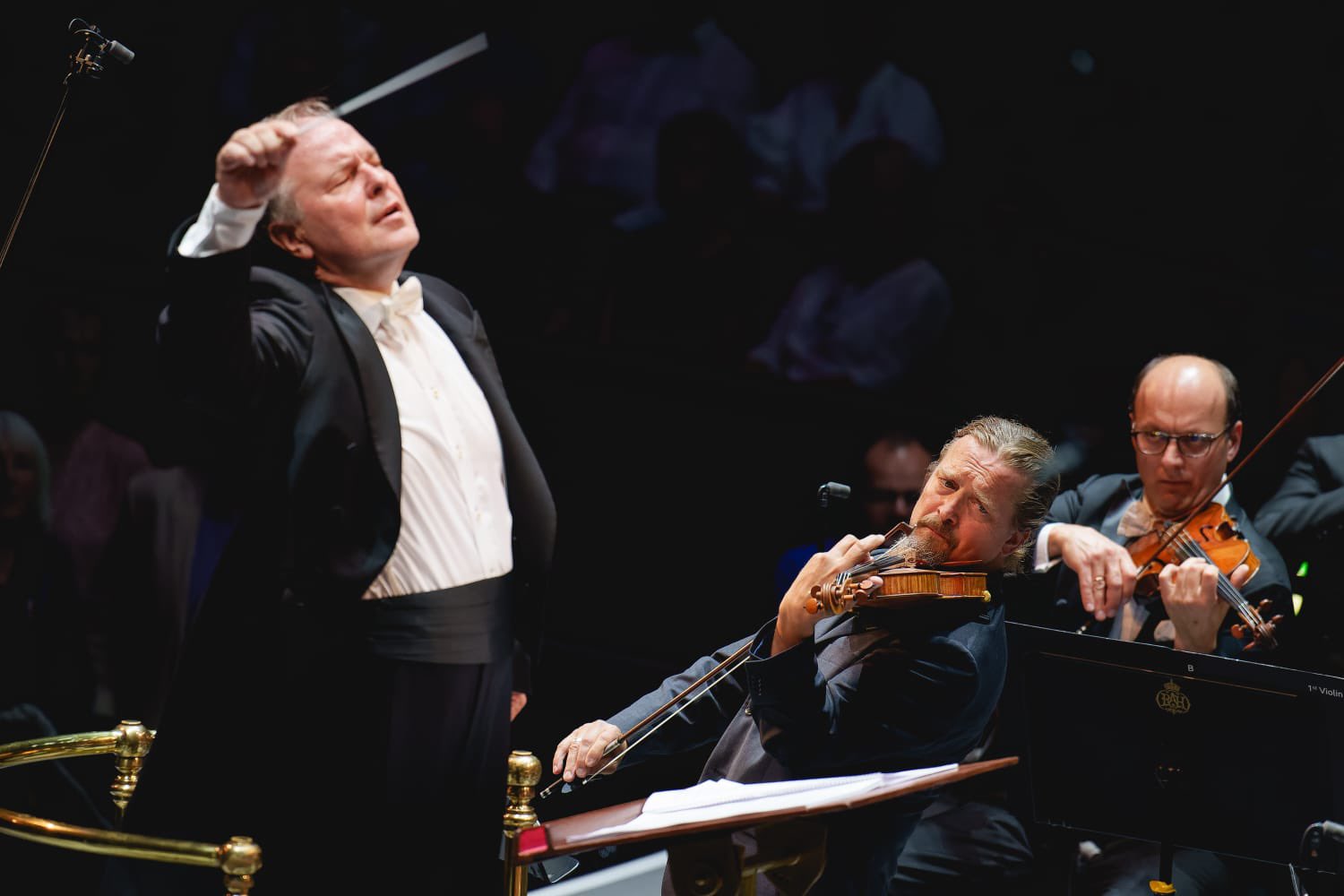
Prom 51 – Christian Tetzlaff (violin), BBC Symphony Orchestra / Sakari Oramo
Weir Begin Afresh (BBC commission, world premiere) (2022-3) Schumann Symphony no.1 in B flat major Op.38 ‘Spring’ (1841) Elgar Violin Concerto in B minor Op.61 (1907-10)
Royal Albert Hall, London Thursday 24 August 2023
by Ben Hogwood photos by Andy Paradise / BBC
The BBC Symphony Orchestra and their chief conductor Sakari Oramo have been on fine form this Proms season, and for their fourth outing together chose a concert whose first half celebrated the vibrancy of spring.
Judith Weir (below) has already written about green matter for orchestra, with her tone poem Forest premiered in 1995 and appearing at the Proms in 2019. Begin Afresh, its title inspired by Philip Larkin verse, takes a more forensic approach, looking at the wonder of trees in an urban setting. Effectively a musical diary, it begins in April, where we found orchestra leader Igor Yuzefovich teaming up with the woodwind section to lead an awakening from months of darkness. Fresh textures and opulent harmonies promised much, but October assumed a heavier tread, trees struggling to produce leaves with the onset of colder weather. Darker colours, including the sharper tone of the piano, came to the fore, but there was strong resolve reminiscent of Sibelius in the colours and phrasing, tonal but restless. True darkness set in among the lean lines of February, where roots fought against the frost, their sinewy profiles etched by the lower strings. Begin Afresh found its victory to be hard-won, but proved to be an attractive and pictorial piece deserving of more outings in the future.
Schumann’s Spring symphony, written in 1841 in the heady aftermath of his marriage to Clara, occupied an odd place in the program but benefited from a freshly minted performance. The initial fanfare set the tone for an interpretation of clarity and poise, the burbling woodwind on fine form. The ensuing Allegro molto vivace was bracing, and was complemented by a softly voiced second movement Larghetto. Here the softer shades were ideally weighted, the strings’ intimate thoughts conveyed with deep feeling. The Scherzo found the violins applying extra force, the theme balanced by two light-footed trio sections that danced happily. Oramo’s fluent reading of this wonderful symphony ended with a convincing last movement affirmation.
If spring was the main focus of the first half, Elgar’s Violin Concerto was ideally suited to late summer. There are many violin concertos in this year’s season – 13 at last count – and although this is the longest work by some distance, it did not tarry here. This was thanks in part to relatively quick tempo choices but mostly due to wholehearted investment from Oramo and soloist Christian Tetzlaff, who clearly loves the piece. From his first statement the violinist was in full, assertive control yet his most meaningful contributions were also the quietest, beckoning the audience in to Elgar’s most intimate thoughts and emotions.
The orchestral counterpoint was clearly and carefully managed by Oramo, himself a dignified Elgarian, with opportunity given for the strings to release ardent feelings in the climax points. The main themes were lovingly delivered, especially in the rapt slow movement Andante, the audience largely silent as the compelling dialogue took hold. While Tetzlaff took every opportunity for virtuoso display, reminding us that no less a violinist than Fritz Kreisler commissioned this work in 1904, none of the acrobatics were for personal gain. Instead they were at the service of Elgar’s expression, which made the final pages all the more telling. As the quiet music took hold a chill spread through the music, a sombre realisation that love – in this case – might not prevail. This realisation unwittingly found a parallel, a musical realisation of the temperatures dropping and the nights drawing in as they do in late August.
The concerto may have had an affirmative finish but these thoughts remained, reinforced by a tastefully restrained encore of the Andante from Bach’s Solo Violin Sonata no.2 in A minor BWV1003. As with the performance before, it was beautifully judged.




 Arcana.fm