In concert – Sheku Kanneh-Mason, CBSO / Kazuki Yamada: Elgar Cello Concerto & Tchaikovsky Symphony no.5

Sheku Kanneh-Mason (cello), City of Birmingham Symphony Orchestra / Kazuki Yamada

Elgar Cello Concerto in E minor Op.85 (1919)
Tchaikovsky Symphony no.5 in E minor Op.64 (1888)

Symphony Hall, Birmingham
Thursday 19 June 2025 2:15pm

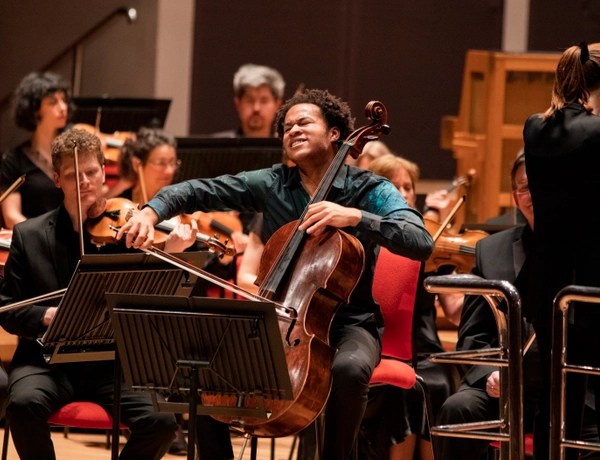
Reviewed by Richard Whitehouse Picture of Sheku Kanneh-Mason (c) Andrew Fox

The City of Birmingham Symphony Orchestra’s ‘Season of Joy’ ended (at least at its home base) this afternoon with this concert in E minor, featuring major works by two composers whose wresting triumph from out of adversity was by no means always their strongest suit.

It is all too prevalent these days to talk of Elgar’s Cello Concerto as being the ‘end of an era’ statement, so credit to Sheku Kanneh-Mason for leavening any overt fatalism with a lyrical intensity which paid dividends in the musing restiveness of the first movement – its indelible opening gesture rendered with an understated defiance that set the course for what followed. Nor was the Scherzo’s glancing irony at all undersold, its tensile energy seamlessly absorbing the mock nobility of its secondary theme on the way to a conclusion of throwaway deftness.

Others may have summoned greater fervency from the Adagio, yet Kanneh-Mason’s unforced poise in this ‘song without words’ was its own justification and an ideal entrée into the more complex finale. Especially impressive was his methodical while never calculated building of tension towards a climax of tangible emotional intensity, capped with the terse stoicism of its coda. Kazuki Yamada and the CBSO were unfailingly responsive in support. Kanneh-Mason returned with the 18th (Sarabande) of Mieczysław Weinberg’s 24 Preludes (1969) as a sombre encore.

If to imply that by being his most ‘classical’ such piece, Tchaikovsky’s Fifth Symphony may also be his most predictable, Yamada evidently had other ideas. Certainly, there was nothing passive about the first movement’s scene-setting Andante, Oliver Janes palpably ominous in its ruminative clarinet theme. A smattering of over-emphases in phrasing just occasionally impeded the Allegro’s rhythmic flow but was outweighed by the gripping spontaneity of the whole. Even finer was the Andante cantabile, as undulating lower strings launched french horn player Elspeth Dutch’s eloquent take on its ineffable main melody. The eventual climax was curtailed by a brutal intrusion of the ‘fate’ motto, before the music subsided into its calmly regretful close. Whether or not Tchaikovsky’s greatest slow movement, Yamada’s reading made it seem so.

Interesting this conductor made an attacca to the ensuing Valse, which proved effective even if one between the first two movements would have been even more so. Whatever its laissez-faire elegance, this cannily structured movement is more than a mere interlude – not least for the way the motto steals in at its close. Yamada ensured it connected directly into the Finale’s slow introduction, its fervency reined-in so as not to pre-empt the energy of the main Allegro as it surged toward one of the most theatrical ‘grand pauses’ in music. Taking this confidently in its stride, the CBSO was equally in control of an apotheosis whose grandiloquence never risked overkill. The charge of insincerity that its composer found hard to refute might never have gone away, yet heard as an inevitable outcome, this was pretty convincing all the same.

It found the CBSO in formidable shape as it embarks on a two-week tour of Japan under its music director. A handful of UK concerts (including an annual appearance at the Proms) then precedes next season which begins with more Elgar in the guise of The Dream of Gerontius.

For details on the 2025-26 season, Orchestral music that’s right up your street!, head to the City of Birmingham Symphony Orchestra website. Click on the names to read more about soloist Sheku Kanneh-Mason and conductor Kazuki Yamada

Published post no.2,571 – Saturday 21 June 2025

In concert – Sheku Kanneh-Mason, Sinfonia of London / John Wilson: Hesketh, Shostakovich & Rachmaninov @ Barbican Hall

Sheku Kanneh-Mason (cello), Sinfonia of London / John Wilson

Hesketh PatterSongs (2008)
Shostakovich Cello Concerto no.2 in G major Op.126 (1966)
Rachmaninov Symphony no.1 in D minor Op.13 (1895-7)

Barbican Hall, London
Tuesday 15 October 2024

Reviewed by Ben Hogwood Picture (c) Mark Allan

This memorable concert enhanced the Sinfonia of London’s status as orchestral game changers. Conductor John Wilson re-established the ensemble in 2018 as a group taking on special projects, both in the studio for Chandos and in the concert hall. To date these have included early musicals, with Oklahoma! and Carousel in the bag, alongside top drawer recordings of orchestral works by Korngold, Ravel and Rachmaninov. The latter’s Symphony no.1, set down the previous week, completes a cycle of his symphonies.

Before that, we heard an orchestral tour de force from Kenneth Hesketh, fully established as a striking voice in British contemporary music. PatterSongs is a dense orchestral collage of music drawn from his opera The Overcoat, after Gogol. Its colourful score is decorated and ultimately dominated by the woodblock, part of a vibrant percussion section whose contributions bring the piece to theatrical life. They were brilliantly played here, as Wilson kept a tight grip on proceedings. With moods ranging from exuberant to grotesque, the sonics panned between slithering trombones, luscious strings and smoky, jazzy interludes with a slow drumkit. All contributed to the spirit of the dance in an ideal modern concert opener.

The Cello Concerto no.2 by Shostakovich offered a marked contrast. Sheku Kanneh-Mason has a special affinity with the composer’s music, having won the BBC Young Musician of the Year in 2016 with a performance of his first cello concerto. Since then he has also played the scarcely heard Cello Concerto by his contemporary and close friend Weinberg. The second concerto is a very different animal to the first, a private and often worrisome affair whose attempts at jollity and light-heartedness are compromised by music of latent menace. The personality of the concerto’s dedicatee, Mstislav Rostropovich, is never far from the music’s mind.

Kanneh-Mason and Wilson found the work’s qualities, if not its beating heart. This was down to a desire to push for faster tempi, their account not always pausing for breath where it might, as though the silence between notes might give something away. The first movement Largo was ideally pitched, questioning and with the occasional hint of a smile. Ultimately it succumbed to the brooding, omnipresent lower strings, who often finished the soloist’s sentences. The Allegro released this tension with impressive solo cadenzas from Kanneh-Mason, who inhabited the outbursts of energy but received the ideal complement in similar phrases from the outstanding horns (Chris Parkes and Jonathan Quaintrell-Evans), bassoons (Todd Gibson-Cornish and Angharad Thomas), timpani (Antoine Bedewi) and percussion (the superb quintet of Alex Neal, Owen Gunnell, Paul Stoneman, Fiona Ritchie and Elsa Bradley).

The transfer to the finale, while Allegretto as marked, felt breathless, the cello’s recurring sweep up to a top ‘B’ robbed of the room it needed for maximum impact. Similarly the macabre ticking of the percussion was clipped. In spite of this, however, Shostakovich’s feverish statement – direct from the sanatorium where he spent his sixtieth birthday – still made a profound impact. As a side note, how gratifying it was to see Kanneh-Mason, a gracious soloist, acknowledge the orchestral contributions mentioned above, before a well-chosen encore of Weinberg, the 18th of his 24 Preludes for solo cello.

Rachmaninov’s Symphony no.1 received a famously disastrous premiere in 1897, one that would affect its composer’s mental health for many years. Indeed he did not hear the work again in his life, the memory of its ragged and disrupted performance under an intoxicated Glazunov fuelling monumental bouts of self doubt. This account could hardly have been more different, John Wilson presiding over a performance of feverish intensity and white hot rhythmic precision. The Sinfonia of London were simply outstanding, led by a first violin section so fully invested in the music they were practically burning a hole in their musical scores!

Wilson clearly loves this piece, and as they set out the immediate drama of the first movement fugue the Sinfonia added clarity to their list of qualities. The silvery strings and rolling timpani of the Intermezzo were beautifully turned, Wilson heightening the connections with Tchaikovsky, whose Pathétique symphony predated this piece by just one year. It was possible to sense a passing of the baton between the two, such was the strength of feeling generated in this performance.

The slow movement had heavenly strings, its central section with increasingly fractious brass that dissolved with the return of the main theme, Wilson crouching towards the floor as he cajoled the strings to greater heights, with hints again of Tchaikovsky’s Romeo and Juliet.

Everything cut loose in the finale, a thrilling drive to the finish from the jubilant main theme to the crash of the gong at the end – where the percussion section were once again on top form, the full force of Rachmaninov’s orchestra laid bare. In these hands it was difficult to see how the first symphony could be perceived as anything other than a masterpiece, its lean structure supporting powerful emotions and meaningful tunes. Wilson and the Sinfonia of London had them all in spades, finishing a concert that will live long in the memory. My ears are still ringing!

You can find more information on further 2024 concerts of this program at the Sinfonia of London website

Published post no.2,333 – Wednesday 16 October 2024

In concert – Sheku Kanneh-Mason, Soloists, Philharmonia Chorus, Royal Philharmonic Orchestra / Vasily Petrenko: Elgar, Weinberg & Rachmaninoff

Sheku Kanneh-Mason (cello), Mirjam Mesak (soprano), Pavel Petrov (tenor), Andrii Kymach (baritone), Philharmonia Chorus, Royal Philharmonic Orchestra / Vasily Petrenko

Elgar In The South (Alassio) Op.50 (1904)
Weinberg Cello Concerto Op.43 (1948/1956)
Rachmaninoff The Bells Op.35 (1913)

Royal Festival Hall, London
Thursday 11 April 2024

Reviewed by Ben Hogwood Pictures (c) Chris Christodoulou

The Royal Philharmonic Orchestra and Vasily Petrenko continued their dual focus on Rachmaninoff and Elgar this season with a deeply satisfying programme. They began with Elgar on holiday, music to match the Mediterranean climate of a rather humid Royal Festival Hall. This was In The South, Elgar’s extended postcard from Alassio, Italy, a sudden burst of inspiration that the composer finished in double quick time. Petrenko and his charges caught the instinctive writing, launching the overture in high spirits that brought the spring sunshine in from outside. Their interpretation grew in stature as it progressed, the central statements from brass given impressive heft. Yet it was the quieter asides that proved most telling, notably a fine viola solo from Abigail Fenna, whose depiction of the ‘canto popolare’ was appropriately reserved and beautifully phrased.

Sheku Kanneh-Mason joined for Weinberg’s Cello Concerto, a fine work sharing the same key (C minor) and elegiac mood of its now neglected equivalent by Nikolai Myaskovsky, completed three years earlier. Sheku’s credentials in Shostakovich (he won the BBC Young Musician prize with a standout account of the Cello Concerto no.1) served him well here, and he was an eloquent guide in the thoughtful first movement. Again this was an interpretation growing in stature, from a silvery first movement to the persuasive habanera of a Moderato that grew increasingly sour in tone, aided by standout solos from trumpeter Matthew Williams. By the third movement Allegro the gloves were well and truly off, incisive solo playing carrying through to an assertive and deeply felt cadenza, before the finale responded with doleful phrases turning us back to the material of the first movement, emotions not fully resolved. The main theme carried more weight second time around, while Kanneh-Mason’s choice of the same composer’s Prelude no.18 for solo cello was ideal as an encore, setting the seal on a fine interpretation. Hopefully his thoughts on the concerto will be set down in the studio by Decca before long.

Rachmaninoff’s four-part choral symphony The Bells formed a dramatic second half, led by an extremely well-drilled Philharmonia Chorus (prepared by Gavin Carr), whose diction and ensemble were most impressive. On first glance the men appeared outnumbered, but when the telling moments came in the third and fourth movements they rose to the occasion with great conviction.

In tenor Pavel Petrov, soprano Mirjam Mesak and baritone Andrii Kymach, Petrenko could call on three excellent soloists, Mesak in particular impressing with her sensitive phrasing and vibrato, passionately singing The Mellow Wedding Bells. Her glittering dress was an ideal match for Poe’s verse, too. Petrov’s ringing delivery set the ideal tone in The Silver Sleigh Bells, while Kymach’s declamation was pitched just right for The Mournful Iron Bells, right after the frenzied scherzo, The Loud Alarm Bells.

The Royal Philharmonic Orchestra gave memorable contributions, with incisive woodwind, plangent brass, strings united as one, and percussion that added punctuation to the choral thunderclaps of The Loud Alarm Bells, Rachmaninoff effectively slamming the door shut on his deepest fears. Following this dramatic high point, the cor anglais solo of Patrick Flanaghan was all the more poignant – and Petrenko made sense of the major key ending, a chink of light in the darkness.

You can find more information on further concerts at the Royal Philharmonic Orchestra website

Published post no.2,146 – Friday 12 April 2024

In concert – Sheku Kanneh-Mason, CBSO / Kazuki Yamada: Beethoven, Shostakovich, Walton

Sheku Kanneh-Mason (cello), City of Birmingham Symphony Orchestra / Kazuki Yamada

Beethoven Leonore Overture no.1 Op. 138 (1807)
Shostakovich Cello Concerto no.1 in E flat major Op.107 (1959)
Walton Symphony no.1 in B flat minor (1932-5)

Symphony Hall, Birmingham
Saturday 16 September 2023

Reviewed by Richard Whitehouse

Having opened the City of Birmingham Symphony Orchestra’s season two days earlier with Verdi’s Requiem, Kazuki Yamada returned for a judicious programme comprising three ‘No. 1’s’ – two mid-20th century masterpieces and an overlooked gem from the previous century.

Beethoven’s First Leonore Overture is in fact the third such piece written in conjunction with his eponymous opera, being intended for a Prague production that never materialized. Shorter in duration and simpler in design than its two ‘successors’, it sets the scene without attempting an overview of Leonore’s dramatic essence. Yamada duly made the most of an introduction as speculative as it was searching, then steered a lively course over the main Allegro – not least a surging crescendo into the coda such as Rossini had taken to heart before the decade was out.

It was with Shostakovich’s First Cello Concerto that Sheku Kanneh-Mason won BBC Young Musician of the Year in 2016 and thus launched a career that shows no signs of stalling. In the meantime, his take on this piece has deepened and at times darkened – the opening Allegretto exuding keen irony abetted by the incisive response from an orchestra whose single horn and double woodwind are thrown into sharp relief against modest strings. If the ensuing Moderato seemed a little measured, its stark intimacy was eloquently sustained to a yearning climax then mesmeric interplay of cello harmonics with celesta in the coda. The third-movement Cadenza emerged with real cumulative impetus, and not even the hiatus while Kanneh-Mason replaced a broken string could stem the final Allegro’s sardonic course to its decisive closing flourish.

A work that has latterly regained (at least in the UK) the reputation it enjoyed decades earlier, Walton’s First Symphony has had regular performances from the CBSO (and a recording with Simon Rattle), and this reading did not lack for commitment. Not least an opening movement such as built methodically and remorsefully from initial expectancy, through a central span of brooding stasis, to a pulverizing culmination; the only proviso being the frequent inaudibility of its underlying pulse in lower strings during the climactic stages. The scherzo seemed even finer in its tense amalgam of spite and barbed humour, its treacherous syncopation dextrously handled, while the slow movement unfolded from a wistful flute melody (affectingly rendered by Marie-Christine Zupancic) to its climax of baleful intensity subsiding into numbed regret.

The finale still tends to be seen as surrender to well-tried symphonic precedent yet, as Yamada presented it, did not eschew formal or emotional obligations. The resolute introduction, agile fugal writing and irresistible build-up to the timely appearance of extra percussion all became part of a conception vindicated by the elegiac trumpet theme (ably conveyed by Jason Lewis); leading to a peroration in which Yamada’s urging his players onward briefly risked unanimity of response while still resulting in the sheer affirmation of those thunderous closing chords.

Overall, an engrossing performance which augurs well for the CBSO’s first full season with Yamada. Next week places the spotlight on Thomas Trotter who, having done forty years as City Organist in Birmingham, takes the loft for repertoire staples by Poulenc and Saint-Saëns.

You can read all about the 2023/24 season and book tickets at the CBSO website. Click on the artist names for more information on cellist Sheku Kanneh-Mason and conductor Kazuki Yamada

In concert – Sheku Kanneh-Mason, CBSO / Charlotte Politi: Tchaikovsky, Shostakovich & Weinberg

16-March-Sheku-KM

Tchaikovsky Swan Lake, Act 2 – Scène, Op. 20 No. 10 (1875-6)
Shostakovich
Cello Concerto No. 2 in G, Op. 126 (1966)
Weinberg
Symphony No. 3 in B minor, Op. 45 (1949-50, rev. 1959)

Sheku Kanneh-Mason (cello, above), City of Birmingham Symphony Orchestra / Charlotte Politi (below)

Symphony Hall, Birmingham
Wednesday 16 March 2022

Written by Richard Whitehouse

This evening’s concert by the City of Birmingham Symphony Orchestra should have been a Weinberg double-bill but the last-minute indisposition of Mirga Gražinytė-Tyla (having tested positive for Covid) brought to the podium one of the orchestra’s assistant conductors, Charlotte Politi.

Something in the programme had to give and that was only the second hearing in the UK for Weinberg’s Fourth Symphony, an incisively neo-classical piece long familiar to enthusiasts through the Melodiya recording issued in the 1970s and which, while it lacks the gravitas of later symphonies, is never less than engaging in its own right. Instead, the programme began with the ‘Scène’ from Act Two of Tchaikovsky’s Swan Lake (itself the opening number of the suite) – its fraught pathos enticingly realized, if making for an all-too brief curtain-raiser.

Sheku Kanneh-Mason was still present for Shostakovich’s Second Cello Concerto, among the first products of his final creative period and one of his most equivocal works in any medium. Most accounts over-stress its introspection, but Kanneh-Mason gauged the varied expressive shades of its Adagio with unforced rightness; its wrenching climax finding acute contrast with the sombre rumination from which it emerges and to which it returns. The ensuing Allegrettos could not be more dissimilar – a tensile and sardonic scherzo culminating in raucous fanfares as set into motion the finale. If coordination of soloist and orchestra in the former was a little tentative, Kanneh-Mason adroitly negotiated the latter’s gnomic dialogue – afforded focus by an easeful refrain and with a culmination of defiant exasperation, then a coda of furtive repose.

With its unshowy virtuosity and its concertante-like solo writing, this is a hard piece to bring off, but Kanneh-Mason rendered it with some conviction. He returned for an eloquent encore of what sounded to be a (Ukrainian?) folksong with the front four desks of the CBSO cellos.

After the interval, another chance to hear the Third Symphony by Weinberg this orchestra has rather made its own in recent seasons. Ostensibly a response to the anti-formalist campaign as spearheaded by Andrei Zhdanov, with the intention of making Soviet art more accountable to the public, its citing Belorussian and Polish folksongs is offset by the opening Allegro’s often ambivalent progress to a coda shot through with foreboding. Politi was often persuasive here, then not at all fazed by the Allegretto’s interplay of whimsical with a more sardonic humour.

Even better was to come in the Adagio’s finely sustained progress towards a climax of stark tragedy, only slightly mediated by the pensive close. An energetic final Allegro duly set out to secure an affirmative end, only to culminate in marked desperation, and it was a measure of Politi’s insight that the coda maintained its uncertainty even as those decisive closing bars echoed to silence. The CBSO responded impressively throughout a piece it must know better than any other orchestra, and it was to Politi’s credit that her own input was so often evident.

Hopefully MG-T will recover in time for the CBSO’s forthcoming European tour, such that Weinberg’s Fourth Symphony will gain the hearings it deserves. And if next season she can schedule the Fifth, arguably his finest purely orchestral symphony, then so much the better.

For more information on the CBSO’s spring tour, visit their website. Meanwhile for more information on the artists, click on the names to access the websites of Charlotte Politi and Sheku Kanneh-Mason. Meanwhile for more on composer Mieczysław Weinberg, click here