In concert – Leonidas Kavakos, Philharmonia Orchestra / John Wilson: Elgar Symphony no.3; Barber & Korngold

Leonidas Kavakos (cello), Philharmonia Orchestra / John Wilson (above)

Royal Festival Hall, Southbank Centre, London
Thursday 27 February 2020

Barber First Essay Op.12 (1937)
Korngold Violin Concerto in D major Op.35 (1945)
Elgar, realized Anthony Payne Symphony no.3 in C minor Op.88 (1933; 1993-4)

Reviewed by Richard Whitehouse
Photo credit (John Wilson) Sim Canetty-Clarke

It is good to see John Wilson taking up more concert engagements, so putting his talent at the service of symphonic repertoire. Tonight, he directed the Philharmonia in a programme that culminated with quite possibly the finest reading Elgar’s Third Symphony has yet received.

The relatively brief first half commenced with Barber’s First Essay, written in the wake of his soon-to-be ubiquitous Adagio and given a high-profile launch by Arturo Toscanini with the New York Philharmonic. Succinct to a fault, the sombre rumination of its initial section soon makes way for music of brittle aggression (such as Britten surely had in mind writing the Dies irae section of his Sinfonia da Requiem two years later), and reaches a short-lived climax with the return of the piece’s opening which itself subsides into musing expectation.

A timely revival, whereas Korngold’s Violin Concerto now seems almost too familiar since coming in from the cold some quarter-century ago. Leonidas Kavakos has become one of his staunchest advocates, but while his recent Proms account often verged towards the soporific, this evening saw much greater focus; not least an initial Moderato whose yearning melodies were rendered with real incisiveness, then a Romanze whose lush textures and diaphanous harmonies never risked becoming cloying. If the final Allegro was even more impressive, this was because what is ostensibly the weakest movement emerged on a par with those before – Kavakos pointing up its effervescence while keeping any indulgence in check on route to the heady return of its opening theme, in what is a coup de théâtre even by Korngold’s standards.

Wilson has already demonstrated his Vaughan Williams credentials, and is evidently no less at home in Elgar. Some 22 years on from its premiere and the Third Symphony, as realized by Anthony Payne, continues to fascinate and exasperate in equal measure – yet, while there can be no denying its conjectural status, what came over here was Wilson’s conviction as he steered a purposeful course through the opening movement – pulling together what can feel a prolix development then evincing similar grip and determination in the coda. What follows was ideally poised between scherzo and intermezzo, its balletic and song-like strains eliding seamlessly, while the Adagio has seldom sounded more potent in its wrenching dissonances and wan consolation as lead to a coda whose fragmented texture only emphasized its pathos.

On to the finale (Wilson rightly ensured minimal pause between movements) and while there was no lack of finesse in the shaping of its themes, Wilson made relative light of there being no concrete development section by bringing its nominally tentative variants into tensile and, above all, cumulative accord. This carried through into the coda – undoubtedly the best Payne which Elgar never wrote and whose spirit of reaching out towards whatever might lie beyond was palpably conveyed as the music receded, slowly but never disconsolately, toward silence.

At some 50 minutes this was as taut and incisive a reading as the piece can yet have received, but the essential rightness of Wilson’s approach could not be doubted. Payne himself looked mightily impressed, and one can only hope a recording with the Philharmonia is in the offing.
Live review – CBSO Youth Orchestra / Kazuki Yamada: Elgar Symphony no.1, Takemitsu & Richard Strauss

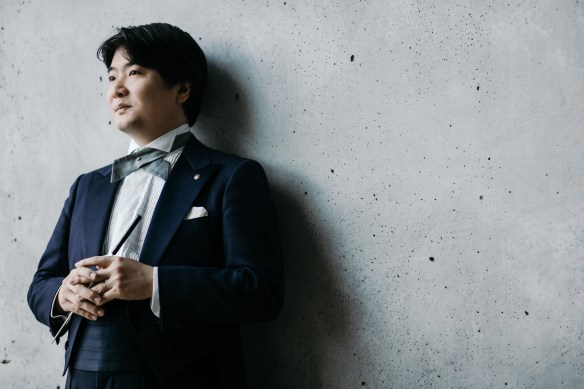
CBSO Youth Orchestra / Kazuki Yamada (above)

Symphony Hall, Birmingham
Sunday 23 February 2020 (3pm)

Takemitsu Dreamtime (1981)
Richard Strauss Till Eulenspiegels lustige Streiche Op.28 (1894-5)
Elgar Symphony no.1 in A flat major Op.55 (1907-08)

Written by Richard Whitehouse

It is hardly an understatement to say that the concerts given each season by the CBSO Youth Orchestra are frequently among the most enterprising and engaging of all those to be heard in Symphony Hall, with this afternoon’s event under Kazuki Yamada proving no exception.

A contrasted pair of tone poems comprised the succinct first half, beginning with a welcome revival of Toru Takemitsu‘s Dreamtime. Conceived as a dance piece for Netherlands Dance Theatre, this is typical of the music from its composer’s maturity in its dissonant (but rarely abrasive) harmonies and its diaphanous textures. Both of these were fully in evidence, with Yamada also mindful to instill a sense of cumulative unfolding as ensures cohesion in music that can easily drift or lose focus. Suffice to add there was little sense of that happening here.

Takemitsu was not a composer given to the humour (ironic or otherwise) permeating Richard Strauss‘s Till Eulenspiegel, heard in an account that initially felt a little stolid in its depiction of that prankster from the Middle Ages; but which soon gained in conviction over the course of Till’s encounters monkish, amorous and social on the way to a vivid depiction of his trial and execution – with its irrepressible pay-off. Assured playing by woodwind and brass were the highlights of a reading to remind one of just how technically exacting this music remains.

112 years on from its premiere and Elgar‘s First Symphony exudes a very different if equally unequivocal virtuosity, such as happily held few fears for these musicians. Japan has a noted line of Elgar interpreters (not least the conductor Tadaaki Otaka), and Yamada demonstrated his credentials with a taut while never inflexible take on the lengthy opening movements – its indelible ‘motto’ theme eloquently and un-fussily rendered, then the main Allegro securing an almost ideal balance between anxiety and rumination across music which strives without ever regaining that calm assurance whose glimpses become the more affecting for their transience. No less impressive was Yamada’s handling of the coda as this winds down towards becalmed resignation, abetted by playing of exquisite finesse from the CBSOYO woodwind and strings.

There was little to fault in a scherzo that alternated the incisive and the wistful with unforced rightness, and how unerringly Yamada judged its transition into an Adagio that, less moulded than it often is, yet unfolding seamlessly towards its serene close. Not that there was anything bland or uninvolving about this music, or a finale that (rightly) followed with minimal pause; the barely suppressed expectancy of its introduction heading into an Allegro whose impetus hardly faltered. Strings never sounded fazed by the contrapuntal intricacy of its development, while brass came into their collective own during an apotheosis where the re-emergence of the motto theme evinced a triumph shorn of bombast or self-regard; the closing bars setting the seal on a performance of a maturity the more remarkable given the age of its exponents.

Elgar One has over the years come in for more than its fair share of objections to its supposed overtones of jingoism and self-gratification. That there was nothing of that here was tribute to Yamada in his drawing so ardent and insightful an interpretation from the CBSOYO players.

Wigmore Mondays – Jennifer Pike & Martin Roscoe: Dani Howard world premiere & Elgar Violin Sonata

Jennifer Pike (violin, above), Martin Roscoe (piano, below)

Wigmore Hall, Monday 27 January 2020 (lunchtime)

You can listen to this concert on the BBC Sounds app here (opens in a new window)

Review and guide by Ben Hogwood

How refreshing to witness a world premiere brighten up an incredibly dull January day. Dualism, by British composer Dani Howard, is a new piece by violin and piano based on the conflict between ambition and relaxation that we experience on an increasing scale in our everyday lives. With the premise in hand it was easy to spot the ambitious bits – the piano’s energy propelling the music forward initially, the violin swept along – and the much-needed relaxation, where the music paused rather beautifully to take in its surroundings.

Because of these moments Dualism (2:39) was easy to relate to, and its tonal language, with wide open textures in the piano part, brought with it thoughts of the space achieved by the music of Copland and John Adams. Howard created some buoyant harmonies to go with the relatively angular melodic writing but the piece had depth too, an ongoing tension between the power for which it strove and the respite it also needed. The ultimate winner was difficult to call over the nine and a half minutes, Jennifer Pike and Martin Roscoe finding a balance between the elements and each other in an attractive performance.

Elgar’s Violin Sonata followed, an important work in his output as it effectively signals the beginning of his late, shadowy style. Here is where the composer’s work takes on an appreciably darker tinge, though each of the four main works in the period – the Sonata, String Quartet, Piano Quintet and Cello Concerto – each contain moments of light despite all being set in a minor key.

The Sonata is an elusive work, but Pike and Roscoe found its essence and its tunefulness. The first movement (2:39) was the strongest, and you can hear on the broadcast the strength of feeling immediately transmitted through the long sweeps of violin melody. The first theme is passionate, but soon the wisps of violin melody (16:28) indicate the dappled light of autumn.

The second movement (23:38) is a Romance, reaching levels of intensity that speak of sadness and bitter personal experience. It begins with a spirit of unrest, and the light humour forces a short-lived smile before Elgar retreats to the shadows once again. Pike and Roscoe apply a lightness of touch that really suits the dance-like figures that ultimately never get off the ground.

The final movement (31:08) is much broader in its dynamic reach and Pike relishes the return to the sweeping style of the first movement, her broad bow strokes bringing beauty to the melody. Meanwhile Roscoe successfully clarifies the busy piano part, again judging its volume ideally. A fine performance – bittersweet but ultimately resolving positively.

The pair finished with a rustic Theme and Variations from Miklos Rózsa, the composer of such epic film scores as Ben-Hur, Spellbound and A Double Life. Rózsa had a firm grounding in classical forms, writing a Violin Concerto for Jascha Heifetz in 1953 among numerous orchestral pieces. The Hungarian Peasant Song in this concert found him inspired by the folk music of his native country, and more specifically the Mátra region – where he wrote 14 variations on a rustic, outdoor theme. Pike had a lot of fun with these but found the emotional centre too, right from the unaccompanied theme itself (42:34).

The piece progressed through long, powerful lines, bold double stopping or short, twanged pizzicato (plucking). Roscoe’s counterpoint to this was a delight, knowing exactly when to hold back or push on, the pair navigating the very different moods of Rózsa’s variations before bringing them all back together at the end.

Repertoire

This concert contained the following music (with timings on the BBC Sounds broadcast in brackets):

Dani Howard Dualism (2019, world premiere) (2:39)
Elgar Violin Sonata in E minor Op.82 (1918) (14:28)
Rózsa Variations on a Hungarian Peasant Song Op.4 (1929) (42:34)

A well-chosen encore came in the form of Elgar’s Salut d’Amour (54:00), this orchestral favourite working beautifully in reduced form and given the appropriate level of indulgence by Pike.

Further listening & viewing

The Elgar and Rózsa music from this concert can be heard in the recorded versions below, including a classic account from early in Nigel Kennedy’s career, with pianist Peter Pettinger:

Martin Roscoe has recorded the Elgar with Tasmin Little previously, but that version is not available on Spotify. However Jennifer Pike has recorded the orchestral version of the Rózsa Variations, and they form part of a highly rewarding disc devoted to the composer’s orchestral works, including a substantial Cello Concerto:

Jennifer Pike’s most recent album The Polish Violin comes highly recommended, a homage to her Polish roots. Based mainly on the exotic works for violin and piano by Szymanowski, it is brilliantly played and really well programmed, with works by Karłowicz and Wieniawski also included:

Finally a playlist of those four late Elgar works – the Violin Sonata, String Quartet, Piano Quintet and Cello Concerto, in order of publication:

Talking Heads: Sheku Kanneh-Mason

Interviewed by Ben Hogwood
Picture courtesy of Decca Classics

Sheku Kanneh-Mason is a rare commodity. In the midst of dazzling publicity, he is helping open doors for classical music by his very approachable demeanour and an approach to album-making that brings it into closer contact with other forms. On the evidence of this interview he is refreshingly grounded and intently focussed on his first love, which of course is music.

While some have expressed concern that the cellist might be overworked early in his career, our discussions around second album Elgar confirm him to be relaxed and deeply satisfied with the newest addition to his discography.

His debut album Inspirations, released this time in 2019, presented the Shostakovich Cello Concerto no.1, the piece he played to win the final of the BBC Young Musician of the Year in 2016. Kanneh-Mason coupled it with diverse pieces from Pablo Casals, Offenbach, Leonard Cohen and Bob Marley. This time however his main focus is the work of a much older man, the Cello Concerto in E minor of Sir Edward Elgar.

The recording of this much-loved corner of the cello repertoire was made with conductor Sir Simon Rattle and the London Symphony Orchestra. It has an intensity which belies Kanneh-Mason’s tender years, offering new viewpoints into what will be familiar music to a lot of people. Again the context into which Sheku puts the Elgar on his album is intriguing, of which more later. But where did he first hear the music of Elgar – and was it the piece he has just recorded?

“It would have been the concerto, definitely”, he recalls. “I listened to it a lot when I was younger, and I grew up with the famous Jacqueline du Pré version. While we were working on it I listened to a lot of different recordings of the piece, it’s such a special work. Other recordings I really love are the most recent Steven Isserlis recording, Truls Mørk with Simon Rattle, and the famous one from Beatrice Harrison with Elgar himself conducting. There is a huge range of ways in which people approach the piece, and what strikes me about the piece is that everyone reacts in a different way.”

The second movement (a Scherzo) finds Kanneh-Mason and Rattle scooting along with a particularly quick choice of tempo, and the cellist clearly relishes the fast bow strokes required. “It’s a fun piece to play, and you get swept up in it but you have to work on getting a lightness of touch with the repeated notes.”

Elgar’s concerto may be the main piece on the album but there are a variety of shorter pieces imaginatively included by Kanneh-Mason. One composer in particular we may be hearing from again is the Swiss-born American Ernest Bloch, born to Jewish parents. Two of his shorter pieces are included here. “I love his music”, says Sheku. “For Grade 8 I did the Prayer for cello and piano, which is a piece I knew to play young. It’s music I really love, and there’s also the piece for cello and orchestra, Schelomo, which I hope to record in the future. You can feel some of the pain in the harmonies he uses.”

More obscure still is a piece for cello ensemble, Hymnus, by the German composer Julius Klengel. “It’s an amazing piece”, he says. “He was a cellist as well, so I think that’s how he ended up writing for 12 instruments. Every week at the Royal Academy of Music we had a cello ensemble, and that’s how we got to know it. There’s a nice link there, as there is for all the pieces on the album. It’s very inspiring being around really young hardworking musicians and all of us being based in one place.”

How does Kanneh-Mason balance his studies with days like today, where he has a whole day of promotional interviews to navigate? “I just have to be very organised with my time, which is a good thing for us anyway. I never feel that I have too much on.”
He is particularly gushing when talk turns to his work with Sir Simon Rattle, and the bond they share in the interpretation of the Elgar. “Definitely. I think what I love about working with someone is the freedom to do what I want but knowing that they can do everything as well. It’s the spirit of true collaboration I think”.

The theme of collaborating runs through both albums, and Kanneh-Mason identifies with this original approach. “It’s nice to have a link and a reason for putting them together, like creating a concert program. It’s great to record a masterpiece and a big piece, and put it with smaller pieces that have an equal range of colour and harmony, and perhaps more subtleties.”

For Elgar he was helped by Simon Parkin, with sensitive arrangements for cello and orchestra of Elgar’s Nimrod, from the Enigma Variations, and the Romance originally written for bassoon and orchestra. To that he adds Frank Bridge’s Spring Song, the folksongs Blow The Wind Southerly and Scarborough Fair, and Fauré’s profound Elégie.

“He’s an amazingly skilled arranger”, says Sheku of Parkin, “and he keeps the heart of the pieces while making the most of the instruments. I love mixing the arrangements that complement the pieces of music in their original form, and it’s great to record them in respect of friends and teachers, which makes it more personal. I’m always excited and open to lots of new things and working with new people. I’ve had some amazing experiences with these recordings, and you can hopefully hear the enjoyment from them.”

As you might expect given his album programming, Sheku’s ‘out of hours’ musical tastes are varied. “I listen to a mixture of classical, jazz, reggae, and different kinds of folk music”, he says. “Growing up with music all around me has been really inspiring, and it has kept me grounded and motivated. Now I live with students, and the people below me are also musicians.”

Thinking back to his BBC Young Musician of the Year triumph brings Kanneh-Mason onto a subject close to his heart, musical education. “I think we should have as many young people in music as possible. The Young Musician of the Year is great as it shows people playing to the highest standard. When I did it I found watching people three or four years older than me was really inspiring, and it ultimately gives people the opportunity to do many more things.”

He also notes the importance of after care. “Afterwards there was so much attention, but the BBC really looked after me. It was important to have the right people around me and to be working with the right people. A competition is only good if what comes after is good.”

With time running out, we conclude by discussing his favourite musicians of the moment. “I love Steven Isserlis”, he says. “He’s my favourite cellist to watch…and I also love listening to the violinist Daniel Lozakovich. Martha Argerich is also someone I find really inspiring, I love watching her play the piano.”

This blend of youth and maturity, established and new, is perhaps the most inspiring thing about Sheku Kanneh-Mason’s success. His approach is very inclusive, and his next ventures will be very interesting to chart and appraise. With Elgar reaching the heights of number eight in the album charts so far, the musical world is very open to him right now.

Sheku Kanneh-Mason’s Elgar album is out now on Decca Classics – it can be purchased here, via Apple Music, or streamed below via Spotify:

Centenary post – Elgar: Cello Concerto

Today is the centenary of one of Sir Edward Elgar‘s best-loved works, first performed on this day in 1919. It was not always that way for the Cello Concerto in E minor, however, as an under-rehearsed premiere may well have contributed to a gap in London performances of more than a year.

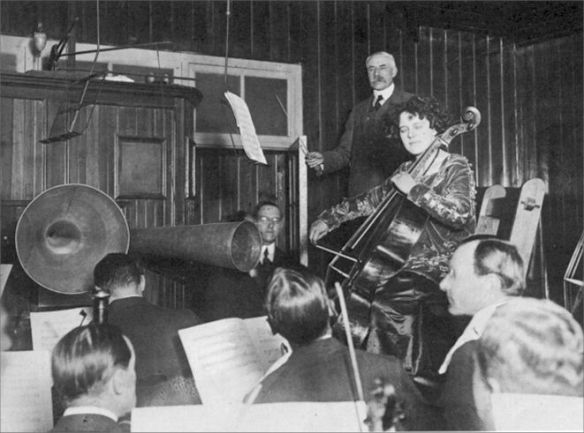
The first performance took place with soloist Felix Salmond, Albert Coates conducting the London Symphony Orchestra. The first cellist to really further the concerto’s cause was Beatrice Harrison, seen above with Elgar in an early recording from 1920. Her official recording with the composer from 1928 can be heard on the playlist below.

Again the work fell into disregard, possibly on account of its darker autumnal hues. The melodies came to Elgar in the aftermath of a painful operation on his tonsils, and while he could hear the sound of fighting in the First World War across the English channel.

It was not really until 1965 that the work reached regular public consumption, thanks to a searing recording by the young Jacqueline du Pre, with the London Symphony Orchestra this time under Sir John Barbirolli’s direction (also on the playlist). This recording preserved du Pré’s reputation as a cellist of great passion and technique, with the considerable help of a seasoned Elgarian in Barbirolli behind the orchestral ‘wheel’. It also apparently convinced a certain Mstislav Rostropovich not to become better acquainted with the piece.

More recently the Cello Concerto has become widespread, most recently with a first night performance at the Proms from Sol Gabetta and an appearance at this year’s season from Sheku Kanneh-Mason.

Gabetta’s recorded version is also on the playlist, with Mario Venzago conducting the Royal Danish National Orchestra. It appears along with two very fine accounts from Julian Lloyd Webber – with the Royal Philharmonic Orchestra and Yehudi Menuhin – and Steven Isserlis, his first recording of the work made with the London Symphony Orchestra and Sir Richard Hickox:

More recently Isserlis has revisited the work with Paavo Jarvi conducting the Philharmonia, a fine account about which he talked to Arcana here.

The Cello Concerto was Elgar’s last major work, completing an intriguing late set of compositions including the Violin Sonata and String Quartet, which share the concerto’s key of E minor, and the wonderful Piano Quintet in A minor. Those four works can be heard on the playlist below:

For a visual treat, though, you can enjoy Jacqueline du Pré’s playing here – not with Sir John Barbirolli but with her husband Daniel Barenboim, conducting the London Philharmonic Orchestra: