
Arcana at the Proms – Prom 10: Laura van der Heijden, BBC Scottish Symphony Orchestra & Ryan Wigglesworth – Britten, Frances-Hoad & Elgar

Britten Gloriana – Symphonic Suite Op.53a (1953)
Frances-Hoad Cello Concerto ‘Earth, Sea, Air’ (2022) [Proms Premiere]
Elgar Symphony no.2 in E flat major Op.63 (1909-11)

Laura van der Heijden (cello), BBC Scottish Symphony Orchestra / Ryan Wigglesworth

Royal Albert Hall, London
Friday 26 July 2024

reviewed by Richard Whitehouse

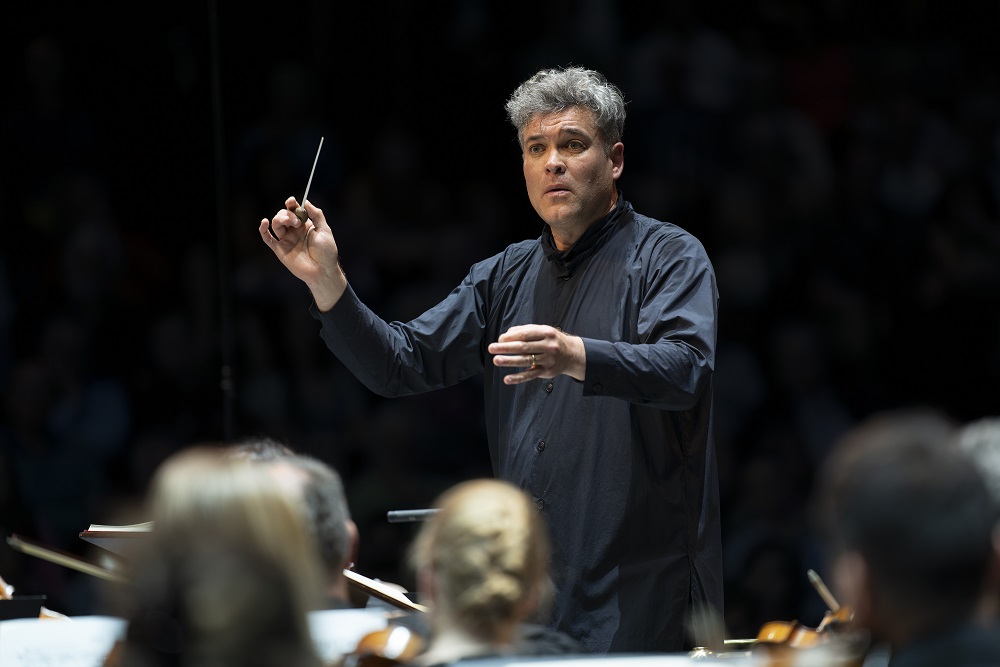
He might not be the only composer-conductor of his generation, but Ryan Wigglesworth has rapidly established himself among the best – as this concert with the BBC Scottish Symphony Orchestra, whose chief conductor he has been over these past two seasons, amply confirmed.

Other than Peter Grimes, the coolly received Gloriana was his only opera from which Britten extracted a concert suite. The vaunting syncopation of Tournament then wrenching fatalism of Gloriana moritura make for a telling framework, with this account at its most perceptive in the wistful poise of the Lute Song – the oboe being an eloquent replacement for the tenor thanks to Stella McCracken – then the evocative sequence of Courtly Dances where Britten effortlessly bridges the historical and the aesthetic divide between the eras of two Elizabeths.

Next a first Proms hearing (just over a year after its Glasgow premiere) for the Cello Concerto by Cheryl Frances-Hoad. Drawing inspiration from recent research into diverse aspects of the natural world, the three continuous movements provide an arresting vantage on an outwardly traditional form. Hence the trajectory of swifts in flight, carbon-absorbing algae over oceanic expanses and gravitational force of volcanic activity each influencing the musical content of a rhythmically impulsive Allegro, harmonically diaphanous Larghetto and melodically soaring Presto giocoso; the whole afforded unity through its composer’s motivic resourcefulness and the engaging commitment of Laura van der Heijden (above) in her realizing of its solo part. She then responded to deserved applause with a limpid reading of Pablo Casals’ The Song of the Birds.
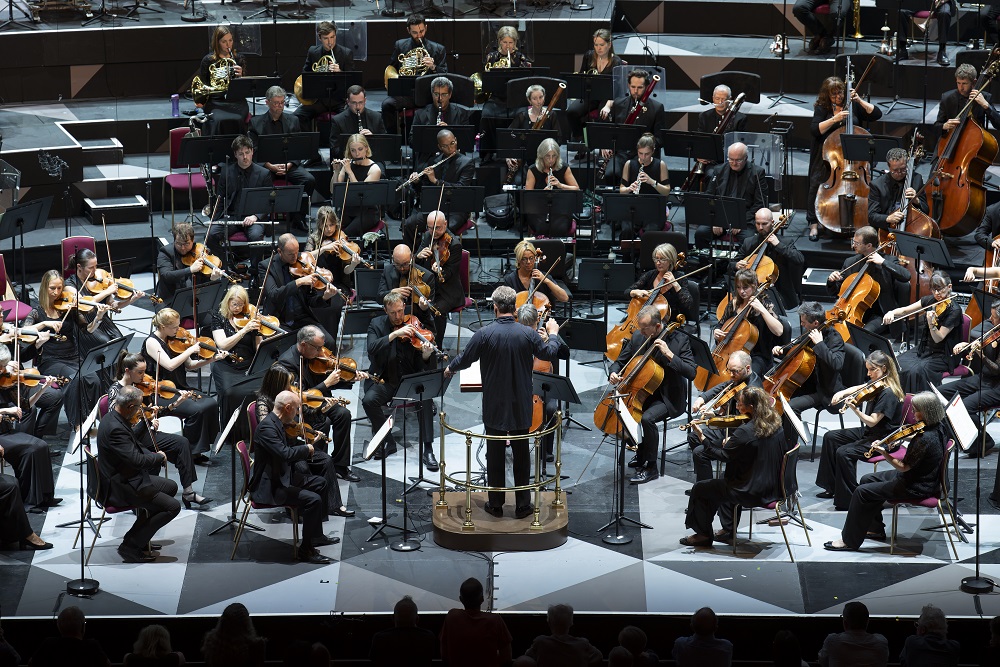
Elgar is a composer evidently close to Wigglesworth’s heart and this evening’s account of his Second Symphony did not disappoint. Launched a little too circumspectly, the initial Allegro duly found a persuasive balance between bounding energy and that musing uncertainty to the fore in the otherworldly processional near its centre. Its overall extroversion was countered by the Larghetto – circumstantial association with the death of Edward VII having tempted many into a funereal pacing but not Wigglesworth, whose handling of its cumulative halves brought sustained emotional intensity framed by the stark lamentation with which it begins and ends.

One of Elgar’s most formally subtle and expressively audacious movements, the scherzo had the requisite impetuousness and nonchalance, thrown into relief by the mechanistic violence towards its core and unnerving energy at its close. Moderate in tempo and not overly majestic in outlook the finale might have been thought anti-climactic, but Wigglesworth’s keen sense of its long-term unfolding emerged in the searching ambivalence of its development and the understated grandeur of a peroration which did not require reinforcing with an organ pedal. Those closing pages could have yielded even greater pathos, but their suffused fatalism was wholly in accord with the conductor’s conception of this movement, as of the work overall.

Just over a year before, Wigglesworth presided over an inspirational account in Birmingham of The Dream of Gerontius. Tonight’s performance of the Second Symphony might not have been quite its equal, but it more than confirmed him as an Elgar interpreter of genuine stature.

For more on this year’s festival, visit the BBC Proms website – and for more on the artists involved, click on the names to read more about Laura van der Heijden, the BBC Scottish Symphony Orchestra and conductor Ryan Wigglesworth, and composer Cheryl Frances-Hoad

Published post no.2,253 – Sunday 28 July 2024

A serenade for an early summer evening…

…in the form of an early work by Sir Edward Elgar. Here is his Serenade for Strings in E minor Op.20, performed by the Royal Philharmonic Orchestra, conducted by Sir Charles Groves:

Published post no.2,204 – Sunday 9 June 2024

In concert – Geneva Lewis & Georgijs Osokins @ Wigmore Hall: Brahms, Scarlatti & Elgar

Geneva Lewis (violin, above) and Georgijs Osokins (piano, below)

Brahms Violin Sonata no.2 in A major Op.100 (1886)
Domenico Scarlatti Sonata in D minor Kk213
Elgar Violin Sonata in E minor Op.82 (1918)

Wigmore Hall, London
Monday 20 May 2024 (1pm)

by Ben Hogwood

The Violin Sonata no.2 is one of Brahms‘s chamber music perennials, a popular recital fixture – but in this recital from BBC New Generation Artist Geneva Lewis and Latvian pianist Georgijs Osokins it was as though the work had received a fresh coat of paint.

The tempo marking Brahms applied to the first movement, Allegro amabile, is seldom found in classical music – ‘amabile’ meaning ‘lovely’. That was certainly the case in this performance, though Lewis and Osokins took a much slower tempo than is the norm. Their daring approach succeeded, however, for the melodic phrasing blossomed, the spring-like main tune given plenty of room to shine. The second theme was laid bare, but again the slow tempo allowed for greater insight, followed attentively by the Wigmore Hall audience.

The dynamic range of both players was also notable, Lewis very much aware of her surroundings in the quiet passages, the audience subconsciously leaning in to the music. At points the music was so quiet that Osokins’ pedalling could be heard…but conversely the pair were not afraid to put the pedal down and play out, as they did in the finale. In between came a tender and affectionate middle movement, its dreamy opening certainly tranquillo, before a most appealing central vivace section.

Elgar’s Violin Sonata was completed when the composer had just turned 60 – and although he would live for another 16 years, very few major works followed. To hear the sonata played by performers in their twenties was eye-opening indeed, with more youthful elements of the piece revealed and a different light shed on a work that often has autumnal reflections to cast.

The first movement was notable for its commanding first paragraph, Lewis setting the tone for the movement as she became immersed in Elgar’s broad phrasing. Osokins, for his part, mastered the full piano textures most impressively, before both performers drew back for a thoughtful second theme. The second movement became a fascinating mini-ballet between the two instruments, its shadowy colours a clue to the composer’s darker thoughts, though the bittersweet melodies were given extra charm by the dance-inflected rhythms.

The finale took flight immediately, the violin surging forward with penetrating melodies that led to a sense of sunlight breaking through the clouds in the closing phrases, Elgar allowing his thoughts to brighten as the music turned to the major key. The imaginatively chosen encore capitalised on this, Lewis and Osokins giving us the rustic finale of Busoni’s Violin Sonata no.2 in E minor, music which might have passed for one of Brahms’s Hungarian-influenced works were it not for some particularly scrunchy harmonies.

In between the two big sonatas, Osokins (above) had the chance to shine alone, one he took with a profound account of one of Domenico Scarlatti‘s many keyboard sonatas. The Sonata in D minor Kk213 is a bittersweet piece, a reminder of how forward looking this composer’s music can. Rooted in the 18th century it may be, but in reality we could have been listening to a Satie Gnossienne, especially with Osokins’ poetic licence drawing out the final harmonic resolution.

Published post no.2,184 – Monday 20 May 2024

In appreciation – Sir Andrew Davis

by Ben Hogwood

Yesterday we heard the sad news of the death of the British conductor Sir Andrew Davis, at the age of 80.

The warmth of the tributes made on social media to Sir Andrew are an indication of his standing as a highly respected conductor who was for many a friend as well as a fellow musician. As a live performer he excelled at the BBC Proms, becoming the festival’s musical figurehead in the 1990s as chief conductor of the BBC Symphony Orchestra, a post he held from 1989 until 2000. Yet he also made his mark overseas, through posts held with the Toronto Symphony Orchestra (from 1975 until 1988) and the Melbourne Symphony Orchestra (from 2013).

The playlist below attempts to summarise his considerable contribution to recorded music – and in particular his many outstanding discs of British music. The reader is particularly directed towards an extensive and hugely rewarding series of Elgar for Chandos, but the list below includes early Berlioz, Delius, Elgar, a recent highlight of Stravinsky‘s Violin Concerto recorded with James Ehnes and the BBC Philharmonic Orchestra, and an outstanding version of Vaughan Williams‘ Symphony no.6, capturing a side of the composer seldom heard at the time of recording.

Published post no.2,156 – Monday 22 April 2024

Elgar Festival Fundraiser – ‘Keep the Music Playing’

The Elgar Festival (27 May – 2 June) is working with a 40% funding cut
from Arts Council England

In this short film, Festival Patron Julian Lloyd Webber introduces the Fundraising Campaign
:

The Festival is raising money to help deliver its 2024 iteration, due to a 40% funding cut from Arts Council England

Donations are valuable in helping to continue the legacy of one of England’s most revered composers. As the festival’s organisers say, “We believe Elgar is for everyone and our developing range of events are for people of all ages, interests, and lifestyles.”

For full information, visit The Elgar Festival website

Published post no.2,151 – Wednesday 17 April 2024