Yesterday we learned of the almost incomprehensible decision by the BBC that they were planning to close the BBC Singers. The choir is one of the leading ensembles of its type in the UK – if not the leading example – and have been responsible for many important premieres and landmark concerts over their 99-year existence.
Only in 2020 they were on stage as the Proms concerts returned, with a memorable performance of Eric Whitacre‘s Sleep, while if you want proof of their versatility from this year, watch this video of an arrangement of ABBA‘s Little Things:
The Spotify playlist below celebrates just some of the recordings made by the BBC Singers, in the hope that they will somehow be able to continue their invaluable service to British music. Included are shorter works by John McCabe, Sir Michael Tippett, Elizabeth Maconchy and Diana Burrell, alongside excerpts from Mozart’s Requiem, under Jane Glover, Janáček’s The Excursions Of Mr. Brouček, in a Proms performance under Jiří Bělohlávek, and the same forces at work in Smetana’s large scale opera Dalibor.
Finally the Singers can be heard in the striking Moth Requiem by Sir Harrison Birtwistle, which they premiered at the Proms in 2013.
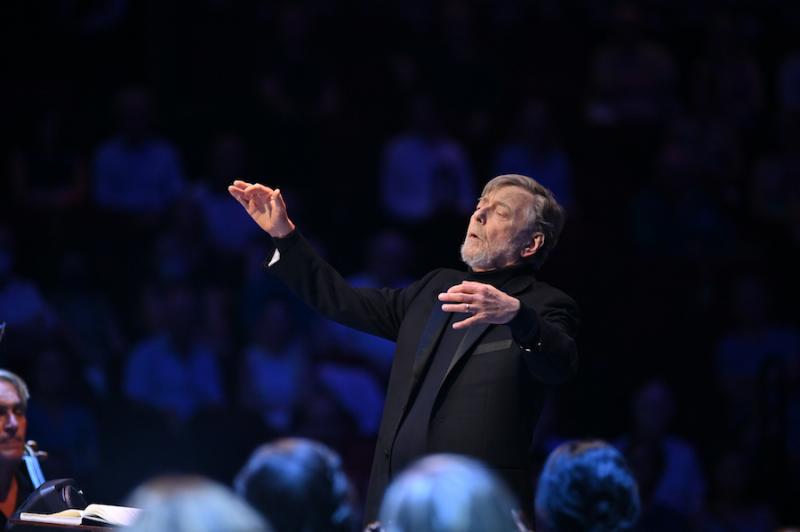
Prom 6 – BBC Philharmonic Orchestra / Sir Andrew Davis
Vaughan Williams Symphony no.4 in F minor (1931-4) Tippett Symphony no.4 (1976-7)
Royal Albert Hall, London Tuesday 19 July 2022
Reviewed by Richard Whitehouse Photo (c) Chris Christodoulou
Whether or not the Fourth Symphonies by Vaughan Williams and Tippett had previously been scheduled together, they made for a striking and provocative programme such as was its own justification. Omer Meir Wellber clearly thought so when this concert was planned and, even though indisposition had led to withdrawing from this year’s Proms, the presence of Sir Andrew Davis on the podium could hardly have been more conducive to the BBC Philharmonic Orchestra giving performances of the interpretive insight and technical conviction as were evident this evening.
Admittedly the Albert Hall’s opulent acoustic is never the best setting for VW4, the visceral impact of whose opening was inevitably diluted. Allowing for rather more expressive leeway than he might otherwise have done, Davis paced this explosive movement securely with just a slightly listless take on its coda detracting from the whole. The Andante was the highlight here – its fatalistic course exuding gravitas but never dragging, with the tritonal plangency of its main climaxes palpably in evidence and pathos of its final bars enhanced by an affecting contribution from flautist Alex Jakeman. This acoustic may have obscured something of the Scherzo’s contrapuntal ingenuity but not its sardonic humour or, in the trio, didactic coyness. The stealthy transition into the Finale could have had even greater cumulative focus, but what followed had all the requisite impetus – its central interlude raptly delineated, then the drama of its ‘epilogo fugato’ conveying increasing velocity through to the starkly inevitable return of the opening gesture and what is the most unequivocal four-letter ending of any symphony.
Interesting to recall the temporal distance between these pieces is now less than that between the Tippett and the present. Enthusiastically received at its Chicago premiere and one among a handful of his works still revived following his death, Tippett’s Fourth Symphony evinces a ‘birth to death’ trajectory that differs – crucially so – from its assumed model of Sibelius’s Seventh in not being a cumulative design; its climax being rather the kinetic developmental paragraph at its centre and from where the piece fans out, in a sequence of evolving episodes, back to the launching of its introduction and onward to the passing of its coda. Although he may have directed performances of greater tautness, Davis here secured a persuasive balance between unity and diversity – bringing a metaphysical poise to its ‘slow movement’ then a deft whimsicality to its ‘scherzo’, whose respective qualities underlined the confrontational drama elsewhere. Lavish writing for brass and percussion helps makes this Tippett’s most virtuosic such statement, in which the BBC Philharmonic was rarely to be found wanting.
A less successful component of this reading was the latest attempt to represent the ‘breathing effect’ specified by the score, in which the real-time voice of CJ Neale seemed hardly more successful than those attempts of wind machine, sampler et al to realize Tippett’s speculative imagery. No matter – any such overreaching was part and parcel of this composer’s inherent ambition; an ambition, moreover, which his present-day successors would do well to emulate. Almost a century and half-century on, both these works pose challenges constantly to be met.
Truscott Elegy for Strings (1944) Tippett Little Music for Strings (1946) Elgar Serenade in E minor, Op. 20 (1892) Chambers The Tall-Eared Fox and the Wild-Eyed Man (1994)
English String Orchestra / Kenneth Woods
Live performances at Guildhall, Worcester, Friday 29 October 2021
A further highlight from last year’s Elgar Festival, in the guise of an attractive miscellany that drew on the abundant body of music for strings, and which was persuasively rendered by the English String Orchestra that has been associated with this repertoire across several decades.
Interesting its principal conductor Kenneth Woods should have proposed a moratorium on the ESO’s performances of Elgar’s Serenade, as the three-year break evidently worked in favour of a piece here emerging as fresh and unjaded – whether in the capering motion of the initial Allegro as was ‘pleasurable’ indeed, the soulful intensity of a Larghetto centred on one of its composer’s most affecting melodies, or a final Allegretto which combines thematic elements with the deftest precision. 130 years on and this piece exhibits no signs of losing its appeal.
Sir Michael Tippett’s Little Music for Strings does seem to be gaining performances, which is only to the good of music as characteristic and accessible as this. Woods was rightly intent on imparting unity to the whole – tempering the rhetoric of the Prelude so it segued into the Fugue with its accumulation of textural weight and expressive intensity, before infusing the Air with a plaintiveness to which the vigorous Finale provided a natural foil. ESO performances in the presence of the composer need not detract from the excellence of its present-day incarnation.
The highlight, however, had come at the start with a revival of the Elegy by Harold Truscott. If the 22 piano sonatas are his greatest achievement, this is surely the piece to make his name more widely known – most likely his expression of acute regret over a failed relationship, and music that went unheard and unacknowledged in his lifetime. The ESO projected its questing tonal trajectory (redolent of later Nielsen) and plangent eloquence with unfailing conviction, so reinforcing its evident claim for a place near the heart of the repertoire for string orchestra.
A relative easing of emotional tension across this programme was made manifest by the final piece. Little known this side of the pond, Evan Chambers is widely respected as a composer and teacher – the present piece evincing his enthusiasm for Irish traditional music through its interplay of jigs which duly underpin the heady evocation that is The Tall-Eared Fox and the Wild-Eyed Man. That inspiration came from an encounter on the west coast of Wales serves to point up the playful irony of music such as strings and conductor alike attacked with relish.
An enjoyable piece, then, with which to round off a recital that was engaging and absorbing by turns. The ESO can be heard in further highlights from last year’s Elgar Festival towards the end of May – by which time, the 2022 edition will be only a few days away from starting.
For further information on the 2022 Elgar Festival click here. For more on composer Harold Truscott click here, and for more on Evan Chambers click here. For more on the English String Orchestra, click here – and their conductor Kenneth Woods, click here
Producer Andrew Keener
Engineer Simon Eadon
Recorded 3-5 February 2018 at City Halls, Glasgow
Reviewed by Richard Whitehouse
What’s the story?
Martyn Brabbins and the BBC Scottish Symphony Orchestra follow their release of Sir Michael Tippett’s first two symphonies (reviewed here on Arcana) with his succeeding two such pieces, along with a first recording for the Symphony in B flat originally intended to be his ‘Opus 1’.
What’s the music like?
Commenced in the wake of Beethoven’s bicentenary, the Symphony no.3 is Tippett’s most ambitious in concept – its four movements falling into two parts such as interrogate without abandoning the formal archetype. Brabbins emphasizes its initial contrast between stasis and dynamism, in the process highlighting unexpected detail, though without the visceral impact of Sir Colin Davis (Decca) or Richard Hickox (Chandos). The Lento is night-music of profound inwardness tellingly realized here, albeit eschewing the ultimate intensity at the climax of the central string threnody. The scherzo that launches Part Two again predicates clarity ahead of impetus: the ensuing blues numbers – respectively soulful, capricious and plaintive – seem a little low-key, but this is no fault of Rachel Nicholls; her singing more accurate than Heather Harper (Davis) and far more insightful than Faye Robinson (Hickox) here or in that extended scena where Tippett confronts then embraces the Beethovenian tenet of compassion. Brabbins rightly ensures its final antagonism between discord and pathos is left hanging in the balance.
Although yet to regain its former eminence, the Symphony no.4 is still the most frequently heard of this cycle and here brings out the most in Brabbins’s Tippettian instincts. Expansive without becoming sluggish and considered without being turgid, it sustains the expressive arc of this single-movement design with no mean conviction – not least in the eruptive climax at its centre which forms this work’s formal and emotional fulcrum, emphasizing its centrifugal rather than centripetal trajectory (unlike Sibelius Seven, to which the present work is often if erroneously compared). Closer in its unforced momentum to Tippett’s account (NMC) than that by Georg Solti (Decca) who premiered it, Brabbins never undersells the music’s forceful persona for all that its introspective qualities are primary. One aspect of this ostensible ‘birth to death’ piece he realizes more convincingly than any predecessor is the human breathing at key moments in its progress – achieved by the subtle deployment of recent technology so the closing bars, in particular, convey an evanescing of life which the composer surely intended.
It is a fair jolt stylistically to go from here into the Symphony in B flat. This latter had at least three hearings and was several-times revised until being discarded in 1944. Received wisdom suggests a reliance on Sibelius but though its formal processes are overtly Sibelian, its sound is much less so if not yet that of Tippett. The first movement is an eventful yet gauche sonata design – its themes intensified in a fusion of development and reprise then framed by a limpid introduction that returns sombrely at the close. What follows is less a slow movement than an intermezzo in which modal and chromatic elements alternate to ambiguous effect, then a final rondo of pronounced folk inflection that builds toward an apotheosis whose hopeful optimism speaks touchingly of the ‘confidence of youth’. Brabbins finds a committed response in music where lambent harmonies and tricky if untypical rhythms go some way to offsetting any lack of melodic profile. Whatever else, the composer’s trustees were right to sanction revival of a piece that offers fascinating insight into Tippett’s creativity before it began falling into place.
Does it all work?
As on the previous release, Brabbins secures excellent playing from the BBCSSO that does not always render Tippett’s exacting rhythms with quite the clarity or impetus required. Not that this undermines too seriously the idiomatic feel of these readings, abetted by the depth and perspective of the recorded sound. At its best (during parts of the Third and most of the Fourth Symphonies), it would certainly be first choice for those coming to the pieces afresh; still, the door remains open for a Tippett cycle that gets to the heart of this inspiring music.
Is it recommended?
Yes, but for the Third Symphony seek out a live 1976 account by Raymond Leppard and the BBC Symphony, with Josephine Barstow a magisterial soprano (BBC Classics). Notes are by Oliver Soden, whose Tippett biography has recently been published (Weidenfeld & Nicolson).
You can read more about this release on the Hyperion website, while for more on Sir Michael Tippett, visit the Tippett foundation. The BBC Scottish Symphony Orchestra can be found here, while more on Martyn Brabbins can be found here
A new recording of Michael Tippett’s symphonies, following on from those by Colin Davis, Georg Solti (Decca, 1968-81) and Richard Hickox (Chandos, 1992-4) was sorely needed, and with his prowess in British music Martyn Brabbins would seem well placed to provide it.
Having begun his cycle of Vaughan Williams symphonies, Brabbins now embarks on those of Tippett, whose reputation seems to be on the ascent given the inevitable decline after his death in 1998. The BBC Scottish Symphony Orchestra may not have had a close association with this music, though the fact each of these recordings was preceded by a live performance at least ensure what is heard here are those interpretations intended by Brabbins rather than merely a run-through that comprises studio takes methodically assembled in post-production.
What’s the music like?
In the First Symphony, informed by the tragedies of war and personal loss, Brabbins handles the initial Allegro’s bracing polyphonic discourse with assurance – less unyielding than Colin Davis if not quite evincing the forward resolve of Richard Hickox. The exposition’s motivic elements are precisely individuated then vividly contrasted in the development, though there could have been greater intensity during the reprise before it reaches stasis in the coda. The Adagio is the highlight here, a passacaglia afforded focus by the expressive contrasts of its variations and cohesion by their near-symmetrical trajectory. Slower then either of his rivals, Brabbins secures greater momentum so that the sombre augmentation of the theme caps this sombre movement overall. The scherzo’s outer sections have the right rhythmic buoyancy, even if its songful trio is a little reticent, and while the twin subjects of the finale’s double-fugue are well delineated, the transition into the reprise lacks impetus; the climactic ‘stretto’ less potent than its disintegration in the coda, though this is likely what Tippett intended.
This remains a frequently impressive account, with that of the more wide-ranging Second Symphony only marginally less so. Its opening Allegro is the finest on disc – more flexible than Davis and less stolid than Hickox, while generating kinetic energy in the development and truly Beethovenian coda. If the Adagio feels less convincing, this is not through lack of insight on Brabbins’s part or finesse on that of the BBCSSO but rather a sense that the ideas in its mosaic-like construction are being juxtaposed without admitting that greater eloquence Hickox finds at a slower tempo and Tippett himself (NMC) conveys to rapturous effect. The scherzo is disappointing as, for all the wealth of detail uncovered, the underlying tempo is too staid for momentum to accrue so the climax feels less Dionysian than merely incisive. Some might also consider the finale too steady, yet Brabbins succeeds more than those before him in knitting the four parts of this fantasia-like sequence into an organic process of continuous variation through to a coda as brings the work forcefully but never overbearingly full-circle.
Does it all work?
Most of the time. As recorded in Glasgow’s City Halls, the orchestral sound has clarity and lustre well in advance of those earlier readings, even if the acerbities of Tippett’s scoring can seem a little too well-blended (the balance of trumpets in the outer movements of the Second Symphony being a case in point), hence a relatively high playback level is preferable. Oliver Soden’s annotations are informed and informative, though not free of occasional tautologies or affectations that one hopes will not feature in his forthcoming biography of the composer.
Is it recommended?
Yes. Whatever their difficulties in execution, the intrinsic musical qualities of Tippett’s symphonies cannot be doubted and this first instalment augurs well for the rest of the cycle. Nos. 3 and 4, as well as the early Symphony in B flat, are due from Hyperion later this year.
You can read more about this release on the Hyperion website, while for more on Sir Michael Tippett, visit the Tippett foundation. The BBC Scottish Symphony Orchestra can be found here, while more on Martyn Brabbins can be found here




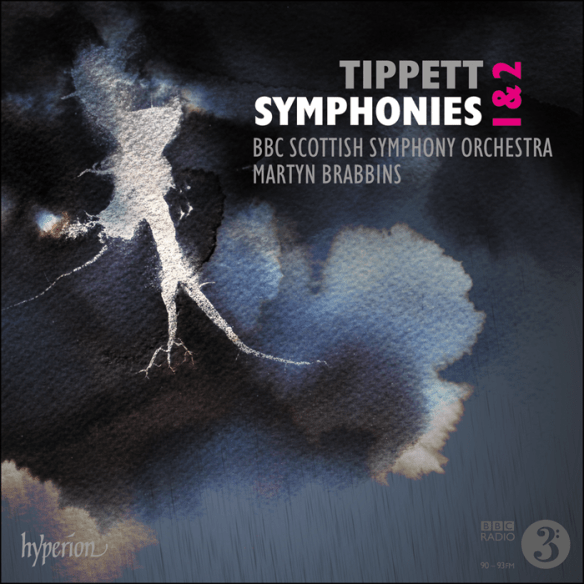 Tippett Symphonies nos. 1 & 2 BBC Scottish Symphony Orchestra / Martyn Brabbins
 Arcana.fm