
Arcana at the Proms – Prom 53: Remembering Sir Andrew Davis

Stravinsky Symphony in Three Movements (1942-5)
Reich Jacob’s Ladder (2023) [BBC co-commission: UK premiere]
Tippett The Midsummer Marriage – Ritual Dances (1946-52)
Elgar Variations on an Original Theme ‘Enigma’ Op.36 (1898-9)

Synergy Vocals [Tara Bungard (soprano), Micaela Haslam (soprano/director), Will Wright, Ben Alden (tenors)], BBC Symphony Orchestra / Martyn Brabbins

Royal Albert Hall, London
Friday 30 August 2024

reviewed by Richard Whitehouse Photos (c) Andy Paradise

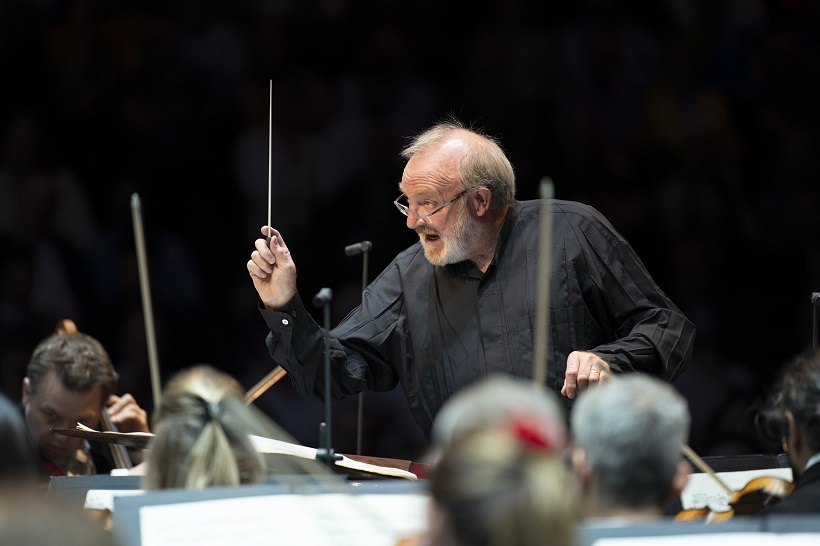
What should have been the 133rd concert that Sir Andrew Davis conducted at the Proms became a commemorative event after his untimely death in April but, with Martyn Brabbins presiding over a thoughtfully amended programme, the outcome could not have been more appropriate.

Proceeding unaltered, the first half began with Stravinsky’s Symphony in Three Movements in a performance redolent of Otto Klemperer in its deliberation if without that conductor’s heft – not least an opening movement whose rhythmic trenchancy felt a little dogged as it unfolded. Best was the Andante – its deadpan humour complemented by the beatific poise at its centre, then a transition of hushed expectancy to launch the finale. Here the closing build-up might have been more visceral, but the conclusiveness of that final chord could hardly be doubted.

Davis (above) was hardly known as proponent of Minimalism in general or Steve Reich in particular, thus his scheduling this first UK performance of the latter’s Jacob’s Ladder could be taken as significant. Playing just under 20 minutes, this is artfully structured as four short ‘expository’ sections followed by four longer ‘developmental’ ones. The former pitted its four vocalists – a telling number in this context of eight strings, six woodwind, two vibraphones and one piano – against an instrumental ensemble that took precedence in those latter sections; the final one brings them together in new-found accord. Dealing with scalic patterns in all their conceptual and metaphorical implications, the musical content typifies late Reich in ruminative elegance or subdued intensity which, if it offers no revelations, is yet satisfying in its stylistic deftness.

Schumann’s Second Symphony had been planned for a second half as now commenced with the Ritual Dances from Tippett’s The Midsummer Marriage – an opera, and composer, close to Davis’ heart. Unfailingly cohesive to the degree its series of elemental and seasonal dances interwove with their respective ‘transformations’ and ‘preparations’, this account was equally notable for its textural clarity even in those most contrapuntally intricate passages, along with a colouristic sense sustained up to the climactic return of its initial music for a magical envoi.

When Brabbins last conducted Elgar’s ‘Enigma’ Variations at the Proms, it was the final item in a 60th-birthday tribute that began with Pictured Within – a latter-day equivalent involving 14 different composers. Tonight’s account gave eloquent insight into what has become almost too familiar a work, evident from the outset in a ‘Theme’ of melting pathos. Highlights from those that followed included the soulfulness of ‘C.A.E.’, pensiveness of ‘R.P.A.’ or elegance of ‘Ysobel’ with its lilting viola from Sebastian Krunnies. ‘Nimrod’ started imperceptibly but built towards a nobly wrought apex, with the affectionate portrayed ‘Dorabella’ or searching evocation of ‘***(Romanza)’ no less affecting. The ‘E.D.U.’ finale moved confidently to an organ-clad peroration exuding what Elgar elsewhere termed a ‘‘massive hope for the future’’.

Just before this performance, Brabbins spoke for a capacity house in paying tribute to Davis with his dedication to music-making in the UK and beyond; something Sir Andrew brought to every one of his 132 appearances at the Proms, across 54 years of dedication to his cause.

You can get details about this year’s season at the BBC Proms website – and you can click on the names to read more about the BBC Symphony Orchestra, their conductor Martyn Brabbins, and an obituary of Sir Andrew Davis himself

Published post no.2,287 – Sunday 1 September 2024

In appreciation – Edo de Waart

by Ben Hogwood

This week the Dutch conductor Edo de Waart announced his retirement, after six decades at the top of his game. On inspection of his discography, de Waart has conducted a number of important recordings – either in San Francisco, Minnesota or the Netherlands – and a selection of these are included in the playlist below, which begins with a classic recording of Steve Reich‘s Variations for winds, strings and keyboards and ends with the landmark Harmonium, by John Adams:

Published post no.2,147 – Saturday 13 April 2024

In concert – Royal College of Music London students – Chamber Spotlight: Different Trains

Ed Driver Fruits Of Their Laboue (world premiere)
Ed Pelham (clarinet), Tabitha Bolter (horn), Aidan Campbell (bassoon), Stone Tung (trumpet), Eddie Curtis (bass trombone), Michal Oren (conductor)
Schoenfield Café Music (1987)
Rubie Besin (violin), Layla Ballard (cello), Alexander Doronin (piano)
Reich Different Trains (1988)
Jordan Brooks, Sara Belic (violins), Scott Storey (viola), Sam Hwang (cello)

Performance Hall, Royal College of Music
Wednesday 15 March 2023, 6pm

by Ben Hogwood

If you live in or around London, it is well worth reminding you that one of the best ways in which to experience classical music is to visit one of the enterprising colleges and academies in the city. They are packed with interesting recitals, with several lunchtime or early evening concerts per week, with interesting programmes and enthusiastic students ready to give them. The two most obvious examples are the Royal Academy of Music and the Royal College of Music, though more can be sought and found.

It was the Royal College of Music in which your reviewer spent an early evening hour. Currently excelling (on the strength of reviews) in a Respighi – Ravel double bill of opera, which sadly this reviewer did not have the time to experience, the college is enjoying a rich vein of musical form. This is due to a strikingly successful renovation of their ground floor space, and a very fine Performance Hall, suited for chamber-sized concerts such as this one. Here we had the chance to appraise the talent within the college, both at composer and performer levels.

The first piece was a world premiere, Ed Driver’s quintet Fruits Of Their Labour. Born in 2000, Driver is a composer of some repute, with recent accolades from the Birmingham Contemporary Music Group and a new piece for the Hermes Experiment just two of his recent notable attributes. Fruits of Their Labour proved an attractive curtain raiser for this concert, Driver enjoying the unusual quintet combination of clarinet, horn, bassoon, trumpet and bass trombone.

Based on a Czech folk song, the piece has a springlike feel as it alternates between dynamism and relative stillness, making the most of the colourful textures available. The energetic sections were contagious, but the slower passages made an arguably greater impact, their chorale-like figures filling the room.

In the latter stage Driver instructed that trumpet and bass trombone should pour water into their instruments, resulting in a sound between a gargle and something of a plumbing malfunction. While effective, the combination with the other instruments was a little superfluous, and when the music returned to its chorale figure the warmer colours were more attractive. On this evidence Driver is a composer of imagination and flair, one to keep in our sights. He received an excellent premiere performance, too, brilliantly played and conducted with authority by Michal Oren.

Next up was a piano trio with a difference. Paul Schoenfield wrote Café Music for the Saint Paul Chamber Orchestra in 1987, looking to bridge the gap between the music you might hear at Murray’s steakhouse in Minneapolis and that heard at the Minnesota ensemble’s home. He achieves his aim with music of great virtuosity and considerable humour, with a great number of enjoyable and quirky themes crammed into a three-movement, 15-minute piece. Rubie Besin, Layla Ballard and Alexander Doronin played these with considerable brio, the pianist in particular impressing with his combination of technical skill and rhythmic drive. The technical demands on the players meant there was not always room to bring the humourous sleights through at their fullest, but Besin and Ballard ensured the music had a smile on its face and a spring to its rhythms, their attractive tones bringing the melodies across with room to spare. The performance that had many flourishes, while allowing time for occasional reflection.

The main work of the evening, Steve Reich’s Different Trains, has become established as a lynchpin of the string quartet repertoire, a reflection of its strength and originality. Inspired by childhood journeys to visit his parents during the Second World War, the piece uses a collection of recordings of trains before, during and after the war – spliced together with interviews from a retired porter, Reich’s governess and two survivors of the Holocaust. Their speech patterns are taken up by the stringed instruments in performance.

This performance had a few balance issues, due to the complexity of balancing loud train noises with live strings in a small performance space, and as a result the words themselves were difficult to hear at times. Yet the quartet gave a fine performance, viola player Scott Storey and cellist Sam Hwang shaping the speech melodies with expression and guile. Violinists Jordan Brooks and Sara Belic added colourful and characterful phrases themselves, bringing rich treble to the train whistles and to some of the motifs generated by the interviews.

Different Trains lasts nearly half an hour, but it says much for the musical content that it passes in the blink of an eye. The quartet here should be congratulated for their musicality and concentration, bringing Reich’s music to energetic and often poignant life.

A fine concert, then – and a reminder to make the most of all this wonderful music if it’s on your doorstep!

For information on concerts at two of London’s central music education hubs, click on the names for concerts at the Royal College of Music and the Royal Academy of Music. Meanwhile you can listen to the premiere recording of Different Trains below

On Record: Los Angeles Philharmonic / Susanna Mälkki – Steve Reich: Runner / Music for Ensemble and Orchestra (Nonesuch)

Steve Reich
Runner (2016)
Music for Ensemble and Orchestra (2018)

Los Angeles Philharmonic / Susanna Mälkki

Nonesuch 7559791018 [35’25”]

Producer Dmitriy Lipay, Engineer Alexander Lipay

Recorded 1-4 November 2018 (Music for Ensemble and Orchestra), 6-7 November 2021 (Runner), Walt Disney Concert Hall, Los Angeles, CA

reviewed by Ben Hogwood

What’s the story?

It is best to let Steve Reich himself tell the story of these two closely related orchestral pieces. Runner, he says, is ‘for a large ensemble of winds, percussion, pianos, and strings.  While the tempo remains more or less constant, there are five movements, played without pause, that are based on different note durations.  First, even sixteenths, then irregularly accented eighths, then a very slowed-down version of the standard bell pattern from Ghana in quarters, fourth a return to the irregularly accented eighths, and finally a return to the sixteenths but now played as pulses by the winds for as long as a breath will comfortably sustain them.  The title was suggested by the rapid opening and my awareness that, like a runner, I would have to pace the piece to reach a successful conclusion.’

Meanwhile its companion, the Music for Ensemble and Orchestra, is in effect Runner 2. It is described by Reich as ‘an extension of the Baroque concerto grosso where there is more than one soloist. Here there are twenty soloists – all regular members of the orchestra, including the first stand strings and winds, as well as two vibraphones and two pianos.  The piece is in five movements, though the tempo never changes, only the note value of the constant pulse in the pianos.  Thus, an arch form: sixteenths, eighths, quarters, eighths, sixteenths.  Music for Ensemble and Orchestra is modelled on my Runner, which has the same five movement form’.

The recording marks the first foray of both the Los Angeles Philharmonic and conductor Susanna Mälkki into the music of Reich in recorded form.

What’s the music like?

Reich clearly enjoyed writing these pieces, as he tells David Lang in the liner notes for this release. The quick tempo means that as the starting gun fires, Runner is immediately into its stride with brisk music and rich colours. When the tempo marking halves to become Eighths, and then Quarters, the slower music is beautifully managed through sustained notes, pulling out the tension. The piano and vibraphones come through beautifully here, while the harmonies continue to negotiate new corners and scenery as a runner would do. The feeling persists, though, that Reich is at his happiest in the music of Sixteenths, where the busy conversations of the woodwind and the bell tolls of the vibraphones give the music impressive stature. The piece ends quickly, with one of the composer’s trademark ‘fades’.

Music for Ensemble and Orchestra feels weightier in its own Sixteenths section starts, pianos oscillating and strings gathering in hymn-like unison before the pianos create an impressive grandeur with their sustained low notes. Reich’s command of the orchestra is immensely assured, more so than it was in earlier works such as the Variations for wind, strings and keyboards or The Four Sections, but never losing the luminosity of those works, nor their capacity to pan out into larger spaces.

The Eighths section is the most emotionally powerful music yet, with large scale harmonies that move freely between weighted dissonance and brief consonance, the latter appearing like shafts of light in the music. Quarters brings forward the choirs of woodwind, their distinctive motif alternating with the piano, before the percussive instruments drive Eighths to greater heights, pianos chiming with the vibraphones. In typical Reich fashion the acceleration from Eighths to Sixteenths is both seamless and thrilling, the clarinets pushing to the front as the music gathers itself for the finish. Then just as suddenly – and seamlessly – the bottom drops away and the figures float away like birds on the wing, all treble and no bass.

Does it all work?

It does. The performances from the Los Angeles Philharmonic and Susanna Mälkki are of a uniformly high degree, and the writing is subtly complex – meaning that Reich’s workings reward close inspection, but that the overall whole is beautifully realised and works well even in the middle foreground for the listener.

Is it recommended?

Of course. Steve Reich is a composer where nearly every move he makes is captured on record, to our advantage – and this pair of works, representing one of his most recently published chapters, are typically rewarding listening.

Listen

Buy

You can buy this new release at the Presto website. For more on Steve Reich himself, visit the composer’s website

On Record – Ensemble Intercontemporain / George Jackson – Steve Reich: Reich/Richter (Nonesuch)

reviewed by Ben Hogwood

What’s the story?

Reich/Richter was originally written to be performed with German visual artist Gerhard Richter and Corinna Belz’s film Moving Picture (946-3). The film is based on Richter’s book, Patterns, where the author took a photo of one of his abstract paintings and scanned it into a computer. He cut the scan in half, then cut each half in two, and then reversed two of the four resultant quarters into mirror images. This process – ‘divide, mirror, repeat’ – was repeated all the way through from a half to a 4096th.

Belz helpfully described the film in terms of pixels, beginning with two-‘pixel’ stripes, while the music started with a ‘two-sixteenth’ oscillating pattern. The music then shadows the film as it moves to four, eight and sixteen stripes, at which point Reich introduced longer notes, expanding the music in response. As he then describes, the music returns to more rapid movement as the pixel count starts to diminish.

The match of visual artist and composer could hardly be more appropriate, and their resultant work was performed more than one hundred times at The Shed in New York during 2019. This recording, with the Ensemble Intercontemporain under George Jackson, was made in Paris at the Philharmonie.

What’s the music like?

One of Steve Reich’s many endearing qualities as a composer is the ability to take what sounds like a very complicated mathematical process and make it incredibly easy on the ear – and Reich/Richter repeats that trick.

As with the best ‘minimalist’ works it rewards attentive listening greatly, the ear drawing out shorter phrases and colour combinations, which prove to be every bit as vivid as the cover implies. Yet background listening works equally well, the ear and moreover the mind able to appreciate Reich’s hazy, impressionistic shades which recall earlier works such as Music for Mallet Instruments, Voices and Organ from 1973. Here, though, it is possible to appreciate Reich’s mastery of writing for wind instruments, incorporating them into the texture.

Unsurprisingly, Reich/Richter works best when experienced in its unbroken span of 37 minutes. There is some busy activity at all times but Reich’s sustained notes really stand out, giving the piece a broad scope that arches almost overhead. The ever-changing texture benefits from the lines afforded to brightly-toned violins, or crisp clarinets, but when these instruments retreat to make up the broad brushed colours in the middle background, a lovely haze ensues. This makes the piece one of Reich’s easiest to listen to, though by the time we get to the third part, Crossfades, the stretching of the notes introduces a notable tension not dissimilar to that experienced in the early Reich piece Four Organs. As the tempo recovers in Ending, the feeling is strangely exhilarating, like a flower opening out again in the sunlight.

Does it all work?

It does, achieving a very interesting blend of movement and stasis. The performance is excellent too, and intriguing that Ensemble Intercontemporain, the Parisian ensemble founded by Pierre Boulez, should now be recording his music! Boulez, it is safe to say, was not a fan of the so-called ‘minimalists’, and it would be fascinating if we could somehow know his thoughts on the recording.

Is it recommended?

Yes, enthusiastically – a compelling listen. The slightly short running time of the album release means that if you’re a Reich completist, it is worth bearing in mind that Nonesuch plan to release a collection of the composer’s complete works in 2023. Now that is definitely something for the diary!

Listen

Buy

You can explore purchase options for this album at the Nonesuch website