Prom 60 – Kirill Gerstein (piano), Berlin Radio Symphony Orchestra / Vladimir Jurowski
Weill Kleine Dreigroschenmusik (1928, arr. 1929) Adès Piano Concerto (2018) [Proms premiere] Rachmaninoff Symphony no.3 in A minor Op.44 (1935-6, rev. 1938)
Royal Albert Hall, London Thursday 31 August 2023
by Richard Whitehouse photos by Andy Paradise / BBC
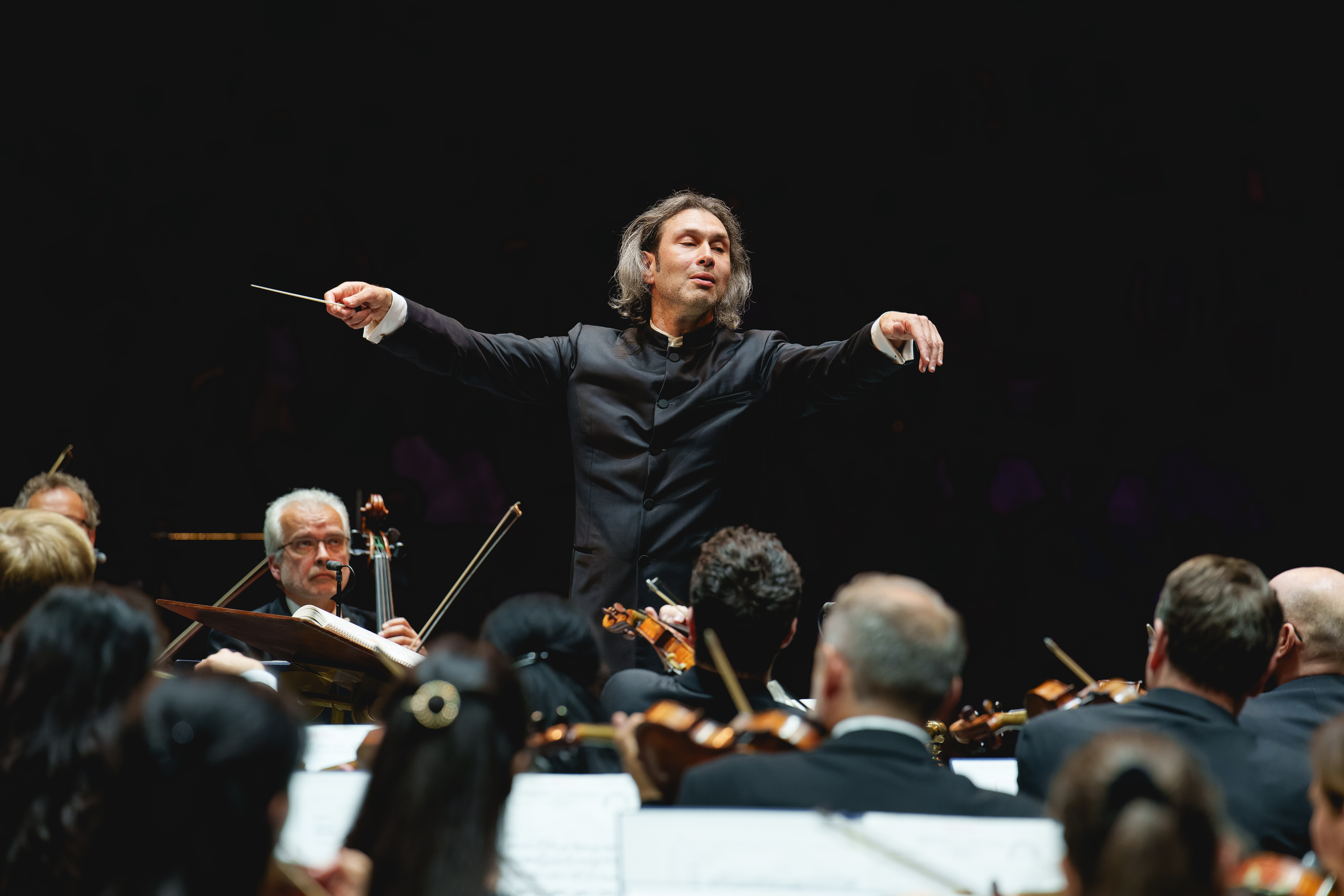
Marking its centenary this October, the Berlin Radio Symphony Orchestra may be less known abroad than other Berlin orchestras but this Proms debut under chief conductor Vladimir Jurowski confirmed an ensemble at home across the broad range of modern and contemporary music.
Not least in Little Threepenny Music, a ‘selection’ Kurt Weill arranged from his and Bertold Brecht’s reworking of The Beggar’s Opera which takes in several of that show’s best-known numbers while also affording a demonstrable overview of its satirical concerns. The BRSO responded with vigour and not a little pathos – above all, in the Threepenny Finale and its juxtaposing pensive ambivalence with a glowering decisiveness: that final chorale making plain its damning inditement of German cultural failings in the era of the Weimar Republic.
A spirited participant, Kirill Gerstein took centre-stage for the first hearing at these concerts of the Piano Concerto written for him by Thomas Adès. Now as before, Gerstein’s dexterity in negotiating this score’s pert amalgam of intricacy and bravura warranted respect: whether in what might be called the ‘Self-Portrait with Gershwin and Ligeti (though Prokofiev is also there)’ of the first movement, Stravinskian cortège of the central Andante, or the interplay of vivacity and uncertainty in the final Allegro. An attentive accompanist, Jurowski summoned playing as tensile and supple as the orchestral writing demands – though abetting the overall impression (his recent works in particular) that even as consummate a conceptualist as Adès needs to instil those ideas, often arresting in themselves, with comparable musical substance.
Gerstein’s transcription of Rachmaninoff’s In the Silence of the Secret Night (Op.4/3) duly prepared for the latter’s Third Symphony. First given at the Proms 85 years ago, it still attracts dislike from those who find it a self-conscious update of the composer’s inherently Romantic idiom as well as those who dislike such an idiom in any case. Not that Jurowski’s account brooked any compromise in marrying consistent technical precision to a powerfully shaped conception of music often appealing, frequently intriguing and not a little unsettling.
The stark rendering of its introduction – spectral ‘motto’ then surging tutti – set the course for an initial movement where contrast between expectancy and eloquence came to a head in the development with its anguished fusion between heart and brain. The Adagio unfolded with an almost Sibelian inevitability, not least in the seamlessness by which its outer sections flowed into then out of a central scherzo abounding in that sardonic humour as became a mainstay of Rachmaninoff’s later years. Nor was there anything blandly predictable about a finale whose opening exuberance was ably maintained through a consoling but never wantonly languorous secondary theme, eventually resolving into a coda whose unfolding as a crescendo of activity brought the whole work – and the present reading – animatedly and satisfyingly full circle.
Impressive music-making on all levels and Jurowski further cemented the Proms connection, specifically that between Rachmaninoff and Henry Wood, with the latter’s transcription of the former’s Prelude in C sharp minor Op.3/2) – as tempestuous as it proved exhilarating.
Elgar: Violin Concerto in B minor, Op. 61 (1910) Enescu: Symphony No. 2 in A, Op. 17 (1912-14)
Julia Fischer (violin), London Philharmonic Orchestra / Vladimir Jurowski
Royal Festival Hall, London Wednesday 13 April 2022
Written by Richard Whitehouse. Photo (c) Marquee TV (Julia Fischer)
Could there be a more instructive coupling than the pieces in this concert, with the London Philharmonic Orchestra and its conductor emeritus Vladimir Jurowski, for showing where musical Romanticism had arrived in the early 20th century and where it might have gone?
Relatively few concertos number among their composers’ most personal works, but Elgar’s Violin Concerto is one such and it was a measure of Julia Fischer’s identity that her account conveyed its conceptual richness as fully as its technical brilliance. Not least in the opening Allegro, Fischer drawing out that fatalism as germane to the heartfelt second theme as to its forceful predecessor such as pervades the initial tutti then the combative development. Here, as with the impetuous coda, Jurowski ensured textural clarity in even those densest passages.
Similarly in the Andante – the musing wistfulness of its main melody finding accord with the high-flown eloquence of what follows, with no undue lingering here or in those rapt closing bars. Its themes may be less overtly memorable, but the final Allegro molto follows a keenly purposeful trajectory whose dynamism is thrown into relief by that accompanied cadenza in which Elgar recollects earlier ideas as an intuitive interlude; rendered by Fischer with a poise as itself prepared ideally for the resumption of the finale then a powerfully rhetorical ending.
Enescu, who conducted the Paris premiere in 1932 with Yehudi Menuhin prior to the latter’s recording with the composer, might well have reflected on the success of this work compared to that of his Second Symphony – coolly received at the 1915 premiere, its score missing until 1924, and no revival until 1961. This might well have been the first hearing in London, but its formal and syntactical intricacy held no fear for Jurowski who, having previously championed Enescu’s Third Symphony and opera Oedipe, presided over a consistently assured rendition.
Not the least of its successes was in maintaining the impetus of the initial Vivace, whose ‘ma non troppo’ marking can easily lead to loss of focus among those polyphonic layers that were delineated with unfailing precision. Music this harmonically complex is (surprisingly?) direct as to melodic contours – not least its central Andante whose main theme, soulfully phrased by Benjamin Mellefont, has the evocative quality of those found in Russian symphonies several decades before. Here its inherent tenderness and its lingering regret could hardly be gainsaid.
The biggest challenge comes in the finale – not least the gauging of an extended introduction whose processional needs to generate momentum sufficient to propel the main Allegro on its eventful if never discursive course. Here, too, the extent of Enescu’s instrumental prowess is made plain by the dextrous contribution from keyboards and percussion to already extensive forces; variety of textures underpinning stages in musical evolution through to a coda whose heady if methodical accumulation of themes and motifs makes for a resplendent apotheosis.
Such was the impression left by this performance, a tribute to Jurowski’s conviction and the LPO’s executive skill. Maybe Enescu’s Fourth and Fifth Symphonies will yet be heard in the realizations by Pascal Bentoiu, his own symphonies themselves deserving of such advocacy.
To read Arcana’s interview with Julia Fischer, who talks about the Elgar and Mozart violin concertos, click here
For further information on the London Philharmonic Orchestra’s 2021/22 season, click here – and for the newly announced 2022/23 season click here For more on George Enescu, head to a dedicated website – and click on the artist names for more information on Julia Fischer and Vladimir Jurowski
Lachenmann Marche fatale (2018) [UK premiere] Beethoven Piano Concerto No. 4 in G major Op. 58 (1805-06) Bruckner Symphony No. 6 in A major (1879-81) [ed. Benjamin-Gunnar Cohrs]
Mitsuko Uchida (piano), London Philharmonic Orchestra / Vladimir Jurowski
Royal Festival Hall, London Saturday 9 April 2022
Written by Richard Whitehouse. Photos (c) Justin Pumfrey (Mitsuko Uchida), Thomas Kurek (Vladimir Jurowski)
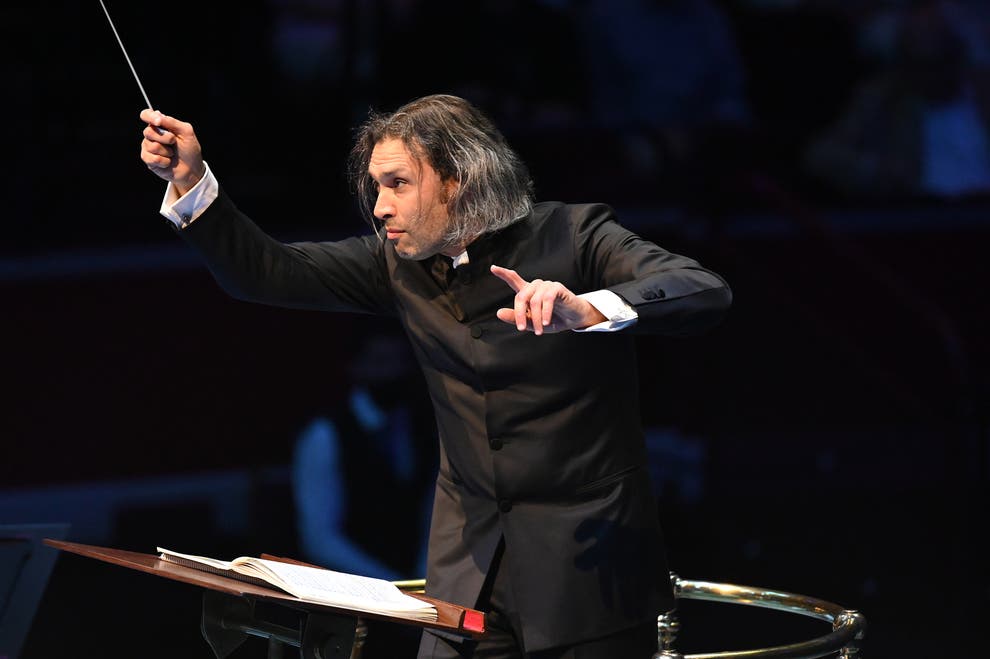
He might now be its Conductor Emeritus, but Vladimir Jurowski (below) clearly has no intention of curtailing his association with the London Philharmonic Orchestra – tonight’s concert being a distinctive take on what might have seemed a straightforward Austro-German programme.
Jurowski’s leisurely traversal through Bruckner’s symphonies (taking in various editions) has now reached the Sixth, long underestimated in the context of its composer’s maturity but now recognized among his most distinctive and resourceful works. Not least for the way Bruckner integrates those two markedly different tempos of the opening Majestoso so it unfolded here as a seamless span – with the heightened cross-rhythmic transition into the reprise thrillingly effected, then the tonal follow-through of the coda rendered for the mesmeric inspiration it is.
The Adagio is often treated as a forerunner of those from Bruckner’s final three symphonies, but Jurowski rightly placed emphasis on its flowing phrases and eloquent paragraphs as they merge into each other across its expansive yet never overly emotive course. The LPO strings, responding with a burnished richness, were no less attentive to the syncopated impetus of the Scherzo – its outer sections pointing up those martial traits in which this piece abounds, with the trio’s teasing ensemble interplay deftly caught. Never an easy movement to bring off, the Finale undeniably succeeded as to its quixotic traversal – the outwardly fragmented contours of its development endowed with a cumulative dynamism; before its coda stealthily drew the almost antagonistic thematic elements together into a striding march-past towards the close.
Whereas Bruckner was writing at a time of relative European stability, Beethoven composed his Fourth Piano Concerto just before France lay siege to Vienna in a marked intensification of the Napoleonic Wars. This may explain the pathos behind the poetry of its first movement, certainly as Mitsuko Uchida (top) now hears it in a reading whose thoughtful understatement was underpinned by a tension such as came to the fore in the stark contrasts of its (more familiar) cadenza before the fatalistic resolve of its coda. Confrontation between piano and strings in the Andante were similarly elided by the former’s improvisatory solo, while the final Rondo stole in with mischievous intent – the wistfulness of its second theme and its transitions not neglected through to an ending where any lingering equivocation was decisively overcome.
As Jurowski emphasized in his introductory remarks, those who equate Helmut Lachenmann with the ‘musique concrète instrumentale’ of his most (in)famous works may be taken aback by the idiom of his recent Marche fatale. Yet what might sound akin to the anarchic take-off of a cartoon score is essentially a parodistic denunciation of Western civilisation as it careers towards a point of no return, the disjunct and increasingly fractured course of this six-minute piece culminating in a percussive onslaught with gong left resounding ominously at its close.
Seeking to open-out the context, Jurowski prefaced this with the fourth then first of Mauricio Kagel’s Zehn Marsche um den Sieg zu verfehlen (1978-9) – the collisions of woodwind, brass and percussion ‘missing the victory’ in ways a near-capacity audience evidently appreciated.
For further information on the London Philharmonic Orchestra’s 2021/22 season, click here Click on the composer names to read more about Helmut Lachenmann and Mauricio Kagel, and click on the artist names for more information on Mitsuko Uchida and Vladimir Jurowski
written by Ben Hogwood Photo of Julia Fischer (c) Felix Broede
Arcana has an audience with Julia Fischer, the multi-skilled violinist and pianist who is Artist-in-Residence with the London Philharmonic Orchestra. Her most recent concerts have contained a complete cycle of Mozart’s five Violin Concertos, along with the Sinfonia Concertante and a chamber concert with LPO soloists. The Mozart will shortly be available to view online, after which Fischer will be busy rehearsing the Elgar Violin Concerto for performance with the orchestra in April.
Our online call finds her bringing a little sunshine to an otherwise grey morning, full of enthusiasm as she greets us from her home city of Munich. To begin, she recalls her first encounters with the Mzart concertos. “The G major Concerto, no.3, was taught by my first violin teacher when I was really very little. I must have been eight, and I remember hearing Arabella Steinbacher play it. I think that was my first encounter with that concerto.”
Perhaps not surprisingly, Fischer does not have a vivid memory of the impact it had on her – but was soon reacquainted with the piece. “A few months after that I actually performed the first movement of the concerto for my then teacher Ana Chumachenco so when I auditioned with her, it was with that first movement of the G major Concerto.”
Fischer recorded the concertos for Pentatone with Yakov Kreizberg and the Netherlands Chamber Orchestra, recordings that have aged will in the 15 years or so since she made them. Having spent a relatively long time with them, has her view changed at all? “I suppose, yes, but not in a conscious way. I learned them between the age of eight and fourteen, when I played the Fifth Concerto, then the Fourth Concerto when I was 16. The First and Second concertos I learned for the recording in 2006. After that I performed the cycle two or three times, and of course there are always things changing from one performance to the next, but my emotional approach didn’t change much.”
There are smaller considerations to be made, however. “Maybe the technical approach, the bowings, the note relations have changed a little, as there is always something you can discuss. You can do it with a large or small orchestra, with a conductor or without a conductor, with a harpsichord or without. There are many options, and I don’t think that any of those options are wrong. For the moment you have to find a good approach, and it depends on the people who are involved and who you play with.”
February seems a good time of year to be discussing and playing these essentially sunny, optimistic works. She smiles. “Let’s hope that we can be optimistic, you know?!” The concerts have interesting and exciting programmes around the Mozart works. Many of them will be given under Thomas Dausgaard, a conductor Fischer has worked with before. “Yes, he is a wonderful conductor. He is a very kind man, a wonderful musician. I specifically asked for him for these concerts.”
Dausgaard it was who chose the Richard Strauss pieces accompanying the Mozart – Don Juan and Tod und Verklärung with the Third and Fourth Concertos, and Till Eulenspiegels lustige Streiche with the Sinfonia Concertante. Meanwhile Fischer herself took charge of one concert. “I will always play and direct the first and second concertos, because I really don’t need a conductor there. I put together the first two concertos with the TchaikovskySerenade for Strings, and he did the rest of the programming.”
With the Mozart works, is there an assumption that the works are too easy to perform? “Yes. You can always find difficulties in any piece, but I think when you do the cycle it is important that each concerto has its own character, so that they don’t all sound the same. The First and Second Concertos are very different from Three, Four and Five, they are still very much from a perspective coming out of the Baroque-ish way of playing. I think Mozart probably had Vivaldi and Tartini in his mind, as they are much more difficult than Three, Four and Five.”
She expands on these three pieces. “The Third is probably the most lyrical one, and has the beautiful aria as its second movement, With the Fourth, it is a beautiful work, and as well as the portmanteau the second movement has this singing part. The Fifth is very different because it has the famous Turkish March finale, but with Three and Four you have to be careful that they don’t get too similar.”
Throughout the concertos, Fischer finds elements of Mozart’s operatic style. “I think it is everywhere”, she says emphatically. “In any Mozart, one has to see him first as an opera composer, and then it’s far easier to perform his instrumental pieces.”
From her answers above you will have gathered that Fischer learned the violin at an extremely young age. Indeed, she met Yehudi Menuhin well before her teens. Did she speak to him about the Mozart concertos at all? “Actually I played the Fifth Concerto with him, when I was 13, maybe 14. I remember playing that with him, but I don’t really remember the musicality of it. I also played the Beethoven Violin Concerto with him and that had a huge impact on me. We had a conductor for the rehearsals so he spent more time with me personally, and we worked on it together. The Mozart was a one-off concert in France, so we just met very briefly for that.”
As part her Mozart season with the London Philharmonic Fischer programmed a chamber concert, placing herself as soloist in the DvořákPiano Quintet no.2 – for she is indeed a fully-fledged concert pianist. It is an extra challenge, but one that she warms to. “I have played the first and second violin parts in that piece, and the piano part!” Does she find chamber music an essential complement to playing concertos? “There’s no difference”, she says. “It’s not as if I use a different technique or different perspective. For me it’s very natural that music is about communication, and communication is crucial to chamber music as well as orchestral pieces. For me it is not a different way of playing.”
As part of the chamber programme, Fischer included the little-heard Octet for Strings by Max Bruch – a composer who is all too often solely represented by his First Violin Concerto. “I love many pieces of his, I think they are really fantastic. The Octet is such a great piece of chamber music, and of course it’s fun to play. My first violin part is like the Mendelssohn Octet, it’s very challenging, and I like the double bass added to it which makes it almost like an orchestral piece. Whenever I am in residence with an orchestra, I try to programme the Bruch because usually I don’t get the opportunity to perform it.”
Fischer is relishing being back on the road and performing to audiences overseas. “In November I did my first tour in one and a half years, so that was very interesting!” she says with characteristic understatement. “Then I lost the LPO tour to Germany in December, and in January I was supposed to have a tour with my quartet. We were supposed to have nine concerts but in the end we had three. It’s a little bit frustrating but I’m very happy to have had this residency to perform.”
Playing the violin was not a challenge during the initial lockdown of 2020, but there were more immediate challenges. “It was very easy for me to keep playing”, she says. “I have no problem with making myself practice every day. I’ve never had a problem with that, but I am a mother to two school-age kids, and German schools were closed altogether for something like two months in the first lockdown. In the second lockdown my son was not in school for around six months. I had problems other than if I practiced or not!”
While she was grateful for the freedom to keep playing, Fischer was aware of the hardship caused. “There were certain professions that had to suffer the most, and we belong to those. Some people kept working through the entire pandemic, and I was basically without work for one and a half years. Of course I am lucky because I didn’t have any financial issues, and have a house and great family and everything, but from a professional point of view, artists were suffering a lot.”
Turning back to the more immediate future, Fischer will be performing the ElgarViolin Concerto with the London Philharmonic Orchestra and Vladimir Jurowski in early April. “It was my debut piece with the LPO in 2004”, she remembers, “it was my first performance with them. It was the first season that I played it in concert, but I learned it two years before that when I actually graduated from school. For my graduation I took five months off from concerts, so I didn’t perform for five months. My teacher said, “OK, let’s learn a few concertos in that time”, so I learned the Elgar and the Khachaturian. That was when I first learned it. I had it on my London Philharmonic tour with Vladimir Jurowski to Asia three years ago. And yeah, we actually wanted to play it on the December tour to be prepared for the April concert, which didn’t happen, so now we have to start over again, but I’m very much looking forward to it.
She is fulsome in her praise for the conductor. “Jurowski is absolutely phenomenal in these huge pieces, because it’s so big. You have such a big orchestra, the piece is very long, and you really need a conductor capable of finding the architecture of such a huge piece, and also one who is capable of accompanying because it is a very free concerto. You need somebody who can really follow you well, so I’m very much looking forward to that.”
She did not get a chance to converse with Yehudi Menuhin about the Elgar. “I remember when I met him, I started to collect his recordings. I have the recording of him when he was 16, with Elgar conducting, and that’s when I first heard the piece. My first encounter was with his recording, but I never talked to him about it.”
The Elgar concerto will be coupled with the Second Symphony of George Enescu, a typical example of Jurowski’s imaginative approach to his concerts. “I know Jurowski is pretty amazing with programming”, Fischer says. “When I need to find new programmes I text him and ask for his opinion, because I know that it’s not my strength, programming – so I always try to get inspiration from somewhere else!”
Fischer has not yet recorded the Elgar – is that something she would like to address? “I was supposed to record it a few times, and then something always just didn’t happen. We are recording the concert in April, so I’m looking forward to seeing that. I don’t think the Elgar is a piece I would want to record in a studio, because it’s so long. It’s hard to find the excitement through the piece, but in a concert recording I think it is entirely possible.”
In the longer term, are there other pieces Julia would like to learn and record? “I have always been very curious, and I used the pandemic to read through a lot of music and learn a few pieces. I don’t have a master plan though. When a conductor asks me to learn something I think about it. For example I’m playing in a year from now in Warsaw with Andrey Boreyko, and he asked me to learn the Violin Concerto by Karłowicz, which dates from around 100 years ago. I’m very happy to do that. I think it’s tough to judge a piece, because usually with many pieces you only know if they are going to work or not when you are on the stage. It’s worth learning and performing them once to decide if that is a piece you are going to keep in your repertory or not.”
Julia has a busy performing schedule for the rest of the year – pandemic permitting, of course. “Well, let’s see what’s going to happen! I’m very much looking forward to touring Europe with the Academy of St. Martin-in-the-Fields in May. The past two tours fell apart and this is a big tour. The problem with touring is that if you lose one country then the entire tour can fall apart. Unfortunately it is usually Germany that is the country with the most strict rules, and with the least support for arts, I have to say. I don’t think as many concerts have been cancelled anywhere as they have been in Germany. Or, even worse, when they don’t cancel but have these 25% or 50% rules. Until last week in Bavaria we had 25% and rules of being vaccinated two or three times. Some people wanted to come but it was too much of an effort, and in Austria it was the same. With those restrictions it is impossible to programme anything, so we will see – but for May the prognosis is good. That sounds hopeful but what we’ve learned in the last two years is not to be certain of that!”
She remains busy as a teacher, “a bit busier than I should be! I have too many students, which was a great thing during the pandemic of course. I was teaching every week, and that gave me a lot of joy, with a wonderful class and wonderful students, some very interesting musicians. We even did little concerts for each other just so that we could keep on performing, even if it was four or five of us we continued to do that. I am a very happy teacher!”
Julia Fischer performs and directs Mozart with the London Philharmonic Orchestra in two concerts set for broadcast on Marquee TV on 5 March and 12 March. For more details click here.
In the first concert she is soloist and director in the first two concertos, while Thomas Dausgaard conducts in the third. The second concert pairs the Fourth and Fifth concertos, while viola player Nils Mönkemeyer joins for the famous Sinfonia Concertante.
Fischer will perform the Elgar Violin Concerto with the LPO and Vladimir Jurowski in the Royal Festival Hall on Wednesday 13 April, with Enescu’s Second Symphony. Tickets for that concert can be found here.
Finally, for more information on Julia Fischer’s European tour with the Academy of St. Martin-in-the-Fields, click below:
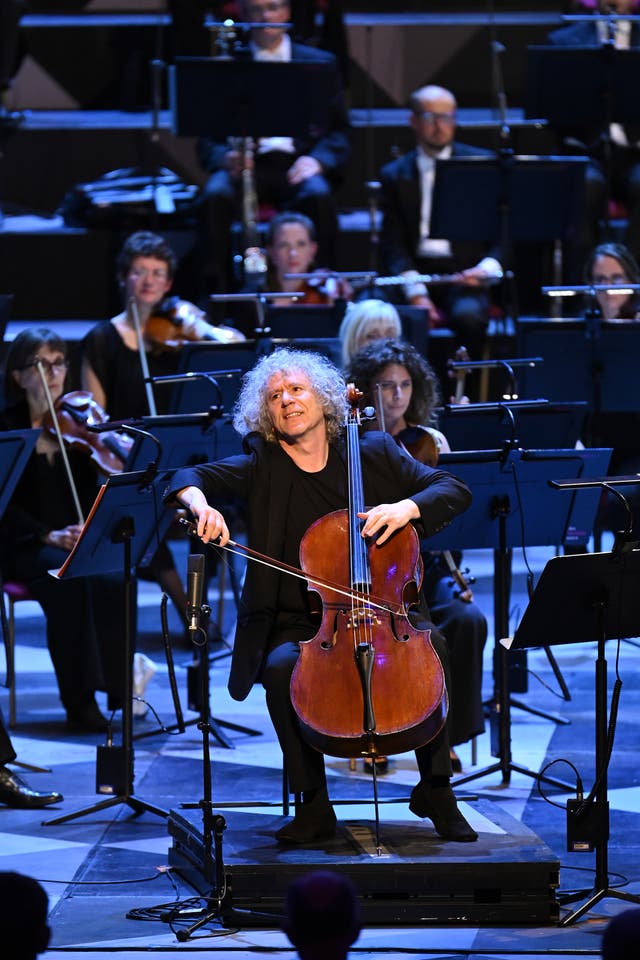
Steven Isserlis (cello, below), London Philharmonic Orchestra / Vladimir Jurowski (above)
Stravinsky Jeu de cartes (1935-6) Walton Cello Concerto (1955-6) Bach (arr. Goldmann) 14 ‘Goldberg’ Canons BWV1087 (1742-4 arr. 1977) Hindemith Symphony ‘Mathis der Maler’ (1933-4)
Royal Albert Hall, London Thursday 12 August 2021
Written by Richard Whitehouse; pictures (c) Chris Christodoulou
Vladimir Jurowski this evening concluded his highly impressive 14-year tenure as Principal Conductor of the London Philharmonic Orchestra with a thoughtfully conceived and well-proportioned programme; one which typically played to this orchestra’s strengths as much as to his own.
Although it can seem something of an ‘also-ran’ in the context of his compositions from the period, Stravinsky’s Jeu de cartes lacks for little in terms of that rhythmic effervescence as was engagingly evident in this performance – Jurowski pointing up the humour and even occasional glimmers of pathos that inform what can easily seem music written on autopilot. The LPO responded with a trenchancy and alacrity as held good throughout this ‘ballet in three deals’, the tonal punning of whose culmination at least ensures a humorous outcome.
Walton’s Cello Concerto used to be regarded with even less favour than Stravinsky’s ballet, but this piece (written by its composer at much the same age) is now seen as more than the enervated recycling of past success. Steven Isserlis (above) has long advocated its cause, and there was little doubting his commitment in a reading of perceptiveness and finesse. At times his spare and even fragile tone tended to recede into even so restrained and transparent as this, Jurowski mindful to rein in those brief climactic moments of the outer movements, but the artful interplay of the central scherzo did not lack for incisiveness or irony. Nor, after the second of the solo variations in the finale, was there any absence of rapture as soloist and orchestra are reconciled in drawing the music through to its close of fatalistic acceptance.
After the interval, a novelty in an arrangement by composer-conductor Friedrich Goldmann (1941-2009) of the 14 canons latterly identified from Bach’s printed copy of his Goldberg Variations. Arranged for a Stravinskian post-classical orchestra, these intricate and arcane studies in canonic dexterity emerge from gentle aridity to luminous elaboration with spare, methodical elegance such as intrigues and disengages in equal measure. Hardly something one expected to hear at such an occasion or this venue, though worth hearing all the same.
In its reiterating the values of Enlightenment humanism, moreover, this prepared admirably for Hindemith’s Symphony ‘Mathis der Maler’; premiered on the cusp of Germany’s descent into barbarous self-destruction, and a plea from the committed – however reluctantly – artist for a rational response as might be worth emulating today. The alternately radiant and tensile unfolding of Concert of Angels was perfectly judged, as too the plaintive resignation of the brief if affecting Entombment. The Temptation of St Anthony then made for an elaborate finale, but Jurowski paced it superbly – the plangent central interlude thrown into relief by the impassioned episodes on either side, then its anguished introduction by an apotheosis whose ultimate wresting of triumph from adversity remains thrilling as a statement of artistic intent.
A performance to savour, then, not least as John Gilhooly presented Jurowski with the Gold Medal of the Royal Philharmonic Society in recognition of services to music – an accolade with an illustrious history, which can rarely have been more deserved than on this occasion.
You can find more information on the BBC Proms at the festival’s homepage




 Arcana.fm