Unknown's avatar

About Arcana

My name is Ben Hogwood, editor of the Arcana music site (arcana.fm)

BBC Proms – Timothy Ridout, BBC SO / Oramo: Arnold, Walton, Foulds & Bray

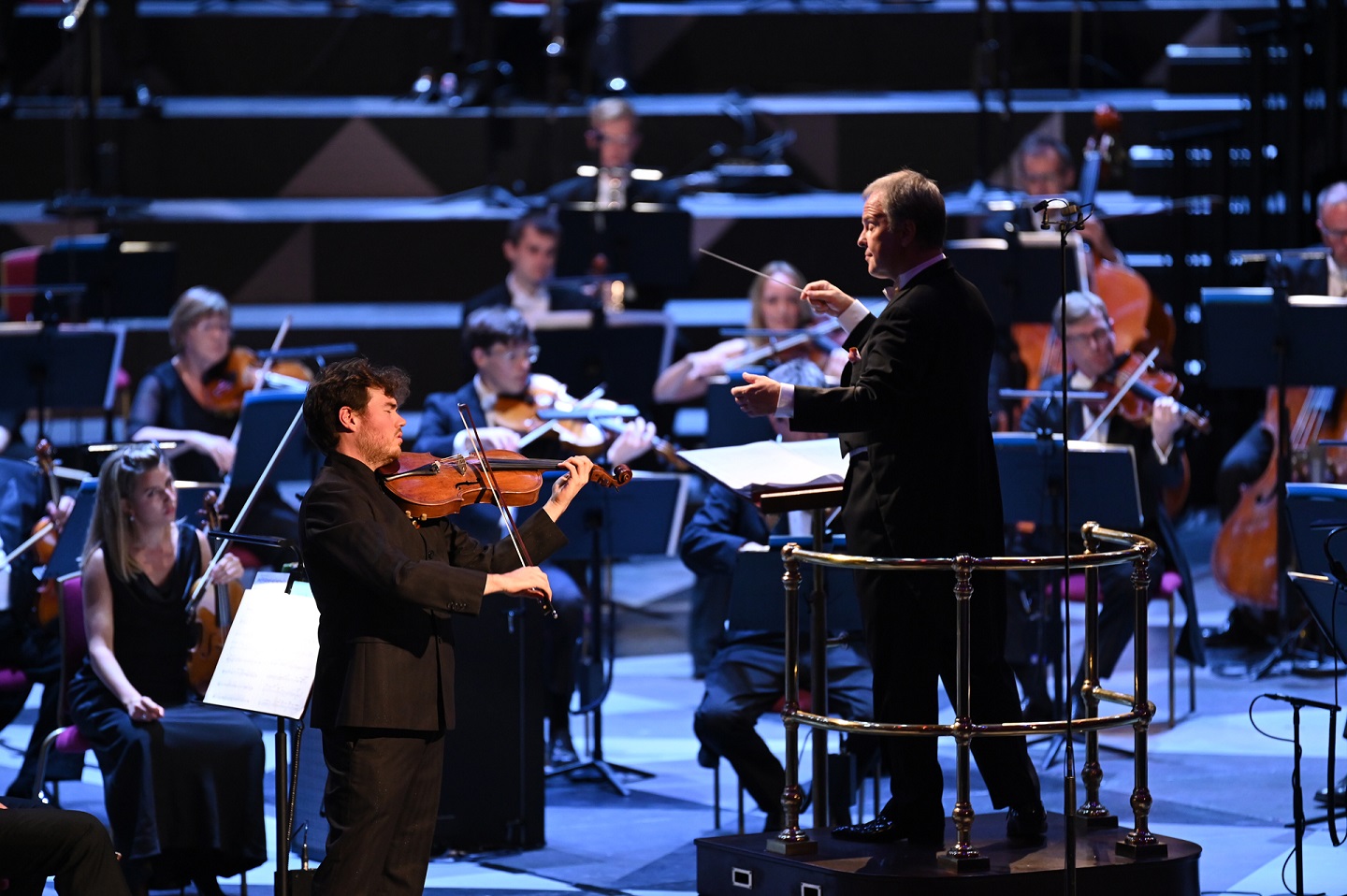
BBCSO_Oramo_Ridout_09_CR.Chris Christodoulou

Timothy Ridout (viola), BBC Symphony Orchestra / Sakari Oramo

Foulds Le cabaret Op.72a (1921) [Proms premiere]
Walton
Viola Concerto (1928-9, rev. 1961)
Bray
 Where Icebergs Dance Away (2021) [UK premiere]
Arnold
Symphony no.5 Op.74 (1960-61) [Proms premiere]

Royal Albert Hall, London
Friday 27 August 2021

Written by Richard Whitehouse; pictures BBC / Chris Christodoulou

Sakari Oramo tonight returned to the Proms for the first of two concerts as chief conductor of the BBC Symphony Orchestra, in a typically wide-ranging programme of British music as commenced with the overture La cabaret that John Foulds penned as incidental music before it became an autonomous item. For all its vaudevillian aura and unabashed razzmatazz, this ‘Overture to a French Comedy’ throws in numerous stylistic curveballs to point up its intent such as Oramo, given an advocacy of this composer stretching back over two decades, underlined with relish.

Although Walton’s music of the 1920s evinces a not dissimilar extroversion, a very different aspect of the composer is evident in his Viola Concerto – heard this evening in its revision for reduced forces but a notable role for harp. It also brought a Proms debut for Timothy Ridout, his burnished tone and unfaltering intonation much in evidence in the first movement with its smouldering pathos and brief if volatile flights of fancy (qualities which suggest Prokofiev’s First Violin Concerto as the most likely model) that were carefully integrated into the whole.

The central Vivo was the undoubted highlight of this performance – Ridout’s passagework unflagging even at the tempo indicated by the revision, not least in those syncopated asides that amply delineate the spirit of the times. By contrast, the finale began reticently then only gradually intensified towards a climactic tutti that brought out the best in the BBCSO; after which, Ridout’s take on the coda made it seem almost parenthetical in its overt rumination, while rounding off the whole work with appropriate inevitability and unforced eloquence.

After the interval, a first hearing in the UK for Where Icebergs Dance Away – the most recent orchestral piece by Charlotte Bray, whose Cello Concerto was a highlight of the 2016 season. Inspired by the icy landscapes encountered on a visit to Greenland, this brief yet atmospheric piece – a faster central episode placing the relative stasis on either side into meaningful relief – suggested qualities of greater organic growth and emotional intensification which deserved to be expounded on a larger scale, while never feeling underdeveloped in the present context.
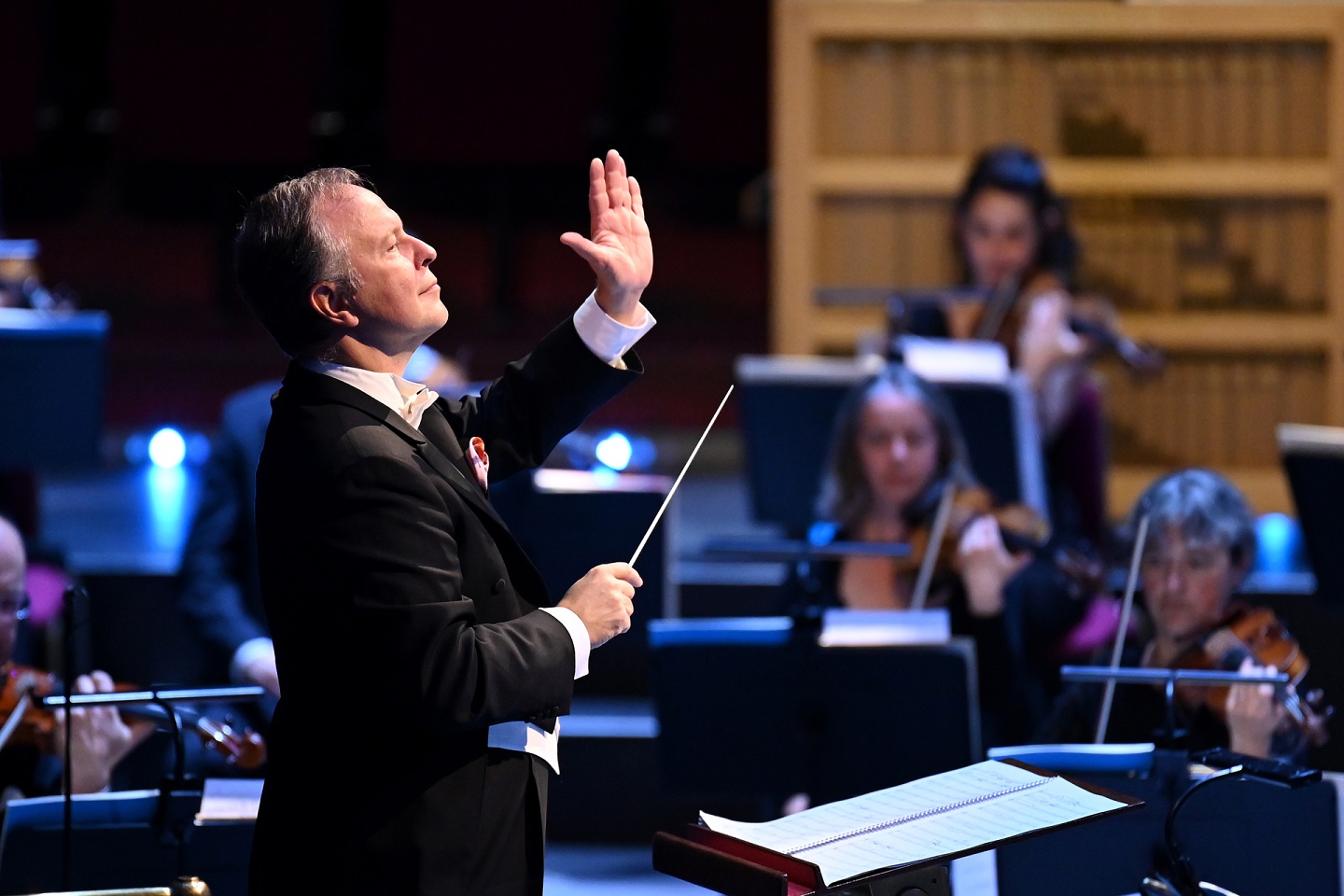
It may have taken six decades to appear at the Proms, but Sir Malcolm Arnold‘s Fifth Symphony – if not the finest of his cycle, is surely its most representative by dint of those confrontational extremes which, in the opening Tempestuoso alone, pit acerbic irony against expressive angst as threaten to overwhelm the movement’s formal logic. That it failed to do so was testament to Oramo’s acuity in keeping this music’s seeming excesses within relative proportion – not least in the violent irresolution of the closing pages, with their stark withdrawal into silence.

Featuring one of Arnold’s most potent melodies, the Andante brought a rapt response by the BBCSO strings and if Oramo drew less than the ultimate terror from the central climax, the transition to the pensive second theme then return to the initial melody were breathtakingly achieved. Neither was there any lack of malevolence or sardonic humour in the scherzo – its energy carrying over into a finale that was paced superbly to a climactic restatement of the Andante‘s melody and its collapse into nothingness. A fitting close to an impressive reading.

You can find more information on the BBC Proms at the festival’s homepage. Click on the composer’s names for more information on Charlotte Bray and Sir Malcolm Arnold, while for more on Timothy Ridout click here

Switched On – Various Artists: Spaciousness 2 (Lo Recordings)

spaciousness-2

reviewed by Ben Hogwood

What’s the story?

In which Lo Recordings founder Jon Tye presents a sequel to their successful Spaciousness compilation of 2019. There they expressed the wish for ‘a series of releases that seeks to explore the connections, the overlaps, the roots and the future of a music variously referred to as ambient, deep listening, new age and even post classical.’

What’s the music like?

The second volume of Spaciousness follows on seamlessly from the first. As he did then, Jon Tye has linked together an especially calming selection exploring the corners of the catalogue. The music is effective as a meditation aid, and works equally well in foreground or background listening.

Highlights include the horizontal vibes of Integer by Lauren Doss, with a soothing vocal amid the flickering textures, and the lightly scattered percussion on David Casper‘s Dawn Poems Part 2: Awakening, which has its origins in the east.

Outdoor sounds and soft bells are the order of the day as first track Cruising in the Dimension of a Shenandoah Backyard, from JD Emmanuel, drifts into view, and this segues into Kaitlyn Aurelia Smith‘s remix of Cool Maritime‘s Climbing Up, which starts out like written out wind chimes but then gains positive energy from busy but soothing loops. The Gigi Masin remix of Brain Machine‘s Crystal Clouds bleeps and chugs in a strangely restful way, while the activity of Ariel Kalma‘s Space Forest is underpinned by an appealing drone.

Later on we get to enjoy the gentle open spaces of Vague ImaginairesLe Sillage du Vaguarti, and a serene closing track from Mary Lattimore, the Ocean Moon Redux of A Unicorn Catches A Falling Star

Does it all work?

Yes – with more bleeps than the first, so not as explicitly relaxing, but still finding a very calm headspace. There is more than a touch of new age about the musical language and titles, but to be honest Spaciousness 2 covers a number of stylistic bases with effortless ease.

Is it recommended?

It is – a worthy sequel to the first volume, and good to see Lo Recordings pushing the boat out and incorporating a number of ambient styles. Proof that you can have many different forms of musical relaxation!

Stream

Buy


Listening to Beethoven #185 – Piano Sonata no.18 in E flat major Op.31/3

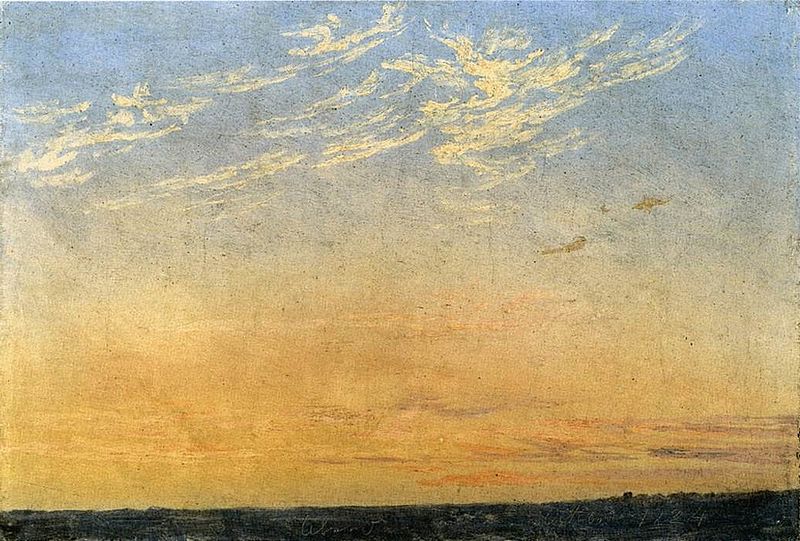
Evening by Caspar David Friedrich (1824)

Piano Sonata no.18 in E flat major Op.31/3 for piano (1802, Beethoven aged 31)

1. Allegro
2. Scherzetto: Allegretto vivace

3. Menuetto: Moderato e grazioso
4. Presto con fuoco

Dedication unknown
Duration 23′

Listen

written by Ben Hogwood

Background and Critical Reception

The third of Beethoven’s Op.31 trilogy is in four movements – the last of his piano sonatas to be structured in this way. It returns to happier climes after the darkness of The Tempest, but does so in wholly original ways.

Critics are united in their praise for this work, with Jan Swafford taking up the story. ‘Beethoven begins Op.31 no.3 in E flat with a harmony so strange that it would have earned him more cries of bizarre from critics if it did not commence a work of surpassing warmth, wit and winsomeness. The beginning is an invitation, like a hand extended in friendship or love.’ The importance of positive feeling is stressed. ‘Following the scherzo, most unexpectedly, comes a graceful and lyrical minuet – he wanted no slow movement to trouble the warm weather of this sonata. For conclusion, a tarantella marked Presto con fuoco, with the fire appropriate to that old whirling dance in which, once upon a time, you hoped to survive the bite of the tarantula by dancing to exhaustion.’

For Sir András Schiff, ‘the third sonata, in E flat major, is probably the hardest one to paraphrase in words: on the one hand it seems tender, entreating and pleading, with a lyrical basic mood strongly in evidence; and on the other hand, in the scherzo and finale it maintains a high spirited and urgent sense of motion.’

The nature of the finale earned the sonata a nickname of The Hunt in some quarters – and many admirers, including Angela Hewitt, who found that ‘Beethoven is in his element, for sure’.

Thoughts

Op.31/3 starts with a gentle question; a chord that is the musical equivalent of a bird unexpectedly landing on a small branch. It is the most unusual beginning to a sonata yet, and opens up a beautifully paced story, Beethoven’s invention bubbling up and down the keyboard. The chord itself is the sort you could easily play over and over again on the piano, creating an oasis of calm and positivity.

After this fascinating and elusive first movement, Beethoven has fun with the martial rhythms of the second. Back in A flat major, this is far removed from the stillness of the Pathétique slow movement, with the composer intent on making his audience smile and jump with the suddenly loud interjections. As a complement, a softer side in the form of a charming minuet, flowing nicely but with just a touch of shade in the form of some unusual harmonies – Beethoven’s second theme has a slight shiver running through it.

The last movement is a canter – as Angela Hewitt says, a bit fast for a hunt, but with a galloping gait. Beethoven builds up terrific momentum here, and some of the bigger chords would surely have been stretching the pianos of the day. The good feeling is irrepressible, in complete contrast to the end of the Tempest, and the sonata finishes with a winning flourish. Beethoven’s strength of feeling wins the day.

Recordings used and Spotify links

Emil Gilels (Deutsche Grammophon)
Alfred Brendel (Philips)
András Schiff (ECM)
Angela Hewitt (Hyperion)
Paul Badura-Skoda (Arcana)
Stephen Kovacevich (EMI)
Igor Levit (Sony Classical)
Claudio Arrau (Philips)
Daniel Barenboim (Deutsche Grammophon)

Some wonderful recordings to savour here – with Sir András Schiff, Stephen Kovacevich and Alfred Brendel particularly enjoyable. Yet the most enjoyable guide, and a regular late night companion for this listener, is Emil Gilels, who gets a perfect balance between the delicacy and determined optimism at the heart of this work.

You can hear clips of Hewitt’s recording at the Hyperion website

You can chart the Arcana Beethoven playlist as it grows, with one recommended version of each piece we listen to. Catch up here!

Also written in 1802 Hummel Piano Quintet in E flat major Op.87

Next up 6 Variations in F major Op.34

Listening to Beethoven #184 – Piano Sonata no.17 in D minor Op.31/2 ‘The Tempest’

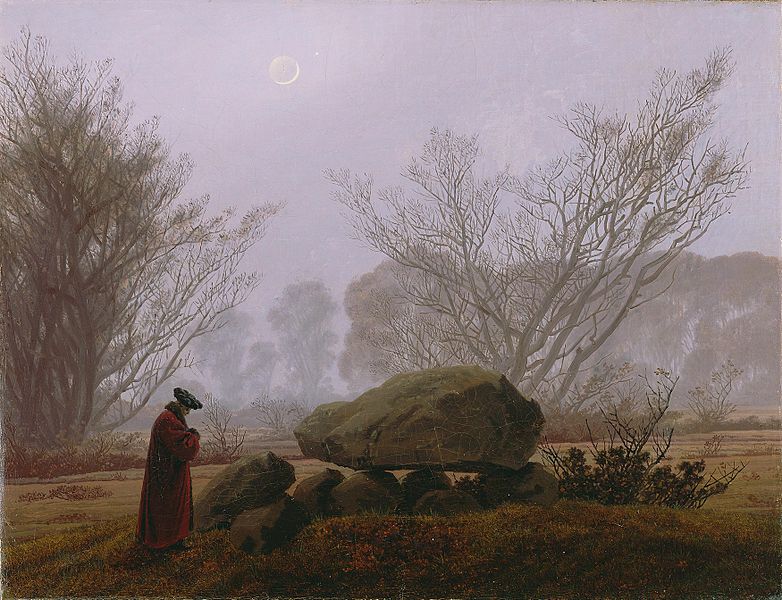
Walk at Dusk (Man Contemplating a Megalith), possibly a self-portrait by Caspar David Friedrich (1837-40)

Piano Sonata no.17 in D minor Op.31/2 ‘The Tempest’ for piano (1802, Beethoven aged 31)

1. Largo – Allegro
2. Adagio
3. Allegretto

Dedication unknown
Duration 23′

Listen

written by Ben Hogwood

Background and Critical Reception

As we have previously considered, the Op.31 sonatas were composed in the year of Beethoven’s Heiligenstadt Testament, written on 6 October 1802. In this landmark letter to his brothers, which was left unsent, he revealed the full torment of his encroaching deafness – and while nobody would guess Beethoven’s fate from the first or last in the Op.31 set of his troubles, they could be left in no doubt by the second.

Its nickname of The Tempest could well be spurious, for it was applied after Anton Schindler recounted a conversation asking the composer what the piece was about, whereupon Beethoven supposedly said, ‘Read Shakespeare’s Tempest!’

Angela Hewitt, in the booklet notes accompanying her Hyperion recordings of the sonatas, gives a heartfelt appraisal of the sonata, noting its quote in the first movement of the aria Es ist vollbracht from J.S. Bach’s St. John Passion, and also the similarity of the last few bars to the rumbling of distant thunder, a quality identified by Beethoven’s friend Carl Czerny.

Hewitt takes in ‘one of Beethoven’s most glorious slow movements’, with a dolce melody that proves ‘heartbreaking in its eloquent simplicity’. In the third movement, ‘the tragic feeling continues right to the end, with the music disappearing into the void.’

Thoughts

This sonata is both dramatic and tragic – the opposite of its predecessor in G major. From the beginning it has a heavy heart, and a tendency to lean on dissonances in a way that somehow anticipates the music of Janáček, still some 120 years away.

The first movement paints a dark picture, with a lot of the action lower down in the piano. Ominous rumblings and angular lines are the order of the day, and as the development of these ideas progresses the music almost stops, enfolded in its own mystery. Suddenly a bolt of lightning thunders down, the listener jolted back to an awful reality.

After the fire and brimstone of the first movement, the second is calmer but not necessarily consoling. The intensity is still present in Beethoven’s thoughts, now presented in a measured way. Again the composer’s use of silence is telling, as is the time given to the lower end of the piano once again.

The finale shifts up towards the higher register but stays resolutely in D minor. It retains the powerful expression of the first two movements, but stays in semiquavers the whole way through, meaning the tension never lets up. Just on the approach to the recap of the main theme the music adopts a rocking motion, before subsiding to a quiet, thoughtful end. There is no major key happiness to be had here.

This must surely be the lowest piano sonata to have been written by 1802, and would have had an enormous impact on early audiences. In the knowledge of Beethoven’s realisation of his deafness it is convenient to link the Tempest sonata to the anguish he must have felt, but it really does feel like a pure expression of pain and loss. The piano sonata as Beethoven would have known it was breaking new grounds.

Recordings used and Spotify links

Emil Gilels (Deutsche Grammophon)
Alfred Brendel (Philips)
András Schiff (ECM)
Angela Hewitt (Hyperion)
Paul Badura-Skoda (Arcana)
Stephen Kovacevich (EMI)
Igor Levit (Sony Classical)
Claudio Arrau (Philips)
Daniel Barenboim (Deutsche Grammophon)

Emil Gilels is the ideal guide for this tragic piece, and his interpretation has a great deal of gravitas. The crunch of the lower register chords comes through on Paul Badura-Skoda’s fortepiano account, while Sir András Schiff conveys plenty of drama too. Angela Hewitt’s heartfelt account is also warmly recommended.

You can hear clips of Hewitt’s recording at the Hyperion website

You can chart the Arcana Beethoven playlist as it grows, with one recommended version of each piece we listen to. Catch up here!

Also written in 1802 Haydn Harmoniemesse

Next up Piano Sonata no.18 in E flat major Op.31/3

Listening to Beethoven #183 – Piano Sonata no.16 in G major Op.31/1

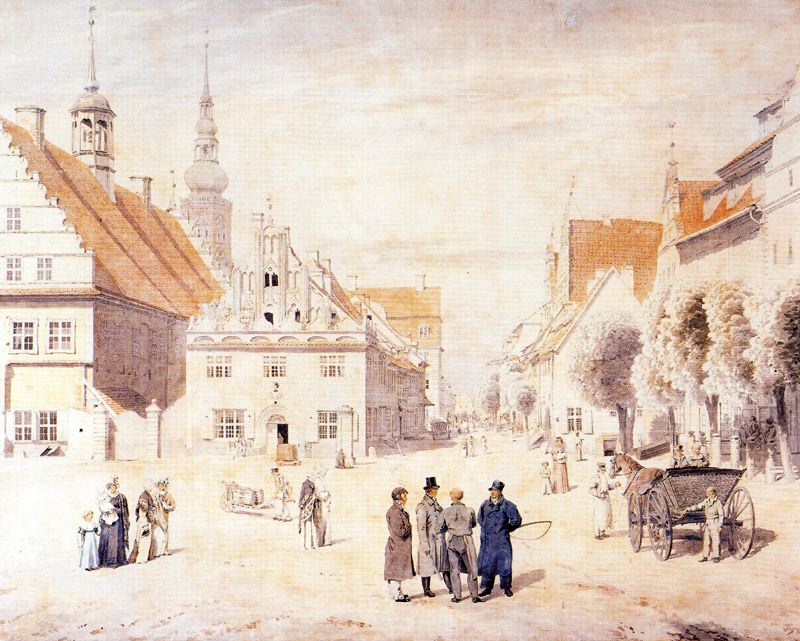
The Marketplace in Greifswald by Caspar David Friedrich (1818)

Piano Sonata no.16 in G major Op.31/1 for piano (1802, Beethoven aged 31)

1. Allegro vivace
2. Adagio grazioso
3. Allegretto

Dedication unknown
Duration 25′

Listen

written by Ben Hogwood

Background and Critical Reception

The three Op.31 piano sonatas stand right at a junction in Beethoven’s output, at the end of his more ‘classical’ approach and at the start of a period of even greater originality. Sir András Schiff notes this is the last ‘set’ of sonatas Beethoven published, and like Op.2 or Op.10, ‘we really do hear and notice an enormous diversity’. The trio is much-loved by pianists, but perhaps inevitably star billing goes to the minor key work in the middle, the ‘Tempest’.

That is to the detriment of the other two works in the group – beginning with this work in G major, something of a conundrum for Angela Hewitt. Writing booklet notes for Hyperion, the pianist confesses to a puzzled reaction on her first encounter with the piece. ‘What on earth is this?’, she thought. ‘It seemed to comprise a first movement in which the two hands can’t play together and, when they do, run around in octave unisons, and with a banal-sounding second theme that didn’t help matters; a second movement which had so many notes on the page and looked either drastically simple or too flowery, and how were you supposed to play that left hand anyway; and a last movement that had a nice theme but looked overly long and, to make matters worse, ended softly. So I didn’t go near it.’

A conversation with conductor Sir Roger Norrington gave her deep insight into the humour in Beethoven’s music, and her view was transformed. It was ‘then possible to see this very unique sonata, and indeed most of the cycle, in a totally different light. It was, and remains, very liberating.’

She points out all the instances of humour in Beethoven’s writing, especially the overly long build up to the return of the first theme, which leans on a spicy clash between E flat and D, before tripping into ‘one of those country themes that Beethoven so excelled at’, and which his pupil Czerny said should be played ‘facetiously’. The slow movement ‘is a very unusual movement. We immediately enter the world of Italian opera, and it is hard not to imagine a great bel canto singer accompanied by a mandolin. The most delicate touch is needed for this movement as well as great poise. I see it more as Beethoven setting out to prove that he could write better Italian music than the Italians!’ Finally the last movement, which ‘is perhaps less inspired, but should not be rushed. Much of this music could pass as Schubert, but the coda couldn’t be by anybody but Beethoven.’

Thoughts

A delightful piece, and an unpredictable one. This is a work where the sense of Beethoven flexing his muscles as a composer is undeniable, and the freedom of expression he has here is perhaps greater than at any point in his output so far. The first movement is allowed to run free, as though improvised at the piano, but it keeps within the boundaries of sonata form and never rambles. Instead it is witty, thoughtful, expansive, intimate and consoling by turn, always on the move and always keeping the listener guessing.

Second movement really expansive flourishes in the right hand, going further and further from the tonic in what feels like an increasingly restless desire to escape the conventional tonality. This is a really substantial, ‘staged’ movement that tells a powerful story.

Third movement feels just right after the emotional drama of the second, it is reassuring and comforting. There are some questions to this however when Beethoven starts developing the theme, and suddenly things feel less certain. The end is pure theatre, too, slowed down and drawing out the inevitable return to the home key – but even this is far from certain

That Beethoven could write a piece of such surety and humour in one of his darkest hours says much for the composer’s temperament, and it gives us an indication of how he would respond to his impending deafness with ever greater and more original music.

Recordings used and Spotify links

Emil Gilels (Deutsche Grammophon)
Alfred Brendel (Philips)
András Schiff (ECM)
Angela Hewitt (Hyperion)
Paul Badura-Skoda (Arcana)
Stephen Kovacevich (EMI)
Igor Levit (Sony Classical)
Claudio Arrau (Philips)
Daniel Barenboim (Deutsche Grammophon)

Artists really enjoy themselves in a work such as this, and providing their approach is sensitive to Beethoven’s original thoughts there is much fun to be had. I particularly enjoyed the versions from Gilels, Badura-Skoda, Hewitt, Schiff and Brendel, though in the hands of Schiff Beethoven’s inspiration felt more on the edge and likely to go over at any moment.

You can hear clips of Hewitt’s recording at the Hyperion website

You can chart the Arcana Beethoven playlist as it grows, with one recommended version of each piece we listen to. Catch up here!

Also written in 1802 Weber Peter Schmoll und seine Nachbarn

Next up Piano Sonata no.17 in D minor Op.31/2 ‘The Tempest’