
Unknown's avatar

About Arcana

My name is Ben Hogwood, editor of the Arcana music site (arcana.fm)

BBC Proms 2017 – I Fagiolini introduce Monteverdi to the Cadogan Hall

I Fagiolini / Robert Hollingworth (above) Photo (c) BBC/Chris Christodoulou

Monteverdi Cruda Amarilli; Sfogava con le stele; Longe da te, cor mio; Possente spirto from Orfeo, Chiome d’oro, Vorrei baciarti, o Filli

Roderick Williams Là ci darem la mano (BBC commission: world premiere)

Monteverdi Laudate pueri Dominum a 5 (concertato); Volgendo il ciel per l’immortal sentiero

Cadogan Hall, Monday 17 July 2017

Listen to this concert on the BBC iPlayer

As an introduction to the wide musical canon of Claudio Monteverdi (1567-1643), there is surely no better place to start than with this vividly coloured concert from I Fagiolini and their quirky leader Robert Hollingworth.

They gave the Cadogan Hall – and BBC Radio 3 listeners – an insight into his daring harmonic world, showing just how keenly Monteverdi could respond to the challenges of word setting. They also showed how he could operate equally effectively in a reverent sacred setting, using the same imagination as in the wild and wonderful secular works.

Monteverdi, who was born 450 years ago to the year, is essentially a ‘Renaissance’ composer (the period running very roughly from 1400 to 1600) but he wrote in such an original way that even now his music sounds forward-looking.

The first trio of madrigals in this concert showed the composer’s skill with unaccompanied voices, and the clarity with which I Fagiolini could deliver them. Cruda Amarilli (from 2:14 on the broadcast link) Sfogava con le stele (5:17) and the darker Longe da te, cor mio (8:45) were all performed with the utmost clarity.

Monteverdi is also the acknowledged father of opera, with L’Orfeo (1607) the first example in the form. It is a remarkable work, and this lengthy excerpt (from 13:09 to 22:30) shows why. Tenor Matthew Long held his notes with impeccable control, but also showered them with the composer’s written embellishments, fluctuating the note ever so slightly to give extra expression. He was shadowed by violins (Rachel Podger and Kati Debretzeni) and cornetts (Gawain Glenton and Conor Hastings).

Back to the madrigals, and the seventh book Monteverdi published in Venice in 1613. Chiome d’oro (Golden tresses) (24:14) had an attractive introduction with the two violins dovetailed, a sign of things to come from the sopranos Anna Crookes and Ciara Hendrick, and their beautiful duet from 25:06. From 27:37-32:32 the spotlight changed to Hollingworth, whose nervous lover was characterised to perfection, and Kendrick, his intended. As the song progressed so he moved progressively closer to her, and by the end the two leaned in towards s kiss – a simple but extremely effective staging!

From 35:30-42:13 we heard a new work, Roderick Williams imaginatively setting Lorenzo da Ponte’s words used by Mozart in the famous Don Giovanni aria Là ci darem la mano, here set for a five-voice choir. Williams writes through the eyes and ears of Monteverdi and the results were intriguing and often laced with humour. In the middle he added a clever invention, the reading of a letter from Monteverdi while the singers tried to outdo each other in the background. The madrigal ended in a flurry of sexual tension.

Roderick Williams takes the applause with I Fagiolini and Robert Hollingworth after the world premiere of his interpretation of Là ci darem la mano.

Finally a pair of real wonders, a setting of Laudate pueri Dominum (from 44:33) and then an extended madrigal, Volgendo il ciel per l’immortal sentiero (52:42–1:03:13), designed for the praise of the Emperor in spite of the Thirty Years War. It is a mini-masterpiece, capped by the central dance (59:10) and its lilting rhythms begun by theorbo player Eligio Quinteiro. In these capable hands we enjoyed the complete purity of C major, beautifully spun by Monteverdi’s hand.

A wonderful concert, then, performed in the vivacious spirit that I Fagiolini bring to all their performances, celebrating the humour and quirky rhythms within the music, but bringing the seriousness of Monteverdi’s invention to play also. I urge you to hear it!

Ben Hogwood
BBC Proms 2017 – John Adams and Beethoven begin the festivities

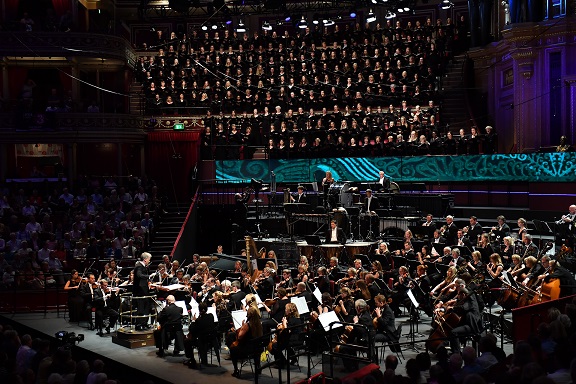
The first night of the BBC Proms is a watershed moment in the summer of a classical music lover. Yet increasingly the festival is working on being more inclusive, and some of this year’s BBC Proms Youth Choir (seen above the BBC Symphony Orchestra and conductor Edward Gardner) had not even sung in public before, let alone attended the festival.

Such is the uniting power of one of Britain’s favourite summer institutions, and once again it was off to a flyer with the customary big choral work (John Adams‘ Harmonium) a world premiere (Tom Coult‘s St John’s Dance) and a high profile solo contribution from Igor Levit, whose account of Beethoven‘s Piano Concerto no.3 met and surpassed its heady expectations.

Both Levit and Coult had political undertones to their work. Coult’s new composition depicted the madness of the Middle Ages, people possessed by an all-encompassing dance of death that drove them into dangerous physical and mental situations. A parallel, you might think, for today’s superpowers and the shocking news they bring on a daily basis. Whether these references were intentional or not, it was good to have a new piece that started quietly, with a deliberately fragile violin solo, and built to its bigger moments.

Levit (above, at the piano) also had quiet asides, but his were absolutely spellbinding – the first movement cadenza and slow movement introduction in Beethoven‘s Piano Concerto no.3 both cases in point. Here we could easily have been back at the Wigmore Hall, witnessing a solo sonata performed to a select few, such was the intensity of his communication at a quiet dynamic. When he was with the orchestra the intensity subsided a little, not least because the balance favoured a coarse timpani sound. That said, the playing of the BBC Symphony Orchestra woodwind was particularly beautiful under Edward Gardner’s watchful eye.

Levit had great things to say, his mind clearly at one with Beethoven’s moods and melodic invention. His use of silence was keenly sensitive, the tension evident in a brooding opening movement and deeply thoughtful Largo. The Rondo finale freed itself from the confines, skipping to a more obvious beat – but then Levit delivered a deeply felt encore, Beethoven’s Ode to Joy (from the Choral Symphony finale) reduced to first principles and played to emphasise its role as an anthem of European unity. It was a provocative statement of which Leonard Bernstein – who conducted the Choral symphony in the unification concert when the Berlin wall fell in 1989 – would have been proud.

Finally we went for broke, with the 400-strong throng of the BBC Proms Youth Choir, brilliantly drilled and tirelessly rehearsed to deliver a moving and colourful performance of John Adams‘ Harmonium. Here too there were powerful statements in settings of the poetry of John Donne and Emily Dickinson, and Edward Gardner ensured they were delivered with great clarity and breadth. The thrill of Adams’ colourful music as it generated momentum was as strong as ever, and the percussionists of the BBC Symphony Orchestra in particular deserve great credit for their dexterity, rhythmic power and definition.

As a side note, what a shame to lose the ‘Further Listening and Reading’ section from the Proms programme this time around. It has been my ‘go to’ page ever since I started going to the Proms, and to not have it there feels like an unnecessary omission, even with the introduction of a new Listening Service – Tom, that is. Books are important in classical music, and so are recorded statements. To lose them from the programme is disappointing.

That said – how great  it is to have the festival back, confirming the ascent of summer in thrilling style. Eight weeks of great music lie ahead!

Ben Hogwood (photos (c) Chris Christodoulou)

This year Arcana will once again have two different approaches to its coverage of the BBC Proms. There will be a few straight ‘reviewed’ concerts, but the focus of our coverage will be on taking people to the Proms who have not been before.

To that end our reviews will come from first-time punters chosen from a pool of friends and contacts – many of whom will see things that us regulars do not! Most reviews will be from the Arena, which is the ultimate Proms experience – and which to my knowledge is the best part of the Royal Albert Hall for sound quality and atmosphere.

No other source reviews from here as far as I am aware…so stick with Arcana in the weeks ahead, particularly through August. We will look to bring classical music to new audiences on a weekly basis!

Wigmore Mondays – Hanno Müller-Brachmann & Hendrik Heilmann in Mahler

Hanno Müller-Brachmann (bass-baritone), Hendrik Heilmann (piano)

Hanno Müller-Brachmann pic © Monika Rittershaus

Mahler Kindertotenlieder (1901-4) (27 minutes)

Mahler Rückert Lieder (1901-2) (21 minutes)

Wigmore Hall, London; Monday 10 July, 2017

Listen to the BBC broadcast here

Written by Ben Hogwood

First, a health warning. These songs have subject matter and musical content that is not for the faint of heart! Yet if you can allow for Mahler’s preoccupation with death and its implications, then there is much to appreciate here in the vivid power of his writing, and it does offer some consolation to the pain and strife elsewhere.

Mahler was drawn to the text of Friedrich Rückert, and set it on several occasions. The first ‘cycle’ of the poet’s works was Kindertotenlieder (Songs on the death of children), which drew from the composer some remarkably bleak and intense music, responding as he was to the death of eight of his siblings during their childhood. The bitterest of ironies was that only four years after the completion of the work, the composer’s daughter Maria died from scarlet fever aged just four.

This lends a painfully poignant air to the music, fully exploited here by the outstanding German bass-baritone Hanno Müller-Brachmann and his descriptive musical partner, pianist Hendrik Heilmann. The singer’s tone was slightly nasal in the delivery of these songs, but right from the start of the opening poem, Nun will die Sonn so hell aufgeh’n (Now the sun will rise as bright, from 1:51 on the broadcast link) it was used very carefully to give an idea of the hollow grief for those involved.

The second song, which seems to tell of a child suffering from an incurable disease (from 7:55), laid bare its grief, as did the third (12:58), talking of ‘O du, des Vaters Zelle, Ach zu schnelle Erlosch’ner Freucenschein’ (‘O you, the joyful light…too soon extinguished’). This was similarly dark, reaching an uncomfortably powerful climax from 16:40.

And yet, the radiant brightness of the sun was gradually used to convey the release of grief and the promise of hope in the future, the young lives laid to rest. This was heard fleetingly in the middle of the second (around 10:35) and third songs, usually where Mahler moved to a major key, but in the fourth, where the poet muses how ‘they have only gone for a long walk’, Muller-Brachmann and Heilmann made clear the serenity of the end (from 20:50), where ‘the day is beautiful on these hills’.

Finally, In diesem Wetter (In this weather, 21:38), where the tension broke loose in the form of a storm, dramatically conveyed by Heilmann, before Müller-Brachmann hurled forth a vocal bristling with anger and panic. This, too, subsided to a form of peace, the five songs finally allowed a resting place.

After this more Mahler was a risky move, but with such authoritative singing it made sense to go into the five Rückert-Lieder, which by and large offer a less stark approach. Liebst du um Schönheit (If you love for beauty, 31:12) offered a lighter mood, and more vibrato from the singer, who then exploited the dark humour from the start of Blicke mir nicht in die Lieder! (Do not look at my songs!) (33:30).

The distracted Ich bin der Welt abhanden gekommen (I am lost to the world) was a beauty, the most fragrant of the songs heard so far, beautifully introduced by Heilmann 34:45 and softly sung. Yet there was a feeling of inevitability about the approaching and devastating Um Mitternacht (At Midnight, 37:56) where a cold shadow fell over the hall. Interestingly this was sung at a lower pitch than is normally the case, suspended in G minor rather than the B flat minor normally used.

Finally a song of true peace and rest, Ich bin der Welt abhanden gekommen (I am lost to the world, 44:50) was introduced with all the time in the world by Heilmann, who dictated the slow but lovingly wrought interpretation.

These were superb, thoroughly authentic Mahler performances, draining every last piece of intensity from the words and, equally importantly, from the piano part. It almost seemed churlish to offer encores, but there were two from Mahler’s pen. The first, a carefree folk setting Ich weiss nicht, wie mir ist! (I do not know what’s wrong with me, 53:45) was followed by the outrageous Lob des hohen Verstandes (Once in a deep valley, 56:23), the singer doing his best to bray like a donkey and coo like a cuckoo or nightingale as he depicted a singing competition between them!

Further listening

The works in today’s concert were orchestrated by the composer, and can be heard on this new release from the superb Alice Coote, showing their versatility for either male or female voices. The female voice lends a special potency to the text of Kindertotenlieder in particular:

It is also worth including a link to what is for many one of the greatest vocal recordings, Dame Janet Baker’s interpretations of the Mahler cycles in this concert, together with the Lieder eines fahrenden gesellen (Songs of a Wayfarer). All are conducted by Sir John Barbirolli:

Finally, in response to the encores, a listen to Mahler’s Des Knaben Wunderhorn (with Müller-Brachmann singing), a collection exploring the composer’s fascination with folksong and a child’s way of thinking, often about nature:

Wigmore Mondays – Clara Mouriz & Joseph Middleton: Songs of the Antique

Clara Mouriz (mezzo-soprano), Joseph Middleton (piano)

Purcell/Britten Alleluia (pre-1702, realised by Britten 1960)

Alessandro Scarlatti Son tutta duolo (c1699)

Anchieta arr. Dorumsgaard Con amores, la mia madre (unknown)

Liszt 3 Petrarch Sonnets (1842-6)

Duparc La vie antérieure (1884)

Hahn Tyndaris (1900)

Ravel Kaddisch (1914)

Falla 7 Spanish Popular Songs (1914)

Wigmore Hall, London; Monday 26 June, 2017

Listen to the BBC broadcast here

Written by Ben Hogwood

A fascinating concert that confirmed the versatility of Clara Mouriz and Joseph Middleton. Their performance, titled ‘Songs of the Antique’, concentrated on songs whose music or text looks a long way to the past for inspiration.

The mezzo-soprano has a rich and powerful voice in the middle register especially, which came to the fore in passionate accounts of the Liszt 3 Petrarch Sonnets, but also in the solo writing of Ravel and the quasi-orchestral scope of Duparc.

First we went right back to the Eighteenth century for an Alleluia – a song originally attributed to Purcell but found to be by John Weldon. Britten, as part of his Purcell revival, provided a complementary piano part, one that shadows the spun out vocal. This vocal won’t be to everyone’s taste, but Mouriz mastered it brilliantly here (from 1:49 on the broadcast link provided).

The Scarlatti, an excerpt from the opera La donna ancora è fedele, made a nice contrast (3:52). Unlike his brother, who wrote copious amounts of keyboard music, Alessandro wrote many operas – and the excerpt here shows how fluid his vocal writing could be. Meanwhile the arrangement of Anchieta’s folksong, thought to be from the fifteenth century, had a primal quality in this interpretation – with elegantly shaped piano from Middleton (7:01).

The Liszt was a highpoint of the recital, not just for Mouriz’s fire and passion but for Middleton’s word painting with the piano part. Liszt was borderline-obsessed with the sonnets, complementing his two vocal settings of the trio with powerfully descriptive pieces for the piano. The vocal line is highly charged in all three songs, and strongly Italian in musical flavour as well as language. Sonetto 104, Pace non trovo (I find no peace) surged forward turbulently in the piano part, a restlessness matched by Mouriz’s outpouring (from 10:31).

The Sonetto 47, Benedetto sia ‘I giorno (Blessed be the day) was notable for ‘the sighs and tears, the longing’ found by Mouriz at 20:07, while the final Sonetto 123 I’ vidi in terra angelici costumi (I beheld on earth angelic grace) was beautifully sung (from 23:10), Mouriz mastering the wide ranges and dynamics Liszt asks for. Middleton’s decorative piano part was brilliantly done too.

After this we had the relatively rare chance to appreciate the songwriting guile of Henri Duparc, a French composer whose life was tragically cut short due to neurasthenia. He left just thirteen published songs, of which La vie antérieure is an expansive example. It began optimistically (30:13) but turned rather sour towards the end, this performance carefully paced and given impressive detail by Middleton.

Hahn’s Tyndaris offered more optimism after the Duparc (from 34:35) while Ravel’s Kaddisch, from his Deux melodies hebraïques, had a powerful declamation that Mouriz used to take over the hall (36:15).

Finally the Spanish mezzo-soprano was completely on home turf for Falla’s brilliantly written songs, a whole wealth of different characters and emotions coming out in this performance (from 42:22).

We had the famous Seguidilla murciana (43:00) where ‘people who live in glass houses shouldn’t throw stones’, the mournful Asturiana (45:10), a brisk Jota (47:58), a soft Nana (Lullaby) (51:03), a brighter Cancion (52:48) with darker lining and finally the dramatic Polo (53:42), where the piano’s repeated notes appear to describe the stabbing pain in the singer’s heart.

As a richly deserved encore the pair gave a soulful performance of a Spanish funeral song, Let my soul mourn (57:08).

Further listening

The works in today’s concert are on Spotify and can be heard below:

As a contrast, why not try an album of orchestral music by the Spanish composer Turina, featuring at its centre the collection of Poema en forma de canciones:

Meanwhile, you can watch Clara and guitarist Sean Shibe perform Asturiana, from the Falla songs, below:

Wigmore Mondays – Carducci Quartet play Philip Glass, Arvo Pärt & Dvořák

Carducci Quartet (above, © Andy Holdsworth) (Matthew Denton, Michelle Fleming (violins), Eoin Schmidt-Martin (viola), Emma Denton (cello)

Philip Glass String Quartet no.3, Mishima (1985)

Arvo Pärt Summa (1992)

Dvořák String Quartet in F major, Op.96 American (1893)

Wigmore Hall, London; Monday 19 June, 2017

Listen to the BBC broadcast here

Written by Ben Hogwood

A fascinating concert presenting Dvořák’s American String Quartet in a very different context to the one we normally see. The Carducci Quartet approached this lovely, tuneful work from the direction of Philip Glass and Arvo Pärt, and their different takes on minimalism. By doing this we got to compare the way each composer works and how they write for string quartet, and then had a chance to enjoy the way Dvořák repeats a lot of the themes in his own piece.

Philip Glass first, and his String Quartet no.3, written as part of his music for Paul Schrader’s film about Yukio Mishima. Some of the soundtrack has music for full orchestra but the string quartet are used for childhood flashbacks, and form an intriguing and character-building whole.

Glass took the five such movements and made them into a string quartet, in music of unexpected tenderness and sensitivity. That said, the first movement, 1957: Award montage, feels like a smaller string orchestra given the full bodied scoring (from 1:28 on the broadcast) November 25: Ichigaya (5:59) is a slow, reflective passage that sounds uncannily like the slow movement of the Dvořák to come. Grandmother and Kimitake (from 7:39) is a forceful, sharply defined piece of writing, brilliantly played here, while 1962: Body building (10:58) starts slower, using the mid to lower ranges of the quartet, before picking up again. Blood oath (12:49) has furtive arpeggios that gather power, while Mishima – Closing (16:13) is warmly reflective of what has gone before.

Estonian composer Arvo Pärt has become one of the most popular living composers. His musical style draws from his experience of chant music and bells, and is referred to as ‘tintinnabuli’, drawing from the Latin for bell. One of the first works to use this approach was Summa, written for string orchestra but equally at home in its string quartet setting (from 22:00). Its five minutes pass in blissful simplicity.

And so to the American Quartet (28:04), the perfect piece for a summer’s day. The Carducci immediately find the warmth of Dvořák’s tunes, which may have been written in America but are full of longing for his home country of Czechoslovakia. Most of them use a ‘pentatonic’ scale, which is a scale with five notes rather than the octave’s eight (explained here

The first movement, marked Allegro ma non troppo (meaning fast but not too fast, from 28:04) is full of the fresh outdoors and has some very hummable tunes. Contrasting the mood a little is the Lento slow movement (from 35:23), which gives more prominence to the cello for its gorgeous slow theme. It is sensitively played here by Emma Denton, especially when it returns at 41:13.

The third movement, marked Molto vivace (lively) is quite mischievous (from 42:47) and a little slower than quartets tend to take it in this performance. The sunny outlook remains, the quartet really enjoying themselves – though there are shadows in the central section. The finale (from 47:02) is marked Vivace ma non troppo (lively but not too fast), and zips along with yet more melodic inspiration. The Carduccis give this an ideal performance, thoroughly enjoying the lively and rustic melodies.

Further listening

The works in this concert are on Spotify and can be heard below:

If you want to hear more Glass then the Carducci have recorded his other quartets, and they are softly hypnotic:

Meanwhile a very appealing two-disc collection by the Chilingirian Quartet puts Arvo Pärt’s Summa in context with works by his contemporary John Tavener: