
Unknown's avatar

About Arcana

My name is Ben Hogwood, editor of the Arcana music site (arcana.fm)

On record: Kyung Wha Chung – Bach: Sonatas & Partitas (Warner Classics)

Bach Sonatas and Partitas for Unaccompanied Violin, BWV1001-1006

Kyung Wha Chung (violin)

Summary

After 15 years out of the recording studio and a similar absence from concert halls in the West, Kyung Wha Chung begins a new chapter of a career dating back almost five decades with this first integral take on the Sonatas and Partitas for violin by Johann Sebastian Bach.

What’s the music like?

Written around 1720, when Bach was attached to the court of Anhalt-Köthen (a period giving rise to the many of his most important orchestral and instrumental works), these Sonatas and Partitas are to the violin what The Well-Tempered Clavier is to the keyboard.

They set a level of compositional and artistic achievement seldom equalled in almost three centuries. The alternation between forms enables Bach to pursue a clear-cut while never inflexible trajectory, with the formal clarity of the sonatas thrown into purposeful relief by the more diverse yet no less integrated layout of the partitas. Allied to this is an expressive range which extends from the poise and vigour of those movements adhering to dance measures, to the cumulative power of those appropriating more abstract models in proto-symphonic terms.

Recorded around the time of her 68th birthday, these accounts confirm that time spent out of the limelight has been to the benefit of Chung’s interpretative insight and conviction. No-one who comes to these pieces for the first time could doubt the intensity of her commitment, and while her playing betrays occasional signs of tentativeness or imprecision, there is never any sense of her technique being inadequate for this music (as, for instance, was that of Mstislav Rostropovich when he recorded Bach’s Cello Suites towards the end of his seventh decade).

Nor is there any doubt that these recordings are suited to the concentrated listening necessary for taking in this music at a single, two-and-a-quarter-hour sitting. Those who might wish to sample individual movements should head to the wistful Siciliana from the First Sonata, the incisive Corrente of the First Partita, the winsome Andante from the Second Sonata, or the nonchalant Gavotte en rondeau of the Third Partita. These interpretations are at their best in the two most imposing works: hence the Second Partita, its closing Ciaccona rendered with implacable momentum; and the Third Sonata, its imposing Fuga rendered with unflagging energy. Comparison with Chung’s 1973 recordings (Decca) confirms that any falling-off of technique is more than outweighed by the sheer intellectual control here evinced throughout.

Does it all work?

Yes, inasmuch that Chung’s approach is always commensurate to the stature of the music at hand. Music which, of course, can take a variety of interpretations – though the present set is notable for the skill with which Chung navigates between the poles of authenticity and that more subjective approach often associated with earlier generations.

The point remains that she secures a cohesion and consistency across all six of these endlessly diverse pieces as is achieved by precious few exponents, and this can be felt to override all other considerations.

Is it recommended?

Indeed. The two discs are logically presented as a chronological sequence, with succinctly informative booklet notes from Julian Haylock and a brief statement of intent from Chung. Among recent accounts, hers needs to be heard for its formal rigour and expressive insight.

Richard Whitehouse

Listen here on Spotify:
Live review – CBSO with Oliver Janes & Andrew Gourlay: Strauss, Copland & Rachmaninov

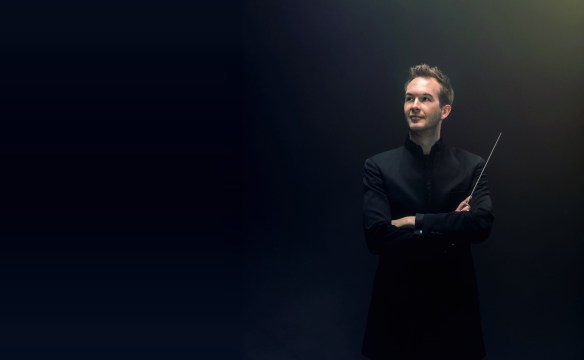
Oliver Janes (clarinet), City of Birmingham Symphony Orchestra / Andrew Gourlay (above)

Symphony Hall, Birmingham. Thursday 6th April, 2017

Richard Strauss Don Juan Op.20 (1888)

Copland Clarinet Concerto (1948)

Rachmaninov Symphony no.3 in A minor Op. 44 (1936)

Written by Richard Whitehouse

An ear infection meant that Mirga Gražinytė-Tyla had to withdraw from this concert, which provided a welcome opportunity for Andrew Gourlay (now into his second season as Music Director of the orchestra in Valladolid) to make his debut at Symphony Hall with the CBSO.

A pity the Fourth Suite from the ballet The Golden Key by Mieczysław Weinberg had to be dropped from the programme, but that will hopefully be rescheduled (and if Gražinytė-Tyla could tackle one of this composer’s symphonies as his 2019 centenary approaches, then so much the better). Instead, Gourlay directed an account of Strauss’s Don Juan which, while it rather failed to ignite in the earlier stages, evinced some suitably enticing playing during the amorous central episode and then a rousing culmination prior to those fatalistic closing bars.

Hardly a natural complement to Copland’s Clarinet Concerto, but the latter piece works well in a variety of contexts. It also provided an impressive showcase for Oliver Janes, now into his third season as principal clarinet of this orchestra and a player whose elegant while never unduly soft-grained tone was admirably suited to the first movement, with its limpid backing for strings and harp. Janes tackled the central cadenza with no less security – necessarily so as, in addition to its technical virtuosity, it functions as a formal and expressive ‘bridge’ into the second movement. This latter, substituting piano for harp and focusing on the jazz idioms often to the fore in Copland, was a little too reined-in over much of its course with the final pages failing to lift off, though there was never any doubting Janes’s identity with the piece.

The highlight of the concert came after the interval with a perceptive and involving account of Rachmaninov’s Third Symphony. Although it lags well behind its predecessor in terms of performance, this piece has moved from the periphery of the repertoire as earlier tendencies to dismiss it as a rerun of past glories have yielded to a recognition of just how subtly while effectively it overhauls the composer’s thinking for the inter-war period. Not for nothing was Nikolay Medtner alarmed by what he heard as the ‘modernization’ of Rachmaninov’s idiom.

In terms of textural balance and formal continuity it poses more problems than any other of Rachmaninov’s orchestral works, but Gourlay was never fazed by these potential pitfalls. The unworldly ‘motto’ launching the first movement was hauntingly rendered, and the only error in what followed was the omission of an exposition repeat necessary to balance an extensive development whose crisis-riven denouement was acutely realized here.

Neither did Gourlay misjudge the integration of slow movement and scherzo in what follows – the outcome being a developing variation as seamless as it was affecting. If the finale then unfolded at slightly too relaxed a pace, this enabled Gourlay to characterize detail in as resourcefully orchestrated a movement as Rachmaninov ever penned – with the closing accelerando vividly brought off.

A convincing take, then, on this engaging symphony and a fine marker for Gourlay to have laid down in what should prove an ongoing association with this orchestra. Those unable to attend Saturday’s repeat can hear it being broadcast by BBC Radio 3 on Tuesday 18th April.

For more information on future CBSO concerts head to their website

Wigmore Mondays – Apollon Musagète Quartet play Haydn & Arensky

Apollon Musagète Quartet [Paweł Zalejski & Bartosz Zachłod (violins), Piotr Szumieł (viola), Piotr Skweres (cello)
Haydn String Quartet in D major Op.64/5 Lark (1790)

Arensky String Quartet in A minor Op.35 (1894)

Wigmore Hall, London; Monday 3 April, 2017

Listen to the BBC broadcast here

Written by Ben Hogwood

If you want a piece of chamber music for a bright spring day, look no further than Haydn’s utterly charming Lark quartet. The fifth in a set of six written for Johann Tost, a violin player from Haydn’s court orchestra, the ‘Lark’ is bright and very breezy. The first violin takes on the role of the bird, soaring above the other three instruments in the first movement () and then enjoying the role of a vocal soloist in the second movement (10:55), essentially an aria.

In this performance the Apollon Musagète Quartet allowed Haydn’s melodies all the room they needed, except for the end of the first movement which became a bit too fast. In the third movement Minuet – a predecessor of Beethoven’s scherzo (16:14) they dug in a little more. For the last movement, a brilliantly played torrent of notes issued forth from Paweł Zalejski’s violin, rushing the whole way through as the other instruments battled manfully to keep up.

The sudden change of mood for Arensky’s String Quartet no.2 was palpable. Arensky was a pupil of Rimsky-Korsakov and a close friend of Tchaikovsky, and although his music has never enjoyed the popularity of these two Russian heavyweights, at its best it has great appeal. Rimsky wrote him off as a composer, but this String Quartet is one of his finest works. A darker piece, it was originally written for violin, viola and two cellos, but in this performance the Apollon Musagete used the conventional quartet make-up.

The first movement was dark, its solemn intonations speaking of Russian liturgy rather than intimate chamber music, serving as a memorial for Tchaikovsky. The quartet captured its brooding thoughts (23:13) but allowed more light to seep into the outlook as the piece progressed.

The second movement (34:03), a set of variations on Tchaikovsky’s Legend, is often played separately in an arrangement for string orchestra, and the Apollon Musagète showed how these big, bold variations could easily be projected for the bigger form. They demonstrated great aptitude for the quick fire variations (36:23) and (close to 39:24) but showed the slow theme and its other slower, minor key counterparts plenty of time, especially in the final variation from 46:25. The music may have been downbeat on these occasions but still had the power to console.

The finale is a strange comparison of dark liturgical intonation (48:01) and a sudden burst of folk song (49:30), which eventually wins the day. When it did here at the Wigmore, the effect was thoroughly convincing and consolation had ultimately been found in this fine performance.

Further listening

In summing up Arensky’s best achievements as a composer the Wigmore Hall note omitted to mention his wonderful Piano Trio no.1, part of a Spotify playlist including piano music and the Quartet played here.

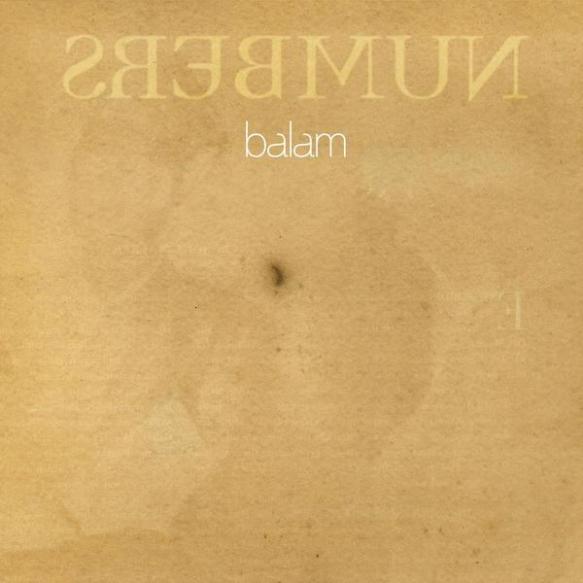
On record: Balam – Numbers (Balam / CD Baby)

Balam: Numbers (Balam / CD Baby)

Summary

Acoustic Alchemy keyboardist Fred White continues his side-project Balam with this disc of mainly solo piano pieces. Numbers confirms his creative versatility as well as a keyboard fluency second to none among those musicians currently active on the ‘smooth jazz’ circuit.

What’s the music like?

Less varied than its Balam predecessor, on which White demonstrated his very real skills as a multi-instrumentalist across a sequence of tracks that featured brass and vocals.

Numbers instead focuses almost entirely on solo piano, over nine pieces whose numbered titles have deliberately been listed in a random sequence to encourage the listener to experience them in varying order.

Although the mood of these pieces is almost entirely muted and introspective, White evinces real command of touch so that timbre and texture never become monotonous. The exception to all of this is Four (track five on the disc), on which White’s piano has been supplemented by soprano saxophone (Jeff Kashiwa, no less), electric guitar, violin, cello and wordless vocals in music whose kaleidoscopic elements feel as enticing as they are hypnotic.

Does it all work?

Yes, in that this relative uniformity in no sense equals drabness. Certainly those who retain a liking for classic ambient piano albums such as the Brian Eno and Harold Budd collaboration Ambient 2: The Plateaux of Mirror will respond to what is on offer here, and rest assured that White’s preference for keeping things austere is a world away from the prettified mood music of Einaudi and his ilk. A pity, even so, that the more questing approach as found on Four was not pursued more extensively: hopefully this might be the case on ‘Balam 3’?

Is it recommended?

Very much so. Fred White is a keyboardist of wide-ranging skill and subtlety, who can only be commended for pursuing his music to regions far removed from that of his regular band. Obtain the disc via his Facebook, Soundcloud or web-page entries and then enjoy the music!

Richard Whitehouse

For more information on Balam head to their Facebook page or Soundcloud. Meanwhile you can listen to Numbers on Spotify below:

Live: Convergence 2017 – Manuel Göttsching at the Barbican

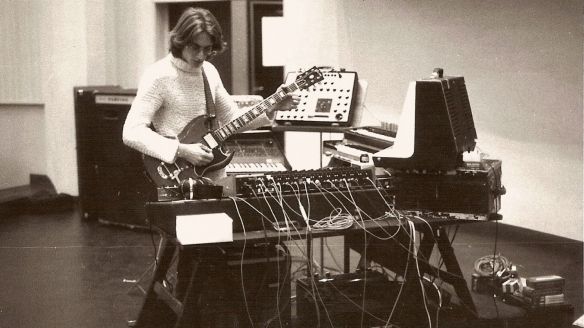
Manuel Göttsching (above – guitars, electronics), Shags Chamberlain (keyboards, percussion), Oren Ambarchi (bass guitar, percussion, drums)

Barbican Hall, Thursday 23rd March, 2017

Göttsching E2-E4 (1984)

Ash Ra Tempel excerpts from Schwingungen and Seven Up (1972)

Written by Ben Hogwood

Now in its fourth year, Convergence is one of those inspirational festivals that bring together different art forms without laying down rules of boundary or art form. Because of that, artists who might not get ready exposure are brought to the fore – and hence gigs like this one can take place.

Manuel Göttsching originally released his E2-E4 album in 1984, but it surfaced in remastered form last year to great acclaim, making listeners of a certain age (your correspondent included!) misty-eyed and reverent about its influence on a generation of techno producers.

The music is relatively close to the Steve Reich school of thought in concept, that is it begins with a deceptively simple phrase that stays constant for an hour, but around it various musical events develop. By the end the root of the music remains but where there was once an airy synthesizer riff there is now a full bodied bass, primitive electronic drums and some dreamy guitar, all of which Göttsching took his time to introduce. Little wonder that this music became an inspiration for Balearic producers such as Sueno Latino.

At this concert in the Barbican Hall, Göttsching performed in an incredibly modest manner, sitting in front of a laptop as though he were answering e-mails for at least half an hour, before standing with his guitar to deliver the crowning layer. The reality of course was very different, the stage dimly but effectively lit so that the audience could sit more or less in the dark, enjoying the music as it unfolded. Tapping the feet and fingers was an instinctive reaction, for this music has a great deal of energy, like a written out DJ set. It became a meditation for the mind but also a joyous ritual, the bright chords retaining their appeal even after an hour.

After the interval Göttsching emerged with drummer Oren Ambarchi and keyboard player Shags Chamberlain for company. Ariel Pink had been promised but was indisposed – but this was not a problem, as the trio set out to play excerpts from albums Göttsching had been involved with in the early 1970s as Ash Ra Tempel. These may well have worked better in the first half, but were nonetheless really well observed and open ended – so much so the improvisations were still going on when I sadly had to depart at 11:10.

The driving rhythms spoke of the Krautrock movement that was to take hold later in the 1970s, while some of the spacious textures and feedback also anticipated shoegaze and My Bloody Valentine. And yet there was the spirit of exploration that also incorporated contemporary classical compositions, with elements of the quieter side of Xenakis and Boulez, while also incorporating rich, added note harmonies of the likes of Thelonious Monk. There was a firm pitch centre, a point of reference at all times save for the last number, which found all three players on the same vibraphone initially. The music was difficult to pin down stylistically – so best just to sit back and enjoy!

It was an inspiring evening, providing some welcome respite and inspiration in the light of the awful events elsewhere in London earlier in the day. Those hung over the gig to some extent, but there was a sense that everybody was grateful to have their minds diverted and altered.

Musically there may not have been a great amount of melody, but inspiration came through texture, harmony and primitive drive – especially when Ambarchi drove the rhythm track forward in the second half. Göttsching himself was in fine form, and it was great to have an opportunity to appreciate and praise his influence on musical movements that have followed. Forty years on, his is a voice that still stands out.

For more information on Convergence, head to the festival festival website

Spotify

The Convergence 2017 playlist is below: