Unknown's avatar

About Arcana

My name is Ben Hogwood, editor of the Arcana music site (arcana.fm)

Wigmore Mondays – Annelien Van Wauwe & Nino Gvetadze play Debussy, Poulenc & Brahms

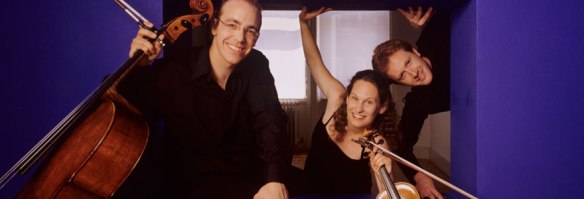
Annelien Van Wauwe (clarinet, above) and Nino Gvetadze (piano, below)

Debussy Première rapsodie (1909-10)

Poulenc Clarinet Sonata (1962)

Schumann Arabeske in C major, Op 18 (1838-9)

Brahms Clarinet Sonata in E flat, Op 120 No 2 (1894)

Wigmore Hall, London; Monday 20 March, 2017

Listen to the BBC broadcast here

Written by Ben Hogwood

The soft, languid tones of Annelien Van Wauwe’s clarinet were perfectly judged at the hushed start of Debussy’s Première rapsodie, the first piece in a nicely chosen set of music for clarinet and piano.

This piece is an elusive ten-minute train of thought, with two distinct ideas – the slow, sleepy opening paragraph (from 1:40 on the broadcast link) and another, spiky idea (around 3:42), begging for a jazz accompaniment. Gradually the two get closer together and the cumulative energy builds. Nino Gvetadze’s colourful piano accompaniment showed just how suitable the piece is for orchestra – which Debussy realised with a subsequent arrangement.

Poulenc’s Clarinet Sonata is one of his last published works, written in homage to fellow composer Arthur Honegger. Central to its success is the yearning theme of the central Romanza (16:36), where Van Wauwe’s tone and phrasing was beautifully observed. The first movement (beginning at 11:24) could have been a bit more mischievous, perhaps, but the brisk and largely upbeat finale (21:22) certainly hit the spot.
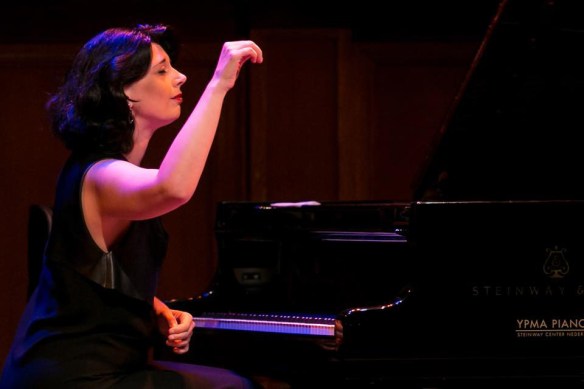
Following this was a chance for Gvetadze to take centre stage in Schumann’s lilting Arabeske (25:40), where wife Clara explicitly asked him to avoid making musical references to her. I’m not convinced he kept that bargain, because the music is very affectionate, and Gvetadze portrayed that too.

We then heard Brahms’ last published chamber work, the last part of an Indian summer instigated by the clarinettist Richard Mühlfeld, whose quality of tone directly inspired four pieces from the composer. This included a pair of sonatas published in 1894 as Brahms’s Op.120. These are lovely autumnal works, and both performers shaded the E flat work, the more positive of the two, with appropriate care. More authority could perhaps have been given to the second movement (marked Allegro appassionato, from 43:26 on the broadcast) but the outer movements had plenty to admire. The first movement (from 35:09) was largely contented, while the last, a theme and variations (48:50), was more changeable in mood and brilliantly played here, Brahms’ inspiration as keen as ever.

A final thought – what will Brexit mean for the non-English contingent the BBC choose for their excellent New Generations scheme? One of many questions classical music and the arts will face in the coming months and years.

Further listening

Brahms’s last works for clarinet are collected in the playlist below. They are autumnal in nature but have some wonderful lyrical writing for the instrument.
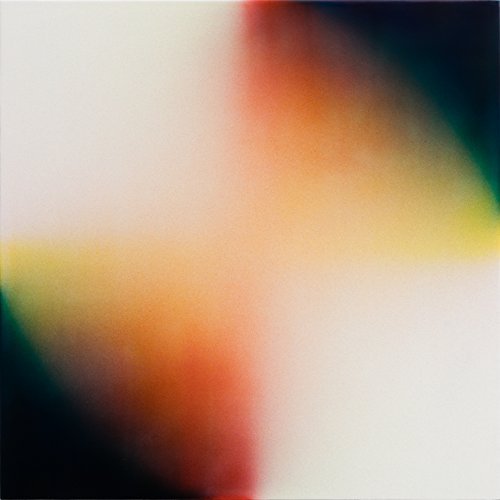

On record: Bing & Ruth – No Home Of The Mind (4AD)

Summary

Bing & Ruth is actually an ensemble of five, headed by the New York composer David Moore. They deal in largely ambient music, communicated in this instance through an intriguing mixture of two pianos, two upright basses and electronics.

No Home of the Mind is designed to be experienced as a single session of meditation. Its tracks link closely together and move from stillness to energetic movement.

What’s the music like?

While a lot of the music is designed for meditative listening, there are pockets of intense energy in Bing & Ruth’s music. Take the start of Starwood Choker, for example, which opens the album in a striking manner. As it begins the listener effectively jumps from a waterfall, the opening notes suddenly tumbling downhill, a torrent of music driven by the rippling piano but supported by drones from the basses. Then for As Much As Possible the momentum stills, pausing for thought, but with long, held notes remaining low in the background. The basses rumble low in the mix, with soft piano notes.

Soon it becomes clear the album is conceived as a single piece of music, and it runs for nearly an hour. Some of the chord progressions Moore has written have a heart stopping beauty, so while there is no melody as such, tracks like The How Of It Sped can become greatly moving with a single change of harmonic focus.

There is mystery and darkness around the edges, particularly in the deep swell of Is Drop, where the basses begin right in the depths, the music starting to collect more energy as it sweeps upwards. The tumbling piano form appears again on Form Takes Gentle before the ebb and flow returns us to a slow tempo with swirling textures at To All It. This moves seamlessly into Flat Line / Peak Color, which reaches towards the end in powerful harmonic progressions.

Does it all work?

No Home Of The Mind is a very effective and thoroughly immersive piece of music, and works really well on headphones. From first hand experience I can tell you it is especially good at taking the heat out of potentially stressful commuting situations!

Moore varies his textures subtly but effectively, so that the tumbling piano motif becomes a real thrill when it appears, while the response of relative calm is rather beautiful and almost timeless. The colours of the ensemble are beautifully rendered, the fuzzy textures enhancing the listener’s dream like state. The reds, greens and yellows of the cover are an accurate reflection of how Bing & Ruth cast a spell on their listeners.

Is it recommended?

Yes. Bing & Ruth make music that is almost completely weightless at times, but which becomes earthbound with the deep, resonant double basses. A real beauty on headphones to take the weight off your troubles!

Ben Hogwood

Listen on Spotify

Víkingur Ólafsson – studying Philip Glass

Víkingur Ólafsson (photo: Ari Magg)

Last year, Arcana defined Víkingur Ólafsson as a true classical music entrepreneur. We explored his introductions to classical music, and talked about the two festivals he helps administer – Sweden’s Vinterfest and the Reykjavik Midsummer Festival. We also covered his friendship with composer Philip Glass, 80 this year. Olafsson professed his admiration for the composer and his creative energy, an admiration he has now transferred to disc in the form of his first recording for Deutsche Grammophon. Time, then, for chapter two in the interview!

When did you first encounter Philip Glass’s music?

It’s quite a specific memory. I was 13 years old, sitting with my two sisters in the back seat of our car on a family vacation. Dad was driving on the highway, heading from France to Switzerland and as we were bored and quarrelling in the back seat, he handed us this recording of Philip Glass Violin Concerto No.1 with Gidon Kremer (on DG as it happens) which we listened to on our Sony Discman players. It was unbelievable to discover this new sound world while passing by the French landscapes on 150 KM per hour.

Some of the Etudes on this album feel like extended meditations. Do you get into a kind of trance when you play them?

Not really, I’d rather have my audience in a trance… I just try to listen intensely and explore the possibilities of the instrument and acoustics, looking for the right proportions of sound and time.

Do you think the Etudes are actually much more emotional than the titles suggest they should be?

What is emotional for one person can be completely impersonal to the next. To me there is a nostalgia to the slow ones, but it’s emotions revealed through the filter of time. Etude means ‘study’, but one can also write etudes on emotions, just as well as on finger dexterity.

What technical challenges does the music present for you?

It’s relatively easy to learn the etudes and play them at an average level. But what I find difficult – as with any music – is to play them in the most specific way, when it comes to rhythm, texture, sound…

To get the clockwork fine tuned in a piece like Opening is extremely delicate and difficult, to take one example. And of course playing a piece like Etude No.6 is quite difficult, and the repeated notes make me feel as if I’m playing a late-20th century Scarlatti.

Etude No.20 requires intense layering of texture and pedal sensitivity and No 15 demands an orchestral palette on the piano. The etudes can be extraordinary when played well, but, like almost all other music, they can also be rather bland when played in a bland way. But blame the performer in that case.

Are you working closely with Philip on any new material?

We’ve discussed briefly a new work, but it’s too early to say more…

Aside from the piano music, what is your favourite piece by Glass?

I saw Einstein on the Beach in Berlin two years ago. It blew my mind to experience it live. I will also mention his Violin Concerto No.1, as it was the first piece I heard by him. And I have to mention Koyaanisqatsi. It’s actually on Youtube, I recommend spending a Sunday afternoon watching and listening to the great work.

Do you play music by any of the other so-called ‘minimalists’?

Yes, but they’re really not minimalists… at least not since the early 70s! I’m playing John Adams‘ Piano Concerto in Leipzig in June and I’ve played a bit of Steve Reich as well. I love these composers but I’ve played far more Glass than either of those.

What is it like being signed to Deutsche Grammophon, and do you have any plans for future releases on the label?

We are meeting in Berlin in March to discuss next albums. We have roughly three different ideas on the drawing board and they are all very different from one another – and from the Glass album. I don’t want people to know what to expect too much, I’d love for each of my album to tell its own story, independent from the previous ones.

I love working with Deutsche Grammophon as we have a mutual love of listening to, exploring and discussing music. And of course I’ve listened to so many DG records in my life and gotten to know so much great music and so many great performances through the label. It’s both a privilege and pleasure to work with them.

You can find out more about the Midsummer Music festival in Reykjavik here, while you can also discover Vinterfest here. For more information on Víkingur himself, head to his own artist website

Wigmore Mondays – Kungsbacka Trio play Schumann and Ravel

Kungsbacka Piano Trio [Malin Broman (violin), Jesper Svedberg (cello), Simon Crawford-Phillips (piano)

Schumann Piano Trio no.2 in F major Op.80 (1847)

Ravel Piano Trio in A minor (1914)

Wigmore Hall, London; Monday 13 March, 2017

Listen to the BBC broadcast here

Written by Ben Hogwood

Schumann seems to have approached his career in clumps of music. 1841 was the fabled ‘year of song’, the catalyst for years of exceptional achievements in the form. The next year he ventured into the world of the string quartet, publishing three works. It wasn’t until 1847 that he decided to publish a piano trio, and here he was apparently spurred on by the quality of his wife Clara’s trio the year before. 1847 yielded two works for the combination.

The Second Piano Trio, Op.80 in his catalogue, begins with an outpouring of fervent but very positive feelings (1:35 on the broadcast), though its casting in F major makes it a little less tempestuous than the First Piano Trio in D minor, Op.63. Yes, it was a prolific year for the composer!

By now Schumann’s style was more contrapuntal – that is to say he was applying more of the practices perfected by Bach, linking his melodies through eventful interplay. The Kungsbacka Trio were alive to this way of writing, and all the parts were clearly audible, though when they merged into one there was some beautiful unison playing.

The second movement, a slow romance (from 9:57), was notable for the sweet tone of Malin Broman’s violin, though there was sterling work from cellist Jesper Svedberg at the outset. Meanwhile the third movement, a ‘canon’ (from 18:11), is almost like one bird following another in a slightly irregular waltz, the ‘canon’ being an almost exact imitation of one instrument (piano) by the others (cello and then violin). This movement softened further into the major key at the end. The finale (from 23:10) continued in the same high spirits.

The only Piano Trio of Ravel made a nice contrast. He did not publish much chamber music, but what his output lacks in quantity is compensated by works that remain right at the top of the repertoire. The shadow of World War I hangs over this work, published in 1914, especially as Ravel finished it before signing up as a truck driver. Despite moments of great sorrow and introspection in the slow movement, it ends on an ultimately positive note.

There are beautiful colours to be savoured, both through Ravel’s writing and this performance. The trio begins in dappled sunshine (31:10), and was especially notable in this performance for a first movement containing a lovely transition from the puffed up statements of the faster music to the slower, daintier second theme (leading up to 36:51).

The second movement (40:27) was also colourful, surging forwards in unison but also really attractively phrased for the second theme given by pianist Simon Crawford-Phillips at 42:23 and then a unison from the strings shortly after. Then the mood turned inwards at 45:09 for the solemn third movement passacaglia, a form where the same bassline is repeated again and again but the tune varies. The final movement (52:30) shimmered in the sunlight, making a timely appearance on the Wigmore Hall stage to accompany the beautifully rendered harmonics of violin and cello.

As an encore the trio gave Beethoven, a movement from his Piano Trio in E flat major, Op.70/2 – again beautifully played and consistent with 20 years of great artistry from this source.

Further listening

A very nice complement to both the Ravel and the Schumann can be found in the Kungsbacka’s recordings of Faure for Naxos. This album includes his late Piano Trio and the stormy – and thrilling! – Piano Quartet no.2

On record: Víkingur Ólafsson – Philip Glass: Piano Works (Deutsche Grammophon)

Summary

Deutsche Grammophon have taken the opportunity to celebrate Philip Glass’s 80th birthday with their new signing, Icelandic pianist Víkingur Ólafsson. He has already performed the piano etudes with the composer himself, and has recognised the depth of invention and emotion that sits beneath the surface of what initially seems to be repetitive, mechanical music.

‘My approach to each of the etudes is to enable the listener to create his or her own personal space of reflection’, he says in the DG press release – and we will get more of his thoughts in an interview given to Arcana shortly.

What’s the music like?

Ólafsson is true to his word. The Etudes – even in Glass’s own performances – can seem a bit dry and difficult to approach. Not so with Ólafsson, whose incredible control means he can play with unexpected grace, using the pieces as reflections but also catching the nuances of Glass’s rhythmic writing. The quality of the DG recording helps here too.

The contours of the Opening piece are caressed and beautifully phrased, proving to be much more emotive than if played straight, as Glass so often is. In No.5 he is slow and lost in thought, and in no.14 too, but by contrast the Etude no.9 is quite punchy. Etude no.15 has a powerful surge in D major before adopting a dance-like profile, while the nervous energy of No.3 puts the performance more on edge.

Quite how Ólafsson plays the repetitive notes of the Etude no.6 is a complete mystery! His performance of no.2 brings both sides of Glass together, beginning in sombre and reflective mood but building to something pretty substantial. Here he is joined by a string quartet, an arrangement by Christian Badzura that proves effective at breaking up the sound of the solo piano and introducing some more colours to the mix.

Does it all work?

Yes, thanks to Ólafsson’s sensitivity and Glass’s awareness of the different colours the piano can offer him. Much of the music here is typical Glass, arpeggiated and with subtle but lasting twists to the harmonies – and it works really well in this context.

Is it recommended?

Without hesitation. So much so that this is probably the best album we are likely to encounter in Glass’s 80th birthday year.

Ben Hogwood

Listen on Spotify