Howard Shelley & London Mozart Players, St John’s Smith Square, 2 March 2016.
Mozart Explored: Piano Concerto no.27
For the latest in their Mozart Explored series at St John’s Smith Square, Howard Shelley and the London Mozart Players turned their attention to the composer’s final work in the form.
It is astonishing when you pause to think that Mozart had already completed 27 piano concertos by the age of 35, quite apart from everything else he did. Even after the composition of this piece, when he was under all sorts of personal and financial pressure, he managed to write such ‘trifles’ as The Magic Flute, the Clarinet Concerto and the Requiem. So although the music here was shown to be wonderfully positive there was a twinge of sadness at a career cut so short.
Howard Shelley was the ideal guide, affable yet knowledgeable, and although his keyboard was positioned so he faced the orchestra rather than the audience this was a good move, for everyone in St John’s could see his hands at the keyboard – and as a result the music physically being made.
St John’s is a lovely venue for this music, a world apart from the incessant clamour of Parliament Square just around the corner – an oasis by the Thames. Shelley’s demeanour only aided this hour of escape, talking through the circumstances around the composition of the concerto and also getting to the nub of the main themes of each of the three movements.
And then the performance itself, which was beautifully and stylishly given. With the orchestra ideally sized, Shelley conducted them through the opening bars of the first movement before his own graceful solo part asserted itself, stressing the vocal nature of much of this music.
There was lovely interplay particularly with the woodwind, who were also a prominent feature of the second movement, which felt like an aria in Shelley’s hands. The finale, written in celebration of the onset of Spring, could have been a little misplaced given the bitterly cold wind outside, but it became a light footed and quite graceful dance, Shelley again taking the lead.
The LMP return on Thursday March 16 to turn their attention to Beethoven’s Emperor Piano concerto – and if you can make it the rewards will surely be many!
Beethoven – Violin Sonata in G major, Op.96 (1812) (28 minutes)
Brahms – Violin Sonata no.2 in A major, Op.100 (1886) (23 minutes)
Spotify
Nicola Benedetti and Alexei Grynyuk have not yet recorded this music, but other versions can be accessed via the playlist below, in case you can’t get to the broadcast:
About the music
Beethoven’s tenth and last published violin sonata sits on its own in his output, a decade after than the composer’s previous work in the form. It is dedicated to the same ‘Archduke’ (Rudolph of Austria) for whom Beethoven wrote his famous B flat major piano trio, also published in 1812. Beethoven supposedly wrote it in a slightly easier style, as the violinist Pierre Rode – who was performing the piece with the Archduke playing piano – was not as skilful as he once was. The G major piece makes allowances, then – but not in a way that you would ever know from listening! It is unusually tranquil, and has instances of the timeless music Beethoven was to find in the slower movements of his late works.
There are no such concessions to technical ability from Brahms, who wrote the second of his three violin sonatas while on holiday by Lake Thun, Switzerland. This is however a relatively late work, and although Brahms has found and established his style the piece still carries some of the pressures of writing for Joseph Joachim. Its lyrical and tuneful nature have helped make it one of the composer’s most popular pieces of chamber music – and like the Beethoven it has a largely sunny outlook.
Performance verdict
A nice combination of two violin sonatas that seemed ideally suited to a bright Spring lunchtime – and how refreshing to hear young artists such as Benedetti and Grynyuk take on two later works like this.
The Beethoven was lovely, performed in a spirit of enjoyment where the violin and piano really were equals. Benedetti’s tone, slightly sweet, was ideal, while Grynyuk proved a very sensitive pianist, with some lightly brushed contributions that made sense of Beethoven’s unusual contentment.
The same mood infused the Brahms sonata, though here there was a greater sense of purpose, as the first movement, having begun relatively slowly, surged through to a much more animated development section. The finale was also notable for revealing some of the shadows that became a greater part of Brahms’s late works – but overall the feeling was one of positivity, celebrating the composer’s good spirits and warm lyricism in this work.
What should I listen out for?
Beethoven
1:58 – as the piece begins there is an immediate feeling of contentment, and although the opening idea is quite innocuous it is distinctive, with its use of the trill ornament. The piano introduces an airy second theme at 3:10, which the violin soon takes up. The mood is summery, and even a bit drowsy. The first section is repeated again at 4:40. Beethoven then develops his ideas fluently before we hear the main tune once again at 8:31, shared this time by the violin and piano. The balmy warmth continues until the end.
13:12 – the second movement is slow, marked Adagio espressivo, and has that kind of heavenly timelessness often found in later period Beethoven. It has a spacious introduction from the piano and is if anything even more relaxed than the first movement. It operates at a similar tempo and mood to the slow movement from the Emperor piano concerto. From around 14:35 the violin lines become quiet and bare, Benedetti using little vibrato, but the warmth does not take long to return.
19: 19 – the third movement, a Scherzo, is short, and if you blink you’ll miss it! Its first idea is once again light of touch, and though there is a heavier trio section it is not at all long before the minor key asserts itself again.
21:48 – the final movement also has a light touch, with a Haydn simplicity, and is particularly rich in the lower register and strong in the continuous, lower runs. The slower music is a delight, still airy and relatively carefree. There is then a quicker, invigorating run to the end.
Brahms
32:37 – one of Brahms’s most celebrated tunes opens this piece, a lovely outpouring of good feeling. It is quite slow and quiet to begin with but grows into a full blooded interpretation as the theme is developed further. There is greater affection here than in much of Brahms’s output.
42:07 – this is definitely the lighter side of Brahms, with a tender slow movement that segues into a more jaunty Scherzo section (43:32), marked by tumbling triplets in the piano part. The slow movement music follows again at a safe distance (44:38) – and then once again the scherzo music trips along (46:43), this time with plucking from the violin.
49:28 – in the last movement we get the warmth of the violin’s lower register, taking the ‘grazioso’ marking in to account. There are though some shadows that the listener might sense occasionally, the odd harmonic turn towards the dark side that never lasts too long but is there nonetheless.
Encore
54:35 – a substantial encore from Benedetti and Grynyuk, and a very different mood in the exotic and intense Myth no.3 by Polish composer Szymanowski.
Further listening
At the bottom of the playlist you will find some further suggestions for violin and piano in the form of sonatas by Schumann – Brahms’ friend, of course – with his Violin Sonata no.1 – and César Franck, whose own Violin Sonata shares the same key and mood as Brahms’s Second. Finally some shorter pieces by Schumann for solo instrument and piano – the joyous Adagio and Allegro and the 5 Pieces in Folk Style, arranged here for cello and piano. Each will put you in a good mood!
Meanwhile if the Szymanowski appeals, Nicola Benedetti has recorded his Violin Concerto no.1:
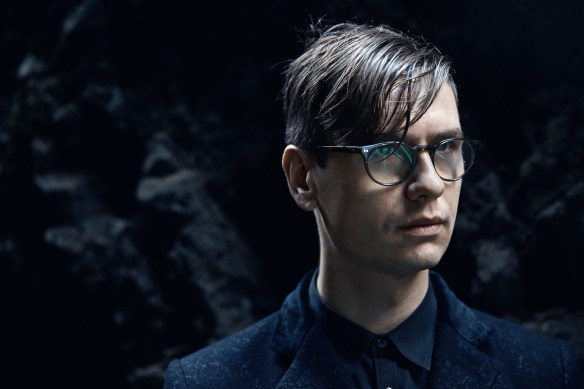
If you wanted a definition of a classical music entrepreneur, Víkingur Ólafsson would surely fit it.
The Icelandic pianist, performing Liszt’s Piano Concerto no.2 this week with Vladimir Ashkenazy and the Philharmonia Orchestra, is Artistic Director both of Vinterfest in northern Sweden and of the Reykjavik Midsummer Festival. He runs a record label (Dirrindí) and has run a ten-part series with Icelandic National Broadcasting Service called Útúrdúr (Out of Tune), looking to encourage new classical music audiences through performance, interviews and demonstrations at the keyboard. He generously took some time to talk to Arcana recently about his career and aspirations.
Can you remember your first encounters with classical music?
I could say my very first encounters were when I was still in my mother’s womb, while she was completing her soloist degree from Berlin’s University for the Arts. She did a huge solo recital when six months pregnant with me! So I was close to the keyboard from the early stages. But more concretely, there are pictures of me reaching for the keyboard high above my head, before I started to speak.
What are your memories of studying piano – are there any pianists / teachers who have left a lasting influence on your career to date?
I saw the piano primarily as a toy – simply the best toy in the world – as a boy. I still do actually. I think I’ve been very fortunate that all my very good teachers maintained this sense of freedom towards music within me, which meant that I never had to be asked to practice – I just felt like playing the piano a lot.
I started listening to some of the great pianists in my early teens, mostly recordings from the 1930s and 1940s. On the one hand, classicists such as Clara Haskil and Dinu Lipatti fascinated me – I don’t know how many dozens of times I listened to Lipatti’s last recital album. On the other hand, I loved the big romantic players – the piano poets – like Benno Moiseiwitsch, Sergei Rachmaninov, Josef Hoffmann, Ignaz Friedman and Alfred Cortot, pianists from the so-called ‘golden age of the piano’. I remember listening incessantly to Friedman’s Chopin mazurka recordings, and trying to imitate them – with very little success I should add. So my early influences came from very different directions.
In my late teens and early 20s, as a student at Juilliard, I had two great piano teachers who, I now realize, could be seen as coming from these very different directions – Robert McDonald the classicist with his unbelievable sensitivity for the proportions of musical form and architecture, and Jerome Lowenthal, the freest musical spirit, master of the spontaneous.
You have performed recently with Vladimir Ashkenazy before in Tchaikovsky’s First Piano Concerto. What did you take from that experience?
It is a privilege to work with Maestro Ashkenazy. It is a special feeling to have one of history’s great pianists on the podium. I can feel that he knows every single note I play on such a deep level. He’s completely with me every second. I’ve been asked whether it is intimidating to have a great pianist like Ashkenazy conducting, but quite on the contrary it really gives me a sense of freedom.
How would you introduce Liszt’s Second Piano Concerto to a newcomer?
When I heard the Second Piano Concerto in my teens, I actually didn’t like it at first. I remember saying it was too superficial. In retrospect, I now realize how superficial I was. It is a brilliant piece of music, written by one of the most captivating personalities in music history. I feel safe to say that Liszt was the greatest pianist of all time. The way he wrote for the instrument, and the way his performances have been described by his contemporaries, the way he invented much of modern day piano technique…he’s a man I have unlimited admiration for.
Liszt lived an enormously glamorous life as a young man and was probably the most famous musician of his day, but gradually turned more towards spiritual practice and even joined a monastery for a time. And I feel the piece contains these two contrasting sides. It is a musical narrative, which seems to take place somewhere midway between the grand and glamorous salons of Paris of the 1840s and a reclusive monastery up in the French mountains. I feel it is a one man’s quest, an Ein heldenleben of sorts.
How was Vinterfest last week – and how do you see the festival evolving in the future?
It was beyond my expectations. I chose the theme ‘New Worlds’ and we explored it in various ways. One concert was called Animal Worlds, featuring music of insects, whales and birds, another looked at the First and Second Viennese schools through juxtaposing the violin and piano fantasies of Schubert and Schoenberg, then there was my John Cage prepared piano workshop, the Eight Seasons of Vivaldi and Piazzolla and lots more.
I was extremely happy to have a BoulezIn Memoriam concert with Michael Barenboim playing Anthèmes 2 for violin and electronics with IRCAM sound engineers. That was such a gourmet concert to listen to – I’ve never heard more beautiful electronics. It took place in a rather awesome car company and the audience was totally into Boulez’s music – nobody complained of it being to ‘too modern’ or ‘difficult’. Which of course it isn’t.
What can we expect from Reykjavík’s Midsummer Music this year?
The theme will be ‘Wanderer’ – and we will be exploring it in Harpa Concert house with artists such as Viktoria Mullova, Kristinn Sigmundsson, Ursula Oppens, Jerome Lowenthal, Tai Murray and more. The dates are 16-19 June, and I’m already looking forward to it.
As an Artistic Director of festivals, what do you look for when you are programming such an event?
To make sure that no festival is too similar to any other festival from earlier years. I don’t want people to be able to predict my festivals. In this respect, I love to work with a closely defined theme. Even if it means 10x more work for me to make the puzzle work with all the factors that need to be taken in to consideration, it allows for each year to have its own distinct palette of colours.
You have worked closely with Philip Glass. What appeals to you about his music, and what is he like as a person?
Mr Glass is such a unique and warm person. He is extremely brilliant of course, and knows what he wants, but is also very open-minded about interpretation. He has this creative energy that is simply put astonishing. I’ll give you an example: After we had done a long day of traveling in the early morning, checking-in to a hotel, going straight to sound check, giving a performance of his complete Etudes, he took me out to a restaurant. This was in Gothenburg in early 2014, and I felt happy but a little exhausted around midnight when we were having the last toast of the evening before heading to the hotel to rest. Or so I thought.
When asking for the bill, Mr. Glass also asked for a large cup of strong black coffee (!) and I asked him how on earth he could drink that before going to bed. He gave the following response: “but Víkingur, I haven’t had any time to compose today! I always compose 5 hours a day, and will do that now in my hotel room”. He, 78 at the time, made me feel like an old man. I was 29 at the time.
Icelandic music seems to be in a very exciting place at the moment. What is it about the country that inspires so much creativity?
The creative output of my fellow countrymen is undeniably impressive and vast when considering the inhabitants on the island are only around 330,000, but there is no simple answer to this question. The island itself is a very special place with strikingly varied and beautiful natural scenery. Maybe this has an influence on the Icelandic people’s (often overblown) sense of themselves as being unique and thus wanting to express themselves creatively through a medium…
Maybe the long and dark winters and the isolation of the island have something to do with this… Maybe it’s got to do with how young we are as a cultural nation, we are not very burdened by the past. I don’t know really…
You are also performing with Viktoria Mullova and Matthew Barley in June – what will you be playing?
We will be playing Schubert’s Piano Trio no.2 and Ravel’s Piano Trio.
What does classical music mean to you?
You might as well ask: “What does nature mean to you”. It means the world to me.
What piece or piece(s) of new Icelandic music would you recommend to Arcana readers? Both obvious and less obvious would be great!
How about Daníel Bjarnason’s Piano Concerto No 2 ‘Processions’ which he wrote for me in 2009, with its first two movements written in the grand tradition of heroic concertos before the third movement concludes the work with something close to techno music…
As a nice compliment from a very different direction, check out Anna Thorvaldsdottir’s album Aerial, out on Deutsche Grammophon. You will find both on iTunes and Spotify.
Víkingur Ólafsson plays Liszt’s Piano Concerto no.2 with the Philharmonia, conducted by Vladimir Ashkenazy, at Symphony Hall, Birmingham on Tuesday 1 March. For tickets click here
You can find out more about the Midsummer Music festival in Reykjavik here, while you can also discover Vinterfest here
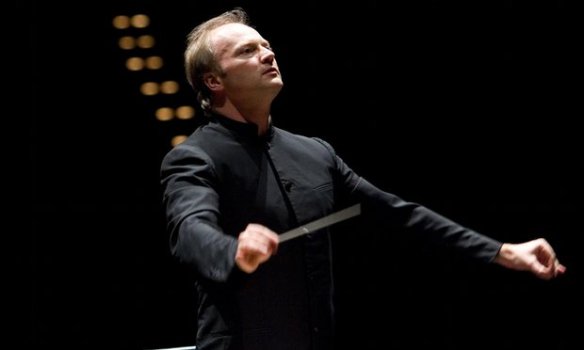
Friendly Fire – Simon Trpčeski, London Symphony Orchestra / Gianandrea Noseda (above)
Barbican Hall, London; Thursday 25 February 2016
Welcome to Arcana’s new ‘alternative’ reviews slot! It is an ‘ask the audience’ feature – where I (Ben Hogwood) take a friend / colleague to a classical concert and get them to review it in the bar afterwards. Our second ‘reviewer’ in the series is John Earls, a family man from Harrow & Wealdstone who works as Head of Research at Unite. He shares his thoughts on a program of music inspired by ‘Shakespeare 400’ – with works by Smetana (Richard III), Tchaikovsky (Romeo and Juliet), Richard Strauss (Macbeth) and the seemingly unconnected Piano Concerto no.2 by Liszt. The artists are pianist Simon Trpceski and the London Symphony Orchestra under newly announced guest conductor Gianandrea Noseda.
Arcana: How did you prepare for this concert?
John: I didn’t do that much in the way of preparation, other than see what the four pieces in the concert were, and whether I was familiar with them. At the time the only one I thought I was familiar with was the Tchaikovsky, but you reminded me I had heard the Liszt before.
What was your musical upbringing?
As a young child, pretty limited. Most of the music I heard from my parents would have been Irish music, then as I went through school I was more exposed to bits of classical music, as I learned the clarinet. In my teens I got more into contemporary music, rock music, new wave – I played in my own band – and became more interested in jazz and classical music as I got older and attended more concerts and read more about those particular types of music. Jazz and classical are the forms of music I listen to most now.
Name three musical acts you love and why:
(almost without hesitation): Miles Daviswas a trailblazer and an innovator who has done some very different things throughout his career. He also struck me as a great leader of bands and ensembles, because he was a great talent spotter who pulled some phenomenal musicians together, and it always struck me that anybody who played with him was better for the experience. They tended to be either better musicians or composersafter having gone through the Miles Davis experience, and also his ensembles tended to be greater than the sum of their parts.
I would also go forChristy Moore, who in many ways would be the soundtrack to my development and my life. I think he has a huge amount of integrity, and if you listen to him sing he comes across as somebody who really means it. If you see him performing live you see a gifted songwriter but also somebody who has a mission to transmit the songs he knows. He has a great deal of songs he hasn’t written but he is able to communicate and pass them on.
I should pick a band really…Wire. I saw them last year for the first time in around 30 years, at the Lexington near Kings Cross. They were influential in my formative days in the late 1970s / early 1980s. They were innovative and straddled the artistic side with the punk sensibility, but had the credibility of doing what they wanted to do. To release an album like they did last year nearly 40 years after they first started, and to think they can still do it, was a phenomenal achievement. They are still great live and the songs incredibly well crafted.
Have you been to classical music concerts before, and if so what has been your experience?
I’m not sure I fit your criteria of ‘someone who doesn’t normally attend a classical concert’. I’m actually a regular classical concert goer – all forms and types. Living in London I’ve been able to see some of the finest musicians and orchestras in the world. Many of my most treasured musical moments have been at ‘classical music’ concerts –Mitsuko Uchidaplaying Schubert’s late piano sonatas,Rattleand the Berlin Phildoing Mahler’sResurrection Symphony,Steve Reich’sMusic for 18 Musicianswith Reich himself playing. I also think some pieces are best experienced live –Messiaen’sTurangalila, for example. Had a few disappointments too! But live music is really important to me.
What did you think of the Smetana?
I thought it was OK – I could see why they had used it as a piece with which to start. Would I have got the Shakespeare connection? Probably not, but having known it I could see there were bits that sounded regal. Some bits reminded me of a royal hunt, with lots of trumpet. Some of it was like a fanfare but there was solo trumpet that was quite ‘angsty’ and personal. I suppose the trumpet has royal connections. Those things came into my mind while I was listening but I’m not sure, as a piece of music, I would be in a huge hurry to listen to it again.
What about the Liszt?
I hadn’t remembered that I had heard it before. I quite enjoyed it, but there were parts where the pianist seemed a bit stroppy and belligerent, reminiscent of Jerry Lee Lewis! I enjoyed it a bit less than I thought I was going to but the thing that did stick out for me was the cello (Rebecca Gilliver’s solo in the third movement – ed). The sound was absolutely beautiful.
What about the Tchaikovsky?
I was more familiar and knew what to expect. I wasn’t used to being that close to the orchestra! If you heard those four pieces of music and was told there was a Shakespeare link to be honest I probably couldn’t have noticed it, but the one that would be most likely would be that one – and you would probably think Romeo and Juliet because of the tragedy, the romance and the action. You almost feel like you’re in a Bond movie! It’s got everything in it, around 16 minutes, it packs it all in, and it’s Tchaikovsky, who I love.
Finally, what about the Richard Strauss?
I thought that was a good piece to finish on. It had a range of things. I don’t think I would have thought Shakespeare but it was more personal in that it was not necessarily a narrative story – you’re inside somebody’s head. I’ve got ‘magisterial’ written down here, and I felt there was a real tension in it. The offstage snare drum was great, I always like that use of the space, and I’ve not heard the percussion played like that before (the tam tam I think! – ed)
It was more psychological I think, and it was only in that piece that I noticed Noseda’s score was tiny, I’ve never seen one so small! I enjoyed the music, and would go back to listen to it again. I didn’t realise Strauss was 24, that’s quite a phenomenal achievement – not only to put all the instrumentation together but to get the psychological elements at that stage, you would think only an older composer would manage that.
What about the environment and setting of the concert, and how it was promoted?
The only PR I’ve seen was the Shakespeare-related things, and I couldn’t see the link with the Liszt, but I like the idea of linking things in. Sometimes it can be a bit contrived but I think if it’s used as a technique to expose you to different bits of music then that’s fine – like Romeo and Juliet – and it worked for me in the case of the Strauss but not the Smetana.
I think they got the range and order of the pieces right. I’ve been to the Barbican as a venue, and I do like the way it works with an instrument offstage, like they did with the Strauss. I’ve seen that done with vocal and choral pieces and it can work. I think the conductor was quite energetic, not necessarily in a flowing way – quite staccato would be your terminology! There seemed a good rapport between him and the orchestra, the sense they really respect him.
If you could give it a mark out of 10 what would you give?
Probably a 7, but that would be an average. The Tchaikovsky and the Strauss would be an 8 or 9, and the Smetana would drag it down a bit. But it was certainly worth going to!
Arcana’s brief thoughts on the concert:
The connections between classical music and Shakespeare are many, but the London Symphony Orchestra did really well to present a variety of nineteenth century settings. All fall into the ‘Romantic’ period, where composers were getting to grips with the idea of the orchestra being a storyteller in what was known the ‘symphonic poem’.
Smetana’s Richard III was an ideal curtain opener, though like its subject it had an uneven walk – brilliantly portrayed but still with a sense of a portrait not quite fully fledged.
Tchaikovsky’s Romeo and Juliet was different. This was the London Symphony Orchestra on white hot form, Gianandrea Noseda conducting like a man wholly affected by the tragedy. This music surged forward with passion and drama in equal measure, and the hair stood up with the volley of brass and percussion, and the intensity of the love theme on the strings.
Richard Strauss’s Macbeth was equally intense, though even more effective in exploring the minds of the two main protagonists of the story. The lower strings had a steely effectiveness, the double basses brilliantly marshalled, while the drama above unfolded in compelling fashion.
Though Liszt’s Piano Concerto no.2 had no Shakespearian connection it was a relatively sound choice, for he is a composer unable to resist the temptation of telling a story! This one had its moments of drama, albeit fleeting in comparison to the warhorses of the second half.
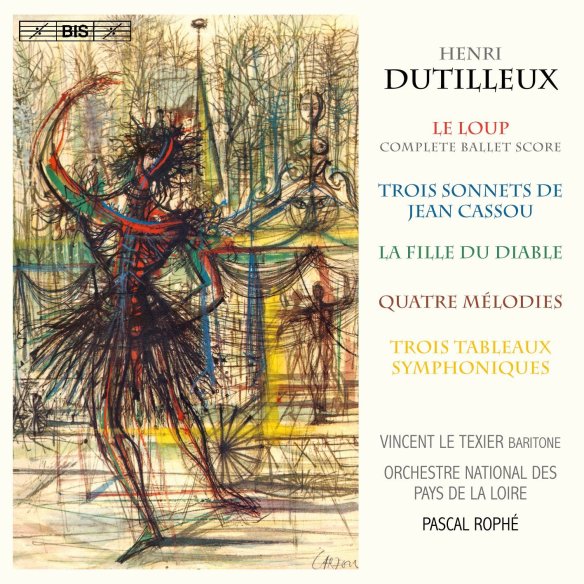
Pascal Rophé, leading exponent of modern French music, conducts this up-and-coming French orchestra in music by a composer whose centenary falls this year, and whose influence on the contemporary music scene is out of all proportion to his modest if fastidiously crafted output.
What’s the music like?
The suite from Henri Decoin’s film La Fille du Diable features six brief items whose elements of Ravel and Stravinsky hardly lessen its attractiveness. Trois Tableaux Symphoniques (1945) derives from a Paris staging of Emily Brontë’s Wuthering Heights and is very different from Alfred Newman’s Hollywood score. Both pieces feature a prominent role for Ondes Martenot (made famous by Messiaen in his Turangalîla-Symphonie), its plangent tone to the fore in a haunting evocation of the Yorkshire moors then poignant depiction of the heroine’s demise.
Le Loup is a special case as though Dutilleux all but rejected the ballet, it occupies a crucial role in his evolution. The only previous complete recording – conducted by Pierre Bonneau in 1954 with co-author Jean Anouilh as narrator – has been restored to circulation (on Erato), but this new account (sans narration) is superior. Rophé finds a palpable momentum over its three tableaux, the influence of Prokofiev uppermost with that of Swiss-born Arthur Honegger – the most important younger French composer during the inter-war years – hardly less pervasive.
What is usually referred to as Deux poèmes de Jean Cassou initially comprised three sonnets by the wartime-resistance poet, these ruminations infused with pained nostalgia being joined by ‘Éloignez-vous’ for this more balanced sequence to which Vincent Le Texier responds in ample measure; his insight enhanced by luminous orchestration. More whimsical in manner, the Quatre Mélodies contains some of Dutilleux’s most appealing early inspirations, audibly increased in this resourceful orchestral version that remained unheard for over seven decades.
Does it all work?
Absolutely. From the outset Dutilleux possessed a technical finesse equalled by few of his peers, and while there is nothing on this disc to match his mature masterpieces, this music’s audible connection between its composer’s past and future makes for pleasurable listening.
Is it recommended?
Indeed. Rophé secures keenly responsive playing which benefits from the immediate yet spacious SACD sound typical of BIS. Pierre Gervasconi contributes informative notes and this disc is a necessary acquisition, not least for those who think they know their Dutilleux.


 Howard Shelley & London Mozart Players, St John’s Smith Square, 2 March 2016.

 If you wanted a definition of a classical music entrepreneur, Víkingur Ólafsson would surely fit it.
 Friendly Fire – Simon Trpčeski, London Symphony Orchestra / Gianandrea Noseda (above)