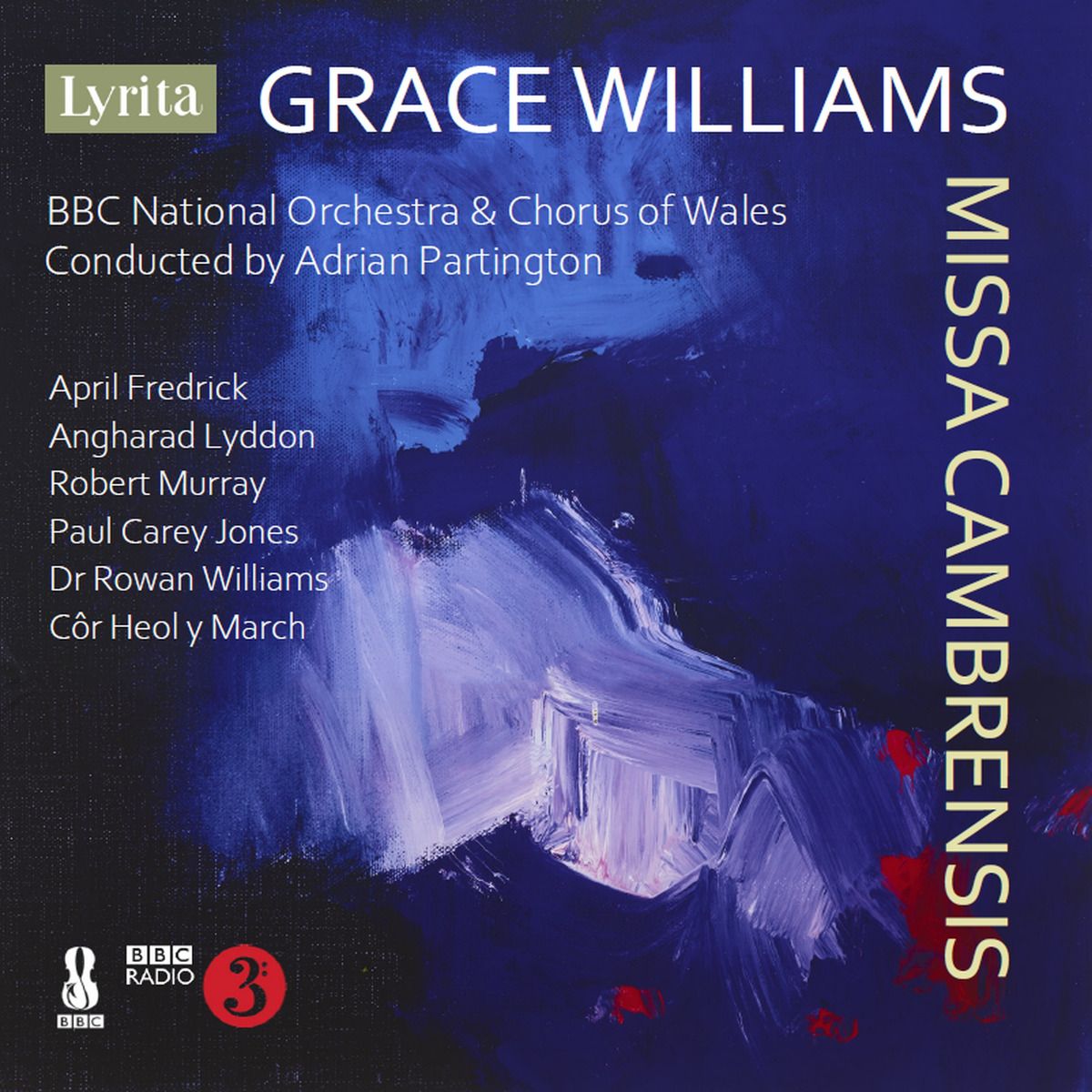
On Record – Soloists, BBC National Chorus and Orchestra of Wales / Adrian Partington – Grace Williams: Missa Cambrensis (Lyrita)

Grace Williams Missa Cambrensis (1968-71)

April Fredrick (soprano), Angharad Lyddon (mezzo-soprano), Robert Murray (tenor)
Paul Carey Jones (bass), Dr Rowan Williams (narrator); Côr Heol y March, BBC National Chorus and Orchestra of Wales / Adrian Partington

Lyrita SRCD442 [66’41’’] Latin / Welsh text and English translation included
Producer / Engineer Adrian Farmer, Engineer Simon Smith

Recorded 20-21 January 2024 at BBC Hoddinott Hall, Cardiff

Reviewed by Richard Whitehouse

What’s the story?

Lyrita continues its coverage of Grace Williams (1906-1977) with her largest concert work, Missa Cambrensis, in a recent studio recording which confirms it as the defining statement from a composer who, almost half a century since her death, is only now receiving her due.

What’s the music like?

As Paul Conway observes in his typically thorough booklet notes, Missa Cambrensis is one among a number of works by Williams that is Welsh only in a titular sense. Premiered at the Llandaff Festival in 1971, it was well received by fellow composers, critics and public alike but not heard again until 2016 in a performance one recalls as originally intended for release on Lyrita and which can be heard via the composer’s dedicated website. Not that the present account is other than successful in conveying the essence of this powerful yet elusive piece.

Many settings of the Mass since Haydn have unfolded a symphonic trajectory, but Williams goes further with the division into five clearly defined movements. The initial Kyrie Eleison not only introduces most of those salient motifs but also establishes that tone, mystical in its undulating equivocation, such as characterizes this work’s long-term expression: the contrast here between choral and soloistic textures duly accentuated by their hieratic and supplicatory quality. This duly sets up an emotional contrast intensified in the Gloria, outwardly the most straightforward part of the work but with a calmly ecstatic response at Laudamus te then an eloquent Dominus Deus that are nothing if not personal, together with an intensely wrought Cum Sancto Spiritu whose culminating Amen’s convey a distinctly ambivalent affirmation.

As most often, the Credo is the most substantial portion but Williams rings the changes by dividing this into halves, a pertinent division coming at Et homo factus est and Crucifíxus étiam pro nobis. In between are interpolated a setting of Saunders Lewis’s Carol Nadolig (A Christmas Carol) for children’s voices with viola, cello and harp of melting pathos, offset by a starkly narrative treatment of the ‘Beatitudes’ prior to a mostly ruminative resumption of the Credo. Pivoting between contemplation and elation, the Sanctus is rounded off by a joyful Hosánna in excélsis which is not to be heard again after the subdued eloquence of the Benedictus. An anguished response to the Agnus Dei feels the more acute, as also a searching Dona Nobis Pacem which brings the work full circle to its contemplative close.

Does it all work?

Yes, and with an understated while readily identifiable personality that surely makes this the most potent setting of the Mass from a Welsh composer. Subliminal influences might not be hard to discern, among them Britten’s War Requiem, but they never detract from Williams’s own idiom. The soloists cannot be faulted in terms of commitment, with Rowan Williams a notably incisive reciter, while Adrian Partington secures a lustrous response from his choral and orchestral forces. Overall, it is hard to imagine the work given with greater conviction.

Is it recommended?

It is indeed, not least in the hope that further live hearings of Missa Cambrensis may prove forthcoming. Good news, moreover, that Lyrita has now acquired the premiere performance of Williams’s only completed opera, The Parlour, which is scheduled for imminent release.

Listen & Buy

You can read more about this release at the Wyastone website

Published post no.2,516 – Monday 28 April 2025

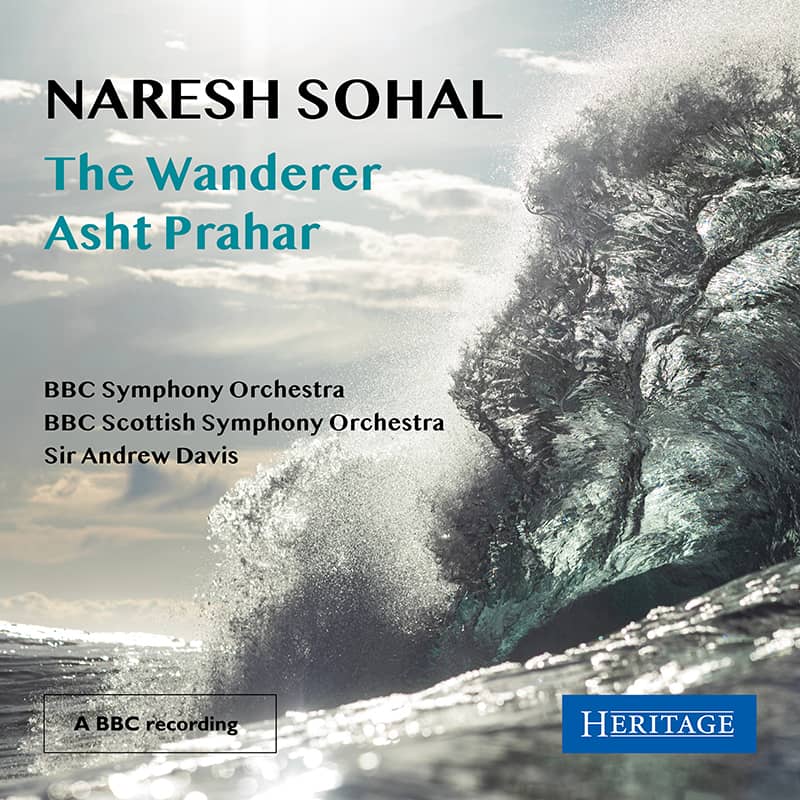
On Record – BBC SSO & BBC SO / Sir Andrew Davis – Naresh Sohal: The Wanderer & Asht Prahar (Heritage)

Naresh Sohal
Asht Pradar (1965)
The Wanderer (1982)

Jane Manning (soprano), BBC Scottish Symphony Orchestra (Asht Pradar), David Wilson-Johnson (baritone), BBC Symphony Chorus and Orchestra (The Wanderer) / Sir Andrew Davis

Heritage HTGCD135 [77’36”] English text included
Remastering Engineer Paul Arden-Taylor

Broadcast performance from BBC Studios, Glasgow on 6 January 1973 (Asht Pradar); live performance from Royal Albert Hall, London on 23 August 1982 (The Wanderer)

Reviewed by Richard Whitehouse

What’s the story?

Heritage issues what will evidently be an ongoing series of archival releases devoted to the music of Naresh Sohal, taken from BBC sources and featuring performers who championed his work over a career whose achievement is not reflected in the availability of recordings.

What’s the music like?

Although he came belatedly to the UK, Sohal (1939-2018) rapidly made up for any lost time when arriving in London in 1962 (further biographical detail can be found in the booklet note for this release and on the composer’s website). Within three years, he had produced his first major (and latterly his first acknowledged) work. Asht Prahar then had to wait until 1970 for its premiere (at the Royal Festival Hall conducted by Norman Del Mar), but it attracted much favourable attention and led to another hearing three years on – the performance featured here.

Taking its cue from the Indian sub-division of the day into eight temporal units (four each for day and night), Asht Prahar unfolds its eight sections as an unbroken continuity. The sizable forces are, for the most part, used sparingly yet resourcefully; as too the deployment of such devices as quarter-tones, along with influences of Ravel and Stravinsky, in music that makes a virtue of its pivoting between East and West. Cyclical if not necessarily cumulative, its final and longest ‘prahar’ brings wordless soprano and orchestra into tangible and haunting accord.

By the time that The Wanderer received its premiere, Sohal had a number of major works to his credit and rationalized his musical idiom accordingly. Setting an anonymous Anglo-Saxon poem in which the male protagonist speaks movingly and often despairingly of his isolation – both physical and spiritual – after the death of his lord, the work divides into two large parts that expand on the narrative’s emotional import. Such ‘‘existential bleakness’’ is intensified by omission of the poem’s last lines with their invoking a specifically Christian consolation. Despite its more than 50-minute duration, there is nothing discursive or unfocussed about The Wanderer’s content. Much of its text is understandably allotted to the baritone, whose austere character is complemented by darkly rhetorical choral passages while offset by an orchestral component with much soloistic writing (notably for flute) in a texture the more involving for its restraint and its strategic use of colour to define specific incidents or emotional responses. Nor is this an opera-manqué, the work succeeding admirably on its inherently abstract terms.

Does it all work?

It does, allowing for the fact that Sohal is not seeking any overt fusion between Occident and Orient, but rather attempting to forge a personal idiom influenced by both while beholden to neither. Both these performances bear out his convictions, Jane Manning adding her ethereal presence to Asht Prahar and David Wilson-Johnson bringing evident compassion to his more substantial role in The Wanderer. Both works benefit from the insightful presence of the late Sir Andrew Davis, whom one regrets never had an opportunity to record them commercially.

Is it recommended?

It is. The sound of these broadcasts has come up decently in remastering, lacking only the last degree of clarity or definition, and Suddhaseel Sen contributes informative annotations. Those looking for a way into Sohal’s distinctive and alluring sound-world need no further incentive.

Listen & Buy

For purchase options, you can visit the Heritage Records website

Published post no.2,451 – Thursday 20 February 2025

Arcana @ 10… Musical moments: Stanford Magnificat & Nunc Dimittis in G

Charles Villiers Stanford by William Orpen Image Credit: Trinity College, University of Cambridge

As part of Arcana’s 10th birthday celebrations, we invited our readers to contribute with some of their ‘watershed’ musical moments from the last 10 years.

Celia Lister writes:

“My musical discovery from the last decade is Charles Villiers Stanford’s Magnificat and Nunc Dimittis in G.

As an oboist specialising in solo and baroque ensemble performance, I was until recently hugely ignorant of vast swathes of church music. That all changed when my children became old enough to be church choristers, a hobby which my husband (an ex-lay clerk) was keen for them to pursue. As a result, over the last few years, I have been exposed to a huge quantity of music which was new to me, ranging from the early Spanish polyphony of Tomás Luís de Victoria to the anthems of Howard Goodall. A firm favourite genre in our house is liturgical Victoriana – Stanford, Wesley, Parry, Wood and Elgar to name but a few. Choral evensong is a highlight of the calendar, and a one of the most wonderful new pieces was Stanford’s ‘Mag & Nunc’ in G.

My daughters are lucky to have inherited my husband’s dulcet tones rather than my mezzo squawking, and my eldest recently had the pleasure of singing the not inconsiderable soprano solo in this wonderful work, with her siblings and parents on sop 2, alto and tenor respectively. Hearing her voice soaring to the rafters was undeniably special, as a parent and as someone who loves music, and was the culmination of hours of church practises, services and RSCM study sessions. It makes the seemingly endless taxi service I perform to shuttle my daughters to and from innumerable rehearsals worth it.

So in a way, it’s not that Stanford in G is a single piece which I can’t do without; it’s that for me it represents the pinnacle of a genre of music which I’d hitherto largely ignored. Liturgical music – not only, but largely Victorian – now affords me great pleasure for both musical and personal reasons. Now all I need to do is wait a few more years until they are trained up for the Passions…

Published post no.2,429 – Sunday 2 February 2025

An Epiphany…Happy New Year!

The Adoration of the Magi, by Edward Burne-Jones

‘A moment of sudden and great revelation or realization’.

This is the second Oxford definition for the word ‘epiphany’…which is also a Christian feast day, ‘the manifestation of Christ to the Gentiles as represented by the Magi’.

It’s the ‘sudden realization’ that has descended on Arcana towers, however, as many of us go back to work today. Christmas is done, two weeks that have flown by – and just a heartbeat later we’re thrust wide-eyed into the New Year, back into the strong current of the river that is modern life.

Help is at hand, however. Music is such a reliable ally in times like this, whether it’s the music we know and love or the music we haven’t discovered yet. Both are reasons to look forward to 2025 with anticipation! Arcana will be hoping for several ‘epiphanies’, as we split our loyalties between the old and the new, covering music from the last 500 years or more as we go.

2025 will see the tenth birthday of this resource, believe it or not – on Saturday 1st February. By then we hope to be well in the groove of providing a daily digest of shared musical loves, interviews and concerts. Along the way there will be special focus on Shostakovich, who died 50 years ago this year, and is a favourite composer in these parts. We will also look to enjoy classical music from London, Birmingham and online, electronic music from all corners of the world, and plenty in between.

If you’d like to get in touch with us about any of it, suggest some things for us to listen to, or even write for us, get in touch! You can get me, Ben Hogwood, via e-mail (editor@arcana.fm), over BlueSky (Ben Hogwood or Arcana) or – if you must – on Twitter / X for a little while longer.

Before you go, do listen to this remarkable carol marking Epiphany from British composer Judith Bingham – both haunting and tremendously powerful. Happy New Year!

Published post no.2,403 – Monday 6 January 2025