Live review – Sara Hershkowitz, BBC Scottish Symphony Orchestra / Antony Hermus – The Ring: An Orchestral Adventure

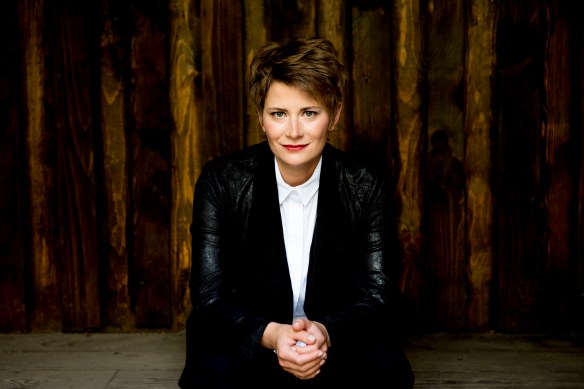
Sara Hershkowitz (coloratura soprano, below), BBC Scottish Symphony Orchestra / Antony Hermus (above)

City Halls, Glasgow
Thursday 28 November 2019

Haydn Symphony no.22 in E flat major ‘Philosopher’ (1764)
Ligeti Mysteries of the Macabre (1974-77; 1992)
Wagner arr. Henk de Vlieger The Ring: An Orchestral Adventure (1991)

Written by Ben Hogwood

An evening of musical philosophy through three very different viewpoints, held together by superb orchestral performances and the artistry and energy of Antony Hermus, making his conducting debut with the BBC Scottish Symphony Orchestra.

On this evidence it has the makings of a fruitful musical relationship. Certainly Haydn‘s Symphony no.22 in E flat major, known as the ‘Philosopher’, was carefully prepared and ideally executed. With just 26 players on the platform, and with most of them strings, the spotlight fell on the pair of horns and cor anglais players. They added unique colours and a doleful atmosphere to the profound opening Adagio, which had a steady accompanying tread. The harpsichord of Andrew Forbes was perfectly judged, complementing Haydn’s harmonic thoughts.

Orchestra leader Laura Samuel helped propel a second movement of earthy substance, which gave way to a charming Menuetto before a lively Presto wrapped things up, Haydn’s wit and inspiration in abundance once again. This was the second Haydn symphony in successive days for Arcana, after the CBSO and Riccardo Minasi’s persuasive reading the previous night. From experience a Haydn symphony a day really can go a long way – and indeed if you did two a week you would have enough for a whole year! Something definitely worth considering.

Back to the concert, and a complete change of tack for Ligeti’s uproarious and outrageous Mysteries of the Macabre, a concert piece lifted from his only opera Le Grand Macabre. And what a show it was from Sara Herskowitz, who has lived with this music some time, even on occasion dressing as Donald Trump to deliver it! Here – no doubt with the presence of BBC recording and streaming in mind – she gave Ligeti’s lines in the most sparkling of silver dresses. To say she owned the platform would be an understatement, for hers was a magnetic presence, often hilarious but frequently dazzling in its utter command of Ligeti’s demands. Using a large bottle of Irn Bru as a prop, she fair brought the house down in a performance that has to be seen to be properly appreciated. The virtuosi of the BBC Scottish Symphony Orchestra were her equal.

Another radical change of subject and perspective saw us experience the whole of Wagner’s Ring Cycle in just over an hour after the interval. The man responsible for this orchestra-only compression is Dutch composer Henk de Vlieger, who has made a remarkable piece of music containing not just the best orchestral excerpts from the four operas but the vocal and thematic music of substance too. With some tasteful composing of his own to complement Wagner’s epic he has created a near-continuous piece of music that, while never expecting to eclipse the impact of the operas, is a wholly effective concert piece.

It helps when given the sort of commanding performance The Ring received here. The brass were simply superb – trumpets, trombones, Wagner tubas, tubas and horns responding to the considerable demands with relish, creating some wonderful sonorities while they did so. The Ride of the Valkyries was an early highlight, the theme given an appropriately majestic profile, while Alberto Menéndez Escibano‘s horn solo for Siegfrieds Heldentat, given from out the back of the hall, was brilliantly done.

The BBC Scottish strings and wind were on the same exalted level, and the Feuerzauber (Magic Fire Music) and Waldweben (Forest Murmurs) were wholly evocative and enchanting. Hermus brought a keen dramatic instinct to his conducting, including rubato where appropriate but also making the silences really tell. Even before the first note sounded he secured complete stillness in the hall, setting the tone for the performance that followed – and when other silences occurred they were impeccably observed by the audience. There was a terrific, ballsy account of Siegfried und Brunnhilde, brass again to the fore, while the violins shone in their unison passages throughout.

Antony Hermus paced the whole ‘adventure’ perfectly, meaning this ‘bite size’ Ring cycle clocked in at around 65 minutes. Do catch this concert online if you can over the next few weeks, for it was a really well constructed programme of very differing but inspiring musical works. From the elegant and sometimes earthy Haydn, through the compressed but outrageous Ligeti to the grand and spectacular Wagner, there was something for everyone.

You can hear this concert on BBC Radio 3 from the evening of Tuesday 3 December by clicking here

Further listening

You can listen to the music from this concert on the Spotify playlist below, made up of some leading recordings of the works played.

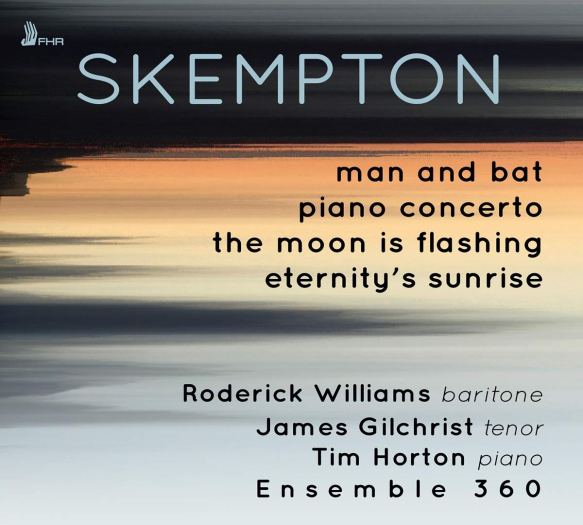
On record – Skempton: Man and Bat, Piano Concerto & The Moon is Flashing (First Hand Records)

Howard Skempton
Eternity’s Sunrise (2003)
The Moon is Flashing (2007, arr. 2018)
Piano Concerto (2015, arr. 2018)
Man and Bat (2017)

James Gilchrist (tenor, The Moon is Flashing); Roderick Williams (baritone, Man and Bat); Tim Horton (piano, Piano Concerto); Ensemble 360

First Hand Records FHR90 [70’25”]

English texts included
Producer Tim Oldham
Engineer Phil Rowlands

Recorded 20 July 2019 at Upper Chapel, Sheffield (Man and Bat), 5-7 February 2019 at All Saints’ Church, East Finchley, London (others)

Written by Richard Whitehouse

What’s the story?

A welcome addition to the recorded representation of Howard Skempton (b1947), including two pieces specially arranged by the composer for reduced forces and also two pieces written specifically for ensemble, all performed by artists closely associated with Skempton’s music.

What’s the music like?

Vocal writing has been a mainstay of Skempton’s in over recent years, the two largest pieces here setting poems by D.H. Lawrence. The term ‘setting’ is used advisedly, given Skempton’s approach is not one of expressive interpretation; rather one in which those individual words articulate a vocal line which, in its turn, articulates the instrumental writing so as to provide context.

Such is the premise on which Man and Bat operates – Lawrence’s highly descriptive, indeed discursive poem treated as a formal framework around which the ensemble unfolds a dialogue of constantly varying (not necessarily developing) motifs and phrases as provide an aural equivalent to what is being described. A not dissimilar approach is pursued in Snake, but here the musical treatment is audibly more static as befits a poem centred upon thought rather than action. This provides the concluding stage in a triptych preceded by a setting of Chris Newman’s self-deprecating A Day in 3 Wipes then, before it, the quizzical humour of Skempton’s own The Moon is Flashing which affords this diverse cycle its overall title.

The other two pieces are both instrumental, while being highly differentiated in themselves. Skempton has used generic titles only sparingly, his Piano Concerto predictable only in its avoidance of obvious models or precursors – the five movements (each lasting between two and four minutes) amounting to a series of vignettes in which the soloist variously combines with the ensemble, here a string quartet rather than string orchestra as originally conceived. Its title might suggest a natural piece with which to open, but Eternity’s Sunrise also makes for a persuasive rounding-off – a perfectly proportioned entity which amounts to a sequence of variations on an undulating theme apposite to the lines from William Blake that provided inspiration. Once again, Skempton’s writing is affecting through its sheer self-effacement.

Does it all work?

Very much so. From an output dominated by miniatures for the piano or accordion (his own instrument), Skempton has amassed a sizable and ever more varied catalogue from which the present release offers a judicious selection. It helps when the performances are so responsive to those qualities of emotional restraint and attention to detail that define the essence of this music. Roderick Williams and James Gilchrist can be relied upon for unforced insight, as too can the underrated pianist Tim Horton and the grouping of soloists which is Ensemble 360.

Is it recommended?

Indeed. Skempton now enjoys a substantial discography which features a number of releases devoted to his music (most notably those on the NMC label), to which should now be added this latest from the always enterprising First Hand Records. The sound has all the focus and detail necessary with this composer, whose succinctly informative notes on each piece are complemented by anecdotal observations from each of the soloists. Those who are new to Skempton will find this an ideal way into his compositional ethos, where little is as it seems.

Stream

Buy

For more information on this release and to purchase in multiple formats visit the Presto website

On record – Shostakovich: The Bedbug; Love and Hate (Naxos)

Shostakovich
The Bedbug Op.19 – complete incidental music (1929)
Love and Hate Op.38 – complete film-score (1935)

Mannheim Opera Chorus / Dani Juris; Deutsche Staatsphilharmonie Rheinland-Pfalz / Mark Fitz-Gerald

Naxos 8.574100 [58’54”]

Russian transliterations and English translations included
Producer Roland Kistner
Engineer Bernd Nothnagel

Recorded 18-21 February 2019 at Philharmonie, Ludwigshafen, Germany

Written by Richard Whitehouse

What’s the story?

Naxos continues its ground-breaking traversal of the film and theatre music by Shostakovich with this coupling of scores long unheard as originally conceived, thanks in part to the work of Mark Fitz-Gerald in having reconstructed these from extant sketches and soundtracks.

What’s the music like?

Shostakovich’s earliest theatre score was for The Bedbug, a scatological comedy by the ill-fated Vladimir Mayakovsky whose two parts were set in the then-present and 50 years later in 1979. The main items include several astringent dance numbers audibly akin to Stravinsky and Weill, while others were recycled for later dramatic projects (most notably the Wedding Scene [track 6] which soon became the Overture to Erwin Dressel’s opera Armer Columbus), with resourceful usage of such instruments as saxophone, mandolin and musical-saw. An air of sardonic detachment pervades this music which doubtless contributed to the production’s brief theatrical run and its subsequent oblivion, but the confidence and panache with which Shostakovich acquits himself can hardly be gainsaid. Although the parodying of such Soviet archetypes as firemen and pioneers soon became taboo in a Soviet Union beholden to Stalin, the experience gained served the composer well in subsequent ballets and revues, so making the present score a significant harbinger for what was to follow over the ensuing five years.

That said, it is the score for Love and Hate that leaves the stronger impression here. Directed by Albert Gendelshtein, this one of several films resulting from Soviet-German cooperation in the interwar period and which ceased in 1937 when the gulf between Stalin’s and Hitler’s ‘socialism’ became unbridgeable. In its quirkily compelling amalgam of post-expressionist and socio-realist elements, this film is more than mere historical curio – as Shostakovich’s music makes plain in an expressive directness evident from the outset. Most notable in this respect is the song How Long Will My Heart Ache and Moan?, initially allotted to mezzo and female chorus [track 19], and a series of searchingly descriptive pieces as culminates in the surging intensity of The Funeral [track 33]. It is at such junctures that the more elegiac aspect of the Fifth Symphony (two years hence) comes into focus, making one regret that no suite was previously compiled. Maybe this will now prove possible given the score’s timely availability, so enabling a vital link in its composer’s evolution to be properly appreciated.

Does it all work?

Yes, not least owing to the insight of Fitz-Gerald’s realizations with regard to those missing or fragmentary sections – where he captures the Shostakovich spirit in full measure – as also to the commitment of the Deutsche Staatsphilharmonie Rheinland-Pfalz in realizing the often wilful while always arresting nature of the composer’s inspirations. Forward but not unduly immediate sound, with extensive annotations by Fitz-Gerald, musicologist Gerard McBurney and Soviet cinema authority John Leman Riley, further enhance the attractions of this release.

Is it recommended?

Indeed, and it is to be hoped Fitz-Gerald will be continuing his exploration of this one facet of Shostakovich’s output as is still inadequately covered in terms of publication or recording. Several of the composer film and theatre scores from the 1930s still await such rehabilitation.

Stream

Buy

For more information on this release and to purchase in multiple formats visit the Naxos website, with an article on the recording here

Live review – Renaud Capuçon, CBSO / Anja Bihlmaier: Dvořák, Ravel, Chausson & Bizet

Renaud Capuçon (violin), City of Birmingham Symphony Orchestra / Anja Bihlmaier

Symphony Hall, Birmingham
Wednesday 30 October 2019 (2.15pm)

Bizet arr. Hoffman Carmen Suite no.2 (1887)
Chausson Poeme Op.25 (1896)
Ravel Tzigane (1924)
Dvořák Symphony no.7 in D minor Op.70 (1885)

Written by Richard Whitehouse

This afternoon concert by the City of Birmingham Symphony Orchestra brought a welcome appearance from German conductor Anja Bihlmaier, presiding over an unlikely yet appealing programme as juxtaposed French and Russian music of the late 19th and early 20th centuries.

Bizet‘s Carmen has maintained its hold on the operatic repertoire such that individual items are seldom encountered in concert other than as encores. As arranged by Fritz Hoffmann, this Second Suite astutely alternates entr’actes with vocal numbers. Thus the purposeful Marche des contrebandiers (akin to an offcut from Elgar’s Wand of Youth) precedes the smouldering Habanera, then a Nocturne which is Micaela’s third act aria with its vocal line transferred to violin and soulfully rendered by guest leader Tamas Kocsis. That of the evergreen Chanson du toreador is similarly heard on trumpet, which instrument is duly partnered by flutes in the infectious La garde montante, before wind instruments variously come to the fore during the Danse boheme which rounded off the present selection in appropriately exhilarating fashion.

Renaud Capuçon then joined the orchestra for an unlikely coupling of concertante pieces that is highly effective in concert. It may have been inspired by a Turgenev story, but Chausson‘s Poème is an autonomous entity whose rhapsodic impulses are balanced by formal rigour and an organic evolution as elides between the introspective and ecstatic – a trajectory conveyed with due eloquence by Capuçon, his fastidious tonal shading deftly reinforced by Bihlmaier’s nuanced direction. What is so often an elusive work left a powerful and enduring impression.

As, albeit in its rather more demonstrative way, did Ravel‘s Tzigane. Effectively the result of a bet with violinist Jelly d’Aranyi that this composer could come up with a rhapsody inspired by Hungarian gypsy music, the piece wears its Lisztian antecedents lightly while pointing the way toward the similarly conceived rhapsodies of Bartók. Capuçon teased out the high-drama of its unaccompanied initial section, then – with harpist Alma Klemm – made a breath-taking transition into its heady medley of gypsy-inflected themes prior to the rousing final flourish.

After the interval, Dvořák’s Seventh Symphony came almost as a corrective in its seriousness of purpose and powerful formal logic. Bihlmaier directed a performance as left no doubt as to such qualities, at its best in a thoughtful while never staid account of the slow movement – its brief yet elated climax ideally judged – then a scherzo whose underlying furiant rhythm was suffused with Brahmsian trenchancy (one reason this piece displeased the anti-Dvořák faction decades hence). Not that there was much lacking with the outer movements, though the coda of the initial Allegro was a little too deadpan for its ominousness fully to register, and that of the finale felt too reined-in emotionally; those granitic cadential chords marginally failing to clinch what is surely the most fatalistic of any major-key ending in the symphonic repertoire.

Even so, this was a finely realized account of a work as can all too often misfire. Bihlmaier will hopefully return before long: next week, the CBSO’s principal guest conductor Kazuki Yamada directs a performance of Mendelssohn‘s Elijah, premiered in this city 173 years ago.

On record – CBSO / Edward Gardner – Mendelssohn in Birmingham Vol.5: Overtures (Chandos)

Mendelssohn
Trumpet Overture Op.101 (1825)
Overture to A Midsummer Night’s Dream Op.21 (1826)****
Calm Sea and Prosperous Voyage Op.27 (1828)**
The Hebrides (Fingal’s Cave) Op.26 (1830)*
The Fair Melusine, Op. 32 (1834)
Overture to St. Paul Op.36 (1836)
Ruy Blas Overture Op.95 (1839)***
Overture to Athalie Op.74 (1844)
Lorenda Ramou (piano)

Chandos CHSA5235 [74’53”]

Producer Brian Pidgeon
Engineers Ralph Couzens, Jonathan Cooper and ****Robert Gilmour

Recorded *20-21 October 2013; **15 and ***16 February 2014; ****13-14 July 2015; 10-11 July 2018 at Town Hall, Birmingham

Written by Richard Whitehouse

What’s the story?

For the fifth release in Chandos’s series Mendelssohn in Birmingham, the City of Birmingham Symphony Orchestra and its onetime guest conductor Edward Gardner further traverse the orchestral output of a composer who was not averse to snatching mediocrity from the jaws of greatness.

What’s the music like?

It should be pointed out only a part of this release consists of new material. The Hebrides, Ruy Blas and Calm Sea and Prosperous Voyage first appeared in harness with Symphonies nos.4 and 5, nos.1 and 3, and no.2 respectively; while A Midsummer Night’s Dream was coupled with a selection of the incidental music for Shakespeare’s play as well as the Violin Concerto. Those who have been acquiring this series may thus feel a little short-changed, which perhaps makes purchasing those previously unreleased items as individual downloads the best option.

Proceeding chronologically, the Trumpet Overture reinforced Mendelssohn’s precocity in the wake of his Octet for strings – its breezily incisive manner, opened-out expressively by ominous asides, a viable template for future generations on which to hone their aspirations. Few could have hoped to match A Midsummer Night’s Dream as to prodigality of invention or technical resource, not least in terms of its redefining the orchestra near the outset of the Romantic era. A more prolix structure, Calm Sea and Prosperous Voyage yet merits revival through the limpid eloquence of its introduction and surging impetus of its Allegro towards a rousing peroration. That said, it cannot compare with The Hebrides in terms of an evocation sustained via formal sleight of hand and emotional clarity as remain breath-taking to this day.

Into the 1830s, The Fair Melusine still remains engaging for those subtly tangible images of watery domains (proto-Wagnerian, though the connection is easily overstated) and headlong fate through a vivid if increasingly impersonal idiom. Such impersonality had all but taken hold by the time of the oratorio St Paul, its overture breathing an aura of unforced piety and ‘natural order’ increased by the fugal interplay at its centre then almost apologetic fervency near its close. Mendelssohn rather grudgingly supplied incidental music for Victor Hugo’s play Ruy Blas, but the overture retains its drama and melodic appeal up to the surging coda. Would that Athalie conveyed comparable conviction, but this overture to Jean Racine’s play yields little more then technical proficiency as its composer strives gainfully for inspiration.

Does it all work?

On a technical level, absolutely. Mendelssohn was a master of his craft whose abundant early promise was only intermittently fulfilled by his later music. Tackling these overtures in order of composition (rather than that of this disc) tends to reinforce such an observation, which is not to deny the sheer technical command of even those lesser pieces or of the conviction that Gardner and his players have invested into this programme overall. Save for just a couple of overly headlong climaxes, there is little to fault here in terms of either playing or recording.

Is it recommended?

Yes, with the proviso detailed above. Bayan Northcott’s estimable booklet note mentions the overture to cantata The First Walpurgis Night as being inseparable from its main work, which makes a CBSO recording of this ‘dark horse’ among Mendelssohn works the more desirable.

Stream

tbc

Buy

For more information on this release and to purchase in multiple formats visit the Chandos website