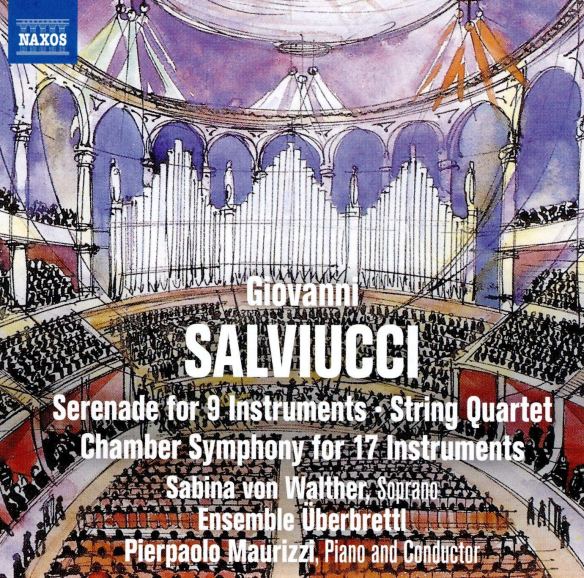
On record – Salviucci: Serenade, Chamber Symphony & String Quartet (Naxos)

Salviucci
Cinque Pezzi (1930)*
Pensiero nostalgico (1931)*
String Quartet in C major (1932)*
Salmo di David (1933)*/***
Sinfonia da camera (1933)**
Serenata (1937)**

***Sabina von Walther (soprano); Ensemble Überbrettl / Pierpaolo Maurizzi (piano)
***Latin text and English/Italian translation.

Naxos 8.574049 [83’05”]

Producer Giovanna Salviucci Marini
Engineer Tommaso Tacchi

Recorded *23-25 July 2017 at Sala dei Concerti di Palazzo Chigi Saracini, Sienna and **4-7 October 2018 at Teatro degli Atti, Rimini

Written by Richard Whitehouse

What’s the story?

Naxos continues its inestimable series devoted to Italian music of the twentieth century with this disc of mainly first recordings by Giovanni Salviucci (1907-1937) – a largely forgotten composer, whom his contemporary Goffredo Petrassi once referred to as ‘‘the best of us all’.

What’s the music like?

Although his composing career lasted barely a decade, Salviucci left several notable works across most major genres. Of those pieces included here, earliest is the Five Pieces for violin and piano – appealing if expressively unvaried music, from which only the lively Alla Festa hints at his later rhythmic ingenuity. Each of them, though, would make an attractive encore; as too would Nostalgic Thought for cello and piano, or Psalm of David for soprano and piano – verse from Psalm 61 with its roots in a modality also drawing on French and Italian sources.

Just before this latter piece, Salviucci achieved something of a breakthrough with his String Quartet. The fast-slow-fast trajectory may yield no obvious surprises, but beneath the intently contrapuntal surface of its outer movements is a quixotic handling of tonality that offsets any risk of predictability. The highlight (in every sense) is the slow movement, an Adagio whose suffused eloquence and finely wrought rhetoric transcend Salviucci’s earlier music. That the piece is unpublished is something this excellent recording should go some way to remedying.

The other two pieces have previously been recorded, which hardly makes them familiar. Its scoring for 17 instruments suggests that the Chamber Symphony may have been conceived with knowledge of Schoenberg’s eponymous work, even though Salviucci’s approach to the balance between wind and strings is less combative and more pragmatic. Outer movements combine rhythmic incisiveness with a harmonic lambency redolent of Vaughan Williams, while the heartfelt Adagio and piquant scherzo confirm an ongoing process of maturation.

A process culminating in the Serenade that was Salviucci’s last completed work. Scored for nine instruments, its textural clarity and harmonic astringency suggest increasing familiarity with the composer’s inter-war contemporaries (Italian and otherwise), and if the lively outer movements are almost too succinct for their motivic ingenuity fully to register, the Canzona elides between soloistic and ensemble writing with deft mastery. The Venice premiere, four days after Salviucci’s death, must surely have rendered the loss of such potential more acute.

Does it all work?

For the most part. Salviucci’s earlier music may be notable more for fluency of technique, but the composer’s idiom evolved apace over his few remaining years, so that one is left only too aware of what he might have gone on to achieve in the very different cultural climate of post-war Italy.

The performances by the excellent Ensemble Überbrettl leave little to chance, with Pierpaolo Maurizzi as astute in direction as he is a pianist. Sound is just a little confined in the chamber works, while Giordano Montecchi’s notes provide a valuable biographical overview.

Is it recommended?

Indeed. Salviucci was already a composer to reckon with, and this generous selection makes an ideal introduction to his music. Hopefully Naxos will now turn to the handful of orchestral works that he completed: in the meantime, the present release should be acquired forthwith.

Stream

Buy

For more information on this release and to purchase in multiple formats visit the Naxos website
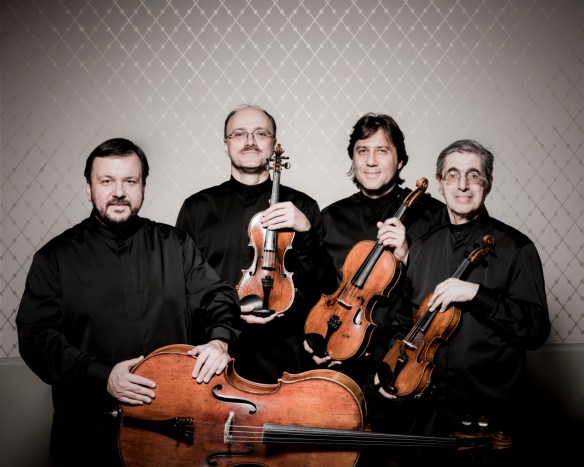
In concert – Borodin Quartet: Tchaikovsky & Arensky at the Wigmore Hall

Borodin Quartet [(Ruben Aharonian and Sergei Lomovsky (violins), Igor Naidin (viola), Vladimir Balshin (cello)]

Wigmore Hall
Wednesday 9 October

Tchaikovsky String Quartet no.1 in D major Op.11 (1871)
Arensky String Quartet no.2 in A minor Op.35 (1894)
Tchaikovsky arr. Dubinsky Album for the Young Op.39 (1878)

reviewed by Ben Hogwood
Photo credit Simon van Boxtel

The Borodin String Quartet have an unparalleled history in performing Russian string quartets, and the first of their three date mini-residency at the Wigmore Hall found them sitting firmly on home ground.

It could be said that the history of the Russian string quartet begins with Tchaikovsky, whose String Quartet no.1 in D major Op.11 began the programme. This contains his first ‘hit’, the second movement Andante cantabile which even now is a firm favourite in its string orchestra arrangement. Heard in proper context here, the understated emotion of Tchaikovsky’s solemn notes made an even stronger impact, especially when performed with due reverence.

The Borodin Quartet belong firmly to the old school of quartet playing, sitting still and straight-faced as they play, but as the evening unwound so too did their apparently stern countenance. The straight approach worked with this piece however, as an elegant first movement introduction gained weight and resolve, and the Scherzo third movement showed a rustic, outdoor quality. The final movement, capping a piece that doffs its cap to Mozart and Mendelssohn, was aware of the influence of both composers but showed off the uniquely Russian edge.

Anton Arensky’s String Quartet no.2 in A minor was written in homage to the recently departed Tchaikovsky in 1894. Replacing one of the violins with a second cello, the still underappreciated Arensky darkened the colours of the quartet, which has a distinctive if rather lopsided three movement structure. The outer movements take time for religious contemplation, while the inner and most substantial movement of the three spends time with developing a theme written by Tchaikovsky.

This Variations on a theme of Tchaikovsky is itself more popular in a string orchestra arrangement, but as with the older composer’s Andante cantabile it is more effective in context, a great example of how to keep the potentially stale variations format fresh and inventive. This was a superb performance, the Borodin Quartet – through necessity reverting to two violins rather than two cellos – gravely intoning the main subject of the outer movements where time seemed to stand still. The Variations were brilliantly characterised and flew off the page, the ensemble speaking as one – and the final pages emphatically threw off the sadness of the chant-influenced passages, looking forward to more optimistic times ahead.

For the second half the Borodin Quartet turned to their one-time leader Rostislav Dubinsky, and his arrangement for them of Tchaikovsky’s piano cycle Album for the Young. Comprising 24 short pieces for children, it is packed full of dances, character pieces and portraits. Initially the thought was that this would be overindulgent and too whimsical, but as the set unfolded so did Tchaikovsky’s charm and Dubinsky’s invention.

Here was the composer who would eventually write so skilfully for younger ears in The Nutcracker, The Sleeping Beauty and Swan Lake, channelled through the medium of an arranger who was able to send up some of the pieces with clever pizzicato or harmonics. This was where the Borodin Quartet let themselves go more, sending up The Toy Soldiers’ March beautifully, then indulging in colourful accounts of the French, German, Italian and Neapolitan Songs. The scurrying Baba Yaga was a treat, while the last two numbers, The Organ-Grinder’s Song and At Church were curiously ghostly, sending the young audience to what might have been a troubled sleep.

No such troubles here though, as we finished with an encore from Borodin himself, the Serenata alla Spagnola. It was led off decisively by the pizzicato of cellist Vladimir Balshin before its main tune, given affectionately by viola player Igor Naidin. It was a fitting way to end a charming and moving concert.

Further listening

You can hear recorded versions of the music played in this concert on the Spotify playlist below, including the Borodin Quartet‘s recording of the Tchaikovsky String Quartet no.1 and Rostislav Dubinsky‘s own Borodin Trio in the Album for the Young:

On record – Jürgen Bruns conducts Hanns Eisler’s Leipzig Symphony (Capriccio)

Eisler
Leipziger Sinfonie (1959-62: compl. 1998 Medek)*
Trauerstücke aus Filmpartituren (1961/2: arr. 2015 Bruns/Fasshauer)*
Nuit et brouillard (1955: original film score)**

*MDR Sinfonieorchester Leipzig, **Kammersymphonie Berlin / Jürgen Bruns

Capriccio C5368 [63’22”]

Producers *Stefan Antonin, **Gideon Boss
Engineers *Martin Staffe and Robert Baldowski, **Stefan Haberfeld and Regine Kraus

Recorded **9 November 2015 at Konzerthaus, Berlin; *15-16 August 2018 at MDR Studios, Leipzig

Written by Richard Whitehouse

What’s the story?

An important disc of orchestral works from Hanns Eisler (1898-1962), each a first recording and confirming the continued distinctiveness of his music over his final years in (then) East Berlin, when more ambitious plans were constantly thwarted by the East German authorities.

What’s the music like?

Eisler essayed symphonic pieces across his output, notably the Deutsche Sinfonie that is his largest concert work.

The Leipzig Symphony was commissioned by that city’s Gewandhaus orchestra but, at the time of Eisler’s death, consisted of a folio of sketches and memos given definition by Tilo Medek (1940-2006) to commemorate the composer’s centenary. Drawing mainly on film scores (as Eisler had done in his six orchestral suites), these four movements make for a quirky yet compelling entity: unfolding from the pungent contrasts of the initial Prelude and Idyll, via a restive slow movement then a sardonic scherzo both entitled Con moto, to a closing March without Words whose bracing impetus is typical of Eisler at all stages of his career. Some aspects – notably a percussive onslaught at the end of the second movement – are likely interventions by Medek (briefly a pupil of Eisler), though overall the expressive content and formal follow-through have an authentic quality such as makes this piece a necessary addition to the Eisler catalogue and one that warrants repeated exposure.

The other two works are both film scores. In the instance of Funeral Pieces of Motion Picture Scores, its nine miniatures were extracted by Jürgen Bruns and Tobias Fasshauer from music for two films about the Holocaust. The moods may be consistently subdued, but the motivic repetition Eisler threaded ingeniously through these scores has enabled a cohesive sequence whose end returns deftly or without contrivance to its beginning. Given that both films were forgotten soon after being made, this arrangement constitutes a worthwhile act of restitution.

Night and Fog presents a rather different proposition. This half-hour piece is in fact the entire score to a documentary about Auschwitz shot (partly on location) by Alain Renais and whose acclaim facilitated his subsequent film career. This is now available on DVD and mandatory viewing, yet Eisler’s contribution is entirely viable on its own terms. Its 13 numbers (lasting between 30 seconds and five minutes) again opt for understatement.

Peter Deeg’s insightful booklet note indicates how the studio musicians seemed nonplussed by Eisler’s insistence on emotional restraint, but the resulting music is its own justification; whether in more ominous episodes (not least one entitled Herr Himmler), or the final movement that encapsulates its subject in a threnody of Mahlerian anguish. Never was Eisler’s ‘commitment’ more explicit.

Does it all work?

Absolutely. It helps that the playing of both MDR Symphony and Berlin Chamber Symphony orchestras feels unerringly attuned to the angularity yet also plangency of Eisler’s expressive ambit, ably guided by the versatile Jürgen Bruns so all three pieces leave a lasting impression.

Is it recommended?

Indeed. To get the measure of Eisler, the collection of (mainly) Berlin Classics recordings – now available on Brilliant Classics – is an essential purchase, but the present disc is a vital supplement and a further significant release from the always enterprising Capriccio label.

Stream

Buy

For more information on this release and to purchase in multiple formats visit the Capriccio website

Wigmore Mondays – Jess Gillam & Zeynep Özsuca

Jess Gillam (soprano and alto saxophones, above), Zeynep Özsuca (piano, below)

Wigmore Hall, Monday 7 October 2019 (lunchtime)

You can listen to this concert on the BBC Sounds app here

Review and guide by Ben Hogwood

Saxophonist Jess Gillam is proving to be a breath of fresh air for BBC Radio 3 and for classical music in general. Her combination of passionate artistry, technical flair and down to earth presentation is ideal, and brought colour to a dull Monday in October. Her spoken introductions between the pieces in this concert had a nicely judged patter, showing someone at ease with an audience and enthusiastic about the music she plays. The refreshing lack of pretence fed into the inspiring performances too. Gillam was helped by a very well chosen programme of music showing off the versatility of her instrument, in doing so covering a rich variety from the last 300 years.

The Pequeña Czarda of Pedro Iturralde was an ebullient first piece and a sign of things to come, placing the first earworm as well as showing off Gillam’s technique and Zeynep Özsuca’s colourful accompaniment. It draws the odd parallel to Midnight In Moscow in its slow passages, and both performers caught the contrast between these and the helter-skelter faster music.

The Marcello Oboe Concerto in D minor, transposed down a tone into C, illustrated how well works for oboe can transcribe for the saxophone, especially when played with as much control as there was from Gillam and Özusca here. The saxophone is a much louder instrument but Gillam really enjoyed the subtle colours available, and this worked especially well in the famous Adagio (11:08 on the broadcast link). In the outer movements Özusca found great clarity to bring the part writing to life.

Anna Clyne’s new piece Snake and Ladder introduced electronics to the equation, reminding us how the saxophone is one of the most versatile instruments between classical and rock music. Written for saxophone and distortion pedal, it was an effective and enjoyable piece, though sat at the back of the hall we had what sounded like wow and flutter from the breathing.

This led through a bit of a stylistic jolt to Poulenc’s Oboe Sonata, which appeared to be presented in original form without an arrangement – certainly none was credited. Gillam clearly loves this piece and played it beautifully, though the more plaintive oboe tone from which the third movement especially benefits was understandably more difficult to find (from 30:06). This movement, an elegy to Poulenc’s great friend Prokofiev, is effectively the last music he wrote and as such is very profound. Gillam did however do a brilliant job with the fast central movement (25:56 on the broadcast), with spiky counter thrust from Özsuca, while the first movement had established the mood.

We then heard from composer Rudy Wiedoeft, an American composer who raised the profile of the saxophone worldwide. His Valse Vanite, an original piece, drew on his love of transcribing other composers, and it was as though Chopin had taken a vacation in Harlem. Both musicians clearly have a lot of affection for this piece, and Gillam’s ornamentation was exquisitely done.

A reduced version for saxophone and piano of John Harle’s RANT! followed, this enjoyable and tuneful piece drawing on folk tunes from Gillam’s native Ullswater. That the composer, also Gillam’s teacher, was in the audience said much for the bond and mutual respect the two enjoy.

A soulful Pièce en forme de habanera followed, Ravel leading nicely into Gillam’s party piece. Milhaud‘s Scaramouche is the work she played in orchestral form at the Last Night of the BBC Proms in 2018, though it is arguably more effective in partnership with piano. Özsuca was a little far back in the mix to begin with but the fast movement was still hugely enjoyable, followed by a thoughtful slow movement and perky Brazileira (58:48), Gillam breaking into a grin once more as she played the catchy tune.

The audience would have been happy with this as the final earworm with which to leave, but a bonus was in store in the form of Duke Ellington’s In a Sentimental Mood (not on the broadcast), the encore showing off Gillam’s remarkable breath control in slower music.

This was a really enjoyable concert, and it was so refreshing to see another younger artist throwing off any shackles that classical music might present, and offering it out as music, pure and simple. Proof if it were ever needed that music should be there for everyone to enjoy!

Repertoire

Jess Gillam and Zeynep Özsuca played the following music (with timings on the BBC Sounds broadcast in brackets)::

Iturralde Pequeña Czarda (2:03)
Marcello Oboe Concerto in D minor (7:34)
Clyne (Snake and Ladder) for saxophone and electronics (19:27)
Poulenc Sonata for oboe and piano (21:05)
Wiedoeft Valse Vanité (35:00)
Harle RANT! (40:27)
Ravel Pièce en forme de habanera (47:53)
Milhaud Scaramouche Op. 165b (51:13)

Further listening

Some of the music played in this concert can be heard on Gillam’s debut album Rise. This includes the orchestral version of John Harle’s RANT!, and the works by Iturralde, Marcello and Wiedoeft – and of course the finale of the Milhaud:

Gillam’s teacher John Harle has a very impressive recorded legacy, raising the profile of the classical saxophone in contemporary classical music. The Sax Drive album (one in a series of PR own goals when it comes to saxophone album titles!) is well worth exploring for the three concertos it holds from Stanley Myers, Richard Rodney Bennett (his Concerto for Stan Getz) and Michael Torke:

Meanwhile if you liked the music of Milhaud you will find this hugely attractive collection from EMI to be very much your thing:

Wigmore Mondays – Boris Giltburg plays Rachmaninov Preludes

Boris Giltburg (piano, below)

Wigmore Hall, Monday 30 September 2019 (lunchtime)

You can listen to this concert on the BBC Sounds app here

Review and guide by Ben Hogwood

When Bach finished the first set of his celebrated Well-Tempered Clavier in 1722, he set in motion an approach to writing for the keyboard that has captured the imagination of several other composers through the centuries, writing a prelude and / or a fugue in each of the 24 keys and having them performed as a collection.

Sergei Rachmaninov was one of those composers so influenced, though he didn’t approach it as a collection initially. In fact he began with just one piece, the Prelude in C sharp minor, which sat in the middle of the 5 Morçeaux de Fantaisie for piano when published in 1892. With the composer still in his late teens, this Prelude shot him to stardom – and so he was only too happy to revisit the form with another 23 pieces, delivered in two installments in the years 1903 and 1910.

The prelude became one of Rachmaninov’s primary methods of expression in his solo piano music, and the pieces are much loved. Boris Giltburg’s selection here did not however include the two most famous examples – the C sharp minor piece, nor the famous G minor prelude from the Op.23 set, Boris Giltburg preferring instead to show that the other 22 are absolutely not to be overlooked! From these he picked a selection of 14, arranged chronologically but also logically in their key groups.

Rachmaninov’s writing for piano is almost instantly recognisable, and only a few seconds of the Prelude in B flat major Op.23/2 (1:27) are needed to confirm his authorship. The ready and natural flow of notes, the power of the right hand, working in octaves on this occasion, and an outpouring of passion. Giltburg kept a fine measure of expression and control.

He complemented this heady start with the soft yet ardent Prelude in D major Op.23/4, and then another stream of consciousness from the Prelude in C minor Op.23/7, carrying all before it to an emphatic end. Giltburg’s phrasing was ideal here, knowing when to ‘breathe’ in the longer phrases.

The Prelude in A flat major Op.23/8 shows something of the influence of Chopin, and this one too flowed nicely under Giltburg’s direction. Shifting the base to the Prelude in E flat minor Op.23/9 brought a more worrisome outlook, the right hand more agitated and becoming relatively sombre in its closing statement. The last of this set, the Prelude in G flat major Op.23/10, negotiated calmer waters, Giltburg lost in thought and the music.

The Op.32 selection begins in the ‘purest’ key, C major, so named as all its notes are the white keys on the piano – yet from Rachmaninov this is his shortest prelude, powered here by Giltburg’s weighty left hand opening. It formed a nice gateway to the Prelude in B flat minor Op.32/2, from which we were led to the heroic Prelude in E minor, the fourth in the set. This was brilliantly characterised and paced by Giltburg, a darkly dramatic performance.

The serenity of the Prelude in G major Op.23/5 was beautifully observed, as was the stark contrast to the following Prelude in F minor Op.32/6, which erupted out of the blocks. Most impressive of all, perhaps, was the substantial Prelude in B minor Op.32/10, a response to Arnold Böcklin’s painting Die Heimkehr (The Homecoming, above), a piece of genuine, bittersweet emotion, especially at the end where Rachmaninov struggles to choose between the minor and the major key.

After this the penultimate Prelude in G sharp minor Op.32/12 had a touch of the Mediterranean in its tremolo passages, and here Giltburg again gave the music plenty of room to breathe, his virtuosity extremely impressive. The final, substantial Prelude in D flat major Op.32/13 had a keen sense of homecoming, given a regal air in this performance.

Repertoire

Boris Giltburg played the following Rachmaninov Preludes (with timings on the BBC Sounds broadcast in brackets):

Rachmaninov
10 Preludes Op.23 (1902-03) – excerpts: in B flat Op.23/2 (1:27); in D Op 23/4 (5:09); in C minor Op 23/7 (9:27); in A flat Op 23/8 (12:04); in E flat minor Op 23/9 (15:56); in G flat Op 23/10 (18:15)
13 Preludes Op.32 (1910) – excerpts: in C Op 32/1 (23:05); in B flat minor Op 32/2 (24:34); in E minor Op 32/4 (27:31); in G Op 32/5 (33:03); in F minor Op 32/6 (36:18); in B minor Op 32/10 (37:50); in G sharp minor Op 32/12 (43:17); in D flat Op 32/13 (45:48)

He also played Schumann’s Arabeske in C major Op.18 (52:00) as an encore:

Further listening

All the preludes in this concert can be heard on this playlist in the order they were performed, using Giltburg’s own recently issued recording:

Giltburg proclaims Rachmaninov to be a favourite composer, and his recent recording of the composer’s Piano Concerto no.3 gives the listener little doubt in that respect! It’s coupled with the solo Variations on a Theme of Corelli:

Meanwhile this earlier release for Naxos gives a welcome coupling for the second set of Rachmaninov’s Études-Tableaux Op.39 – one of his best achievements for solo piano – and the impressive 6 Moments musicaux Op.16, which between them last around half an hour and contain some deeply expressive music: