BBC Proms 2017 – Sir John Eliot Gardiner conducts Lutheran cantatas by Bach

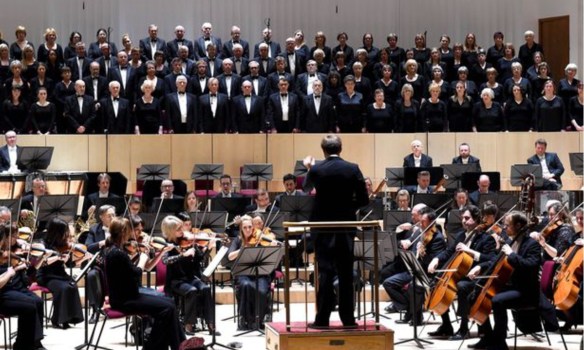
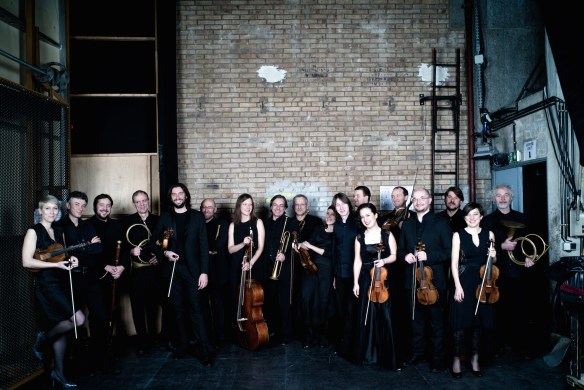
Monteverdi Choir, English Baroque Soloists / Sir John Eliot Gardiner (above)

Schütz Nun lob, mein Seel, den Herren, SWV 41; Nicht uns, Herr, sondern deinem Namen, SWV 43; Danket dem Herren, denn er ist freundlich, SWV 45 (all c1617)

J.S. Bach Cantata No.79, ‘Gott der Herr ist Sonn und Schild’ (1725); Cantata No.80, ‘Ein feste Burg ist unser Gott’ (1716, revised 1720s-1735)

Royal Albert Hall, Wednesday 2 August 2017 (late night)

After the earlier evening headiness of John AdamsNaïve and Sentimental Music from the Philharmonia, it was quite a stylistic shift to the night’s second Prom, which began with three canzonas / hymns of Heinrich Schütz, written some 400 years ago.

Yet as the ear gradually adjusted and the members of the Monteverdi Choir and English Baroque Soloists quickly found their level, it was clear we were listening to something quite special. Under the fastidious but loving direction of Sir John Eliot Gardiner, an old hand at these scores, Schütz’s own minimalism came to light, helping the transition from first Prom to second. The choir were carefully positioned and instrumental soloists stood where possible for their contributions, an effective technique that spotlit them for the audience but also ensured the Royal Albert Hall acoustic was keenly observed.

Though the Schütz was very good, the two J.S. Bach cantatas took this late night concert to the next level. First was Gott der Herr ist Sonn und Schild, where the vocal soloists Amy Carson (soprano), Reginald Mobley (alto) and Robert Davies (bass) were particularly fine, and the small continuo* (*accompanying) section negotiated their tricky lines with deceptive ease.

The second cantata, Eine feste Burg ist unser Gott, became the focus of the evening, Bach’s Lutheran cantata a cornerstone not just of his sacred compositions but of Baroque music and the Reformation in general. Gardiner took every opportunity to depict the ‘mighty fortress’, whether through the strength of the choral sound or the meaty orchestral textures, capped at the bottom end by the extraordinarily satisfying rasp on Stephen Saunders’ bass sackbut, an ancestor of the trombone. Brought to the front for the Prommers’ benefit, it was a wonderful thing to witness.

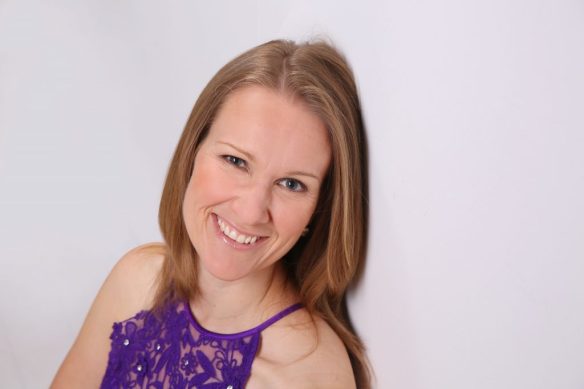
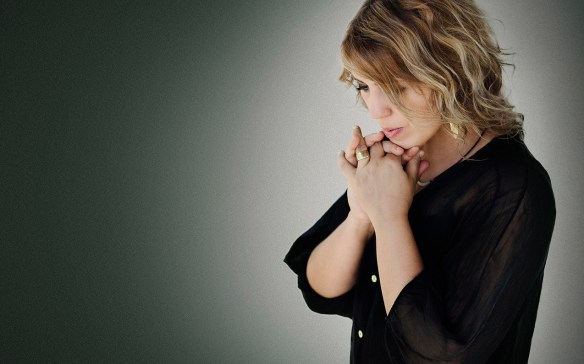
This was just the tip of the iceberg though. One of the great assets of the Monteverdi Choir is that its members are all potential soloists, making it a great team of individuals. Soprano Miriam Allan and bass Robert Davies dueted in the Aria and Chorale, and complemented each other very nicely, then tenor Hugo Hymas sang beautifully for the Recitative, while Mobley (above) once again impressed with his passionate and full-bodied tones in a duet with the tenor. The orchestra were once again on top form, though this time oboist Leo Duarte was keenly in focus, moving between the conventional wooden oboe, an oboe d’amore and an oboe di caccia (which looks rather like a banana!) with great dexterity and flair.

The chorus were impeccable with their diction and ensemble, and Bach’s music had that life-giving energy that comes across in successful performances such as this. Eliot Gardiner has written a whole book (Music In The Castle of Heaven) on his love of Bach’s music, and listening to his charges here was akin to standing on the turrets of that building, faces turned skywards. It really was that enlightening.

Ben Hogwood

Ask the Audience at the BBC Proms – Rob Chung on the BBC Symphony Orchestra with Sir Andrew Davis

Ask The Audience Arcana at the Proms

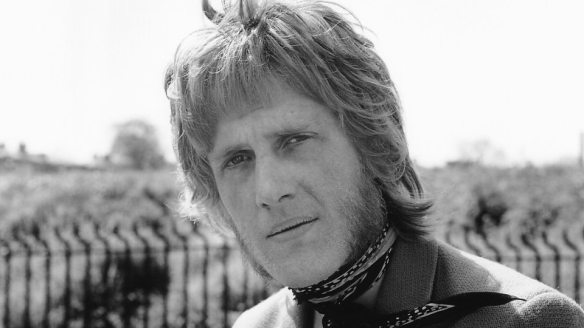
Last year Arcana went on a charm offensive, introducing friends to the BBC Proms, some for the first time. For the 2017 season we will continue to bring the festival to people in this way, discovering fascinating musical facts and insights as we go. For our first visit we chose the concert commemorating Sir Malcolm Sargent, one-time conductor of the Proms in the 1960s. The program replicated his 500th Prom, given in 1966 – and to offer an appraisal we invited Rob Chung (above)

Rob is DJ Chug, a drum ‘n’ bass DJ who runs his own Elements night in East London, and he has releases forthcoming this summer on Soul Deep and Co-Lab Recordings. Yet, as he revealed to Arcana, he has a classical past.

Beatrice Rana (piano), BBC Symphony Orchestra / Sir Andrew Davis

arr. Sir Henry Wood The National Anthem; Berlioz Le carnaval romain Overture, Op.9 (1844); Schumann Piano Concerto in A-minor, Op.54 (1845); Elgar Cockaigne (In London Town) Op.40 (1900-01); Walton Façade – Suite No.1; Popular Song (1922-28); Holst The Perfect Fool – Ballet Music (1918-22); Delius On Hearing the First Cuckoo in Spring (1912); Britten Variations and Fugue on a Theme of Purcell (The Young Person’s Guide to the Orchestra), Op.34 (1945)

You can listen to this Prom on the BBC iPlayer here

Arcana: Rob, what was your musical upbringing?

It was quite an extensive one – mainly from my sisters, when I was little. They would have anything from Duran Duran to Wham!, the big pop hits of the 1980s. My parents had a bit of Motown on vinyl, then as my sisters got older the influence came into early ‘80s R&B, swing, hip hop, De La Soul, Public Enemy, a lot of gangster rap – and then some jazz – Courtney Pine, Julian Joseph. And then it was on to drum ‘n’ bass, to Goldie and 4Hero, that kind of stuff. So that was the influence from my sisters, and then because there wasn’t any local radio in East Anglia – it was just Radio 1 or nothing, no pirate radio – I used to listen to a lot of dance DJs in the evening, such as Dave Pearce, Danny Rampling and Tim Westwood. I used to record Tim Westwood’s shows every Saturday, and fell in love with hip hop basically!

My sister came to university in London, and used to record all the drum ‘n’ bass in London, off the pirate radio stations, and she used to send me the tapes back. From there I learned what was going on in London. Then at about 15 or 16 there was a new pirate station in Norwich, of all places, called Flight FM, so I used to listen to that all the time. A lot of local DJs were playing garage and drum ‘n’ bass, and that’s when I discovered UK garage, and bought my first set of decks. I was buying anything and everything – house music, hip hop, drum ‘n’ bass, and it all went from there.

At the same time I played the piano and violin as a kid, at school. I played the violin from six years old to 18, and I was in an orchestra – I got to grade seven. I was in an orchestra at school, we used to play in the chapel and the cathedral, which you take for granted now. I have this recurring nightmare about playing on the second desk of the violins, losing my place and trying to pretend I was playing for the next hour or so. It still haunts me to this day, and I still bring it up with my school mate whenever I see him!

Have you had any other classical music experiences beyond orchestra?

Not really. I used to go to the odd concert with my parents, at Christmas carol time, otherwise not really. Not since school days.

Could you name three musical acts you love, and why you love them?

Currently, Robert Glasper – a great jazz pianist, fusing hip hop, R&B and jazz, three forms I really like. He’s an amazing musician and great live. I’ve seen him about five times now, he blows me away every time.

Stevie Wonder I think is the greatest musician I’ve ever seen. I’ve seen him at Glastonbury, and at Hyde Park last year. He’s got an amazing repertoire, great albums and a great voice. He plays any instrument amazingly well, he just blows me away.

For the third one…a drum ‘n’ bass producer called Serum, who is absolutely smashing it on the drum ‘n’ bass scene at the moment. He covers all styles, has in your face, stupid jump up tunes. Anything he releases at the moment I would listen to it and probably buy it.

How did you rate your first Proms experience?

I would give it 10/10, it was awesome – amazing. Everything about it, the experience, the sound, the crowd, the quality of the orchestra, the conductor – it was a really good experience. I forgot what it was like to be at a concert but the stereo width of the sound blew me away, following the music. I was really impressed with it, and it was the Royal Albert Hall of course. The sound was crystal clear, not loud but you could hear every single thing. It was really impressive.

What was your favourite piece?

I haven’t actually decided on that yet…probably the Elgar piece…or the Schumann, with the piano. I’ll go for that one, I liked the call and response between her (Beatrice Rana) and the orchestra, with the clarinet and the cellos, going back and forth. I really enjoyed that and she was pretty special. It took you all over the place but she was the focal point as well.

You mentioned how you knew it was Elgar during the piece.

Yeah, I don’t know why – and the same with Britten as well. It feels like an English tune, I don’t know what it is. They always used to play Nimrod at the end of every year at our school, and I think it was the harmonics or the chord progression, as soon as they started playing – and how the strings come in and out, with a slow attack.

What was your least favourite?

I think it was The Perfect Fool. I got a bit lost, and couldn’t keep up with what was going on. That was the intention, right?! I couldn’t really follow it. I liked the Walton piece though, it was a bit of fun in the middle, and the fact you could get a crowd laughing at a random ending, that was pretty special. That was where the percussion came out and were really getting into their element.

What did you think of the Delius piece, On hearing the first cuckoo in spring?

I quite liked that, again – spring, the strings coming in, it was a nice, short, to the point piece.

Do you think in terms of the length of the pieces some was too long?

It’s hard to keep up for that length of time. Some of the Schumann I struggled with a bit at the end, but at the same time in the Walton when it was short and sweet I sometimes felt it was too short, a little poem rather than a chapter. It was a nice change, a bit like listening to a Disney score.

It can be quite mentally tiring trying to take all of the music in, you start wandering. But I was comparing tonight to when I saw James Blake play at Shepherd’s Bush, and it was a sensory overload with all the lights and everything, there was a lot to take in. it was like that tonight, with lots of different things going on and trying to keep up – it was a good workout for the brain.

I thought it was also interesting how someone in the orchestra can have just one small part in 30 minutes, but when you come in you can’t miss a place. The Elgar piece I felt a lot of tension building, the Walton piece – I forget you can have things in triple time. These days everything I listen to is in four!

What did you think of the concert as an experience?

It was a lot more informal than I was expecting. I enjoyed the laid back atmosphere, it seems very open – which is not what I expected at all. We had people reading their books, people lying down, a guy reading along to the music which I thought was quite cool. I liked the crowd involvement – not a lot but traditional, it was really nice. The National Anthem at the start threw me a bit (and me! – ed) but at the same time it is nice to do these things, it doesn’t happen very often.

The acoustics vary differently where you are, it’s interesting to compare down in the Arena with up in the gods. I would be interested in how they mic everything up and do the soundchecks. There is the depth of sound as well, you really feel the depth with the violins to the tuba. I liked how the organ just snuck in during the Elgar too. Nobody was out of sync, either! I was trying to spot someone…but not gonna happen!

What we said about the conductor, how much control he has over everything – I was impressed with that, how he sped it up, slowed it down and brought people in. I forget how much hard work that must be. You’ve got to know the pieces inside out, and it was very impressive.

Was there anything you would change about how the concert was staged or presented?

Not really. I guess I’m used to having members of the band introduced, pointing out a certain lead – but I guess that’s done in the programme notes. I don’t think I would change anything.

Would you go again?

Definitely, I would happily go.

Verdict: SUCCESS


BBC Proms 2017 – I Fagiolini introduce Monteverdi to the Cadogan Hall

I Fagiolini / Robert Hollingworth (above) Photo (c) BBC/Chris Christodoulou

Monteverdi Cruda Amarilli; Sfogava con le stele; Longe da te, cor mio; Possente spirto from Orfeo, Chiome d’oro, Vorrei baciarti, o Filli

Roderick Williams Là ci darem la mano (BBC commission: world premiere)

Monteverdi Laudate pueri Dominum a 5 (concertato); Volgendo il ciel per l’immortal sentiero

Cadogan Hall, Monday 17 July 2017

Listen to this concert on the BBC iPlayer

As an introduction to the wide musical canon of Claudio Monteverdi (1567-1643), there is surely no better place to start than with this vividly coloured concert from I Fagiolini and their quirky leader Robert Hollingworth.

They gave the Cadogan Hall – and BBC Radio 3 listeners – an insight into his daring harmonic world, showing just how keenly Monteverdi could respond to the challenges of word setting. They also showed how he could operate equally effectively in a reverent sacred setting, using the same imagination as in the wild and wonderful secular works.

Monteverdi, who was born 450 years ago to the year, is essentially a ‘Renaissance’ composer (the period running very roughly from 1400 to 1600) but he wrote in such an original way that even now his music sounds forward-looking.

The first trio of madrigals in this concert showed the composer’s skill with unaccompanied voices, and the clarity with which I Fagiolini could deliver them. Cruda Amarilli (from 2:14 on the broadcast link) Sfogava con le stele (5:17) and the darker Longe da te, cor mio (8:45) were all performed with the utmost clarity.

Monteverdi is also the acknowledged father of opera, with L’Orfeo (1607) the first example in the form. It is a remarkable work, and this lengthy excerpt (from 13:09 to 22:30) shows why. Tenor Matthew Long held his notes with impeccable control, but also showered them with the composer’s written embellishments, fluctuating the note ever so slightly to give extra expression. He was shadowed by violins (Rachel Podger and Kati Debretzeni) and cornetts (Gawain Glenton and Conor Hastings).

Back to the madrigals, and the seventh book Monteverdi published in Venice in 1613. Chiome d’oro (Golden tresses) (24:14) had an attractive introduction with the two violins dovetailed, a sign of things to come from the sopranos Anna Crookes and Ciara Hendrick, and their beautiful duet from 25:06. From 27:37-32:32 the spotlight changed to Hollingworth, whose nervous lover was characterised to perfection, and Kendrick, his intended. As the song progressed so he moved progressively closer to her, and by the end the two leaned in towards s kiss – a simple but extremely effective staging!

From 35:30-42:13 we heard a new work, Roderick Williams imaginatively setting Lorenzo da Ponte’s words used by Mozart in the famous Don Giovanni aria Là ci darem la mano, here set for a five-voice choir. Williams writes through the eyes and ears of Monteverdi and the results were intriguing and often laced with humour. In the middle he added a clever invention, the reading of a letter from Monteverdi while the singers tried to outdo each other in the background. The madrigal ended in a flurry of sexual tension.

Roderick Williams takes the applause with I Fagiolini and Robert Hollingworth after the world premiere of his interpretation of Là ci darem la mano.

Finally a pair of real wonders, a setting of Laudate pueri Dominum (from 44:33) and then an extended madrigal, Volgendo il ciel per l’immortal sentiero (52:42–1:03:13), designed for the praise of the Emperor in spite of the Thirty Years War. It is a mini-masterpiece, capped by the central dance (59:10) and its lilting rhythms begun by theorbo player Eligio Quinteiro. In these capable hands we enjoyed the complete purity of C major, beautifully spun by Monteverdi’s hand.

A wonderful concert, then, performed in the vivacious spirit that I Fagiolini bring to all their performances, celebrating the humour and quirky rhythms within the music, but bringing the seriousness of Monteverdi’s invention to play also. I urge you to hear it!

Ben Hogwood

Wigmore Mondays – Hanno Müller-Brachmann & Hendrik Heilmann in Mahler

Hanno Müller-Brachmann (bass-baritone), Hendrik Heilmann (piano)

Hanno Müller-Brachmann pic © Monika Rittershaus

Mahler Kindertotenlieder (1901-4) (27 minutes)

Mahler Rückert Lieder (1901-2) (21 minutes)

Wigmore Hall, London; Monday 10 July, 2017

Listen to the BBC broadcast here

Written by Ben Hogwood

First, a health warning. These songs have subject matter and musical content that is not for the faint of heart! Yet if you can allow for Mahler’s preoccupation with death and its implications, then there is much to appreciate here in the vivid power of his writing, and it does offer some consolation to the pain and strife elsewhere.

Mahler was drawn to the text of Friedrich Rückert, and set it on several occasions. The first ‘cycle’ of the poet’s works was Kindertotenlieder (Songs on the death of children), which drew from the composer some remarkably bleak and intense music, responding as he was to the death of eight of his siblings during their childhood. The bitterest of ironies was that only four years after the completion of the work, the composer’s daughter Maria died from scarlet fever aged just four.

This lends a painfully poignant air to the music, fully exploited here by the outstanding German bass-baritone Hanno Müller-Brachmann and his descriptive musical partner, pianist Hendrik Heilmann. The singer’s tone was slightly nasal in the delivery of these songs, but right from the start of the opening poem, Nun will die Sonn so hell aufgeh’n (Now the sun will rise as bright, from 1:51 on the broadcast link) it was used very carefully to give an idea of the hollow grief for those involved.

The second song, which seems to tell of a child suffering from an incurable disease (from 7:55), laid bare its grief, as did the third (12:58), talking of ‘O du, des Vaters Zelle, Ach zu schnelle Erlosch’ner Freucenschein’ (‘O you, the joyful light…too soon extinguished’). This was similarly dark, reaching an uncomfortably powerful climax from 16:40.

And yet, the radiant brightness of the sun was gradually used to convey the release of grief and the promise of hope in the future, the young lives laid to rest. This was heard fleetingly in the middle of the second (around 10:35) and third songs, usually where Mahler moved to a major key, but in the fourth, where the poet muses how ‘they have only gone for a long walk’, Muller-Brachmann and Heilmann made clear the serenity of the end (from 20:50), where ‘the day is beautiful on these hills’.

Finally, In diesem Wetter (In this weather, 21:38), where the tension broke loose in the form of a storm, dramatically conveyed by Heilmann, before Müller-Brachmann hurled forth a vocal bristling with anger and panic. This, too, subsided to a form of peace, the five songs finally allowed a resting place.

After this more Mahler was a risky move, but with such authoritative singing it made sense to go into the five Rückert-Lieder, which by and large offer a less stark approach. Liebst du um Schönheit (If you love for beauty, 31:12) offered a lighter mood, and more vibrato from the singer, who then exploited the dark humour from the start of Blicke mir nicht in die Lieder! (Do not look at my songs!) (33:30).

The distracted Ich bin der Welt abhanden gekommen (I am lost to the world) was a beauty, the most fragrant of the songs heard so far, beautifully introduced by Heilmann 34:45 and softly sung. Yet there was a feeling of inevitability about the approaching and devastating Um Mitternacht (At Midnight, 37:56) where a cold shadow fell over the hall. Interestingly this was sung at a lower pitch than is normally the case, suspended in G minor rather than the B flat minor normally used.

Finally a song of true peace and rest, Ich bin der Welt abhanden gekommen (I am lost to the world, 44:50) was introduced with all the time in the world by Heilmann, who dictated the slow but lovingly wrought interpretation.

These were superb, thoroughly authentic Mahler performances, draining every last piece of intensity from the words and, equally importantly, from the piano part. It almost seemed churlish to offer encores, but there were two from Mahler’s pen. The first, a carefree folk setting Ich weiss nicht, wie mir ist! (I do not know what’s wrong with me, 53:45) was followed by the outrageous Lob des hohen Verstandes (Once in a deep valley, 56:23), the singer doing his best to bray like a donkey and coo like a cuckoo or nightingale as he depicted a singing competition between them!

Further listening

The works in today’s concert were orchestrated by the composer, and can be heard on this new release from the superb Alice Coote, showing their versatility for either male or female voices. The female voice lends a special potency to the text of Kindertotenlieder in particular:

It is also worth including a link to what is for many one of the greatest vocal recordings, Dame Janet Baker’s interpretations of the Mahler cycles in this concert, together with the Lieder eines fahrenden gesellen (Songs of a Wayfarer). All are conducted by Sir John Barbirolli:

Finally, in response to the encores, a listen to Mahler’s Des Knaben Wunderhorn (with Müller-Brachmann singing), a collection exploring the composer’s fascination with folksong and a child’s way of thinking, often about nature:

Wigmore Mondays – Clara Mouriz & Joseph Middleton: Songs of the Antique

Clara Mouriz (mezzo-soprano), Joseph Middleton (piano)

Purcell/Britten Alleluia (pre-1702, realised by Britten 1960)

Alessandro Scarlatti Son tutta duolo (c1699)

Anchieta arr. Dorumsgaard Con amores, la mia madre (unknown)

Liszt 3 Petrarch Sonnets (1842-6)

Duparc La vie antérieure (1884)

Hahn Tyndaris (1900)

Ravel Kaddisch (1914)

Falla 7 Spanish Popular Songs (1914)

Wigmore Hall, London; Monday 26 June, 2017

Listen to the BBC broadcast here

Written by Ben Hogwood

A fascinating concert that confirmed the versatility of Clara Mouriz and Joseph Middleton. Their performance, titled ‘Songs of the Antique’, concentrated on songs whose music or text looks a long way to the past for inspiration.

The mezzo-soprano has a rich and powerful voice in the middle register especially, which came to the fore in passionate accounts of the Liszt 3 Petrarch Sonnets, but also in the solo writing of Ravel and the quasi-orchestral scope of Duparc.

First we went right back to the Eighteenth century for an Alleluia – a song originally attributed to Purcell but found to be by John Weldon. Britten, as part of his Purcell revival, provided a complementary piano part, one that shadows the spun out vocal. This vocal won’t be to everyone’s taste, but Mouriz mastered it brilliantly here (from 1:49 on the broadcast link provided).

The Scarlatti, an excerpt from the opera La donna ancora è fedele, made a nice contrast (3:52). Unlike his brother, who wrote copious amounts of keyboard music, Alessandro wrote many operas – and the excerpt here shows how fluid his vocal writing could be. Meanwhile the arrangement of Anchieta’s folksong, thought to be from the fifteenth century, had a primal quality in this interpretation – with elegantly shaped piano from Middleton (7:01).

The Liszt was a highpoint of the recital, not just for Mouriz’s fire and passion but for Middleton’s word painting with the piano part. Liszt was borderline-obsessed with the sonnets, complementing his two vocal settings of the trio with powerfully descriptive pieces for the piano. The vocal line is highly charged in all three songs, and strongly Italian in musical flavour as well as language. Sonetto 104, Pace non trovo (I find no peace) surged forward turbulently in the piano part, a restlessness matched by Mouriz’s outpouring (from 10:31).

The Sonetto 47, Benedetto sia ‘I giorno (Blessed be the day) was notable for ‘the sighs and tears, the longing’ found by Mouriz at 20:07, while the final Sonetto 123 I’ vidi in terra angelici costumi (I beheld on earth angelic grace) was beautifully sung (from 23:10), Mouriz mastering the wide ranges and dynamics Liszt asks for. Middleton’s decorative piano part was brilliantly done too.

After this we had the relatively rare chance to appreciate the songwriting guile of Henri Duparc, a French composer whose life was tragically cut short due to neurasthenia. He left just thirteen published songs, of which La vie antérieure is an expansive example. It began optimistically (30:13) but turned rather sour towards the end, this performance carefully paced and given impressive detail by Middleton.

Hahn’s Tyndaris offered more optimism after the Duparc (from 34:35) while Ravel’s Kaddisch, from his Deux melodies hebraïques, had a powerful declamation that Mouriz used to take over the hall (36:15).

Finally the Spanish mezzo-soprano was completely on home turf for Falla’s brilliantly written songs, a whole wealth of different characters and emotions coming out in this performance (from 42:22).

We had the famous Seguidilla murciana (43:00) where ‘people who live in glass houses shouldn’t throw stones’, the mournful Asturiana (45:10), a brisk Jota (47:58), a soft Nana (Lullaby) (51:03), a brighter Cancion (52:48) with darker lining and finally the dramatic Polo (53:42), where the piano’s repeated notes appear to describe the stabbing pain in the singer’s heart.

As a richly deserved encore the pair gave a soulful performance of a Spanish funeral song, Let my soul mourn (57:08).

Further listening

The works in today’s concert are on Spotify and can be heard below:

As a contrast, why not try an album of orchestral music by the Spanish composer Turina, featuring at its centre the collection of Poema en forma de canciones:

Meanwhile, you can watch Clara and guitarist Sean Shibe perform Asturiana, from the Falla songs, below: