In concert – Leila Josefowicz, CBSO / Thomas Søndergård: Richard Strauss, Adès & Brahms

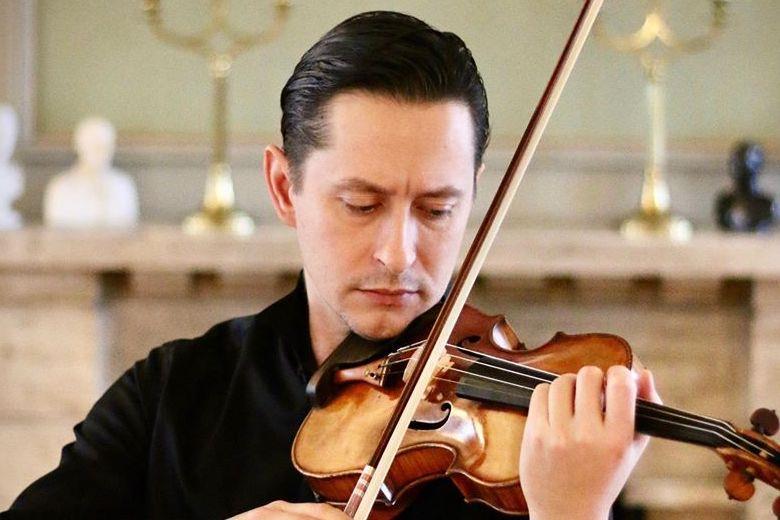
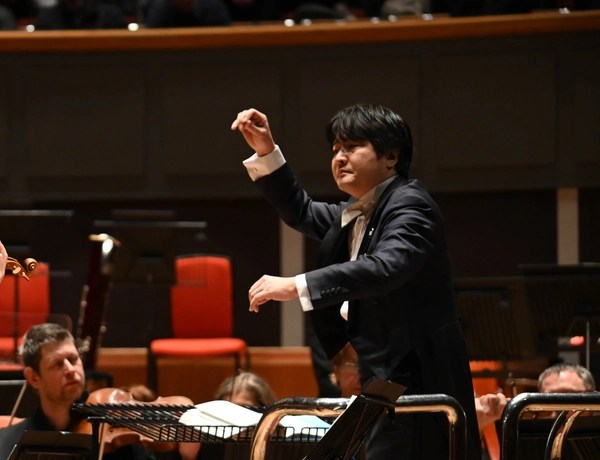
Leila Josefowicz (violin, above), City of Birmingham Symphony Orchestra / Thomas Søndergård (below)

Richard Strauss Don Juan Op.20 (1888)
Adès Violin Concerto, Op.24 ‘Concentric Paths’ (2004)
Brahms Symphony no.2 in D major Op.73 (1877)

Symphony Hall, Birmingham
Thursday 10 October 2024

Reviewed by Richard Whitehouse Pictures (c) Tom Zimberoff (Leila Josefowicz), Chris McDuffie (Thomas Søndergård)

He may be spending more time in the US than in the UK these days, but Thomas Søndergård tonight made a timely reappearance with the City of Birmingham Symphony Orchestra in a programme such as placed a highpoint among recent concertos between two established German classics.

Richard Strauss‘s Don Juan poses few technical issues for an orchestra these days – the only proviso about this performance being its almost too easy unfolding, the initial stages seeming suave rather than impetuous and emotional contrasts following on almost too seamlessly. Yet the central ‘love’ episode featured a melting contribution from oboist Lucie Sprague, with horns duly firing on all cylinders in a unison theme ultimately capped by a silence of tangible anticipation then a postlude of hushed resignation – heroic aspiration submerged in an aura of starkest fatalism.

If much of Thomas Adès’ music the past two decades has been of a conceptual brilliance that outweighs its intrinsic content, the Violin Concerto is destined to endure and rightly so given these Concentric Paths complement each other in a finely balanced totality. One, moreover, with which Leila Josefowicz identifies wholeheartedly: despatching its brief outer movements with an energy and a panache so that Rings conveyed a volatility channelled towards greater affirmation in Rounds; between them, the relatively expansive Paths proved a chaconne as methodical in evolution as it was affecting in its suffused intensity. Assured in her handling of the solo part, Josefowicz dovetailed it unerringly into orchestral writing as resourceful as any the composer has written. Those in the audience unfamiliar with it were most likely won over.

Many of those present were no doubt looking forward to BrahmsSecond Symphony after the interval, where Søndergård (above) and the CBSO did not disappoint. Outwardly its composer’s most equable such piece, this yields more than its share of ambiguities and equivocations that were rarely absent here. Not least in the opening movement, its unforced progress duly taking in an eventful development whose granitic culmination set its easeful themes at a notably uncertain remove, then with a coda whose restive horn solo was eloquently rendered by Elspeth Dutch. Søndergård was no less probing in the Adagio, flexibly paced so its autumnal main theme did not override the more whimsical and anxious elements which inform its longer-term progress. Certainly, the closing reflection on that theme cast a potent shadow on what had gone before.

The other two movements are usually thought to present few if any interpretative problems, so credit to Søndergård for finding no mean pathos in those reiterations of the Intermezzo’s main theme – not least when it returns as a winsome coda. Nor was the final Allegro lacking in incident, such as that spellbinding transition into the reprise whose epiphanic aspect was not lost on Mahler. Given its head without sounding at all rushed, the coda then emerged as the ebullient though never grandstanding peroration which Brahms himself surely intended.

A resounding close to an impressive performance, and there should be more music-making on this level next week when the CBSO is joined for the first time in many years by former chief guest conductor Mark Elder for an enticing programme of Brahms, Janáček and Shostakovich.

For details on the 2024-25 season A Season of Joy, head to the City of Birmingham Symphony Orchestra website. Click on the names to read more about violinist Leila Josefowicz, conductor Thomas Søndergård and composer Thomas Adès.

Published post no.2,331 – Monday 14 October 2024

In concert – Piotr Anderszewski @ The Barbican: Beethoven, Brahms, Bartók & J.S. Bach

Piotr Anderszewski (piano, above)

Beethoven 6 Bagatelles, Op.126 (1823)
Brahms Intermezzos (1892-93) – Opp.119/1 & 3; Op.118/1 & 2; Op.117/2; 118/6
Bartók 14 Bagatelles BB50 (1908)
J.S. Bach Partita no.1 in B flat major BWV825 (1726)

Barbican Hall, London
Thursday 3 October 2024

Reviewed by Richard Whitehouse. Photo © MG de Saint Venant licenced to Virgin Classics

Expecting the unexpected is the most predictable aspect of a recital from Piotr Anderszewski, tonight’s programme no exception in its juxtaposing collection by Beethoven and Bartók with a selection from Brahms and music by Bach that has long been a cornerstone of his repertoire.

Alive to their iconoclastic flourishes and improvisatory asides, Beethoven’s last bagatelles yet emerged as a cohesive and integrated unity as it ventured through limpid musing and angular playfulness then disarming elegance before arriving at a propulsive take on the B minor Presto muscular or energetic by turns. The final two numbers were of a piece with what went before – the one understated and the other’s ingratiation bookended by outbursts of grating humour. Nothing to be taken for granted in this music, then, as Anderszewski intimated only too well.

Although published as four separate collections, there is no reason why Brahms’s late piano pieces cannot be given separately or in autonomous groupings as here. Starting with Op. 119, Anderszewski brought a confiding touch to the plaintive B minor Intermezzo and rendered the lilting syncopation of that in C with real playfulness. Turning next to Op. 118 and the forlorn quality of its A minor Intermezzo complemented ably that in A, whose new-found popularity need not detract from its harmonic subtlety or soulful poise. From Op. 117, the B flat minor Intermezzo struck note of ingrained fatalism intensified by that in E flat minor from Op. 118 – its ‘mesto’ marking here underlined as the music unfolded toward an endpoint of unforced resignation. Anderszewski looked regretful it should end so before duly leaving the platform.

As his recent recording confirms, Anderszewski has forged unerring identity with the Op. 6 Bagatelles where Bartók gave notice of his fast-emerging individuality. Played with minimal pauses (albeit with a 3-3-2-2-2-2 grouping such as brought these into line with the six pieces in each of those other sets), they offer a conspectus of possibilities over his ensuing creative decade that was to the fore here, alongside a cumulative focus evident less in any increasing technical demands as in a gradual opening-out of their emotional world made explicit in the final two numbers as doubtless stems from Bartók’s unrequited love for violinist Stefi Geyer. Thus, the sombre restlessness of Elle est morte merged directly into the valse Ma mie qui danse – this latter’s vicious irony maintained right through to its almost dismissive pay-off.

Had Bach ever entertained any such feelings, they were certainly far removed from the keen objectivity of his First Partita. A little restive in its Praeludium, Anderszewski hit his stride in its gently eddying Allemande then animated Courante. There was no lack of gravitas in its Sarabande, but this was as deftly inflected as was the elegance of its contrasted Menuet dances, then the Gigue made a dextrous yet assertive conclusion to a sequence where (as in everything heard tonight) what was made possible outweighs what had already been achieved.

It would have been possible to combine these works with other pieces – maybe some or even all of Ligeti’s Musica ricercata that Anderszewski will hopefully play at a future recital. For now, a limpid reading of Chopin’s Mazurka in A flat major (Op.58/2) made for an ideal envoi.

To read more on Piotr Anderszewski, visit his website

Published post no.2,321 – Friday 4 October 2024

In Concert – Alina Ibragimova & Cédric Tiberghien @ Wigmore Hall: Janáček, Enescu, Barry & Beethoven

Alina Ibragimova (violin), Cédric Tiberghien (piano)

Janáček Violin Sonata in G sharp minor JW VII/7 (1913-15, rev. 1916-22)
Enescu Violin Sonata no.3 in A minor Op.25 ‘Dans le caractère populaire roumain’ (1926)
Barry Triorchic Blues (1990, rev. 1992)
Beethoven Violin Sonata no.9 in A major Op.47 ‘Kreutzer’ (1802-03)

Wigmore Hall, London
Saturday 28 September 2024

Reviewed by Richard Whitehouse

The duo of Alina Ibragimova and Cédric Tiberghien has offered some memorable recitals at Wigmore Hall during the past few seasons, with this evening’s typically diverse programme ranging over almost two centuries of compositions for the combination of violin and piano.

A first half of complementary opposites began with the Violin Sonata by Janáček. Ensuring cohesion across its four highly contrasted movements is no easy task, but the present artists succeeded admirably in this respect. Thus, the opening Con moto had an edgy ambivalence which was allayed in the Ballada – its relative repose and expressive warmth infused with a nostalgia as likely reflects the composer’s youth (and may indeed derive from one of those long-lost sonatas written while studying in Leipzig and Vienna 35 years earlier). Despite its marking, the Allegretto is a tensile scherzo whose frequently combative interplay was much in evidence here; the final Adagio then pivoting between stark plangency and a heightened eloquence which subsided into an ending whose muted regret was unmistakably to the fore.

Whatever the conceptual or aesthetic gulf between them, Enescu’s Third Sonata followed on with some inevitability. This was inspired by and recreates without quoting traditional music, as its subtitle duly indicates, and Ibragimova was alive to the musing inwardness of an initial Moderato whose ‘malinconico’ consistently undercuts any formal or expressive resolution up to a close where the songful and dance-like themes disperse into silence. The highlight was a central Andante of sustained though unforced intensity, its improvisatory aspect a stern test of coordination violinist and pianist met head-on. Almost as compelling, the final Allegro lacked a degree of inevitability in its unfolding – Tiberghien’s superbly articulated pianism less than implacable at the close, for all that Ibragimova conveyed its ominous ecstasy in full measure.

Beginning life as a test-piece for solo piano and adapted for numerous media, Triorchic Blues is Gerald Barry at his most uninhibited and would have made an ideal encore in this context – but its ever more scintillating opposition of instruments was not out of place after the interval.

This second half ended with the grandest of Beethoven’s violin sonatas, its ‘Kreutzer’ subtitle misleading yet indicative of this music’s inherent virtuosity. Ibragimova and Tiberghien made an impressive cycle of these works for the Wigmore’s own label, so it was surprising to find them at slightly below their best here. Not in the central Andante con variazioni, its judicious fusion of slow movement and scherzo rendered with unfailing poise and an acute sense of the profundity drawn out of so unassuming a theme. Yet, after its suitably arresting introduction, the first movement lacked drama – the duo playing down its rhetoric not least in a less than impulsive coda. The relentless tarantella-rhythm that underpins the finale felt similarly reined in with, again, too little of an emotional frisson as this music vividly reinforces the home-key.

What was never in doubt was their quality of playing individually and collectively, making one anticipate future recitals by these artists which will hopefully find them exploring more of that extraordinary corpus of music for violin and piano of the early and mid-20th century.

For more on the Autumn season visit the Wigmore Hall website. For more on the artists, click on the names Alina Ibragimova (violin), Cédric Tiberghien (piano), and click here for more on composer Gerald Barry

Published post no.2,316 – Sunday 22 September 2024

In concert – BBC Symphony Orchestra / Sakari Oramo: Mahler Symphony no.6

BBC Symphony Orchestra / Sakari Oramo (above)

Mahler Symphony no.6 in A minor (1903-04)

Barbican Hall, London
Thursday 26 September 2024

Having just extended his contract with the BBC Symphony Orchestra until 2030, which at 17 years will make him its longest serving chief conductor after Sir Adrian Boult, Sakari Oramo began the new season with this frequently impressive account of Mahler’s Sixth Symphony.

Impressive but equally unpredictable – not least in an opening movement whose tensility and even terseness was emphasized by mostly swift tempos and the nowadays rare omission of its exposition repeat, which predicated martial aggressiveness over any more yielding expression. There was no lack of deftness in the central interlude, for all that the off-stage cowbells were distinctly unevocative in their tinkling, yet the developmental passages either side exuded an unwavering purposefulness so that the arrival of the reprise more than usually made its mark. Stealthily launched, the coda duly emerged rather than burst forth though this was audibly in accord with the ambivalence of its affirmation as Oramo perceived it. Those closing bars had no lack of finality, for all that there was more of ruthlessness than joyousness in their arrival.

Speaking recently, Oramo stated his conviction in the revised order of the central movements with the Scherzo placed second. He might profitably have headed into this without pause, as to underline the consistency of rhythmic profile with what went before, but there was no hint of inflexibility here or in the trio sections which effortlessly elided between the winsome and sardonic. Equally in evidence was that fatalistic sense pervading the music as it unfolds, and so made possible a coda whose evanescent poise could not conceal more ominous portents.

From this vantage, the Andante provided if not balm to the soul, then a measure of unforced pathos. Enticingly rendered with some notably felicitous playing by the BBCSO woodwind, it was shaped by Oramo with unerring rightness through to a climax whose emotional force was the greater for its being held in check. Surprising that this movement has never attained the popularity of the Adagietto from the Fifth Symphony: then again, its salient qualities are conveyed even more completely when experienced within the context of the work as a whole.

By a similar token, it arguably matters less in what order the middle movements are played if the finale proves a culmination in all respects. That it certainly was here – Oramo imbuing its lengthy introduction with acute expectancy balanced by the visceral impact of what followed. Nor did tension fall off in those quiet but eventful interludes, strategically placed between the larger formal sections, and in which cowbells are overlaid by tubular bells for what became a haze of resonance as affecting as any more demonstrative expression elsewhere. Oramo also restored that third hammer-blow which does not so much alter the course of this movement, as confirm its resignation before fate in even more graphic terms. Nothing could have sounded more matter of fact than the baleful rumination of brass prior to that explosive closing gesture. While not the most inclusive performance, this was undoubtedly one to renew admiration in the audacity of Mahler’s conception or his conviction in bringing it off. It also gave notice of continued rapport between Oramo and the BBCSO as they begin their 12th season together.

For more on their 2024/25 season head to the BBC Symphony Orchestra website – and click here to read more on their chief conductor Sakari Oramo

Published post no.2,315 – Saturday 28 September 2024

In Concert – PRS Presents – Classical Edition: Manchester Collective @ LSO St Luke’s

Manchester Collective [names not given in the programme but assumed to be Rakhi Singh (violin, director), Jonathan Martindale (violin), Alex Mitchell (viola), Christian Elliott (cello)]

Mason Muttos from Sardinian Songbook
Finnis String Quartet no.2
Wallen Five Postcards
Campbell 3AM
Mason Eki Attar from Tuvan Songbook
Tabakova Insight
Hamilton In Beautiful May
Glass String Quartet no.4 ‘Buczak’ (2nd movement)
Meredith Tuggemo

Wigmore Hall, London
Wednesday 25 September 2024

Reviewed by Ben Hogwood

This inspiring concert, the first in a series presented by the enterprising team at the Performing Rights Society (PRS), revealed the innovation afoot even in the most traditional classical music forms. The string quartet has been an established medium for close on 300 years, but the four players assembled by the Manchester Collective showed where future possibilities lie.

Christian Mason’s work reproduces throat singing for the medium, often with vocal contributions from the players themselves – and the Collective’s performances of Muttos and Eki Attar were gripping and rhythmically vital.

Grabbing the attention in a very different way were quieter works by Edmund Finnis and Jocelyn Campbell. The former’s String Quartet no.2 inhabited the rarefied atmosphere that Finnis seems able to conjure at will, with interlocking phrases and melodies given an unexpectedly tender accent. The Manchester Collective played with beautiful sonority, enhanced by microphones – which in the case of Jocelyn Campbell’s 3AM was an asset, portraying the streets of London in the hour of the day where they are at their most deserted. The slights of hand, the nocturnal rustlings, the shadows we couldn’t quite make out – all were beautifully rendered and sculpted by a composer whose painting in sound is uncommonly vivid.

This was before the elephant in the room – Andrew Hamilton’s In Beautiful May – was dealt with. A piece for solo violin and electronics, it was delivered with great virtuosity by Rakhi Singh, who warned us ahead of the performance that it would be a ‘marmite’ piece. She was absolutely right, playing music that was definitely not for everyone’s enjoyment – and certainly not this reviewer. Hamilton’s collage of jarring violin phrases and pop song snippets meant we jumped between Singh and snatches of Shalamar’s I Can Make You Feel Good, Take That’s Back For Good and Will Young’s Evergreen. The short attention span of the music was infuriating, its cut and paste approach chopping the music into small bits and spitting it against an unforgiving wall. Yet personal feelings should be qualified, as Hamilton’s piece got one of the strongest reactions of the night!

Perhaps surprisingly the second movement from Philip Glass’s String Quartet no.4, Buczak, provided some much-needed balm, with an elegance not normally associated with the American composer. The Manchester Collective gave a beautiful legato performance allowing time for reflection.

Meanwhile Dobrinka Tabakova’s Insight made a strong impression, its folk melodies and rhythms winningly played and melded into an extremely convincing whole, offering further proof of the Bulgarian composer’s assured and compelling writing for strings in particular.

Errollyn Wallen’s Five Postcards, for violin and viola, were given a brilliant performance by Singh and Alex Mitchell. These were a lot of fun, ranging from bluesy musical chats to intimate asides, and a reminder that the combination of violin and viola – used so effectively by Mozart but surprisingly few composers since – is well worth revisiting.

Finishing the concert was Tuggemo by Anna Meredith, using the old English word for a swarm of birds or flies. It made for a suitably hedonistic note on which to finish the concert, with its driving four to the floor beat and jagged quartet riffing. While meant to be loud, the beat swamped the quartet on this occasion, its ultimate destination the middle of a dancefloor before the piece broke off and left us hanging.

This was, however, another example of Manchester Collective’s remarkable virtuosity and further evidence of their clever programming. Both elements combined to make this a memorable and highly stimulating concert.

Published post no.2,313 – 26 September 2024