BBC Proms #7 – Soloists, La Nuova Musica / David Bates: Purcell Dido and Aeneas

Purcell Dido and Aeneas (c1689)

Dido – Alice Coote (mezzo-soprano)
Aeneas – James Newby (baritone)
Belinda – Gemma Summerfield (soprano)
Sorceress – Madeleine Shaw (mezzo-soprano)
Second Woman – Nardus Williams (soprano)
Sailor – Nicky Spence (tenor)
Spirit – Tim Mead (countertenor)
First Witch – Helen Charleston (mezzo-soprano)
Second Witch – Martha McLorinan (mezzo-soprano)

La Nuova Musica / David Bates (harpsichord)

Royal Albert Hall, London
Tuesday 19 July 2022 (late night)

Reviewed by Richard Whitehouse Photo (c) Chris Christodoulou

After the existential confrontations of Vaughan Williams and Tippett earlier this evening, the more restrained yet no less acute expression of Dido and Aeneas came as a necessary tonic – with Purcell’s only through-composed work for the stage leaving a memorable impression.

The nature of its conception might remain as conjectural as the circumstances of its premiere, but there can be no doubt that this opera’s blazed a trail over the centuries that followed. Not the least of its attributes is a formal economy and a tensile dramatic trajectory whose ‘less is more’ aspect could scarcely be more evident. Neither is there any lack of expressive diversity in a score where elements of levity, even slapstick are aligned with a dramatic acuity which draws the three short but judiciously balanced acts into a cohesive and inevitable continuity.

Tonight’s concert performance manifestly played to these strengths. For the title-roles, Alice Coote brought gravitas and nobility of spirit to that of Dido, with James Newby an impulsive while knowingly fickle Aeneas. It was, however, Gemma Summerfield who stole the show as Belinda in rendering this most dramatically fluid of the opera’s parts with an emotional force, latterly foreboding, that was never less than captivating. Madeleine Shaw was larger than life if never overly parodic as the Sorceress, with Tim Mead a plangent Spirit whose intervention (from the organ console) seals the fate of the main protagonists. Credit, too, to Nicky Spence for an uproarious yet winning cameo as the Sailor in a scene whose Village People campery seemed entirely apposite in context and hence made this opera’s outcome the more affecting.

Directing La Nova Musica from the harpsichord, David Bates never lost sight of the dramatic continuity while ensuring an exemplary balance between chorus and ensemble. The former responded with a judicious combination of eloquence and discipline, whereas the emphasis on a continuo section of theorbos, harps and even guitar opened out but never obliterated the bracing string sonorities. Tempos were almost invariably well chosen, and though the final chorus was undeniably drawn out, this reinforced its postludial function to the work overall.

The past 58 seasons have since Dido and Aeneas given complete on four previous occasions, each time reflecting on how the opera was perceived at the time. Tonight’s performance was such a statement, and one as reaffirmed its greatness some 333 years after the first staging.

For more information on the 2022 BBC Proms season, you can visit the festival website. For more on the artists, click on the names for La Nuova Musica and David Bates.
BBC Proms #6 – BBC Philharmonic Orchestra / Sir Andrew Davis: Vaughan Williams & Tippett Fourth Symphonies

Prom 6 – BBC Philharmonic Orchestra / Sir Andrew Davis

Vaughan Williams Symphony no.4 in F minor (1931-4)
Tippett Symphony no.4 (1976-7)

Royal Albert Hall, London
Tuesday 19 July 2022

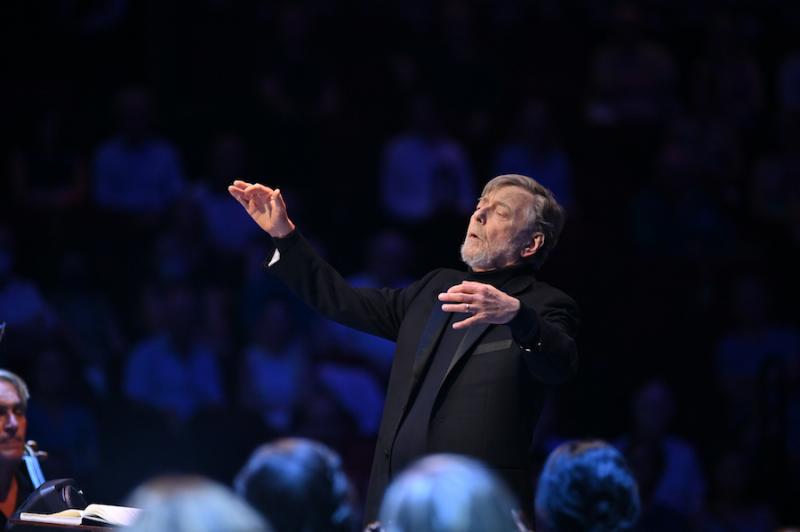
Reviewed by Richard Whitehouse Photo (c) Chris Christodoulou

Whether or not the Fourth Symphonies by Vaughan Williams and Tippett had previously been scheduled together, they made for a striking and provocative programme such as was its own justification. Omer Meir Wellber clearly thought so when this concert was planned and, even though indisposition had led to withdrawing from this year’s Proms, the presence of Sir Andrew Davis on the podium could hardly have been more conducive to the BBC Philharmonic Orchestra giving performances of the interpretive insight and technical conviction as were evident this evening.

Admittedly the Albert Hall’s opulent acoustic is never the best setting for VW4, the visceral impact of whose opening was inevitably diluted. Allowing for rather more expressive leeway than he might otherwise have done, Davis paced this explosive movement securely with just a slightly listless take on its coda detracting from the whole. The Andante was the highlight here – its fatalistic course exuding gravitas but never dragging, with the tritonal plangency of its main climaxes palpably in evidence and pathos of its final bars enhanced by an affecting contribution from flautist Alex Jakeman. This acoustic may have obscured something of the Scherzo’s contrapuntal ingenuity but not its sardonic humour or, in the trio, didactic coyness. The stealthy transition into the Finale could have had even greater cumulative focus, but what followed had all the requisite impetus – its central interlude raptly delineated, then the drama of its ‘epilogo fugato’ conveying increasing velocity through to the starkly inevitable return of the opening gesture and what is the most unequivocal four-letter ending of any symphony.

Interesting to recall the temporal distance between these pieces is now less than that between the Tippett and the present. Enthusiastically received at its Chicago premiere and one among a handful of his works still revived following his death, Tippett’s Fourth Symphony evinces  a ‘birth to death’ trajectory that differs – crucially so – from its assumed model of Sibelius’s Seventh in not being a cumulative design; its climax being rather the kinetic developmental paragraph at its centre and from where the piece fans out, in a sequence of evolving episodes, back to the launching of its introduction and onward to the passing of its coda. Although he may have directed performances of greater tautness, Davis here secured a persuasive balance between unity and diversity – bringing a metaphysical poise to its ‘slow movement’ then a deft whimsicality to its ‘scherzo’, whose respective qualities underlined the confrontational drama elsewhere. Lavish writing for brass and percussion helps makes this Tippett’s most virtuosic such statement, in which the BBC Philharmonic was rarely to be found wanting.

A less successful component of this reading was the latest attempt to represent the ‘breathing effect’ specified by the score, in which the real-time voice of CJ Neale seemed hardly more successful than those attempts of wind machine, sampler et al to realize Tippett’s speculative imagery. No matter – any such overreaching was part and parcel of this composer’s inherent ambition; an ambition, moreover, which his present-day successors would do well to emulate. Almost a century and half-century on, both these works pose challenges constantly to be met.

In appreciation – Monty Norman

Today brings the sad news that the great Monty Norman has passed away, at the age of 94. His greatest gift to us, of course, will always be the James Bond theme, later arranged (but crucially not composed) by John Barry. It remains one of the most evocative and distinctive pieces of 20th century music. Here it is in all its glory:

Here, too, is the music Norman wrote for the famous scene in the Dr No film where Honey Ryder (Ursula Andress) emerges from the sea, sung by Cibelle:

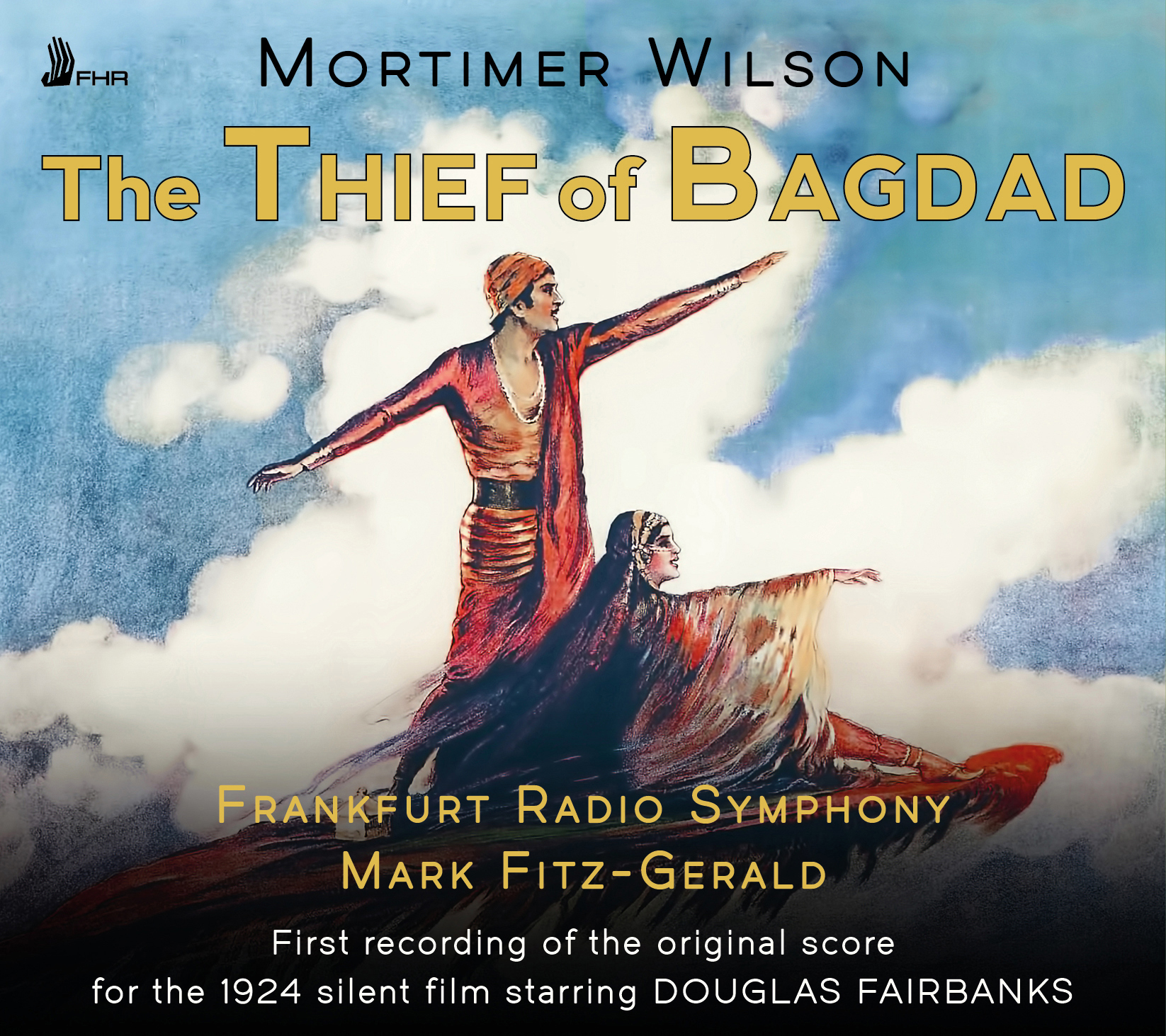
On record – Frankfurt Radio Symphony Orchestra / Mark Fitz-Gerald – Mortimer Wilson: The Thief of Bagdad (First Hand Records)

wilson-baghdad

Frankfurt Radio Symphony Orchestra / Mark Fitz-Gerald

Wilson The Thief of Bagdad Op.74 (1924)

First Hand Records FHR126 [74’45”]

Producer Philipp Knop Engineer Lisa Harnest

Recorded 11 April 2019 at Sendesaal, Hessicher Rundfunk, Frankfurt

Written by Richard Whitehouse

What’s the story?

First Hand Records comes up with another ‘first’ in this recording of the score for the film The Thief of Bagdad starring Douglas Fairbanks – one that set new standards for the ‘epic’   during the silent era, and which originally featured music to match from Mortimer Wilson.

What’s the music like?

Having starred in several major films (The Mark of Zorro, The Three Musketeers and Robin Hood), Fairbanks Sr determined to take matters to another level with The Thief of Baghdad – not least making its score an integral component. For this he turned to Wilson (1876-1932) – who had studied in Leipzig with Reger and later directed the Atlanta Symphony Orchestra, writing numerous compositions and several pedagogical books – encouraging him to create music whose symphonic aspect and panoramic expression were in themselves innovative.

Not all those involved in the project shared Fairbanks’s enthusiasm – among them impresario Morris Gest, who conspired to replace Wilson’s score with one from a higher-profile figure. James C. Bradford’s hurriedly assembled concoction almost immediately fell by the wayside, allowing the film’s highly successful first run to continue with Wilson’s music firmly in situ. Understandable, perhaps, why it had garnered praise but also attracted reservations given an emotional intensity and technical intricacy in advance of those previously attempted within a cinematic context. That said, Wilson was keen to make realization as practicable as possible – using relatively modest forces to facilitate performances in out-of-town venues, limiting the number of tempo or expression markings and even printing its parts in an easy-to-use format.

Nine decades on, its restoration was inevitably a challenge such as Mark Fitz-Gerald, having done comparable work on Shostakovich’s similarly ground-breaking scores for New Babylon (Naxos 8.572824-25) and Alone (Naxos 8.570316), was well equipped to undertake. How the music was initially reassembled and then adjusted to ensure its absolute synchronization with the film is explained in the accompanying booklet, a process which took several months prior to the first present-day showing at the Pordenone Silent Film Festival in October 2016, with the French premiere at Lyon this March. DVD presentation will hopefully be possible in due course; for now, the opportunity to hear Wilson’s superbly crafted score in so sympathetic a performance can only be welcomed by admirers of silent films and early 20th century music.

Does it all work?

Nearly always. Wilson’s music is firmly within the late-Romantic vein of Glière or Respighi, though a pertinent comparison might be Ernesto Halffter’s score for the silent film Carmen released just two years later and on which Fitz-Gerald undertook a similar act of restoration (Naxos 5.572260). In both cases, the music’s panoramic sweep is reinforced by interplay of themes and motifs which sustains dramatic tension across the whole. Moreover, the exclusion of repeated sections makes for a ‘screen symphony’ which fits comfortably onto a single disc.

Is it recommended?

Indeed. The Frankfurt Radio Symphony Orchestra responds ably to Fitz-Gerald’s astute direction, and the sound has clarity as well as presence. The booklet, featuring extensive commentaries by Fitz-Gerald and Patrick Stanbury, sets the seal on this ambitious and worthwhile enterprise.

Listen and Buy

To listen to excerpts from this disc and view purchase options, visit the First Hand Records website. To read more about Mortimer WIlson, this interesting article from the New York Times gives more information, while for more on Douglas Fairbanks click here To read more about the performers, click on the names of Mark Fitz-Gerald and Frankfurt Radio Symphony Orchestra.

In Appreciation – David Lloyd-Jones

by Ben Hogwood

This week we have learned the sad news of the death of conductor David Lloyd-Jones, at the age of 87. David was instrumental in founding Opera North in 1978, and there is a heartfelt tribute on their website in his honour.

While Lloyd-Jones was a highly respected opera conductor, I have chosen to focus on his many and pioneering recordings of English music by way of a tribute. These include extensive surveys of the orchestral music of Stanford (including a symphony cycle), Alwyn, Bliss, Rawsthorne and Arnold Bax, including another survey of his symphonies, and Holst – with an important disc of his orchestral music released in 1998. Here is just a hint of his discography for Naxos, with highlights from some very impressive recordings: