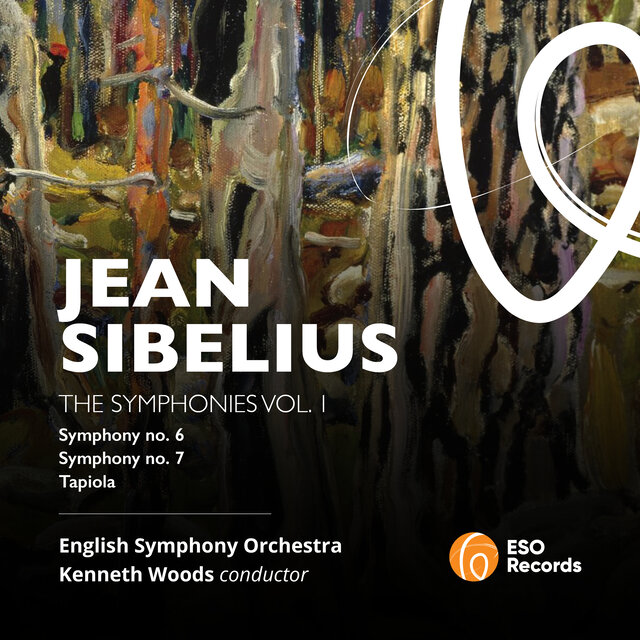
On Record – English Symphony Orchestra / Kenneth Woods – Sibelius: Symphonies 6 & 7, Tapiola (ESO Records)

Jean Sibelius
Symphony no.6 in D minor Op. 104 (1918-23)
Symphony no.7 in C major Op. 105 (1923-4)
Tapiola, Op, 112 (1926)

English Symphony Orchestra / Kenneth Woods

ESO Records ESO2502 [67’16”]
Producers Phil Rowlands, Michael Young Engineer Tim Burton

Recorded 1-2 March 2022 (Symphony no.6 & Tapiola); 2 May 2023 (Symphony no.7) at Wyastone Concert Hall, Monmouth

Reviewed by Richard Whitehouse

What’s the story?

Good to find the English Symphony Orchestra issuing the follow-up release on its own label (after Elgar’s First Symphony and In the South), launching an ambitious project to record all seven symphonies and Tapiola by Sibelius prior to the 70th anniversary of his death in 2027.

What are the performances like?

Only if the Sixth Symphony is considered neo-classical does it feel elusive, rather than a deft reformulation of Classical precepts as here. Hence the first movement unfolds as a seamless evolution whose emotional contrasts are incidental – Kenneth Woods ensuring its purposeful course complements the circling repetitions of the following intermezzo, with its speculative variations on those almost casual opening gestures. Ideally paced, the scherzo projects a more incisive tone which the finale then pursues in a refracted sonata design that gains intensity up to its climactic mid-point. Tension drops momentarily here, quickly restored for a disarming reprise of its opening and coda whose evanescence is well conveyed; a reminder that Sibelius Six is as much about the eschewal of beginnings and endings in its seeking a new coherence.

A decisive factor in the Seventh Symphony is how its overall trajectory is sensed – the ending implicit within the beginning, as Sibelius fuses form and content with an inevitability always evident here. After an expectant if not unduly tense introduction, Woods builds the first main section with unforced eloquence to a first statement of the trombone chorale that provides the formal backbone. His transition into the ‘scherzo’ is less abrupt than many, picking up energy as the chorale’s re-emergence generates requisite momentum to sustain a relatively extended ‘intermezzo’. If his approach to the chorale’s last appearance is a little restrained, the latter’s intensity carries over into a searing string threnody that subsides into pensive uncertainty; the music gathering itself for a magisterial crescendo which does not so much end as cease to be.

Tapiola was Sibelius’s last completed major work, and one whose prefatory quatrain implies an elemental aspect rendered here through the almost total absence of transition in this music of incessant evolution. A quality to the fore in a perceptive reading where Woods secures just the right balance between formal unity and expressive diversity across its underlying course. Occasionally there seems a marginal lack of that ‘otherness’ such as endows this music with its uniquely disquieting aura, but steadily accumulating momentum is rarely in doubt on the approach to the seething climax, or a string threnody whose anguish bestows only the most tenuous of benedictions. A reminder, also, that not the least reason Sibelius may have failed to realize an ‘Eighth Symphony’ was because he had already done so with the present work.

Does it all work?

Pretty much throughout. Whether or not the cycle unfolds consistently in reverse order (with a coupling of the Fourth and Fifth Symphonies having already been announced), this opening instalment is the more pertinent for focussing on Sibelius’s last years of sustained creativity.

Is it recommended?

Indeed. The ESO is heard to advantage in the spacious ambience of Wyastone Hall, and there are detailed booklet notes by Guy Rickards. Make no mistake, these are deeply thoughtful and superbly realized performances which launch the ESO’s Sibelius cycle in impressive fashion.

Listen / Buy

You can read more about this release and explore purchase options at the Ulysees Arts website. Click on the names to read more about the English Symphony Orchestra and conductor Kenneth Woods, and for the Ernest Bloch Society

Published post no.2,622 – Sunday 10 August 2025

Summer music – Delius: Summer Evening

In an attempt to reclaim summer in Western Europe, as it seems to have temporarily disappeared, here is a warm-hearted piece from Delius to take the edge off Monday evening:

Published post no.2,616 – Monday 4 August 2025

On this day – the birth of composer Ottorino Respighi

by Ben Hogwood

Today marks the anniversary of the birth of composer Ottorino Respighi in 1879.

Respighi’s most famous works are the orchestral pieces making up the ‘Roman trilogy’ – in order of composition the Fountains of Rome, Pines of Rome and Roman Festivals. Here they are in landmark performances from the Chicago Symphony Orchestra conducted by Fritz Reiner:

Published post no.2,590 – Wednesday 9 July 2025

On this day – Rodrigo Concierto de Aranjuez & Fantasía para un gentilhombre

by Ben Hogwood

Today marks the anniversary of the death of composer Joaquin Rodrigo in 1999, at the age of 97.

Rodrigo can claim to have written one of the 20th century’s most popular pieces, the Concierto de Aranjuez, for guitar and orchestra. The concerto’s Adagio is especially treasured, and can be heard at the heart of this performance:

Another popular Rodrigo piece is the Fantasía para un gentilhombre, also for guitar and orchestra:

Published post no.2,587 – Sunday 6 July 2025

On Record – Parry Karp, BBC National Orchestra of Wales – Bloch: Schelomo & Suite (Signum Classics)

Ernest Bloch
Schelomo (1918)
Suite for Viola and Orchestra (1919; arr. Rejtő/Baller, 1969)

Parry Karp (cello), BBC National Orchestra of Wales / Kenneth Woods

Signum Classics SIGCD932 [60’58”]
Producer Phil Rowlands Engineer Andrew Smilie

Recorded 29-30 July 2024 at BBC Hoddinott Hall, Wales Millennium Centre, Cardiff

Reviewed by Richard Whitehouse

What’s the story?

Signum Classics issues its first release devoted to Ernest Bloch (1880-1959), comprising what is his best-known work alongside a piece that receives its first recording in a version for cello and orchestra – making for a representative introduction to this now under-appreciated figure.

What’s the music like?

Considered in his lifetime to be on a par with such contemporaries as Bartók and Stravinsky, Bloch duly suffered that almost inevitable falling off of reputation from which his music has never quite recovered, but almost all his major works have now been recorded and often on several occasions. Among his sizable output, those with a concertante element are especially notable for their redefining the relationship between soloist and orchestra as holds good for the present works, written as they were either side of the composer’s emigration to the USA.

Its title might translate as Solomon, but Schelomo is by no means a portrait of the Biblical monarch nor is the solo part merely a ‘translation’ of lines from Ecclesiastes such as Bloch had initially intended to set. This ‘Hebraic Rhapsody’ is the last and most representative, if not necessarily the finest, of his Jewish Cycle, its three contrasting sections amounting to a concerto (or maybe a Konzertstück) in terms of their encompassing a gradually cumulative ‘exposition’, then an impulsively tense ‘development’ whose impassioned climax subsides into a ‘reprise’ which takes in a musing accompanied cadenza prior to the starkly fatalistic close. Parry Karp is a perceptive interpreter – one who never over-emphasizes its eloquence or rhetorical overkill, while rendering the piece as a cohesive and an audibly unified whole.

Conceived for viola and piano, the Suite was orchestrated soon afterward then arranged for cello a half-century on by cellist Gábor Rejtő and pianist Adolph Baller. The layout, though not so integrated as to make it a concerto, is none the less striking. Its lengthy initial Lento (originally entitled ‘In the Jungle’) pits soloist against orchestra in a fantasia-like evolution that finds effective contrast in an alternately capricious and ruminative Allegro ironico, then the songfulness of an equally compact Lento; its searching inwardness pointedly dispelled by the lively and playful Molto vivo which brings about an affirmative conclusion. Karp is fully attuned to its understated charm and Kenneth Woods, who directed the likely premiere of this version in 2008, secures playing of sensitivity and imagination from the BBC NOW.

Does it all work?

Almost always. As his introductory note makes plain, Karp has been an enthusiastic advocate for this music throughout his career and there is no doubting the extent of his commitment in either piece. Schelomo remains Bloch’s most recorded work such that those who have any one of Gregor Piatigorsky (Testament), Pierre Fournier (DG), Mstislav Rostropovich (Warner) or, more recently, Sol Gabetta (Sony) can rest content; yet this newcomer is worth a place on any shortlist and a first recording of the Suite in this guise makes the release self-recommending.

Is it recommended?

It is. Balance between cello and orchestra could not be bettered in the spacious yet analytical ambience of Hoddinott Hall, while Woods contributes his customary insightful observations. Aficionados and newcomers alike will find much to delight and absorb them on this release.

Listen / Buy

You can read more about this release and explore purchase options at the Signum Records website. Click on the names to read more about cellist Perry Karp, the BBC National Orchestra of Wales and conductor Kenneth Woods, and for the Ernest Bloch Society

Published post no.2,585 – Friday 4 July 2025