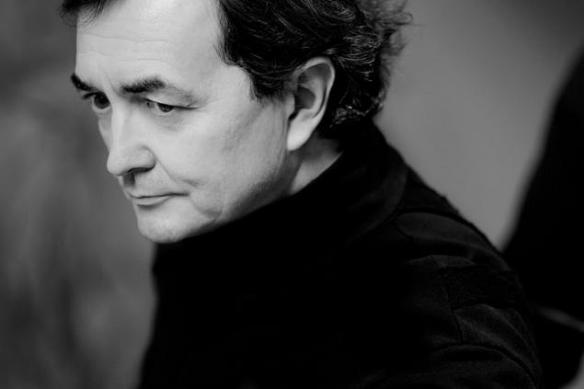
Pierre-Laurent Aimard – Birdsong at Aldeburgh

pierre-laurent-aimard

Pierre-Laurent Aimard (photo Marco Borggreve)

This will be the eighth and final season of the Aldeburgh Festival to have Pierre-Laurent Aimard as its Artistic Director. To mark the occasion, the pianist has curated some unusual and intriguing concerts, and for the final year these revolve around his first instrument.

There will be a complete performance of Bartók’s Mikrokosmos, but the event generating even more discussion is a performance of the complete Catalogue d’oiseaux, the collection of pieces for piano completed by Olivier Messiaen in 1958, the composer looking to directly replicate a rich variety of birdsong.

Aimard is presenting all of these, some 3 hours’ worth of music, in Snape and surrounding locations on Sunday, June 19. The day begins before first light, at 3:30am, with the audience given the opportunity to enjoy the dawn chorus, before Aimard begins his own performance just an hour later.

black-eared-wheatear

Le traquet stapazin (Black-eared Wheatear) – the first of Messiaen’s Catalogue d’oiseaux to be performed in Aimard’s sequence.

During the day the music will move out and about, taking in RSPB Minsmere, before returning to the Britten Studio in Snape Maltings, where the final performance is at 11:00pm. Pierre-Laurent generously allowed Arcana time to talk about the day of birds, his experiences with Messiaen around the music itself, his thoughts on the festival and his plans for the future.

When did you first visit Aldeburgh, and what were your first impressions?

I first visited Aldeburgh a certain amount of time ago, long before I took over the direction of the festival. Like everybody I was impressed by the magic of the landscape, and also by the acoustic at Snape Maltings, not to mention the open-mindedness of the audience. These things don’t change!

What gave you the idea of performing the ‘Catalogue d’oiseaux’ in this way? Is it because Aldeburgh lends itself as a venue for music about nature?

I played my first bird pieces when I was twelve, so it’s a long story of music that has always been very close to me. I loved those pieces from the start, but I always wondered how can we present them to make sense? The sonorities in each of them are so different. Does it make sense to play them in recital? I’m not sure, and so I think we have found the most genuine, natural environment for this music.

Have you been rehearsing at the appointed concert times, such as 4:30am?!

I played the pieces recently in Tokyo, and they were day concerts – so I realised that when you play at midday there it is like 4:00am in the Europe. Now I think I’m trained!

How else have you prepared for this performance? Have you been walking in the reeds around Snape?

I have been walking of course, at all kinds of moments, both day and night. The impact of the place, and the nature of how the music sounds, is very strong. I do feel that we have picked all the right locations for this, and especially in the case of Minsmere, which is absolutely the right location. Messiaen loved and studied birdsong, so there is nothing better.

I am amazed by the number of places there are in the UK dedicated to the observation of birds, and the number of people who are devoted to them. Clearly this is a thing where mankind realises what can be lost, and I think this is an important thing to consider in the performance.

It is great there is this increase of interest in nature, and I think Messiaen, as a sort of prophet, felt this keenly. He was seen as foolish and crazy when he wrote the Catalogue d’oiseaux in the late 1950s, and he was a lost, isolated man as a result.

However I notice a big difference in the listeners between then and now. I performed the whole set in Dresden recently, with two short breaks, and there was a fabulous level of concentration from the audience. It shows how artists can challenge people.

There are many levels of richness in the music itself, exploring the relationship between man and nature, and showing the new language in the 1950s that Messiaen found, in sound vocabulary. He didn’t do it with new innovations such as serial composition, but with his birdsongs.

woodlark

L’Alouette lulu (Woodlark)– the last of Messiaen’s Catalogue d’oiseaux to be heard in Pierre-Laurent Aimard’s sequence.

What did you learn from studying with Messiaen himself, or his wife Yvonne Loriod, about the ‘Catalogue d’oiseaux’?

Studying with Messiaen was like hearing the original language, and you can sense it in their fingers. It was just like he imagined and wrote the music, and he is the source – so it was an incredible privilege to experience this music from him. He loved to explain everything and he spoke a lot about each piece. He would imitate the birds with onomatopoeia, describing their habits as well as the songs they sang. Even the silences in this music should be just right, and alive.

Do you plan to record the complete ‘Catalogue d’Oiseaux’?

I would love to at some point. I have recorded small parts within my albums for Deutsche Grammophon on the music of Liszt, and Messiaen, but I would love to record it in full.

You have also programmed the complete Mikrokosmos to be played at the festival. Do you think this will especially appeal to those players who have encountered this music of Bartók as part of their learning?

The last Sunday will be my very last day as Director of the Aldeburgh Festival, so I wanted it to reflect the priorities we have shared. Discovery is a big part of that, so we finish with the sixth book of a huge project. The second priority is shared pedagogical progress, and discovering the shared accessible world of Bartók’s project. All kinds of pianists are taking part, so it is the principal of sharing with a community spirit. On the Saturday we will include new pieces alongside them.

These are the priorities – creation, pedagogy and community, the culmination of working with a marvellous team for 8 years.

aldeburgh

The view from Aldeburgh Music (c) Philip Vile

Do you see the Aldeburgh Festival as a unique institution?

Yes, both in its range and originality. I was the exception but I am an interpreter that loves creation. Jonathan Reekie, who chose me, saw an interpreter who was not from the UK, and saw that as a way to open up the festival. I try to be an interpreter, and not to stick to one religion. I have treated it rather like a composer, and I try to have a dialogue between ‘religions’ or ‘composers’.

Jonathan chose me because I could bring a presence from outside of England, and an eye on the UK artists that is not the same. That was the wish, to open up the game.

If you are in charge of a big legacy you are not serving it well by simply copying it. Clearly you have to try to bring in complements, differences, and sometimes controversy, to help it progress. I have looked to present the music of Britten in different contexts, and this year I chose Tippett, for the links of friendship, harmony, contradiction and consideration.

Do you think it is important to take classical music beyond those who already know it with the festival?

I think we have been very lucky with the team and community of programmers. This is not only a tradition but a necessity in the special way that artistry should be shared with many participants.

What are your plans for the future, post-Aldeburgh?

With my future plans I am sure of one thing. I loved doing this job, though mentally it took a lot of time and attention. I will be delighted to invest that back in to the piano, but I will have many activities other than that, which you will find out about!

Looking back on your time with the festival, what has been your most satisfying achievement?

It is not so important for me to think of personal achievements, but it is important that there were memorable moments for people watching. As far as I could analyse the comments, I think the festival has changed, but has stayed alive and continued to move forward. Fundamental elements have been retained and that was important, to respect the identity of an institution the best I could, but to have another level of reflection and excitement, to avoid a routine, provincial approach and sterility. I think we can say we have achieved that.

Pierre-Laurent Aimard will perform the complete Catalogue d’oiseaux at Aldeburgh Festival locations throughout Sunday 19 June. Tickets are sold out, but BBC Radio 3 will be broadcasting the whole experience, beginning here and ending here

For more information on Pierre-Laurent Aimard, visit his website

Tasmin Little – in praise of Beethoven and Yehudi Menuhin

tasmin-little1

Violinist Tasmin Little is a cherished English violinist, loved for her interpretations of the classics in the repertoire but also for her pioneering work in ensuring less heard British works for the instrument get their due. More recently she has championed the worth of classical music education, and ensuring classical music is promoted to those who do not often hear it.

Her strong relationship with Chandos Records has yielded a number of high quality recordings, among them a recent release of Beethoven’s complete sonatas for violin and piano with Martin Roscoe. She gave generously of her time in this recent interview, talking with characteristic enthusiasm about Beethoven, Yehudi Menuhin, the importance of musical education – and how to stop those aches and pains violinists so often get!

Can you remember your first encounters with classical music?

The answer is no…because it was probably while I was inside the womb! Neither of my parents is a classical musician, but they love classical music and my father was an actor who sang. There was always music in the house, and they had very broad taste, so I remember Blood, Sweat & Tears and The Beatles in particular. I grew up with the whole range, including the genre of musicals as I grew up. It was the same as talking, listening to music!

How did you develop a love of the violin?

As part of my parents’ record collection they had some violin concertos. I used to listen to them and as I got older, say five or six years old, I began to know what some of the instruments were. I loved the violin especially, and then the piano. My sister began to learn the violin, but it was a disaster and I thought it would be a disaster if I tried too! We begged her to give up, and as a result she is now a visual arts star!

When I was seven I fell ill with chicken pox and I hit on the idea of teaching myself the recorder while I was ill in bed. I did that, and loved it. So when I got better I had piano lessons – and then I thought I would learn the violin.

What experience of playing Beethoven did you have prior to recording the sonatas?

I’ve played Beethoven for years and year, as a student at the Yehudi Menuhin school, where I played it in string quartets and tackled some of the violin sonatas. They are difficult, so I didn’t play them until my early teens – probably the Spring Sonata first. The more complex works such as the C minor sonata I left until later, and then the big mountain, the Kreutzer Sonata, I tackled when I was 21.

tasmin-little-martin-roscoe

Tasmin with her accomplice in the Beethoven sonatas, pianist Martin Roscoe

“Of course when you play these works you need a really good pianist, and it wasn’t until we were at least in our teens that we could cover this music. I’ve been playing some of the sonatas for 30 years, others for 20-25 years, so I’ve known them for a long time. It is really important with works of this nature and complexity, and works that are well recorded to have mature thoughts on them.”

The Violin Concerto I have known since I was 21, and it has been in my repertoire for a long time. More recently I also learned the Triple Concerto, which I recorded with Howard Shelley and Tim Hugh, but it is the Violin Concerto that I completely adore. One of the earliest recordings I had was made by Zino Francescatti, that I have listened to and played into the ground.

Was it daunting recording the sonatas?

I always wanted to record this repertoire, as it is the big mountain of violin and piano repertoire. The violin sonatas by Mozart are a bit more juvenile, whereas with the Beethoven sonatas they are all of such quality you need comparable maturity and sophistication to play them. I took a deep breath before doing the sessions! We did the first five, working fast, in three days – and we felt we were on such a role, Martin and I. Then six months later we finished off the remaining five. It was good to do it like that, otherwise we would have suffered a hit in quality. There was a feeling of momentum.

To begin with in the sonatas they are spring-like, but then that all starts to change. The A minor work, Op.23, is quite a nervy piece but still can’t resist a few jokes. The C minor sonata, Op.30 no.2, is a steely work from start to finish, there is no let up in the drama or intensity. The Kreutzer Sonata is another dimension removed from that, it is an incredibly complex piece. He thinks of it as a concerto for both players, and that’s how it has to be represented. We each represent the orchestra if you like, there are times when he has the fire, and I am in battle against him and his orchestra.

With the ten works covering each period of Beethoven, do you feel like you’re really getting to know him as you progress through each work?

It’s actually misleading, because nine of the sonatas were written in a small space of time, within two years of each other. Then there is a long pause before the last work, Op.96. They are not so representative of the different periods in his output, and that’s why, unlike Mozart, you have this tremendous consistency, within that, he was such a master of so many different styles.

With the equal billing for piano and violin in the Beethoven sonatas, does it help that you have such a good understanding with Martin Roscoe?

Definitely. Beethoven actually puts the piano before the violin in his title pages, it says Sonata Für Pianoforte und Violine – so he considers them piano sonatas with the violin. Because of that I felt strongly that Martin should have lead billing on the cover for this release.

You have got to have someone who is capable of mastering the strength of these pieces, but also the subtlety of colours and the sophistication, mastering the great tunes. You need someone who knows how to play a great tune without being fussy. That’s one of the great strengths of Martin’s playing.

Do you think the sonata recordings are a nice balance to the English music that you’ve recorded?

Absolutely, it is very important to have a balance. I know I’m well known for promoting British music – and there is so much wonderful music that comparatively few people are promoting. I love the standard repertoire too though – Beethoven, Brahms and Tchaikovsky – and I enjoy playing them in concerts.

What is lovely about the relationship I have with Chandos is their support of those aspects of my recording, they don’t try to box me in. The recordings have been varied, with British repertoire but also with the works by Schubert, Richard Strauss and Respighi that I have recorded recently – that’s quite a range. It gives me a much more interesting balance.

You were taught by Yehudi Menuhin as part of your education. What would you say he left as a legacy for violinists?

I would say he left us so much. From a practical point of view he commissioned so many works, to think of just a few those by Bartók, Walton and Panufnik. He also was very much interested in bringing to people’s attention other composers such as Delius. He was very good at communicating, and he used his abilities to bring these to the public.

I also think he was one of the first genuine crossover artists, thinking of his work with Stéphane Grappelli, Ravi Shankar and world music. He made it acceptable to work in different genres, it was fine because he was doing it. He was a great teacher – he founded the school I went to – and he also used his position politically to bring people together. In addition to what he left as a violinist he was trying to use his position to unite conflict – and he did this in the House of Lords, through his work as a conservationist and humanitarian.

You’re also judging the Yehudi Menuhin competition. Given all that you’ve done for music education and youth, is it important for you to be putting something back into this level?

I was at a state primary school in the 1970s, and music had a high position in the curriculum. There was a full time violin teacher, and if there hadn’t have been I would not have started. Because there was, and because music was so high on the governmental agenda, all these things were possible.

That is why it is so important to keep lobbying to make sure that gifted people do not fall through the net. I have given two speeches to the House of Commons and the House of Lords about this, and have written letters about it to them as well.

On another tip entirely, do you suffer from aches and pains as a violinist?

The violin is such an unnatural playing position, horrendously so! You have the full weight on one shoulder, and because of that I do work hard keeping shipshape – I have massages and treatments. I have had a few problems so far but I think generally I have been lucky. You have to take care, as it’s a great physical input as well as emotional and intellectual.

Finally, what violin concertos would you suggest to someone who hasn’t heard any before?

There are two that spring to mind. The first is the Mendelssohn, which is a sparkly, light piece. The second is the Bruch Violin Concerto no.1, the one that I get asked to play the most. It is dark, mysterious and very romantic!

For those who have already heard a few violin concertos I would suggest the one by Glazunov, which I absolutely love!

Steven Isserlis – revisiting Elgar and discovering Walton

steven-isserlisCellist Steven Isserlis is one of Britain’s best-loved classical artists – loved for his highly respected interpretations of the cello repertoire, but also for his open, honest and enthusiastic approach to classical music.
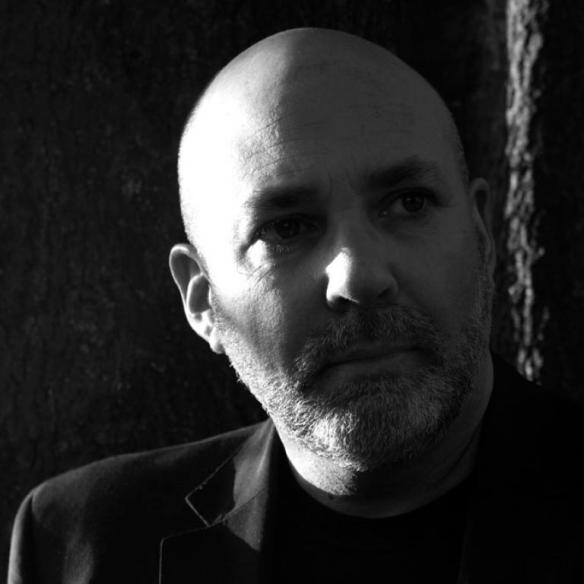
Isserlis, an author of books introducing children to the likes of Beethoven, Handel and Schumann, generously donated time to talk to Arcana about the roots of his love of the cello, his new disc of Cello Concertos by Elgar and Walton and his new work as an author.

Can you remember your first encounters with classical music?

I can’t remember a time without music! From the time I remember anything, my sisters were already learning instruments, and I used to go to sleep at night to the sound of my father practising the violin and my mother the piano.

How did you develop a love of the cello?

My sister Rachel played the violin, and my elder sister Annette was always going to play the viola. So a cellist was needed – that would be me. So my parents took me to a local teacher, and – after a false start at the age of four or five – I began lessons from the age of six. I think my love for the cello developed as I came to realise that if I played OK I could be the centre of attention!

What was it like returning to record Elgar’s Cello Concerto? Was it invigorating in the company of someone (the conductor Paavo Järvi) who may not have encountered the composer’s music so much?

Well, I’ve played the Elgar so many times over the 25+ years since I first recorded it that it seemed a good idea to record it again. It’s true that Paavo needed a bit more persuading than he did for our Prokofiev / Shostakovich disc, but not much more; he’s always up for a challenge.

Was it your aim to bring out a little more of the humour in the last movement of the Elgar, given the relative darkness around it? It also feels a little quicker than your first recording of the concerto.

It was not a conscious aim – I really didn’t think about (or listen to) the earlier recording. But yes, there is humour in parts of the last movement – which for me throw the tragedy into even sharper relief.

This is the first time you have recorded the Walton (I think!) I’m assuming you knew it very well before, but what effect did it have on you in the recording process?

I’m not sure it had any particular effect on me ‘in the recording process’, but I’d been wanting to record it for some years, since I feel passionately about it. I always name the Schumann, Dvorak, Elgar and Walton concertos as the four very greatest cello concertos (though I’d be bereft without those of Haydn, C.P.E. Bach, Boccherini, Saint-Saëns, Prokofiev, Shostakovich, Dutilleux etc).

It feels like a very romantic piece, with sighing melodies and deeply felt thoughts. Given your booklet note for the release, is that how you would view it?

Definitely – romantic, poetic, impassioned, magical.

The Gustav and Imogen Holst pieces make fascinating complements. Do you think people are in neglect of just how adventurous Gustav’s music could be?

Perhaps. To my shame, I know very little of it. But I love Invocation, maybe especially so since I had something of a part in its rediscovery.

What do you remember of Imogen Holst as a person, and of the piece here? Her ‘Presto’ seems to me (a bit of wishful thinking I’m sure!) to depict birds chasing each other in the reeds at Aldeburgh.

I remember Imogen as a wonderfully quaint personality who was also sharp as a stainless steel razor! Wonderful. I’ve always thought of the Presto as depicting leaves flying around in a storm. Recently I was sent a note by the work’s dedicatee, Pamela Hind O’Malley, apparently written with Imogen’s approval, which describes it as ‘the scuttering of leaves in a high wind’. I like that word ‘scuttering’!

I understand you have just completed a book – are you able to tell us more about it at this stage?

It’s advice for young musicians – incorporating and updating Schumann’s book of the same name. I suppose that means that I’m now an old musician – groan…

Is it important for you to communicate to people, young and old, in a language that brings classical music to everybody?

Absolutely! And I enjoy playing for children, as well as writing for them – it can be tremendous fun.

Do you think classical music should do more to get the music beyond its ‘inner circle’, so to speak?

Well, yes – but not if that means distorting it, or promoting sugary crossover stuff. Classical music doesn’t need that!

You can hear extracts from the new Steven Isserlis disc of cello concertos by Elgar and Walton, released by Hyperion Records, here – including shorter pieces by Gustav Holst – his Invocation – and his daughter Imogen, a short suite for solo cello The Fall of the Leaf.

Meanwhile forthcoming concerts from the cellist are listed on his website

Matt Dunkley – Discovering new worlds

Matt-DunkleyMatt Dunkley’s debut album as a solo artist is long overdue – because until now he has spent his time working with other people.
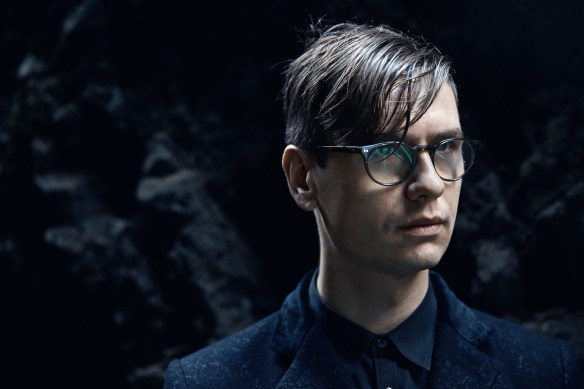
The list of artists for whom he has produced is an impressive one, including Massive Attack, Patti Smith, Nick Cave and the Kronos Quartet – while within the discipline of the film soundtrack, Dunkley’s principal form of work, he has worked on The Dark Knight, Inception and Black Swan. This prestigious CV only heightens the anticipation for Six Cycles, shortly to be released on Village Green and recorded with the Babelsburg Film Orchestra.

Dunkley spent some time with Arcana to talk about his past, studying with the renowned composer Christopher Palmer, and his present – while also recommending some music for us to enjoy.

Can you remember your first encounters with classical music?

MD: I can remember my first encounter very clearly. It was a junior school trip to a Saturday morning children’s concert at the Fairfield Halls in Croydon, South London. The orchestra played, amongst other pieces, Tchaikovsky‘s 1812 Overture. I think it was the Royal Philharmonic Orchestra, an orchestra I’ve since conducted many times. I was transfixed, particularly by the brass section – and soon afterwards I started learning the trumpet.

What are your memories of studying trumpet and piano at college? Did they push you in the direction of composing?

Music College was a wonderful experience. I was pretty focused on being a professional trumpet player back then, but I did start writing and arranging for small college ensembles. Learning the classical repertoire and having the discipline to spend long hours practising and performing day in and day out was an excellent training for my future career. After a few years as a freelance professional trumpet player, I began to move towards arranging and composing more seriously.

What did you learn from studying with Christopher Palmer?

Chris taught me everything. He was an amazing orchestrator and arranger, a brilliant producer, and a gifted writer and academic. I learnt so much from him. He had worked with Maurice Jarre and Dimitri Tiomkin in Hollywood. He was an expert on William Walton and many of the post war English composers, such as Britten, Delius and Tippett. Just looking over his shoulder and absorbing that depth of learning was inspirational for me. He taught me how to orchestrate, and he taught me how to listen. Really listen.

I remember the first recording session I attended with him. The Academy of St Martin-in-the-Fields were recording some Walton film music that Chris had reconstructed. After the first take (which to my ears was perfection) he went on the talkback and proceeded to rip the performance to shreds, albeit with great charm and politeness. He showed me, in that moment, how high the quality bar should be set. He wanted perfection – and on take four he got it!

Is it beneficial to conduct your own material, and does the composition process continue if you do that?

I love conducting my own material, and for this album, which I conducted in Berlin with the Babelsberg Film Orchestra, I made many small changes on the floor of the studio, making adjustments in phrasing and volume, changes in the voicing of chords, and even altering the notes of a melody at one point. When you have the orchestra playing live in front of you, you hear things that inspire you to adjust your writing, to make the living, breathing being that is an orchestra really come to life.

What do you love about writing for orchestra, and strings in particular?

The orchestra is such a wonderful instrument, capable of so many colours and moods and effects. Once you know how to harness the power of this instrument the possibilities are endless.

Strings are the basis of it all, and for this album I chose to just use a string orchestra, with piano, violin and cello solos. There is something so organic and visceral about a string orchestra. The textures, the colours, the power, the beauty.

Are there any particular circumstances behind ‘Six Cycles’? You have mentioned a painting, poetry and a personal loss, but are there specific examples?

Each one of the six ‘cycles’ was inspired by something very personal to me, but I decided to give each piece an enigmatic title as I wanted the listener to have their own emotional responses to the music, and not to be led by me. I can tell you, for example, that Cycle 6 was inspired by a beautiful love poem by Brian Patten, Simple Lyric, which means a lot to me. But the listener might feel something entirely different when hearing that piece. That’s the wonderful thing about music. It’s so subjective.

Are you composing to imaginary pictures with some of this music?

I’ve done that in the past, certainly. But for Six Cycles each piece had a very clear inspiration. I wrote these pieces separately over a two year period, whenever inspiration struck. It was only when I began to collect them together that I thought of them as one work, or cycle.

There is some very powerful writing for string orchestra here, and a subtle but constant movement of colour. Was that your aim with the music?

Thank you, and yes. I try to achieve the feeling of ebb and flow in my string writing, with the music always in motion, whether externally with climactic loud driving rhythms or internally with subtle quiet movement between the inner voices. Even the moments of stillness have shifting sands beneath the surface.

What has been your most satisfying piece of pop work to date – either in composition or musical direction?

I’ve been very lucky to work with some wonderful artists throughout my career. Working with Tom Jones (on his duets album Reload) was pretty special, as was working on albums with the Pet Shop Boys, Catatonia, Massive Attack, U2 and Badly Drawn Boy.

Who was most rewarding to work with…and if you’re able to mention names, who was least?

Well I tend to find that the most talented artists are the easiest and most rewarding to work with. Any of those mentioned above fall into that category. It’s the less talented that cause all the problems…..but I’m too discreet to name names!

What does classical music mean to you?

Classical music was my first love and it still means everything to me. I grew up in the 1970s / 80s and my older brother and younger sister were all over the pop music of the era. Classical music was mine and it still is. It’s my go-to place in good times and bad.

What piece or piece(s) for the cinema would you recommend to Arcana readers? Both obvious and less obvious would be great!

I’ve been lucky enough to work on many, many movies in my career, and I have a great love of music for the cinema. Here’s a list of some of my favourite scores – some obvious, some less so…

Víkingur Ólafsson – a true classical music entrepreneur

vikingur-olafssonIf you wanted a definition of a classical music entrepreneur, Víkingur Ólafsson would surely fit it.

The Icelandic pianist, performing Liszt’s Piano Concerto no.2 this week with Vladimir Ashkenazy and the Philharmonia Orchestra, is Artistic Director both of Vinterfest in northern Sweden and of the Reykjavik Midsummer Festival. He runs a record label (Dirrindí) and has run a ten-part series with Icelandic National Broadcasting Service called Útúrdúr (Out of Tune), looking to encourage new classical music audiences through performance, interviews and demonstrations at the keyboard. He generously took some time to talk to Arcana recently about his career and aspirations.

Can you remember your first encounters with classical music?

I could say my very first encounters were when I was still in my mother’s womb, while she was completing her soloist degree from Berlin’s University for the Arts. She did a huge solo recital when six months pregnant with me! So I was close to the keyboard from the early stages. But more concretely, there are pictures of me reaching for the keyboard high above my head, before I started to speak.

What are your memories of studying piano – are there any pianists / teachers who have left a lasting influence on your career to date?

I saw the piano primarily as a toy – simply the best toy in the world – as a boy. I still do actually. I think I’ve been very fortunate that all my very good teachers maintained this sense of freedom towards music within me, which meant that I never had to be asked to practice – I just felt like playing the piano a lot.

I started listening to some of the great pianists in my early teens, mostly recordings from the 1930s and 1940s. On the one hand, classicists such as Clara Haskil and Dinu Lipatti fascinated me – I don’t know how many dozens of times I listened to Lipatti’s last recital album. On the other hand, I loved the big romantic players – the piano poets – like Benno Moiseiwitsch, Sergei Rachmaninov, Josef Hoffmann, Ignaz Friedman and Alfred Cortot, pianists from the so-called ‘golden age of the piano’. I remember listening incessantly to Friedman’s Chopin mazurka recordings, and trying to imitate them – with very little success I should add. So my early influences came from very different directions.

In my late teens and early 20s, as a student at Juilliard, I had two great piano teachers who, I now realize, could be seen as coming from these very different directions – Robert McDonald the classicist with his unbelievable sensitivity for the proportions of musical form and architecture, and Jerome Lowenthal, the freest musical spirit, master of the spontaneous.

You have performed recently with Vladimir Ashkenazy before in Tchaikovsky’s First Piano Concerto. What did you take from that experience?

It is a privilege to work with Maestro Ashkenazy. It is a special feeling to have one of history’s great pianists on the podium. I can feel that he knows every single note I play on such a deep level. He’s completely with me every second. I’ve been asked whether it is intimidating to have a great pianist like Ashkenazy conducting, but quite on the contrary it really gives me a sense of freedom.

How would you introduce Liszt’s Second Piano Concerto to a newcomer?

When I heard the Second Piano Concerto in my teens, I actually didn’t like it at first. I remember saying it was too superficial. In retrospect, I now realize how superficial I was. It is a brilliant piece of music, written by one of the most captivating personalities in music history. I feel safe to say that Liszt was the greatest pianist of all time. The way he wrote for the instrument, and the way his performances have been described by his contemporaries, the way he invented much of modern day piano technique…he’s a man I have unlimited admiration for.

Liszt lived an enormously glamorous life as a young man and was probably the most famous musician of his day, but gradually turned more towards spiritual practice and even joined a monastery for a time. And I feel the piece contains these two contrasting sides. It is a musical narrative, which seems to take place somewhere midway between the grand and glamorous salons of Paris of the 1840s and a reclusive monastery up in the French mountains. I feel it is a one man’s quest, an Ein heldenleben of sorts.

How was Vinterfest last week – and how do you see the festival evolving in the future?

It was beyond my expectations. I chose the theme ‘New Worlds’ and we explored it in various ways. One concert was called Animal Worlds, featuring music of insects, whales and birds, another looked at the First and Second Viennese schools through juxtaposing the violin and piano fantasies of Schubert and Schoenberg, then there was my John Cage prepared piano workshop, the Eight Seasons of Vivaldi and Piazzolla and lots more.

I was extremely happy to have a Boulez In Memoriam concert with Michael Barenboim playing Anthèmes 2 for violin and electronics with IRCAM sound engineers. That was such a gourmet concert to listen to – I’ve never heard more beautiful electronics. It took place in a rather awesome car company and the audience was totally into Boulez’s music – nobody complained of it being to ‘too modern’ or ‘difficult’. Which of course it isn’t.

What can we expect from Reykjavík’s Midsummer Music this year?

The theme will be ‘Wanderer’ – and we will be exploring it in Harpa Concert house with artists such as Viktoria Mullova, Kristinn Sigmundsson, Ursula Oppens, Jerome Lowenthal, Tai Murray and more. The dates are 16-19 June, and I’m already looking forward to it.

As an Artistic Director of festivals, what do you look for when you are programming such an event?

To make sure that no festival is too similar to any other festival from earlier years. I don’t want people to be able to predict my festivals. In this respect, I love to work with a closely defined theme. Even if it means 10x more work for me to make the puzzle work with all the factors that need to be taken in to consideration, it allows for each year to have its own distinct palette of colours.

You have worked closely with Philip Glass. What appeals to you about his music, and what is he like as a person?

Mr Glass is such a unique and warm person. He is extremely brilliant of course, and knows what he wants, but is also very open-minded about interpretation. He has this creative energy that is simply put astonishing. I’ll give you an example: After we had done a long day of traveling in the early morning, checking-in to a hotel, going straight to sound check, giving a performance of his complete Etudes, he took me out to a restaurant. This was in Gothenburg in early 2014, and I felt happy but a little exhausted around midnight when we were having the last toast of the evening before heading to the hotel to rest. Or so I thought.

When asking for the bill, Mr. Glass also asked for a large cup of strong black coffee (!) and I asked him how on earth he could drink that before going to bed. He gave the following response: “but Víkingur, I haven’t had any time to compose today! I always compose 5 hours a day, and will do that now in my hotel room”. He, 78 at the time, made me feel like an old man. I was 29 at the time.

Icelandic music seems to be in a very exciting place at the moment. What is it about the country that inspires so much creativity?

The creative output of my fellow countrymen is undeniably impressive and vast when considering the inhabitants on the island are only around 330,000, but there is no simple answer to this question. The island itself is a very special place with strikingly varied and beautiful natural scenery. Maybe this has an influence on the Icelandic people’s (often overblown) sense of themselves as being unique and thus wanting to express themselves creatively through a medium…

Maybe the long and dark winters and the isolation of the island have something to do with this… Maybe it’s got to do with how young we are as a cultural nation, we are not very burdened by the past. I don’t know really…

You are also performing with Viktoria Mullova and Matthew Barley in June – what will you be playing?

We will be playing Schubert’s Piano Trio no.2 and Ravel’s Piano Trio.

What does classical music mean to you?

You might as well ask: “What does nature mean to you”. It means the world to me.

What piece or piece(s) of new Icelandic music would you recommend to Arcana readers? Both obvious and less obvious would be great!

How about Daníel Bjarnason’s Piano Concerto No 2 ‘Processions’ which he wrote for me in 2009, with its first two movements written in the grand tradition of heroic concertos before the third movement concludes the work with something close to techno music…

As a nice compliment from a very different direction, check out Anna Thorvaldsdottir’s album Aerial, out on Deutsche Grammophon. You will find both on iTunes and Spotify.

Víkingur Ólafsson plays Liszt’s Piano Concerto no.2 with the Philharmonia, conducted by Vladimir Ashkenazy, at Symphony Hall, Birmingham on Tuesday 1 March. For tickets click here

You can find out more about the Midsummer Music festival in Reykjavik here, while you can also discover Vinterfest here