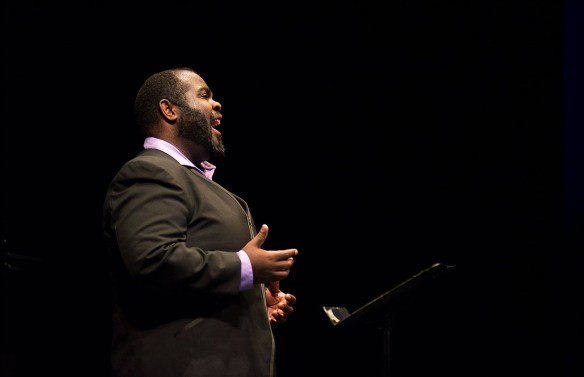
BBC Proms 2017 – John Storgårds conducts the BBC Philharmonic Orchestra in Sibelius, Grieg, Schumann & Hindemith

Prom 33: Lise Davidsen (soprano), Alban Gerhardt (cello), BBC Philharmonic Orchestra / John Storgårds

Grieg Peer Gynt Op.23 (excerpts) (1876)

Sibelius Luonnotar Op.70 (1913); Karelia Suite Op.11 (1893)

Schumann Cello Concerto in A minor Op.129 (1850)

Hindemith Symphony, Mathis der Maler (1934)

Royal Albert Hall, Thursday 10 August, 2017

You can listen to this Prom by clicking here

John Storgårds has been making his mark on the BBC Proms in his appearances as Chief Guest Conductor of the BBC Philharmonic. Tonight’s tale of two geographical halves commenced with excerpts from Grieg’s music to Peer Gynt; starting with the lively Overture (hardanger fiddles in evidence thanks to the violas), then continuing with a vehement Ingrid’s Lament, a deftly propelled Morning and a pensive Solveig’s Song undermined by Lise Davidsen’s fluttery vocal; finishing with the suitably quirky Dance of the Mountain King’s Daughter.

Davidsen (above) was then heard to better advantage in Sibelius’s tone-poem Luonnotar, coping ably with the stratospheric range of this singular creation myth – not the least of whose fascinations was having been premiered at the Three Choirs Festival in Gloucester Cathedral. There have been some memorable accounts of this piece over recent years, and if Davidsen did not efface memories of such as Mattila and Komsi, she duly pointed up its drama and mystery in what was, for the greater part, a sympathetic account. The Proms audience was suitably attentive.

Sibelius’s comparatively mellifluous Karelia Suite brought this Nordic first half to its close. Storgårds’s widely contrasted tempi for the Intermezzo left a rather disjointed impression, and while the Alla Marcia sounded rumbustious enough, a certain coarseness of playing rather limited one’s enjoyment. Best by far was the Ballade, one of the composer’s most arresting earlier pieces in its enfolding modal harmonies and given a notably rapt reading with such aspects as the wistful cor anglais melody towards its close eloquently phrased.

The Germanic second half began in more restrained mood with Schumann’s Cello Concerto. Rarely performed for decades (and more often in the transcription for violin), this deceptively genial piece is among its composer’s most ingenious in terms of form and motivic continuity. Alban Gerhardt (above) maintained a determined while never merely inflexible course across its three continuous movements, the BBC Philharmonic providing support as attentive yet unobtrusive as the music required. Interesting to hear that the soloist thought the finale musically the least successful, as this emerged as arguably the most successful part – not least with its engaging dialogue kept on its toes and with no sense of dourness or grittiness as regarded the orchestral texture. Overall, a perceptive and convincing account of a work still too easily overlooked.

Storgårds then rounded-off the programme with a taut and tensile reading of the symphony that Hindemith derived from his opera Mathis der Maler. This retelling of cultural meltdown and social antagonism during the Thirty Years War proved too ‘contemporary’ for the Nazi regime to stomach, and it was no surprise that the premiere of the complete opera took place in Zurich. Storgårds had the measure of the Angelic Concert with its austere chorales and angular though never impersonal polyphony. The Entombment of Christ was affecting for all its brevity, while the climactic Temptation of St Anthony built surely and impulsively from its stark introduction, through a central interlude of tangible pathos, to a culmination such as blazed forth in affirmation. All credit to Storgårds for ensuring so cathartic an impact.

Richard Whitehouse (photo of Lise Davidsen (c) Ole-Jørgen-Bratland)
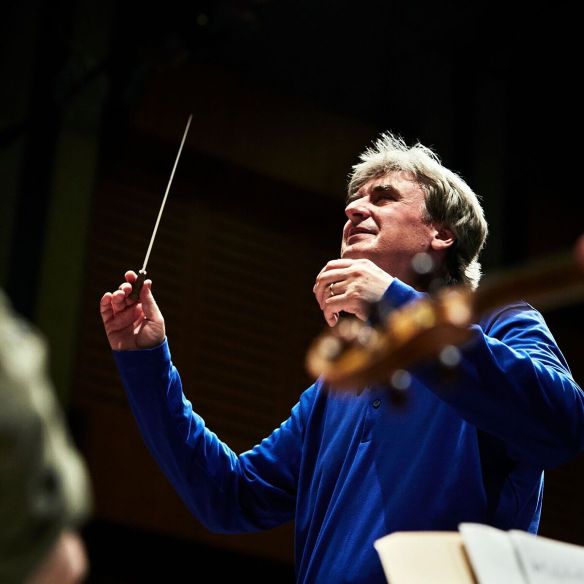
BBC Proms 2017 – BBC Scottish Symphony Orchestra with Thomas Dausgaard: Mahler & Schubert ‘Unfinished’

Prom 36: BBC Scottish Symphony Orchestra, Thomas Dausgaard (above)

Schubert Symphony No. 8 in B minor, D759, ‘Unfinished’ (1822)

Mahler Symphony No. 10 in F sharp, realized Deryck Cooke (1910; 1959-76)

Royal Albert Hall, Saturday 12 August, 2017

You can listen to this Prom by clicking here

Having made an auspicious start to his tenure with the BBC Scottish Symphony Orchestra, Thomas Dausgaard tonight brought the orchestra to the BBC Proms for its most ambitious concert this season – Mahler’s I, given in the ‘performing edition’ by Deryck Cooke.

Left unfinished at Mahler’s death in 1911, the work was partially premiered in 1924 though it was not for another four decades that a complete rendering was heard – Berthold Goldschmidt conducting the London Symphony Orchestra at the Proms in Cooke’s realization. Since when his (subsequently revised) edition has become the preferred option for those tackling Mahler’s last symphony in its entirety. Dausgaard recently won praise for his recording with the Seattle Symphony, and his account this evening proved no less successful as an overall interpretation.

Other than the notably deliberate tempo for the violas’ initial theme, such as made it almost an epigraph to the movement overall, the opening Adagio was flexibly paced; the wrenching theme heard on massed strings finding contrast with the sardonic, waltz-like music as passed between solo woodwind. The development’s polyphonic intricacy was eventfully unfolded, then the climactic dissonance – with its piercing trumpet note – was pointedly drawn into the whole so that the lingering coda evinced a serenity whose fulfilment was at best provisional.

The first Scherzo emerged even more impressively. Texturally the least cohesive movement as Mahler left it, its contrapuntal density allied to elliptical harmonic progressions make it the most radical (the earlier music of Hindemith and Weill tangibly within reach) and Dausgaard expertly integrated its increasingly close-knit sections into a stretto of mounting excitement. The brief, fulcrum-like Purgatorio which follows was a little matter-of-fact for its glancing irony wholly to come through, and Dausgaard ought to have made an attacca into the second Scherzo (the three movements of this second part ideally form a continuous whole). Not that there was much to fault in this latter as it pivoted between anguish and appeasement, before vanishing into that ‘tunnel’ of darkness whose nihilistic overtones were palpably to the fore.

Come the Finale and Dausgaard might ideally have deleted the opening drum stroke, while the climax of the central Allegro really needed underpinning from drums for its intensified reprise of the first movement’s dissonance to make its fullest impact. But these were minor flaws in a perceptive rendering overall – sepulchral opening brass making way for the most eloquent flute melody in the symphonic literature (not least as played by Charlotte Ashton), transformed into a radiant string threnody which brings about this work’s cathartic ending.

An impressive reading was fittingly programmed within the context of Schubert’s Unfinished, of which Dausgaard has made a fine account with the Swedish Chamber Orchestra. While his rapid take on the first movement (little ‘moderato’ about this Allegro) did not transfer ideally onto full orchestra (at least in the resonance of the Albert Hall acoustic), the ensuing Andante had no lack of poise: the hushed dynamics of its coda no less arresting than the blissful final cadence in which Mahler’s transcendent leave-taking, 88 years on, was not hard to perceive.

Richard Whitehouse (photo of Thomas Dausgaard (c) Thomas Grøndahl)

You can listen to Dausgaard’s recordings of these pieces on the Spotify playlist below:

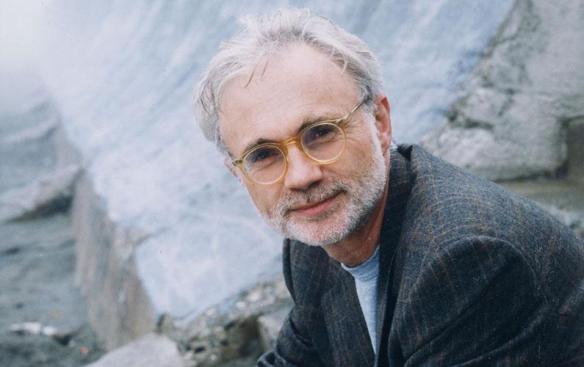
BBC Proms 2017 – Sir John Eliot Gardiner conducts Lutheran cantatas by Bach

Monteverdi Choir, English Baroque Soloists / Sir John Eliot Gardiner (above)

Schütz Nun lob, mein Seel, den Herren, SWV 41; Nicht uns, Herr, sondern deinem Namen, SWV 43; Danket dem Herren, denn er ist freundlich, SWV 45 (all c1617)

J.S. Bach Cantata No.79, ‘Gott der Herr ist Sonn und Schild’ (1725); Cantata No.80, ‘Ein feste Burg ist unser Gott’ (1716, revised 1720s-1735)

Royal Albert Hall, Wednesday 2 August 2017 (late night)

After the earlier evening headiness of John AdamsNaïve and Sentimental Music from the Philharmonia, it was quite a stylistic shift to the night’s second Prom, which began with three canzonas / hymns of Heinrich Schütz, written some 400 years ago.

Yet as the ear gradually adjusted and the members of the Monteverdi Choir and English Baroque Soloists quickly found their level, it was clear we were listening to something quite special. Under the fastidious but loving direction of Sir John Eliot Gardiner, an old hand at these scores, Schütz’s own minimalism came to light, helping the transition from first Prom to second. The choir were carefully positioned and instrumental soloists stood where possible for their contributions, an effective technique that spotlit them for the audience but also ensured the Royal Albert Hall acoustic was keenly observed.

Though the Schütz was very good, the two J.S. Bach cantatas took this late night concert to the next level. First was Gott der Herr ist Sonn und Schild, where the vocal soloists Amy Carson (soprano), Reginald Mobley (alto) and Robert Davies (bass) were particularly fine, and the small continuo* (*accompanying) section negotiated their tricky lines with deceptive ease.

The second cantata, Eine feste Burg ist unser Gott, became the focus of the evening, Bach’s Lutheran cantata a cornerstone not just of his sacred compositions but of Baroque music and the Reformation in general. Gardiner took every opportunity to depict the ‘mighty fortress’, whether through the strength of the choral sound or the meaty orchestral textures, capped at the bottom end by the extraordinarily satisfying rasp on Stephen Saunders’ bass sackbut, an ancestor of the trombone. Brought to the front for the Prommers’ benefit, it was a wonderful thing to witness.

This was just the tip of the iceberg though. One of the great assets of the Monteverdi Choir is that its members are all potential soloists, making it a great team of individuals. Soprano Miriam Allan and bass Robert Davies dueted in the Aria and Chorale, and complemented each other very nicely, then tenor Hugo Hymas sang beautifully for the Recitative, while Mobley (above) once again impressed with his passionate and full-bodied tones in a duet with the tenor. The orchestra were once again on top form, though this time oboist Leo Duarte was keenly in focus, moving between the conventional wooden oboe, an oboe d’amore and an oboe di caccia (which looks rather like a banana!) with great dexterity and flair.
The chorus were impeccable with their diction and ensemble, and Bach’s music had that life-giving energy that comes across in successful performances such as this. Eliot Gardiner has written a whole book (Music In The Castle of Heaven) on his love of Bach’s music, and listening to his charges here was akin to standing on the turrets of that building, faces turned skywards. It really was that enlightening.

Ben Hogwood

BBC Proms 2017 – John Adams: Naive and Sentimental Music – Philharmonia / Esa-Pekka Salonen

Marianne Crebassa (mezzo-soprano), Philharmonia Voices and Orchestra / Esa-Pekka Salonen

J.S. Bach arr. Stravinsky Canonic Variations on Vom Himmel hoch, da komm, ich her (1956)

Ravel Shéhérazade (1904)

Adams Naive and Sentimental Music (1999)

Royal Albert Hall, Wednesday 2 August 2017

You can listen to this Prom here for 28 days from the date of the performance

This year’s Proms celebration of John Adams‘ 70th birthday moved on to some Naïve and Sentimental Music. Not my label, but the composer’s own – and a misleading one at that. The title implies a sketchily composed, throwaway fragment, but what we actually get is something very substantial, longer than many symphonies. The construction of the three sections making up the piece illustrate the ease with which the music of Adams expands to fill such dimensions, not something you could always say about the music of like-minded ‘minimalists’, Philip Glass and Steve Reich.

Where others of his ilk tend to work in smaller melodic units, Adams thinks nothing of spinning out a long, intense melody over several minutes, hanging like a long telegraph wire above the sun-drenched plains. Such an image came to my head as we listened to the second movement of three, Mother of the Man, where the guitar of Huw Davies sounded rather like the early music of Pat Metheny in its deceptively lazy traversal. The strings held fast, creating the wide expanses of which Copland would surely have been proud. The treble textures were especially rich, but when the dynamic dropped to a barely audible whisper on the violins, members of the audience were subconsciously leaning forward to follow developments in the music.

It helped that the conductor was also the dedicatee of Adams’ sizeable score, Esa-Pekka Salonen taking delivery on behalf of the Los Angeles Philharmonic in 1999. Here he secured some outstanding playing from the Philharmonia Orchestra, who responded to the virtuoso demands of the music with impressive rhythmic impetus, intense focus and characterful phrasing. When the music gathered itself several times in the first movement, Naïve and Sentimental Music, the pacing and rhythms felt just right, with especially good work from harpists Heidi Krutzen and Stephanie Beck, not to mention percussionists Antoine Siguré, Scott Lumsdaine, Peter Fry, Stephen Burke, Tim Gunnell and Karen Hutt.

Towards the solemn close of Mother of the Man it was the brass bringing deeper shades to the forefront of the picture with exquisitely held chords. As Chain to the Rhythm hurried along the intensity built steadily and inexorably until it became nerve-shredding, the piece thundering along with gongs, bass drum, cymbals and massive timpani strokes giving it a mountainous perspective. We ended through the altitude of the violins, these massive orchestral sounds now a huge echo. It was a moving finish to a piece that is clearly underrated in Adams’ canon. Salonen clearly believes in it, and this audience did too.

A curious (but very interesting) first half began with Stravinsky’s arrangement of J.S. Bach’s Canonic Variations on Vom Himmel hoch, da komm, ich her, a recomposition made to accompany the world premiere of the latter composer’s Canticum Sacrum in St Marks, Venice in 1956. This was an oddity of economical orchestration and sung text from a reduced choir. There was some quite tart colouring in the manner of Stravinsky’s later style, and his additions to the music of Bach added extra spice to the harmonies at unexpected points. An intriguing but puzzling arrangement, and one that threw the softer textures of Ravel’s Shéhérazade into relief.

This was no doubt intentional, for we were privy to a wonderful performance from French mezzo-soprano Marianne Crebassa (above). Shéhérazade is a magical song cycle when performed well, but here it transcended all expectations – in fact I don’t recall ever seeing a singer who gauged the acoustic of the Royal Albert Hall with quite the accuracy of Crebassa. Her direct communication with the audience was reinforced by the elegance and understated strength of her vocal delivery, a truly beautiful tone that caressed Ravel’s lines with clear love and affection.
The first song, Asie, held an exquisite tension as the travelling scene unfolded, while La flûte enchantée, the instrument itself beautifully played by Samuel Coles, thrilled with its orchestral colours and heady textures. L’indifférent was a little more mischievous, and again the exquisite tones and textures were in full accord with the very best Ravel performances.

Crebassa is most definitely an artist for the future, and her blend and rapport with the Philharmonia was something to behold. The reverent string textures and typically pinpoint orchestration were viewed through Salonen’s technicolour lens, but the team brought something very special to Klingor’s text. If you get the chance to hear the broadcast, do so as soon as you can. You will hear one of the best young singers in classical music right now!

Ben Hogwood

Stay tuned for the next in Arcana’s Ask The Audience series, where Steve Hodges will give his verdict on the John Adams Prom. Coming shortly!

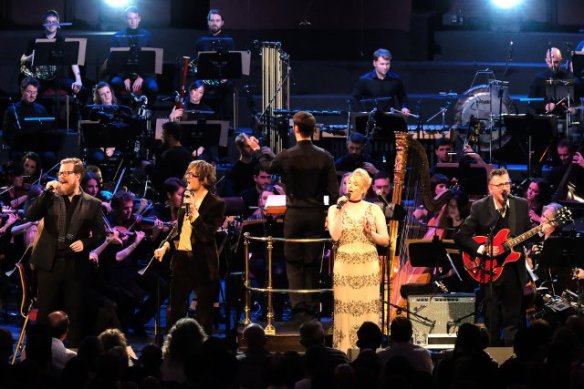
BBC Proms 2017 – The Songs of Scott Walker

John Grant, Jarvis Cocker, Susanne Sundfør and Richard Hawley (all above), London Contemporary VoicesHeritage Orchestra / Jules Buckley

Walker, arr. Jules Buckley, Stefan Behrisch, Peter Riley and Tom Trapp Titles from Scott (1967), Scott 2 (1968), Scott 3, Scott 4 (1969) & Till the Band Comes In (1970)

Dick Hovenga and Simon Raymonde, creative directors

Royal Albert Hall, Tuesday 25 July 2017 (late night)

You can watch this Prom here

This late-night Prom highlighted the song-writing talent of Scott Walker from his late 1960s heyday. Less challenging while no less provocative than the music he has released this past two decades, it is a token of their composer’s fleeting stardom that few, if any, of these songs were played live when they were written; only to be consigned to vinyl limbo once Walker’s star waned and he abandoned live performance in 1978. Tonight’s programme saw a notable line-up of singers assembled to honour this legacy and maybe even give it a new lease of life.

The songs themselves were drawn from the four ‘numbered’ albums released during 1967-69, along with three tracks from Till the Band Comes In – the 1970 offering that Walker himself disowned but which he now seemingly recognizes as a worthy successor to what went before.

Although he has known Walker well since their collaboration on Pulp’s final album We Love Life in 2001, as a vocalist Jarvis Cocker is not best suited to the interpreting of songs whose technical demands brook no compromise. After the plangent orchestral strains of Prologue had died away, he struggled with the ethereal Boy Child (its fusing of music and expression the most perfect of Walker’s song in this period), then under-projected the surreal and ominous imagery of Plastic Palace People. Nor was he a natural choice for the bittersweet poise of The War is Over (probably the most obscure of all these hidden gems), despite rendering it with telling sotto voce understatement, though the breezy litany of chaos and disaster which informs Little Things That Keep Us Together allowed his innately ironic delivery free rein.

There could be no doubt, even so, that John Grant is infinitely more attuned to this music, and so it proved as he brought out the wrenching pathos of Rosemary, then the pert confessional of The World’s Strongest Man. No less telling was the capricious whimsy of Copenhagen or propulsive drama of the Ingmar Bergman-inspired The Seventh Seal; this latter number benefiting from a starkly fatalistic tone such as the 24-year-old Walker could not summon back in the day. A whole album of these ‘covers’ from Grant would be more then welcome.

As also would be one from Icelandic singer Susanne Sundfør (above), whose often brittle yet always focussed delivery teased out the deadpan humour from On Your Own Again then stripped Angels of Ashes of undue preciousness. Best of all was the edgy irony she brought to The Amorous Humphrey Plugg, another highpoint of Walker’s song-writing, while Hero of the War aligned anger and compassion to a telling degree. A slight pity that Long About Now, Walker’s one number intended for a female vocalist, was not featured. Maybe another time?
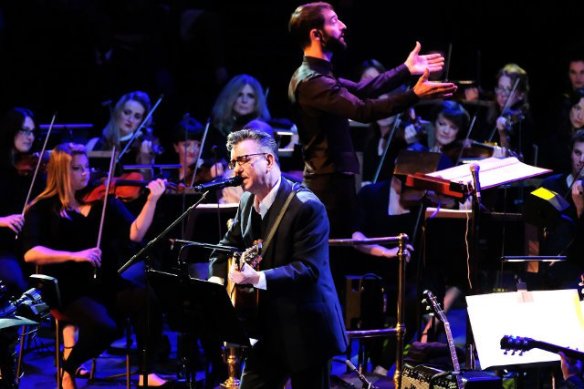
A fine guitarist and distinctive crooner, Richard Hawley proved as attentive to the tangible atmospherics of It’s Raining Today as to the warm evocation (so easy to sentimentalize) of Two Ragged Soldiers. Neither was there any dilution of that yearning for domestic bliss in Montague Terrace (in Blue) or sardonic humour in The Old Man’s Back Again (Dedicated to the Neo-Stalinist Regime) – a song which underlines Walker’s awareness of the political realities during this period, as has surfaced more obliquely in much of his more recent music.

Throughout this 90-minute sequence, Jules Buckley secured vivid and attentive playing from the Heritage Orchestra, while London Contemporary Voices made the most of some brief yet pertinent contributions. They, together with all four of tonight’s singers, united for a rousing Get Behind Me – a surprisingly funky number in context – to end this impressive showcase. Hawley remarked to the audience that such an event might never happen again, though one cannot help feeling Walker’s 1960s output could now be up and running – not before time!

Richard Whitehouse (photos (c) Mark Allan)