In concert – John Cale @ Royal Festival Hall

John Cale (vocals, keyboards, guitar), Dustin Boyer (lead guitar/samples), Joey Maramba (bass guitar), Alex Thomas (drums, synths)

Royal Festival Hall, London
Friday 21 March 2025

Reviewed by Richard Whitehouse Picture (c) Madeline McManus

It feels reassuring to know, whatever else may be happening, that John Cale is still making music as only he can. Tonight saw him return to the Royal Festival Hall, the scene of some memorable gigs over the past four decades, during the course of his POPtical Illusion Tour.

A tour where his trusty viola has been absent found Cale playing guitar on just the opening track, the sardonically catchy Shark-Shark, before he took his place behind keyboards for the remainder. An album which does not so much defy time as channel it his way, last year’s POPtical Illusion was understandably much in evidence with the deadpan levity of Setting Fires, the unalloyed sassiness of Davies and Wales or the ominous edginess of Company Commander all featured. A further number, unheard until making it onto the setlist just last month, the imperious and intense Long Way Out Of Pain is evidently one of those 50 or so songs which, created during lockdown, has still to find an official release and leads one to hope Cale’s recent productivity in terms of studio albums will continue for some while yet.

Tonight’s set ranged thoughtfully across the greater part of Cale’s output. From 2023’s Mercy, (happily a valediction no more) came the stark Out Your Window with Cale’s voice thrown into stark relief against the fugitive backing vocals. Otherwise, it was back to 1996’s Walking on Locusts for the eloquent Set Me Free, surely among the most affecting songs from that or any other decade, then 1989’s Words for the Dying for the deceptively carefree treatment of Dylan Thomas’ Do Not Go Gentle Into That Good Night which emerged unscathed shorn of its classical stylings. What seemed an overly diffuse number heard on 1979’s Sabotage/Live, Captain Hook became a gripping band workout centred on Cale’s bitingly accusatory lyric, while 1980’s baleful Rosegarden Funeral Of Sores remains the ultimate B-side from hell.

Nor was Cale’s classic singer-songwriter era overlooked – 1975’s Helen of Troy represented by the glancing pathos of My Maria, that same year’s Slow Dazzle by his world-weary take on the Elvis standard Heartbreak Hotel that ever since has accompanied him through thick and thin, and from 1974’s Fear the hard-driving Barracuda which has never sounded more power-pop than now. From 1973’s Paris 1919, The Endless Plain Of Fortune here swapped pathos for pertness in what is among the most interventionist and intriguing of Cale rethinks.

Cale was heard within a band that has largely stayed intact since his return to active gigging – with the inventive lead of Dustin Boyer, resonant underpinning of bassist Joey Maramba and forceful impetus of drummer Alex Thomas. These proved the collective soul of discretion in Frozen Warnings, most confiding number from Nico’s 1968 The Marble Index where Cale honed his formidable skills as a producer and an oasis of intimacy prior to Villa Albani from 1984’s Caribbean Sunset whose new-wave knowingness afforded the expected rounding-off.

More surprising was their no-show for the Velvet Underground 1967 classic Waiting For The Man, a regular encore during this tour. That said, Cale’s departure with ‘‘We’ll see you again soon I hope’’ suggested we may have not seen the last of him on stage. Don’t stop now John! Support was provided by Tom McRae, whose songs had caught the attention of both Cale and Bowie three decades ago. Voice and guitar enhanced by subtle atmospherics, his set suggested his dozen studio albums and almost as many live releases should be worth exploring at leisure.

John Cale and his band played: Shark-Shark, Captain Hook, The Endless Plain of Fortune, Heartbreak Hotel, Setting Fires, Davies and Wales, Rosegarden Funeral of Sores, Set Me Free, My Maria, Do Not Go Gentle Into That Good Night, Company Commander, Out Your Window, Long Way Out Of Pain, Frozen Warnings, Barracuda, Villa Albani

Published post no.2,484 – Tuesday 24 March 2025

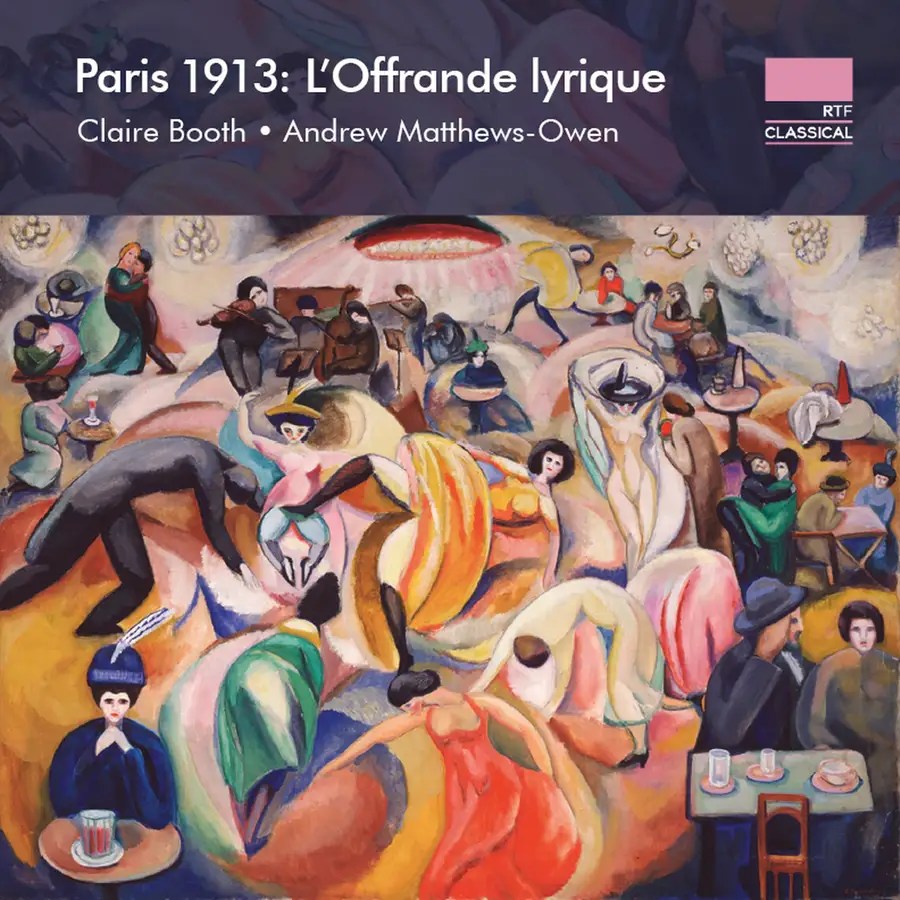
On Record – Claire Booth & Andrew Matthews-Owen: Paris 1913: L’offrande lyrique (Nimbus)

Caplet En regardant ces belles fleurs
Milhaud L’innocence Op. 10/3
Hahn À Chloris
Ravel arr. Stravinsky Trois poèmes de Stéphane Mallarmé M64
Auric Trois Interludes: Le pouf.
Ropartz La Route
Durey L’Offrande lyrique Op. 4
Saint-Saëns Petit main Op.146/9
Fauré Il m’est cher, Amour, le bandeau, Op. 106/7
Chaminade Je voudrais être une fleur
Debussy Trois poèmes de Stéphane Mallarmé L127
Satie ed. Dearden Trois Poèmes d’Amour
Lili Boulanger Clairières dans le Ciel: Vous m’avez regardé avec votre âme
Grovlez Guitares et mandolines

Claire Booth (soprano), Andrew Matthews-Owen (piano)

Nimbus RTF Classical NI6455 [66’23”] French texts included
Producer & Engineer Raphaël Mouterde

Recorded 11/12 March, 4-6 September 2023 at Wyastone Concert Hall, Monmouth

Reviewed by Richard Whitehouse

What’s the story?

Another enterprising song recital from Claire Booth and Andrew Matthews-Owen, this one focussing on songs that were either conceived, composed or premiered in Paris during 1913 and resulting in an absorbing collection best heard as a diverse while unpredictable totality.

What’s the music like?

Interleaving standalone songs and song-cycles, this recital opens with André Caplet’s take on Charles d’Orléans, its limpid modality highly appealing, then continues with an early song by Darius Milhaud as already demonstrates his distinctive and amusing approach to word-setting, while that by Reynaldo Hahn typifies the teasing charm familiar from his vocal music overall. Maurice Ravel’s triptych to texts by Mallarmé is performed in a version by Stravinsky with its accompanying nonet reduced to piano which, in preserving and maybe even accentuating the music’s questing introspection, represents no mean fete of transcription. Still relatively little known, this certainly deserves to be heard as at least an occasional alternative to the original.

Remembered best as a prolific writer of film scores, Georges Auric had shown a precocious talent for song as is evident in his sensuous setting of René Chalupt. A composer who often wrote on a symphonic scale, Guy Ropartz is heard in a setting of his own verse that amounts to a ‘scena’ in its wide expressive ambit. Interest understandably centres on the eponymous cycle by Louis Durey, a member of Les Six whose increasingly far-left conviction tended to marginalize his creativity yet, as these lucid and empathetic settings of Rabindranath Tagore (as translated by André Gide) confirm, had emerged as a protean talent by his mid-twenties. Hopefully these artists will be encouraged to investigate other of his songs from this period. By contrast, a late song by Camille Saint-Saëns exudes a touching poignancy, while that by Gabriel Fauré typifies the elusiveness of those in his last decade. As is evident here, Cécile Chaminade was a songwriter of style and elegance, then the Mallarmé triptych by Debussy (its first two texts identical to those of Ravel) finds this composer probing the inscrutability of these poems while drawing back from any more explicit intervention. The inscrutability conveyed by Erik Satie’s aphoristic settings (edited by Nathan James Dearden) of his own texts is altogether more playful – after which, the recital continues with a pensive offering by Lili Boulanger, with Gabriel Grovlez’s sultrily evocative setting of Saint-Saëns to finish.

Does it all work?

Yes, given the fascination of this collection taken as a whole and, moreover, the quality of these renditions. Booth is not a singer willing to take the easy option in her interpretations, and so it proves here with singing as fastidious as it is refined, while Matthews-Owen duly instils often deceptively spare accompaniments with understated insight. They contribute a succinctly informative note, but the booklet includes only the French texts with the English translations available at https://rtfn.eu/paris1913/: might it have best the other way round?

Is it recommended?

Very much so. There is much to fascinate even those who consider themselves afficionados of the ‘chanson’, and those who are unfamiliar with much of this repertoire could not have a better means of acquainting themselves with certain of its treasures – hidden or otherwise.

Listen & Buy

For purchase options, you can visit the Ulysees Arts website. For information on the performers, click on the names to read more about Claire Booth and Andrew Matthews-Owen

Published post no.2,466 – Friday 7 March 2025

On Record – Gavin Higgins: The Fairie Bride, Horn Concerto (Lyrita)

Gavin Higgins
Horn Concerto (2023)
Fanfare, Air and Flourishes (2021)
The Fairie Bride (2021)

Marta Fontanals-Simmons (mezzo-soprano), Roderick Williams (baritone), Ben Goldscheider (horn), Three Choirs Festival Chorus; BBC National Orchestra of Wales / Jaime Martin (Horn Concerto), Martyn Brabbins (The Fairie Bride)

Lyrita SRCD440 [84’14”] English/Welsh libretto included
Producer Adrian Farmer Engineer Andrew Smilie

Recorded in Hoddinott Hall, 11 January 2024 (Horn Concerto), Concert Hall, Wyastone Leys, Monmouth, 4 April 2024 (Fanfare, Air and Flourishes), live performance from Gloucester Cathedral on 23 July 2023 (The Fairie Bride)

Reviewed by Richard Whitehouse

What’s the story?

Lyrita adds to the already growing discography of Gavin Higgins (b.1983) with this release featuring two recent major works, both of which are heard in their first performances and thereby confirm this composer’s place among the leading British voices of his generation.

What’s the music like?

Listeners may have come across Higgins’s music via the release Ekstasis (see the link below), a collection of chamber pieces which attests to a distinctive and searching personality. Such is equally true of those here, not least the Horn Concerto that takes its place in a notable lineage of such works ‘in E flat’, while taking in Schumann and Ligeti as part of its range of stylistic or conceptual allusions. Its three movements have as their inspiration the Waldhorn – the first, Understorey, duly outlining an emergence from the (Wagnerian) depths to the forest floor in mounting waves of activity. There follow Overstorey with its airily expressive evocation of the forest canopy as builds considerable fervency over its course, then Myelium Rondo with its overtones of the hunt and energetic fanfares which propel this work to an affirmative close.

No stranger to the horn (being his own instrument), Higgins had indirectly prepared for this concerto with Fanfare, Air and Flourishes, a brief but eventful solo triptych which tries out several gestures or motifs to be developed in the larger work as well as in his second opera.

Commissioned by the Three Choirs Festival, The Faerie Bride takes a legend from the Book of Hergest for its synopsis of the coming together but eventual (its being inevitable) disunion between water spirit and earthly man. This is played out over seven scenes divided into two parts – Francesca Simon’s succinct yet artfully constructed libretto moving from their initial encounters at the lake, via the gradual dissolution of their relationship through events during each of the four seasons, to a climactic juncture when the woman returns with her extended family into the depths. Musically the work encompasses the range of Higgins’s idiom up to this point, its richness and variety of texture complemented by an instrumental clarity which ensures vocal audibility throughout – certain discrepancies between the libretto as published and as sung being immediately evident. That this opera keeps its emotions close to its chest much of the time only makes the closing stages the more powerful, not least in the way the ending reaches back to the beginning for a tangible sense of resolution borne of experience.

Does it all work?

Yes, in that Higgins is able to integrate his influences into a coherent and personal language. It helps that these performers are audibly attuned to this music – not least Marta Fontanels-Simmons as an otherworldly Woman and Roderick Williams as the uncomprehending Man – with Ben Goldscheider a consummate exponent of works for horn. The Three Choirs Festival Chorus characterizes the Villagers with suitable aggression, while Jaime Martin and Martyn Brabbins secure idiomatic playing of real finesse from the BBC National Orchestra of Wales.

Is it recommended?

Very much so. Those yet to do so should certainly acquire the earlier release on Nimbus, but the works featured here round out the potency of Higgins’s music accordingly. Detailed and informative notes by Gillian Moore, though watch out for those discrepancies in the libretto.

Listen & Buy

For purchase options, you can visit the Ulysees Arts website. For information on the performers, click on the names to read more about Ben Goldscheider, Marta Fontanals-Simmons, Roderick Williams, Jaime Martin, Martyn Brabbins and the BBC National Orchestra of Wales. Click to read more about composer Gavin Higgins and about Ekstasis

Published post no.2,465 – Thursday 6 March 2025

In concert – Susan Bullock & Richard Sisson @ Bechstein Hall, London

Susan Bullock (soprano), Richard Sisson (piano)

Bechstein Hall, London, 21 February 2025

by John Earls. Photo credit (c) John Earls

There can’t be that many connections between Richard Wagner and the Great American Songbook, but Susan Bullock is one of them.

The revered British soprano has appeared as Wagner’s Brünnhilde in opera houses around the world, and has also performed the role of Isolde.

Last year she and pianist Richard Sisson released Songs My Father Taught Me, an album of songs from and inspired by some of the classics from the Great American Songbook, and that formed the basis of this wonderful recital at the shiny new Bechstein Hall in London’s Wigmore Street (a stone’s throw from Wigmore Hall).

It was clear from the start the genuine affection and affinity both musicians have for these songs. Bullock’s father was, she tells us, “a policeman by day and a wannabe Bing Crosby by night”. Sisson’s grandmother was a fan of the classic musicals.

I’ve Got the World on a String (Harold Arlen and Ted Koehler) and Hello Young Lovers (Rodgers and Hammerstein) were a fine opening to the show, before Sisson drew the audience’s attention to the full programme listing displayed on the digital notice boards in the hall – “the writing’s on the wall. It’s like Belshazzar’s feast!”

And what a programme! In the first set alone we had greats from Rodgers and Hart (My Funny Valentine), George and Ira Gershwin (‘S Wonderful) and Jerome Kern and Oscar Hammerstein (Bill and Can’t Help Lovin’ That Man), as well as a zingy What About Today (David Shire).

There was also a gorgeous Bewitched, Bothered and Bewildered (Rodgers and Hart) and a charged If I Loved You (Rogers and Hammerstein) with Bullock ranging from whisper to exhortation and Sissons eulogising afterwards about the amazing “symmetrical chords”.

The first half finished with a fabulous One for My Baby with Bullock playing the part perfectly, sat at the piano looking weary before finally walking down the aisle still singing to exit out the back door.

Alas, Bullock was not to be seen nursing ‘one for the road’ in the bar during the interval but thankfully returned for an excellent second set. This started by acknowledging some great heirs to the American Songbook. Firstly, Stephen Sondheim (Oscar Hammerstein II was a mentor to Sondheim and something of a surrogate father) with a moving Send in the Clowns, a very humorous The Boy From… and a dramatic Losing My Mind. This was followed by a beautiful arrangement and performance of Bert Bacharach and Hal David’s A House Is Not a Home.

A warm The Folks Who Live on the Hill (Kern and Hammerstein) was then followed by a magical medley from songwriters featured earlier – Stormy Weather, The Man I Love, All the Things You Are, What’s the Use of Wond’rin’ plus Tommy Wolf and Fran Landesman’s The Ballad of the Sad Young Men.

Of course these songs have wonderful tunes and beautiful melodies, which is why they have been, and continue to be, frequently covered as instrumentals, particularly by some of the jazz greats. But they also have stunning lyrics that can be touching, witty and poetic. One could grab lines from any of the songs in this programme but Sisson made a particular reference to the lyrics of The Ballad of the Sad Young Men. Take these closing lines:

While a grimy moon, watches from above
All the sad young men, who play at making love

Misbegotten moon shine for sad young men
Let your gentle light guide them home again
All the sad, sad, sad, young men.

The show ended with a delightful take on the Gershwins’ Let’s Call the Whole Thing Off and a moving encore of You’ll Never Walk Alone from Rodgers and Hammerstein’s Carousel.

This was a superb celebration of magnificent songs. Bullock’s singing was expressive and crystal clear, Sisson’s piano accompaniment was wonderfully balanced with some lovely flourishes. These great songs have endured for a reason. And with advocates and performances such as this they will be around for a good while yet.

John Earls is Director of Research at Unite the Union. He posts on Bluesky and tweets / updates his ‘X’ content at @john_earls

Published post no.2,454 – Sunday 23 February 2025

On Record – BBC SSO & BBC SO / Sir Andrew Davis – Naresh Sohal: The Wanderer & Asht Prahar (Heritage)

Naresh Sohal
Asht Pradar (1965)
The Wanderer (1982)

Jane Manning (soprano), BBC Scottish Symphony Orchestra (Asht Pradar), David Wilson-Johnson (baritone), BBC Symphony Chorus and Orchestra (The Wanderer) / Sir Andrew Davis

Heritage HTGCD135 [77’36”] English text included
Remastering Engineer Paul Arden-Taylor

Broadcast performance from BBC Studios, Glasgow on 6 January 1973 (Asht Pradar); live performance from Royal Albert Hall, London on 23 August 1982 (The Wanderer)

Reviewed by Richard Whitehouse

What’s the story?

Heritage issues what will evidently be an ongoing series of archival releases devoted to the music of Naresh Sohal, taken from BBC sources and featuring performers who championed his work over a career whose achievement is not reflected in the availability of recordings.

What’s the music like?

Although he came belatedly to the UK, Sohal (1939-2018) rapidly made up for any lost time when arriving in London in 1962 (further biographical detail can be found in the booklet note for this release and on the composer’s website). Within three years, he had produced his first major (and latterly his first acknowledged) work. Asht Prahar then had to wait until 1970 for its premiere (at the Royal Festival Hall conducted by Norman Del Mar), but it attracted much favourable attention and led to another hearing three years on – the performance featured here.

Taking its cue from the Indian sub-division of the day into eight temporal units (four each for day and night), Asht Prahar unfolds its eight sections as an unbroken continuity. The sizable forces are, for the most part, used sparingly yet resourcefully; as too the deployment of such devices as quarter-tones, along with influences of Ravel and Stravinsky, in music that makes a virtue of its pivoting between East and West. Cyclical if not necessarily cumulative, its final and longest ‘prahar’ brings wordless soprano and orchestra into tangible and haunting accord.

By the time that The Wanderer received its premiere, Sohal had a number of major works to his credit and rationalized his musical idiom accordingly. Setting an anonymous Anglo-Saxon poem in which the male protagonist speaks movingly and often despairingly of his isolation – both physical and spiritual – after the death of his lord, the work divides into two large parts that expand on the narrative’s emotional import. Such ‘‘existential bleakness’’ is intensified by omission of the poem’s last lines with their invoking a specifically Christian consolation. Despite its more than 50-minute duration, there is nothing discursive or unfocussed about The Wanderer’s content. Much of its text is understandably allotted to the baritone, whose austere character is complemented by darkly rhetorical choral passages while offset by an orchestral component with much soloistic writing (notably for flute) in a texture the more involving for its restraint and its strategic use of colour to define specific incidents or emotional responses. Nor is this an opera-manqué, the work succeeding admirably on its inherently abstract terms.

Does it all work?

It does, allowing for the fact that Sohal is not seeking any overt fusion between Occident and Orient, but rather attempting to forge a personal idiom influenced by both while beholden to neither. Both these performances bear out his convictions, Jane Manning adding her ethereal presence to Asht Prahar and David Wilson-Johnson bringing evident compassion to his more substantial role in The Wanderer. Both works benefit from the insightful presence of the late Sir Andrew Davis, whom one regrets never had an opportunity to record them commercially.

Is it recommended?

It is. The sound of these broadcasts has come up decently in remastering, lacking only the last degree of clarity or definition, and Suddhaseel Sen contributes informative annotations. Those looking for a way into Sohal’s distinctive and alluring sound-world need no further incentive.

Listen & Buy

For purchase options, you can visit the Heritage Records website

Published post no.2,451 – Thursday 20 February 2025