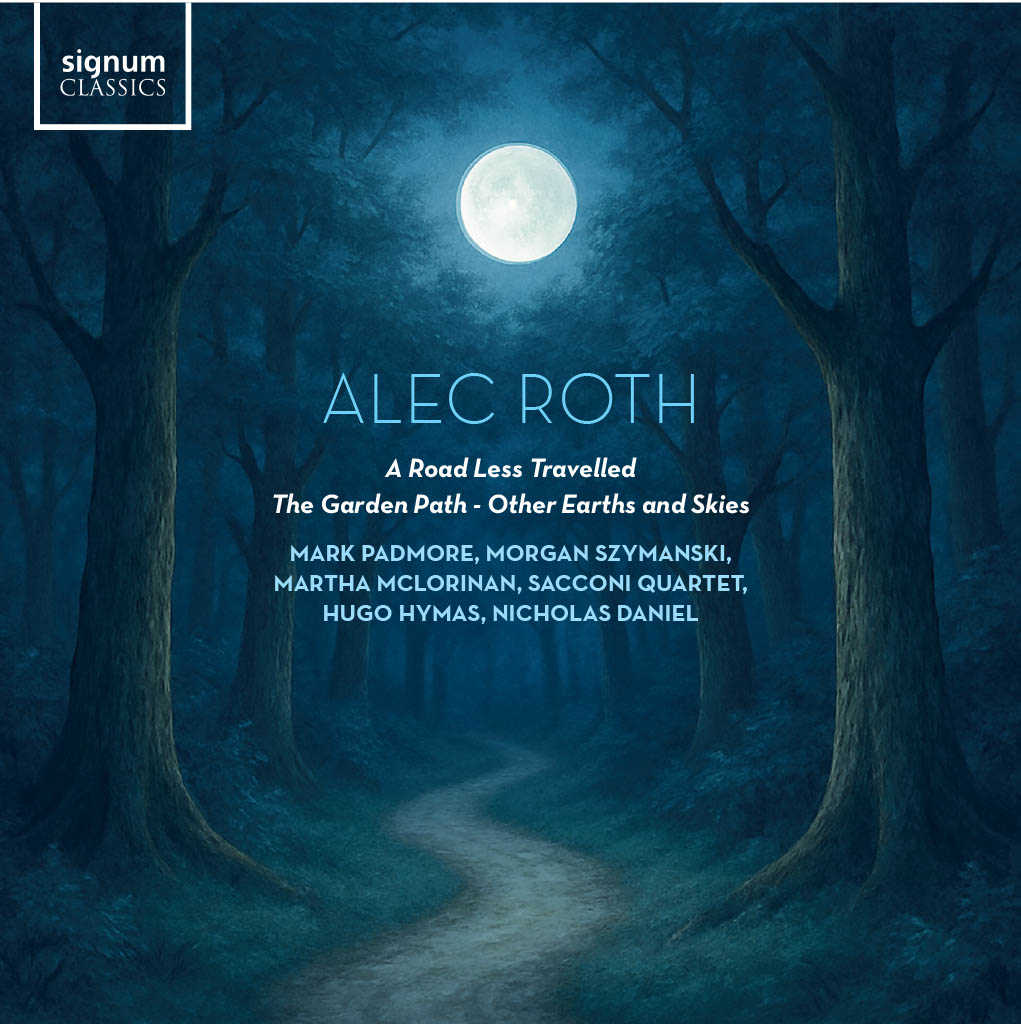
Mark Padmore (tenor), Morgan Szymanski (guitar) (A Road Less Travelled); Martha McLorinan (mezzo-soprano), Sacconi Quartet [Ben Hancox and Hannah Dawson (violins), Robin Ashwell (viola), Cara Berridge (cello)] (The Garden Path), Hugo Hymas (tenor) with Nicholas Daniel (oboe) (Other Earths and Skies)
Alec Roth A Road Less Travelled (2017) The Garden Path (2013, rev. 2022) Other Earths and Skies (2010, rev. 2022)
Signum Classics SIGCD971 [61’12”] English texts included Producer Adrian Peacock Engineer David Hinnitt
Recorded 6,8 & 10 October 2025 at Church of St Anne and St Agnes, Gresham Street, City of London
Reviewed by Richard Whitehouse
What’s the story?
Signum Classics resumes its coverage of Alec Roth (b.1948) with this album of song-cycles, their scoring with guitar, string quartet or oboe confirming the versatility of the composer’s idiom and enabling each to be enjoyed on its own terms or as part of the overall programme.
What’s the music like?
Best known for larger-scale choral works (though his string quartets – recorded by the Allegri Quartet on RTF Classical NI6321 – are well worth anyone’s investigation), Roth has produced a number of song-cycles whose accompaniment can be as crucial as the words in determining the overall expressive trajectory. Each of these works has notable British precedents – Britten or Walton with guitar, Gurney or Vaughan Williams with string quartet, then VW again with oboe – though, in terms of his fashioning a personal response, Roth is definitely his own man.
Performable with guitar and/or string quartet (the former chosen here), A Road LessTravelled sets (whole or in part) 12 poems by Edward Thomas – though the title is actually the title of a poem by Robert Frost, the American poet who had encouraged Thomas to develop his poetic muse. Pivoting around an instrumental Interlude, the settings in this ‘solo cantata’ are mainly brief while strongly evocative of a mood shared by all these texts; namely, the journey itself as more lastingly significant than the destination indicated, or at least implied, over its course.
The ‘song-cycle’ that is The Garden Path utilizes four poems by Amy Lowell and started out with piano accompaniment before being revised with string quartet. Here it is those parallels between her garden, which the poet describes in its myriad states and variety, and the human condition which come to the fore in these four relatively lengthy settings; alongside a feeling of what may lie beyond such luxuriance and abundance for the protagonist, as for the reader. That such ambiguity emerges so candidly yet obliquely is integral to this cycle’s fascination.
Finally to Other Earth and Skies – these ‘five miniatures’ after eighth-century Chinese poet Li Bai (once known as Li Tai-po) having been translated by Vikram Seeth, an author with whom Roth has collaborated on numerous occasions. It is the haiku-like brevity and concentration of the texts as sets the tone for this sequence, with its interplay between all-too-human emotions and metaphysical longing in which any vestige of ego has been subsumed into the numinous. Quite likely the deepest such cycle featured on this album, and certainly the most intriguing.
Does it all work?
Pretty much throughout. As an adherent of the ‘less is more’ ethos, Roth’s settings are almost consistently spare in texture and restrained in manner; their meaning arising out of the actual words as much as from any poetic gloss. Demonstrably yet never stereotypically tonal, while often teasing as to their emotional remit, this is song-writing of a high order and as pleasurable for the listeners as they are manifestly are for the singers and instrumentalists featured herein. All the texts are included, though there is never any problem with hearing what is being sung.
Is it recommended?
Indeed it is. The church acoustic is evidently an ideal ambience for recording such music, and those who respond to it should investigate earlier releases of Roth on this label – most notably the vocal miscellanies Songs in Time of War (SIGCD124) or Sometime I Sing (SIGCD332).
from the press release. Picture of Benjamin Appl (c) David Murano
The Oxford International Song Festival marks its 25th anniversary with a thrilling and wide-ranging programme centred on the theme of love. Spanning 59 events, the Festival explores love in its myriad forms – its joys, complexities, and heartbreaks expressed in music and poetry, and its creative force in the lives of composers and poets. Alongside headline recitals by world-leading artists, audiences can enjoy lunchtime, rush-hour and late-night concerts, as well as study events. The programme is further enriched by choral music, dance, chamber works and discussions.
The Festival opens on 9 October with a recital by Dame Sarah Connolly, also marking the Festival’s first event at the newly opened Schwarzman Centre. Baritone Matthias Goerne makes his Festival debut on 10 October with a performance of Schubert’s Winterreise at the Olivier Hall. Other featured singers include Carolyn Sampson, Benjamin Appl, Katie Bray, Roderick Williams, Alice Coote, Katharina Ruckgaber, Johannes Kammler, Camilla Tilling, Sarah Maria Sun, Anna Prohaska and Christoph Prégardien. They are joined by pianists including Joseph Middleton, Tamara Stefanovich, James Baillieu and Pauliina Tukiainen, among many others, including the Festival’s Artistic Director, Sholto Kynoch.
The programme includes several world premieres: Nardus Williams performs Marriage of…?, a new work by Associate Composer Emily Hazrati and librettist Nazli Tabatabai-Khatambahksh; Katy Thomson and Rustam Khanmurzin premiere a new work by John Webb, exploring the corrupting nature of power; and Anna Dennis and John Reid present The Silent Songs of Josefine, a bold new Kafka-inspired work by Can Bilir.
The Festival’s central weekend (17–18 October) is devoted to the music of Franz Schubert, with Graham Johnson continuing his landmark exploration of the composer’s final years, 200 years on. Other highlights of the weekend include Camilla Tilling returning to perform Schubert’s Rückert settings and Helen Charlston (below) performing Die Schöne Müllerin, both with Sholto Kynoch; and Sarah Maria Sun performing Der Hirt auf dem Felsen with pianist Jan Philip Schulze and clarinettist Julian Bliss.
On Wednesday 21 October, the New Generation Day showcases three concerts in partnership with the BBC Radio 3 New Generation Artists scheme, all recorded for future broadcast. Performers include baritone Andrew Hamilton and pianist Michael Pandya; soprano Erika Baikoff with Sholto Kynoch; and Konstantin Krimmel with Ammiel Bushakevitz, presenting a programme that includes Vaughan Williams’ Songs of Travel.
Louise Alder and Joseph Middleton explore the passing of the year in a programme featuring Helen Grime’s Seasons, written for them in 2025. Alice Coote and Julius Drake present an imaginative recital blending repertoire from David Bowie to Mozart. Renowned pianist DameImogen Cooper performs Hugo Wolf’s Italienisches Liederbuch as part of her final concert season before retirement. Juliane Banse returns with pianist Alexander Krichel, dancer István Simon and choreographer Andreas Heise for a danced performance of Mozart songs and piano music.
Instrumental highlights include appearances by the Carducci String Quartet, performing the Mozart Quintet with Julian Bliss and Alec Roth’s Seven Elements with James Gilchrist, guitarists Bryan Brenner and Václav Fuksa, and accordionist Murray Grainger. Eight Oxford Song Young Artist duos each give short showcase slots at the start of headline evening recitals in the first week of the Festival. In the second week, they immerse themselves in the residential Mastercourse, led by Jan Philip Schulze, with daily public masterclasses.
With thousands of tickets priced under £20, discounts for multiple bookings, and £10 tickets available for under-35s, the Festival remains accessible to the widest possible audience.
Each autumn, audiences from around the world are drawn to Oxford for the Festival’s outstanding artistic quality and the city’s unique atmosphere. Performances take place in a range of venues, including the historic Holywell Music Room – Europe’s oldest purpose-built concert hall – as well as the Levine Building, the Olivier Hall, Garsington Studios at the Wormsley Estate and, for the first time, spaces within the Schwarzman Centre.
Public booking opens on Wednesday 20 May. Tickets can be booked online at oxfordsong.org or via the Box Office on 01865 591276 (Monday to Friday, 11am–1pm).
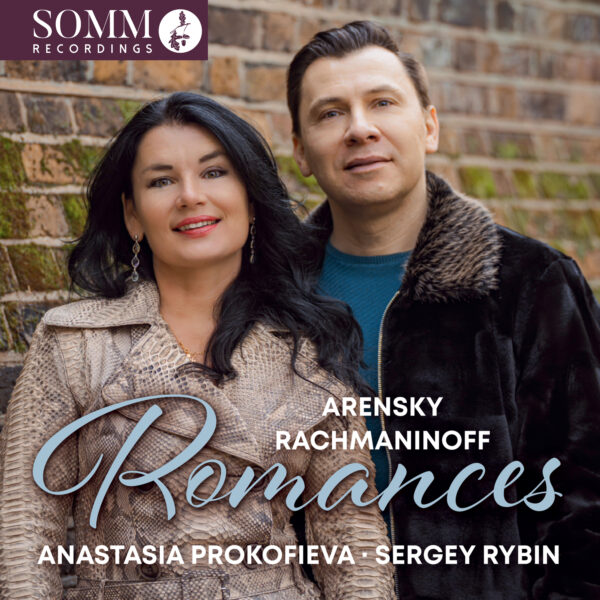
One of the most intriguing classical albums to be released in 2026 so far is an album of songs by Sergey Rachmaninoff. Nothing particularly unusual in that, you might think, but on this occasion he shares top billing with his teacher at the Moscow Conservatory, Anton Arensky. A composer often overlooked, Arensky played a critical part in Russian musical history, forming a tangible link between the Romantic composers Glinka and Tchaikovsky, the ‘Mighty Handful’ Russian group of composers Balakirev, Cui, Mussorgsky, Rimsky-Korsakov and Borodin, and the 20th century giants, of whom Rachmaninoff is certainly one.
The artists on this album for Somm Recordings, soprano Anastasia Prokofieva and pianist Sergey Rybin, have joined Arcana on a call to discuss their album, and in particular the central character Arensky. People who know the composer are likely to have heard his Piano Trio no.1, one of his finest chamber music works, but the songs are not familiar at all. “The songs are lovely, but they are absolutely unique and rare – even in Russia”, says Anastasia (below). “It came to our attention that this music should be elevated and performed. The idea came that when you hear and sing this music it is something very fresh and very new. It should be more present for people, otherwise it will vanish.” “I knew some Arensky before”, says Rybin, “particularly the songs, through being curious about the facets of Russian music and not just Tchaikovsky or Rachmaninoff, though we did want to do some Rachmaninoff to begin with. Then this idea came to us that there is a connection between the two composers, because one is a pupil and one is a teacher. The idea grew from there, and we thought this slant, this side view would be an interesting way to put it across. So what is the chicken, and what is the egg?! Suddenly you realise that Rachmaninoff wasn’t born in a vacuum, and there are things so closely connected to his style, and you can literally hear how his style was influenced by Arensky, particularly in the piano writing. From my point of view can absolutely see and touch it.”
The selection process was next. “We looked through 57 romances, we surveyed it all and selected what we liked.” The album is linked logically, rewarding continuous listening as the spotlight shifts between the composers so that it proves difficult to tell where one begins and the other ends. “They are so similar, and yet there is a difference”, says Rybin. “It is like listening to Debussy and Ravel, you can feel it is of the same nature, but there is a notion which is just imperceptibly different. I personally enjoy that as an audiophile, feeling that slight personal intonation, particularly with Arensky, It’s hard to describe what it is. With Rachmaninoff you hear the Orient, you hear that sort of Russian romantic Orientalism in play. With Arensky it is something else, and it is hard to put your finger on it.”
Was Arensky writing his songs with a particular singer in mind? “I don’t think he was”, says Sergei. “Rachmaninoff did, and his Op.38 songs were written for Nina Koshetz, and he went on tour in 1916 playing those songs with her. Subsequently her descendants emigrated to America, and there were two more songs discovered in their archives, Prayer and Glory to God. Somebody held it in a private archive for decades and then suddenly they appeared.”
“There is a funny story about this particular singer, which my professor in Moscow told me, that Koshetz did not like high notes at the end of the song, so she threw the score at Rachmaninoff and told him to sing them!”, says Anastasia. “It is emotionally so strong if you get to that point with this pianissimo, and you need to be on a very good day with your technique and with your state of mind. Our collaboration helps me to sometimes hold on and do the words first, with the music. That’s why it’s fantastic to work, with such a musician and such a pianist as Sergey. So it’s not only me as a singer, getting to the point of high notes, I always try to see it through our ‘duet’ point of view, so it should be tender and fragile, not necessarily loud and big.”
“I would add that in general Russian music is so vocally based”, says Rybin (above), because it is first of all coming from folk tradition, which is mostly singing. And then, as I often say to students, Russian music did not know a Baroque period – almost nothing. It’s only Bortniansky and Berezovsky, at the turn of the 18th to 19th century, and they studied in Europe. The Russian national school arrived straight in to ‘bel canto’, and St. Petersburg used to run a full time Italian opera company. When went to the opera, that meant Italian opera, and so the Russian school of writing for the voice is profoundly based on that, the bel canto nature. That points to your question – yes, they did know what to ask for the voice, and they asked hard things, because they heard all the Verdi, and Wagner came to Russia.”
“This connection between Italian bel canto and Russian styles is amazing, and in addition we are so blessed to have these amazing musicians who were not only singers but pianists or violinists too”, says Anastasia. “I was a violinist, so this kind of intonation and presentation helps when you play the instrument first. That helped me a lot. “I would add”, says Rybin, “that in Rachmaninoff and Rimsky-Korsakov, the separation of the female voice into soprano and mezzo-soprano is very, very pronounced. With Rachmaninoff the soprano is very high and the mezzo very low. Arensky is more on Tchaikovsky’s side, writing very centrally for the soprano voice, with maybe one top note. Rachmaninoff creates more of a diversion with his range.”
“Speaking of Tchaikovsky”, says Anastacia, “I think he and Arensky were quite close friends, because he complemented Arensky’s opera Dream on the Volga a great deal, and wrote letters to the Bolshoi Theatre asking them to invest more money for the staging.” The opera is based on the Ostrovsky melodrama Voyevoda, which Tchaikovsky himself set and ultimately destroyed. “It was actually presented at the Bolshoi Theatre”, she says, “and had a good deal of success, and Tchaikovsky was greatly touched by the music and the style. So they were quite close in terms of musical language and understanding. It touched me a lot, because Tchaikovsky is such a fantastic composer, a base of the whole Russian music culture, and knowing that there is another composer who was close in the thinking or musical language is fantastic, how close their musical worlds were, and that we can come back and elevate one of those voices. My first operatic aria was by Arensky, and some of his arias are particularly famous in Russia, but the rest of the world doesn’t know him so well, and we are really happy to lift his profile.”
She is helped by Rybin, who she praises for his informative booklet notes and presentational style at concerts, giving audiences an insight into the music they perform. “He is a unique musician who has an ability to explain this music, a talent for presenting it. I’m in good hands!”
Together the pair have recorded albums devoted to the music of Hahn and Dargomyzhsky. “His music is absolutely brilliant”, says Anastacia of the early Russian Romantic, “he wrote in French and in Italian, and elevated that with some hidden gems, and the album game together beautifully. Reynaldo Hahn wrote some fantastic music, too.”
It may seem an obvious point, but listening to a composer’s song output is to hear a whole new element of their output, which makes this album all the more important for highlighting this area of Arensky’s output – and Rachmaninoff’s, too. “By volume, you realise the songs are a significant part of the output”, says Sergey, “for Rachmaninoff too, who wrote 86 songs. It is a big output, and we all think of this grandiose composer with big hands and a crushing sound, but when you go into the songs – the majority of them, apart from Spring Waters, maybe – you realise those two or three pages are absolutely perfect, with not a note out of place. They are really works of absolutely refined precision, perfect vocal miniatures, and there are some bars in those songs when you can count the notes on one hand! This minimal restraint and nuance, the light and shade, are in a perfect miniature form, which is a refreshing thought for me. Of course I hear the finale of the Piano Concerto no.3, but then you look into the songs, and you realise that’s not all Rachmaninoff is. He is a perfect vocal miniaturist.”
“That emotional exquisite moment”, says Anastasia, “has roots in Arensky, because some of his songs are so touching and so beautifully done. Someone from the audience said to me yesterday, it’s like the ‘Letter Scene’ from Eugene Onegin, but shorter, a mini letter scene in three pages. That was the connection between the teacher who was already showing Rachmaninoff that emotional presence is possible in a couple of minutes, showing what is going on but also how the person is feeling.”
The two talk as they perform, in rather fetching harmony. “Rachmaninoff studied harmony with Arensky”, points out Sergey, “and Arensky was the first ‘harmonist’, with no study books to use since conservatories had just been established in Russia. He was the author of the first study book of harmony in Russian, and I find this very important. Rachmaninoff was just below 20 when he studied harmony, and then of course we realised that harmony for Rachmaninoff is a particularly important tool and dimension. We hear that it is his, but I also hear those dextrous shifts in Arensky, he is really mobile on his feet in terms of harmony, writing adventurous modulations. There is a line there, where Rachmaninoff was influenced in this harmonic sense, which carried through his life.”
With Rachmaninoff’s continually strong emphasis on melody, are there any challenges that are particular to phrasing in the songs? “Absolutely”, says Anastasia. “The Op.38 songs are particularly concentrated, and you have to never sharpen your intonation. Sometimes it takes you years to perfect! It has always amazed me that the compose were so young to compose these songs, especially Arensky, who had a short life, colourful and interesting. He was very young to be a professor writing this book. We need to present these people not only as composers, with the beautiful music, but also as human beings. They were blessed with so many talents, and have given us these amazing scores, books and knowledge – how to feel, to be happy and sad, this emotional flourishing that we miss sometimes these days when watching Netflix and things! This deep knowledge needs to be brought to the new world and presented to young people.”
The pair have recent experience in this field. “In our concert yesterday we had children around eight years old listening, and they could understand the music because it’s so emotionally easy and clear – not easy as in simple, but it appeals to them and has resonance. It is poetic, and the heart and imagination immediately start working, which we all want. I’m happy to have been a bit closer to them and bringing this music to the new generation.”
With regards to vocal technique, she considers. “Because he was such a brilliant pianist, Rachmaninoff didn’t really have limits, so you somehow need to make it happen, to make it work, and it’s quite an achievement to do. It’s beautiful when it happens!” Does it help that both composers were pianists, being able to set scenes with such economy? “I’m really pleased that it is such brilliant music for Sergey to play, because sometimes the piano part is limited. Here it is like an orchestra, and I was so happy that we could both flourish, with some beautiful pieces both to sing and to play. Our audience yesterday reacted very well to this musical language, which is so colourful and rich. They are great pieces to present!”
You can listen to clips and explore purchase options for the new album of songs by Arensky and Rachmaninoff at the Somm Recordings website
by Ben Hogwood picture courtesy of Colbert Artists Management
Last week we learned the sad news of the death of the great Belgian baritone, José van Dam, at the age of 85. A suitable obituary can be read at the Presto Music website
van Dam’s discography is extremely impressive, and the Tidal playlist below taps in to a number of elements of it, not least his many recordings made with the Berliner Philharmoniker and Herbert von Karajan. Yet there are landmark recordings of French opera and melodies too, which are also included – with music by Massenet, Ibert and Ravel:
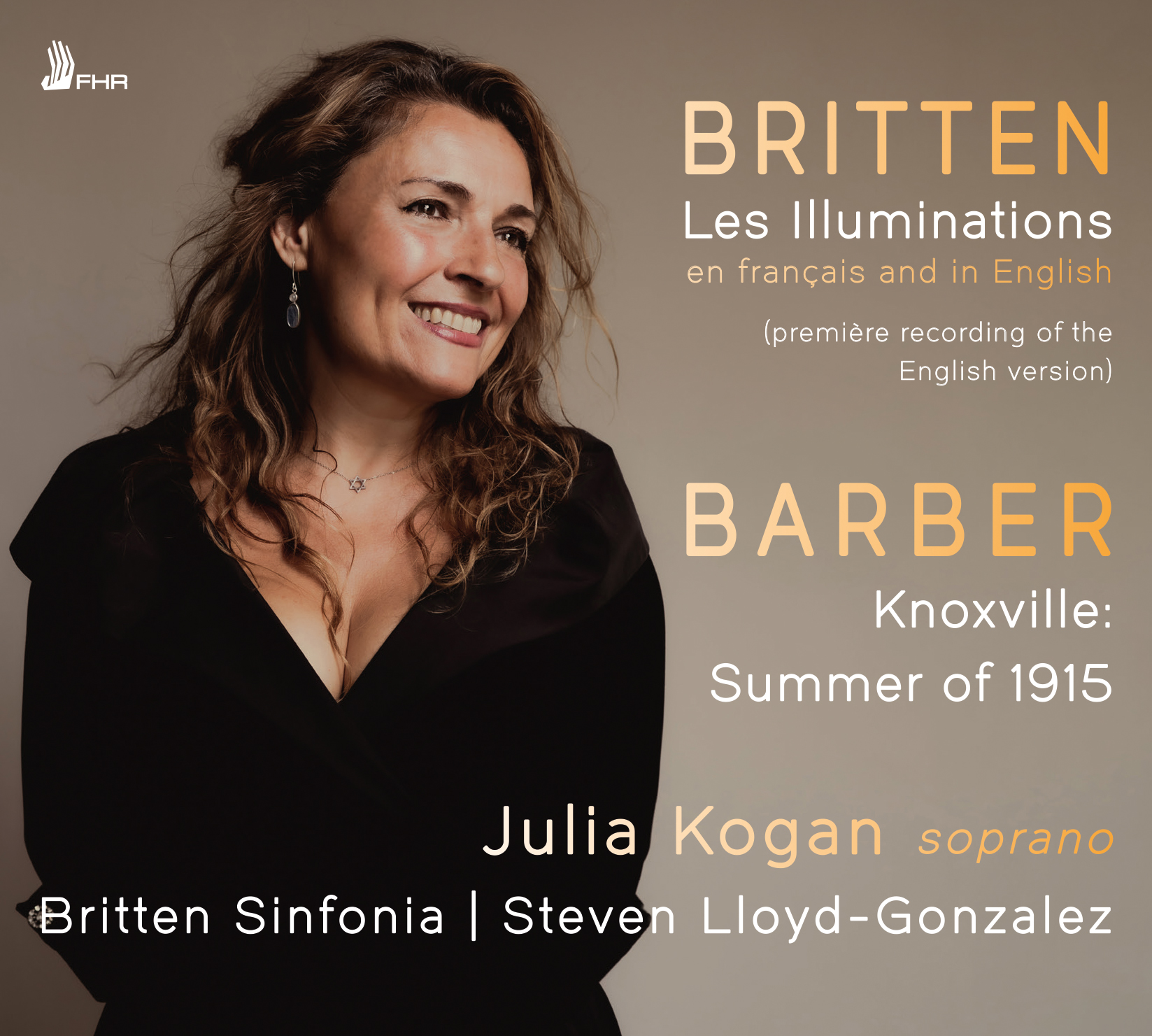
Julia Kogan (soprano), Britten Sinfonia / Steven Lloyd-Gonzalez
Barber Knoxville: Summer of 1915 Op. 24 (1947) Britten Les Illuminations Op.18 (1939) – French and English versions
First Hand Records FHR150 [60’04’’] English/French texts and English translation included Producer Andrew Walton Engineer Debs Spanton
Recorded 8-10 October 2023 at Henry Wood Hall, London
Reviewed by Richard Whitehouse
What’s the story?
First Hand Records releases a recording of Britten’s Les Illuminations with a difference – this reading of its original French version being heard alongside one of a new English translation, and with Barber’s Knoxville: Summer of 1915 included as far more than a mere makeweight.
What’s the music like?
Second of Britten’s song-cycles, Les Illuminations sets poems from the eponymous collection by Arthur Rimbaud and was among the earliest works written during his three years in North America. Although most often performed with tenor, this was conceived for soprano and Julia Kogan amply underlines the emotional frisson possible when sung thus. Such is immediately evident from the simmering anticipation of Fanfare, its single-line setting recurring midway as the sensuous Interlude then as impetuous conclusion to the sardonic Parade. Elsewhere, the feverish excitement of Villes, knowing elegance of Antique and rapt longing of Being Beauteous are tangibly rendered – as is the inherent fatalism of Départ which evanesces into sombre repose. If not Britten’s defining vocal work, this is surely among his most engrossing.
All the more surprising, then, it should never have received an English translation – until now. Long established as translator and poet, Timothy Adès has come up with one that is idiomatic and conveys the essence of each setting to often startling degree. That said, these translations read arguably as explications of the poem at hand rather than as linguistic equivalents for the purpose of singing, which is not to deny the conviction that Kogan puts into their realization. Whether or not this establishes itself as a viable alternative is for future exponents to decide.
Cannily interspersed between these performances, Knoxville: Summer of 1915 finds Barber setting extracts from James Agee’s prose-poem as a ‘lyric rhapsody’ that offsets its evoking of idyllic contentment with a bittersweet acknowledgement of what can arise in the light of experience. Interesting to recall Agee was barely a decade older than Rambaud at his death, and that the trajectory of his life moved in something of an opposite direction as regards its unfolding from outward security to inner upheaval. There have been memorable recordings of this work across the decades, and that by Kogan is surely set to join them in terms of the imaginative insight she wrests out of Barber’s setting along with its undoubted vocal allure. Whatever their virtues, few earlier accounts get to the heart of this matter with such acuity.
Does it all work?
Pretty much always and not forgetting the contribution of Britten Sinfonia (whose association with its namesake’s song-cycles goes back to recordings from John-Mark Ainsley some three decades ago) – all directed here with no lack of perception by Steven Lloyd-Gonzalez, whose discography features worthwhile accounts of Shostakovich’s Sixth and Ninth Symphonies for FHR. The balance of voice and orchestra – whether with or without wind instruments – could hardly have been bettered, while Kogan contributes a succinct though revealing booklet note.
Is it recommended?
Indeed. Kogan has previously recorded a collection by Isabelle Aboulker for FHR, and it is to be hoped her association with the label will continue. Certainly there is much in the repertoire of English and French orchestral song to which her distinctive response would be well suited.