In concert – Three Choirs Festival: Adrian Partington conducts Elgar’s ‘Dream of Gerontius’

John Findon (tenor), Niamh O’Sullivan (mezzo-soprano), David Ireland (bass-baritone), Three Choirs Festival Chorus, Philharmonia Orchestra / Adrian Partington

Wagner Parsifal – Prelude to Act One (1878)
Elgar The Dream of Gerontius, Op. 38 (1899-1900)

Gloucester Cathedral
Saturday 1 August 2026

Reviewed by Richard Whitehouse Photo credits (c) James O’Driscoll

Closing this latest edition of the Three Choirs Festival with Elgar’s The Dream of Gerontius felt both inevitable and fitting, given its seminal place in the annals of the English choral tradition as of this festival, in what proved if not an unblemished then certainly a memorable realization.

Hearing this work now is to feel surprise how, aside from aspects of Cardinal Newman’s text, its musical treatment could have seemed so problematic whether technically or interpretively. Maybe the musical lineage on which it drew being not yet fully assimilated by musicians and listeners, or its contrasts between life and after-death being so emotionally charged, presented challenges to be overcome only with time and perseverance. If such were the case, then those challenges have certainly been met in the 124 years since its first hearing at the Three Choirs.
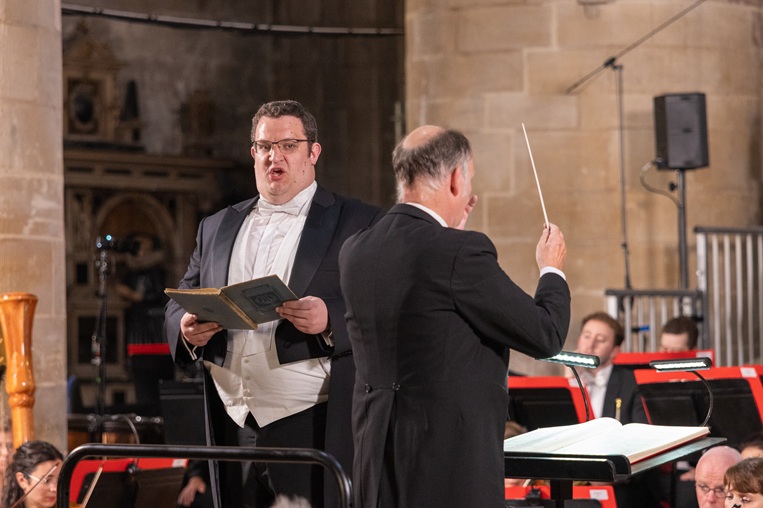
Allotting the vocalists so they merge into a balanced and complementary whole is a task this evening’s performance met convincingly. John Findon (above) brought fervour and an immediacy to Gerontius which never threatened overkill. Witness the assured pacing of his ‘Sanctus fortis’ solo so it dominated the opening part without undermining the latter’s formal and expressive trajectory; or the respective poise and fervour of ‘I went to sleep’ and ‘Take me away’, at the start then climax of the second part, in furthering overall dramatic flow.
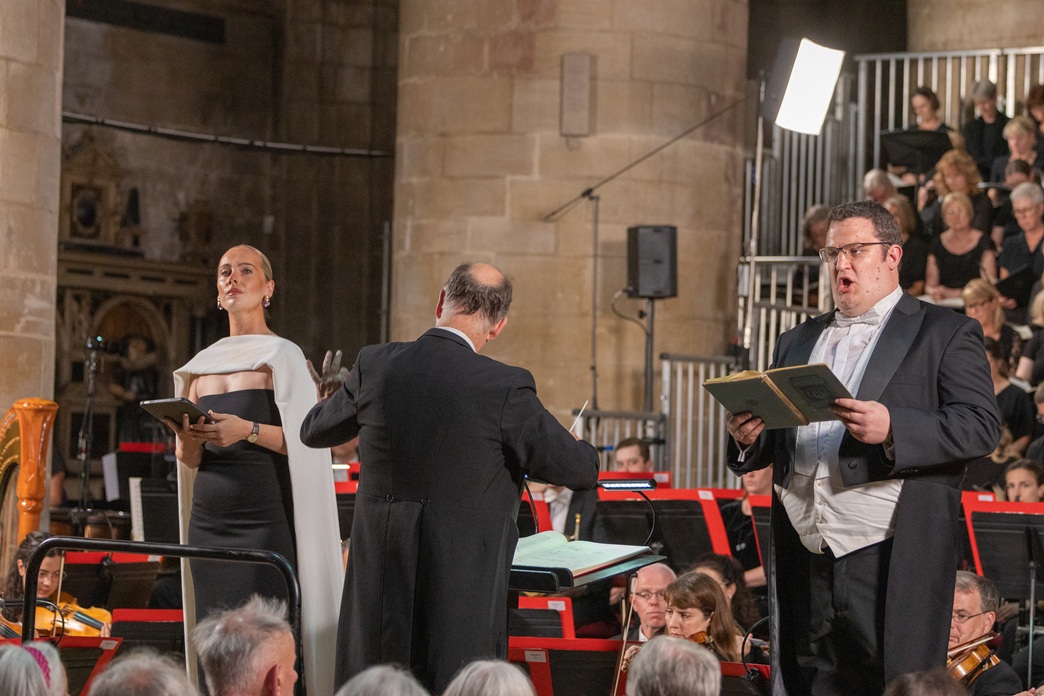
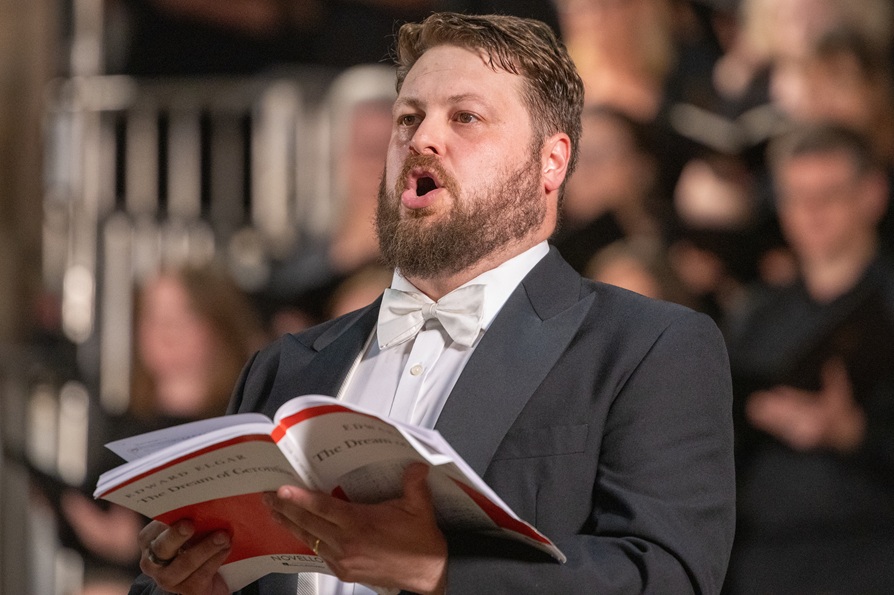
A little too detached initially, Niamh O’Sullivan (above, with Findon) duly entered into the persona of the Angel such that ‘Softly and gently’ exuded an affecting poise. Starkly implacable as the Priest, David Ireland (below) brought to Angel of the Agony an understatement preferable to that wanton rhetoric often encountered.
Few such works have so extensive and varied a choral component as Gerontius, in which the Three Choirs Festival Chorus did not disappoint. Thus the distant response of the Assistants, menacing aggression of the Demons, accumulating power of the Angelicals in their majestic ‘Praise to the Holiest’ or ethereal chant of the Souls in Purgatory were all characterized with the requisite insight. Nor was the Philharmonia found wanting in Elgar’s always resourceful though often demanding orchestral writing, notably a Prelude such as unfolded purposefully towards its eloquent culmination. Here, as throughout, Adrian Partington (below) gave notice of his deep knowledge of and unfailing involvement with this score – not least when bringing out those sombre if luminous hues as were a hallmark of the composer’s orchestration forthwith.

Orchestral and conductor were also at one when delineating the hieratic mystery or grandeur of the Prelude to Wagner’s Parsifal. Its inclusion prior to Gerontius has often found favour in recent years yet, other than pointing up that debt which Elgar repaid handsomely in his own terms, it hardly seems necessary given the emotional scope or inclusiveness of what follows. If it is included then better, surely, to play this piece without its Act One ‘resolution’ then go straight into the Elgar to point up their conceptual connection and ensure cohesion forthwith.

Attendees at the performance had the benefit of programme notes by Martin Lee-Browne – author, authority on British music (not least Delius) and one-time Chairman of Gloucester Three Choirs – whose presence at and contributions to this festival will be greatly missed.

To read more about the 2027 festival in Worcester, head to the Three Choirs Festival website. Click on the names for more on the artists in this concert – tenor John Findon, mezzo-soprano Niamh O’Sullivan, bass-baritone David Ireland, the Philharmonia Orchestra and conductor Adrian Partington

Published post no.2,954 – Monday 6 July 2026
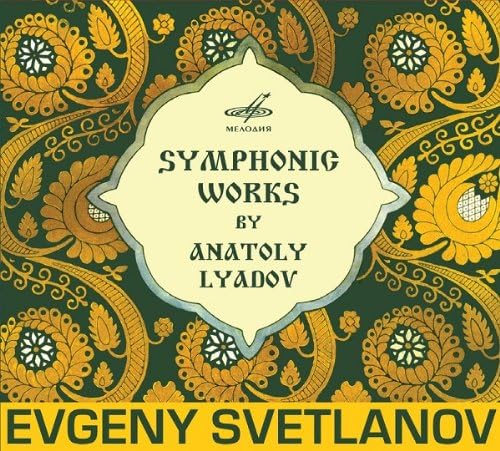
#AmbientAugust no.2 – Lyadov: The Enchanted Lake

by Ben Hogwood

The second entry for Arcana’s contribution to #AmbientAugust is very different from the first. Whereas yesterday we enjoyed thoughts from the studio of Aphex Twin, today we hear from 44-year old Russian composer Anatoly Lyadov, and his remarkably vivid portrait of The Enchanted Lake.

Stillness like this in an orchestral piece is relatively rare…as is the luminous orchestration:

Published post no.2,966 – Sunday 2 August 2026

Published post no.2,965 – Saturday 1 August 2026

#AmbientAugust no.1 – Aphex Twin: Xtal

by Ben Hogwood

One of the benefits of social media is the opportunity to share music we love, to get new perspectives on music we know, and to discover whole new pathways and music we haven’t heard before.

This used to be one of the best things about Twitter, but for obvious reasons I’ve closed that particular door and now enjoy BlueSky, where a welcoming community share music challenges from month to month. I’ve enjoyed a few challenges, but the latest one is definitely worth sharing with Arcana readers.

Without further ado, welcome to #AmbientAugust – with thanks to Coinneach Rooney (@coinneachrooney.bsky.social), whose idea it was. The guidelines are:

“Post an ambient track each day in August. Modular synths, lo-fi guitars, digital landscapes, or whatever feels right to you. There are rules, but you’ll only find out what they are after breaking one. 😂 Use #AmbientAugust when you post.”

My contribution for day one is Aphex Twin‘s Xtal, one of the very first bits of music we heard from Richard James back in 1992, when it was released as the first track of his Selected Ambient Works Vol. 1 anthology for Apollo Records. It samples Evil at Play, a production music track by Steve Jefferies, Mary Carewe and Donald Greig, and Apache by Incredible Bongo Band.

The track has special significance for me, as the Selected Ambient Works Vol. 1 album played a part in helping me through glandular fever at university. Here it is – very simple, and blissful:

Published post no.2,965 – Saturday 1 August 2026

New music – Dave Angel – A Time And Place (R&S)

posted by Ben Hogwood, with text from the press release.

British electronic music pioneer Dave Angel returns to R&S Records with A Time And Place, his first full-length album release for the seminal Belgian label. Arriving thirty-five years after Dave first joined the R&S family, the album reunites one of UK techno’s defining voices with the imprint that helped launch his career, renewing one of electronic music’s most enduring creative partnerships.

The first track to be made available from A Time And Place is Reflexion, featuring trumpeter Steve Waterman, an airy and jazz-inflected number that you can watch below:

A Time And Place feels less like a return than the continuation of a conversation left unfinished. Rather than revisiting former achievements, the album reflects the perspective of an artist whose creative journey has continued to evolve. Reconnecting with the label that first championed his work, Angel delivers his most personal and musically expansive statement to date.

Across fifteen compositions, the album reaches beyond the conventions of techno to reveal the full breadth of Angel’s musical identity. Drawing on jazz, soul, improvisation and richly textured electronic production, the album balances rhythmic precision with warmth, melody and emotional depth. Reflections on family, heritage, nature and the communities that have shaped his life sit alongside broader observations of the world around him, creating a body of work that feels both intimate and expansive.

That openness is reflected in a carefully chosen cast of collaborators. Celebrated trumpeter Steve Waterman features on both Réflexion and The Yellow Butterfly, bringing a lyrical, Miles Davis-inspired voice to the album after first catching Angel’s attention through his work on Paul Hazel’s Out Of This World. Elsewhere, legendary Chicago vocalist Robert Owens appears on Harmony Serenade, while guitarist Merv Carswell and vocalist Aurii Sky (Dave’s daughter, adding a poignant family connection) add further colour and texture to a record rooted in musicianship and shared expression.

While Dave Angel’s influence on British electronic music has long been established, A Time And Place reveals another dimension of an artist whose foundations were laid long before techno. Raised in a household immersed in live music and jazz culture, Angel has spent a lifetime absorbing sounds beyond the club, allowing those influences to surface naturally throughout a career defined by curiosity rather than convention.

For R&S Records, the album renews a relationship that stretches back to the label’s formative years. For Dave Angel, it reflects both the path travelled and the road ahead. Thirty-five years after 1st Voyage first announced his arrival, A Time And Place reunites artist and label with the same forward-looking spirit that brought them together in 1991, proof that the strongest creative partnerships continue to evolve.

Published post no.2,964 – Friday 31 July 2026

New music – Sennen: New Quiet (Sonic Cathedral)

posted by Ben Hogwood, with text from the press release. Sennen photographed by Brian David Stevens

Sennen release New Quiet, their first album in over 10 years, on 30 October. It’s a wonderfully warm and fuzzy record, self-recorded by the band but with the end results mixed by James Chapman, aka Maps. It sounds at once fresh but familiar, with the band approaching their music with an uncomplicated honesty.

The first single – the Big Star-shaped Here It Comes – is out now on all digital platforms. It is a bittersweet, summery song with a hopeful message, with its repeated refrain of “everything will be OK”.

“I didn’t write that line with any cynicism,” says singer / guitarist Larry Holmes. “There’s an awareness of how fragile being OK is, and the magic of the things in your life that make you feel like everything will be OK. Us making this new record was definitely one of those things.”

You can watch the video by Innerstrings below:

On New Quiet, the now London-based four-piece’s familiar influences are still there, but this time they are leaning into them rather than shying away. “In the past we’ve felt uncomfortable, but you can end up sabotaging a good idea like that,” explains singer/guitarist Rich Kelleway. “On this album, I think we’re feeling a sense of freedom from self-imposed stipulations we’ve put upon ourselves.”

In short, they’re having fun and enjoying being a band again, something that was inspired by putting together an expanded anniversary reissue of their classic debut album Widows in 2021. This certainly explains the slightly wistful atmosphere that pervades New Quiet, a mix of nostalgia and acceptance.

“When we did the Widows reissue we were able to recognise the unfiltered joy we got from being in a band and making music together when we were in our early 20s,” says Rich, “and making the new album has brought that into focus again.

“I’ve accepted that I need this band in my life. I like to think we’ve funnelled that feeling into making this record and it’s an honest expression of us, now.”

“Sennen is a lifeboat for us, and always has been,” adds singer/guitarist Larry Holmes. “The happy-sad, fear, hope stuff comes from us getting older and having to experience a fair old fucking slice of life here and there – as does everyone.”

Essentially, New Quiet is an album about itself; about the importance of being in a band; about making a record; about listening to music.

This band could be your life.

Published post no.2,963 – Thursday 30 July 2026