On record – George Zacharias, Alexandros Koustas, LPO / Brabbins – Skalkottas: Two Concertos (BIS)

George Zacharias (violin), Alexandros Koustas (viola), London Philharmonic Orchestra / Martyn Brabbins

Skalkottas
Violin Concerto (1937-8, ed. Mantzourani)
Double Concerto (1939-40, ed. Zacharias)

BIS BIS 2554 SACD [57’57”]

Producers Matthew Bennett (Violin Concerto), Alexander Van Ingen (Double Concerto)
Engineers Dave Rowell (Violin Concerto), Andrew Mellor, Brett Cox (Double Concerto)

Recorded 5-6 January 2020 (Violin Concerto), 19-20 April 2022 (Double Concerto), Henry Wood Hall, London

Written by Richard Whitehouse

What’s the story?

BIS continues its long-running project devoted to music by Nikos Skalkottas (1904-49) with this revisiting of his Violin Concerto, alongside a first recording for his Double Concerto in what is a typically apposite pairing which none the less points up the diversity of his output.

What’s the music like?

It was with a release featuring the Violin Concerto that BIS inaugurated its Skalkottas series a quarter-century ago. This recording uses the ‘new critical edition’ prepared in 2019 by Eva Mantzourani, whose volume The Life and Twelve-Note Music of Nikos Skalkottas (Routledge: 2011) is necessary reading for anyone interested in this composer. Many of these corrections will only be evident to those having access to the score, but interpretive differences between Gorgios Demertzis in 1997 and George Zacharias in 2022 are clear from the outset. The latter adopts appreciably quicker tempos for the first two movements that make the opening Molto appassionato more febrile in its expressive contrasts, then the Andante spirito feels closer to an intermezzo after the example of Schoenberg’s Violin Concerto as is brought more directly into focus. Demertzis launches the final Allegro rapidly, Zacharias gaining momentum more gradually before tackling the Prestissimo coda with abandon. Which one prefers depends on how one views the competing expressionist and classicizing impulses of this masterly work.

Although finished barely two years later and pursuing a nominally similar formal trajectory, the Concerto for Violin, Viola and Wind Orchestra presents a markedly different take on its composer’s thinking. Different though not unexpectedly so, given Skalkottas’s approach to serial composition was anything but predictable while it took shape, moreover, in a cultural milieu where Hindemith and Weill (briefly his teacher) were as necessary a creative catalyst as Schoenberg. Not only does the scoring of this piece find accord with that of Hindemith’s concertante works and Weill’s Violin Concerto during that period, but the evolution of each movement in sometimes oblique though always discernible terms gives the overall design a distinctly neo-classical feel. Zacharias sounds even more ‘inside’ this work, and Alexandros Koustas is no less assured in viola writing which is (surprisingly?) always audible against an orchestra whose saxophone section accentuates the presence of jazz as against the militaristic element of brass and other woodwind. The result is a piece by turns engaging and disturbing.

Does it all work?

Pretty much always. Thoughtfully conceived and impressively executed, Skalkottas’s music does not play itself so that performers need to take the lead in rendering its inherent qualities as comprehensively as possible. Which is undoubtedly the case here – Zacharias and Koustas convincingly overcome any incidental technical difficulties, while Martyn Brabbins secures a trenchant and committed response from the London Philharmonic Orchestra in works with which neither he nor they have had the opportunity to come to terms via live performances.

Is it recommended?

It is. Those who already have that earlier recording of the Violin Concerto still need this new release which, with its immediate sound and detailed notes, brings the Skalkottas discography nearer fruition. How about a complete version of the Second Symphonic Suite as a follow-up?

Stream

Buy

For more information on this release visit the BIS website

BBC Proms 2023 – Soloists, London Philharmonic Choir and Orchestra / Gardner – Ligeti & Richard Strauss

Prom 36 – Jennifer France (soprano), Clare Presland (mezzo-soprano), Edvard Grieg Kor, London Philharmonic Choir, Royal Northern College of Music Chamber Choir, London Philharmonic Orchestra / Edward Gardner

Ligeti Requiem (1963-5); Lux aeterna (1966)
Richard Strauss Also sprach Zarathustra Op.30 (1896)

Royal Albert Hall, London
Friday 11 August 2023

by Richard Whitehouse photos by Mark Allan / BBC

There did not seem any more concrete reason to build a Prom around the music from Stanley Kubrick’s film 2001: A Space Odyssey other than this being the 55th anniversary of its release, but it at least offered an opportunity to revive one of the last century’s defining choral works.

Much has been made of a then avant-garde composer writing a piece based on a seminal text from the Christian liturgy, but centenary composer György Ligeti’s Requiem is anything but beholden to tradition. Focussing on what would normally constitute the first half of the Requiem Mass itself skews the textual imagery away from any hope of attaining ‘eternal rest’ – the four movements duly proceeding from a sombre Introitus in which the music’s conceptual vastness along with its expressive extremes are laid bare. The Kyrie is the most (in)famous part – emerging in two successive and cumulative waves of micropolyphony both overwhelming and disorientating, not least when rendered with the poise and precision that the combined choirs summoned in the Albert Hall’s expanse. Inevitably, the terror of the infinite gives way to that of the absurd.

Hence the Dies irae sequence, designated On the Day of Judgement and a veritable tour de force of choral outbursts with vocal interjections; Clare Presland’s ominous intoning tellingly offset by Jennifer France’s stentorian pronouncements, with the wind and brass of the London Philharmonic Orchestra visceral in their contribution under the attentive guidance of Edward Gardner. Neither did the Lacrimosa lack gravitas, the soloists musing eloquently if wearily against a stark instrumental backdrop whose essential emptiness carries through to the close.

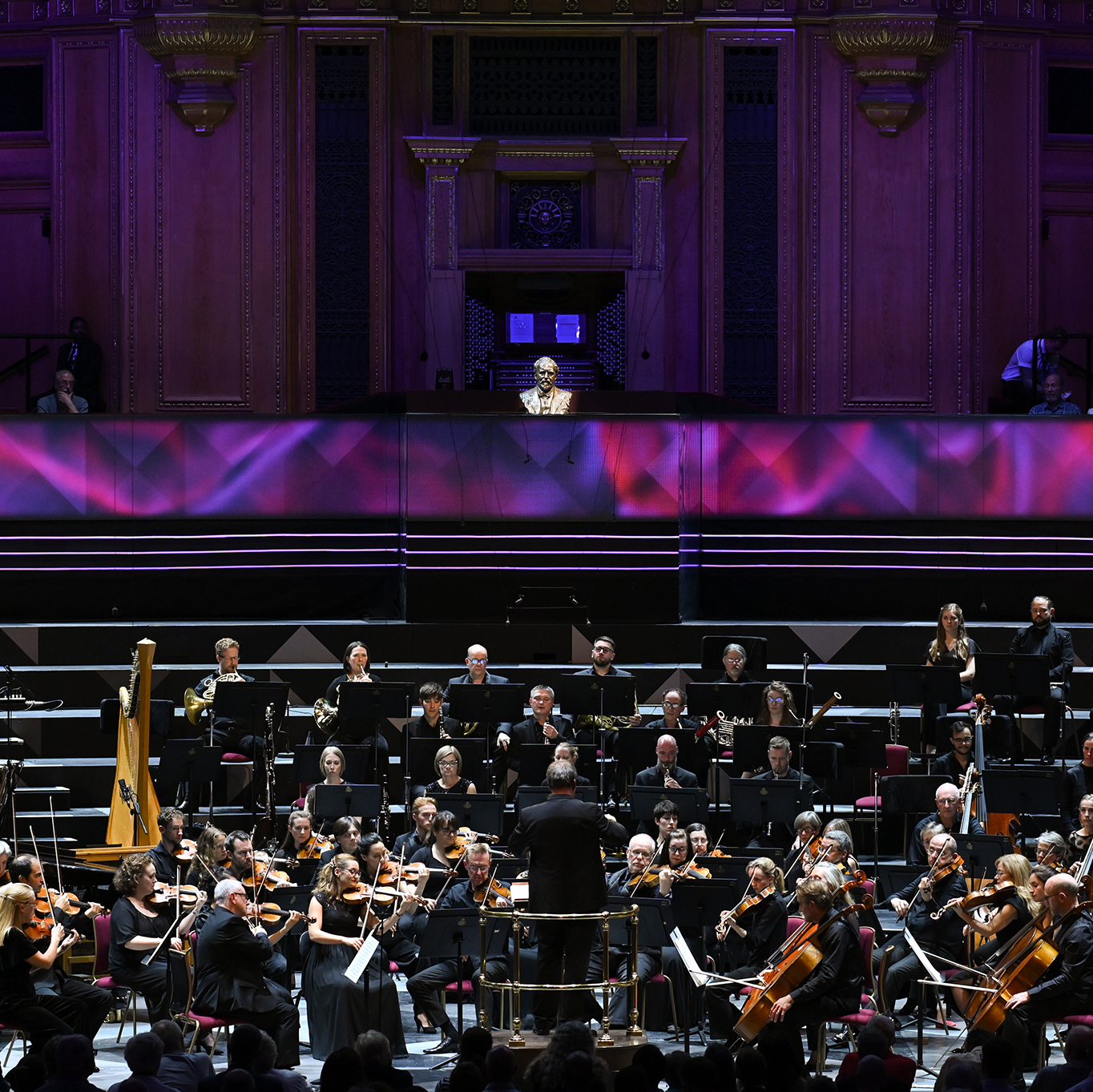
While not intended as a continuation of the larger work, Lux aeterna still makes for a viable resolution in its undulating yet never static textures such as conjure the presence of ‘eternal light’ without any concomitant spiritual aspect. Set high-up in the gallery, to the right of the platform, the Edvard Grieg Kor evinced a faultless intonation along with a tangible sense of the music’s timelessness – though this piece would maybe have been better placed after the Ligeti instead of before the Strauss, not least as there was no segue between the latter works.

Also sprach Zarathustra was, of course, elevated to a new level of public recognition after its Introduction had been utilized as fanfare in Kubrick’s film, and a less than thrilling rendition here at least ensured this Sunrise could not pre-empt the remainder in Strauss’s free-ranging overview of Friedrich Nietzsche’s influential tract. On fine form overall, the various sections of the LPO relished their passages in the spotlight, reminding one that this piece is as much a ‘concerto for orchestra’ before its own time as the musical embodiment of human aspiration. Pieter Schoemann audibly enjoyed setting The Dance Song in motion and while others have made its climax more intoxicating, Gardner brought a rapt serenity to the Night Wanderer’s Song such as made the tonal equivocation of those final bars the more acute and intriguing.

Numerous recent Proms have followed the second-half work with an ‘official’ encore and, while this practice is not always justified, the inclusion tonight of a certain waltz by another Strauss would have extended the 2001 concept still further and effected a more definite close.

For more on the 2023 BBC Proms, visit the festival’s website at the BBC. Meanwhile click on the names for more information on artists Jennifer France, Clare Presland, the London Philharmonic Orchestra and conductor Ed Gardner. For more on Ligeti, head to this dedicated website

On record – Orchestra New England / James Sinclair – Ives: Complete Sets for Chamber Orchestra (Naxos)

Orchestra New England / James Sinclair

Ives
Set no.1
Set no.2
Set no.3
Set no.4: Three Poets and Human Nature
Set no.5: The Other Side of Pioneering, or Side Lights on American Enterprise
Set no.6: From the Side Hill
Set no.7: Water Colors
Set no.8: Songs without Voices
Set no.9 of Three Pieces
Set no.10 of Three Pieces
Set for Theatre Orchestra

Naxos American Classics 8.559917 [68’17”]

Producer Kenneth Singleton
Engineers Benjamin Schwartz, Jonathan Galle

Recorded 8-9 March 2022 at Colony Hall and Choate Rosemary Hall, Wallingford CT

Written by Ben Hogwood

What’s the story?

James Sinclair here continues his long-term Naxos project devoted to Charles Ives with this first complete release of the sets for chamber orchestra that the composer put together across two decades and several of which are only now receiving their first recordings in this guise.

What’s the music like?

While his contribution to such major genres as the symphony, piano sonata and string quartet can hardly be gainsaid, Ives was no less committed to the miniature – whether in terms of his c130 songs, or nearly 40 evocative vignettes that are collated here. As Sinclair points out, the first three of these sets emerged during the First World War so pre-date the songs which were derived from them, whereas those other seven drew retrospectively on Ives’s songs as well as revising numerous of the composer’s shorter pieces – including his most famous single work.

Those relatively familiar with Ives’s output will be aware of many of the pieces through other media, not least the still excellent When the moon collection which Richard Bernas recorded with Music Projects in the 1990s (Decca) and which remains available for download. The 16 items which became songs are included thus in estimable readings by soprano Susan Narucki or baritone Sanford Sylvian with pianist Alan Feinberg, though the merit in having these sets as an integral series is self-evident as to make it surprising this had not earlier been attempted.

That the first three sets are relatively well-known does not lessen the arresting quality of such items as Ives’ quirky take on a Yale processional which is Calcium Light Night (Set 1/No 5), sardonic elision of (in)famous people in Gyp the Blood’ or Hearst!? Which is Worst?! (2/2), or his stark directive to embrace the future in Premonitions (3/3) with its subsequent setting of Robert Underwood Johnson. The ensuing five sets (Nos. 4 and 8 are recorded here for the first time) each has a descriptive title with which to characterise its content, while the last two sets (again in their first recordings) emerged nearly a decade after Ives had effectively ceased original composition – but inclusion of a (definitive?) version of The Unanswered Question (9/3) and reappearance of Like a Sick Eagle (1/4 & 10/1) thereby brings the series full circle.

Also featured here is the Set for Theatre Orchestra that Ives assembled around the same time as the First Set, and whose individual items between them encapsulate three distinct facets of his mature idiom – being respectively ominous, uproarious and nostalgic in their expression.

Does it all work?

It does indeed. Taken overall this collection might be felt to represent the essential Ives – its diversity of contents allied to its economy of means comparable to the orchestral miniatures which Webern composed some years earlier, not least by their exuding comparable intensity of expression. It helps to have so attuned an Ivesian as Sinclair at the helm, who directs with precision and insight these pieces – many of which he, Kenneth Singleton and David Porter realized for performance. Both sound and annotations are fully on a par with these readings.

Is it recommended?

Very much so. This is the fifth volume of Ives which Sinclair has now recorded for Naxos and, whether the series is slated to run to eight or nine volumes, it is building into the most inclusive and reliable edition of the composer’s orchestral output that has so far been made.

Stream

Buy

For more information on this release and purchasing options, visit Naxos Direct. For more information on the conductor’s Ives discography, visit the James Sinclair page on the Naxos website

BBC Proms 2023 – Leila Josefowicz, BBC Symphony Orchestra / Sakari Oramo – Berg & Mahler

Prom 35 – Leila Josefowicz (violin), BBC Symphony Orchestra / Sakari Oramo

Berg Violin Concerto (1935)
Mahler Symphony no.7 (1904-5)

Royal Albert Hall, London
Thursday 10 August 2023

by Richard Whitehouse photos by Chris Christodoulou / BBC

The late indisposition of Sir Andrew Davis saw Sakari Oramo at the helm for this programme of Berg and Mahler, an effective coupling even allowing for the replacement of the latter’s Tenth Symphony with his Seventh. Hopefully it will be ‘third time lucky’ for Davis and Mahler 10.

It might have received almost 20 hearings at these concerts, but Berg’s Violin Concerto is not easy to bring off in so resonant an acoustic as the Albert Hall’s. As elegantly as she delineated the initial Andante’s arch-like trajectory, Leila Josefowicz did struggle to make herself heard against a restrained though dense orchestral backdrop. Balance righted itself with the ensuing Allegretto – the soloist’s ingratiating response ideal for its alluring, even coy expression with a bittersweet folksong inflections then its ominous foreshadowing of the work’s second part.

It was in that latter half’s Allegro the performance really took flight, Josefowicz as attuned to its fractious opening pages as to the plangent searching of its cadenza-like central span. Both the seismic start of the movement’s culmination and its convulsive wind-down were assuredly handled – the emergence of Bach’s Es ist genug chorale setting the course for a final Adagio where pensive inwardness and heartfelt supplication were palpably conveyed through to the fervent climax, then a close bringing matters full circle with its mood of beatific resignation.

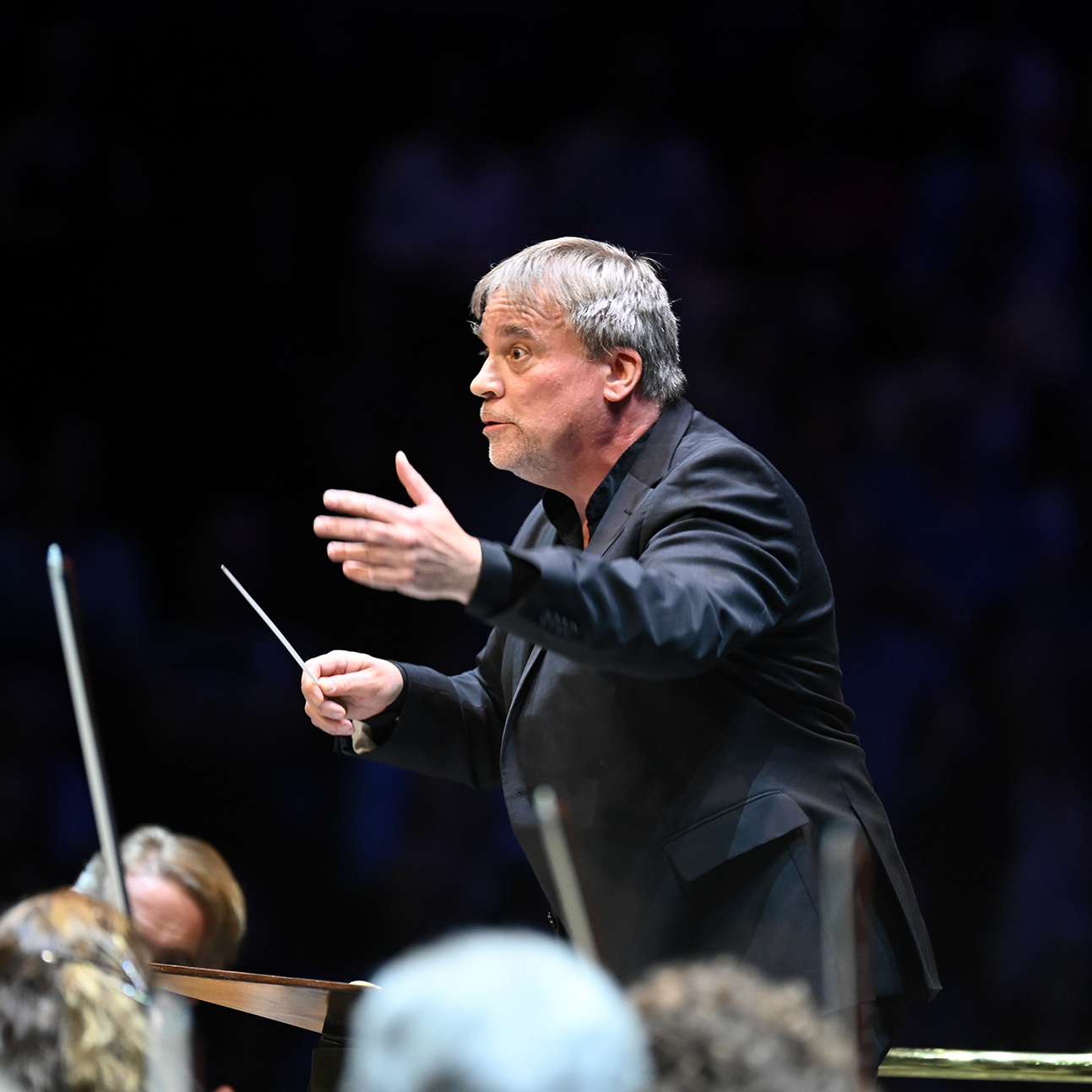
Unheard at the Proms until 1969, Mahler’s Seventh was also the last of his symphonies to win wider acceptance and is still a tough challenge to make cohere. Oramo (above) had its measure though not consistently in an opening movement, the effortfulness of whose introduction pervades its main Allegro yet without impeding its onward and increasingly cumulative course. For all the wonderment of its central interlude then emotional heft of the lead-in to the reprise, there was yet a sense of this music being coerced into shape rather than unfolding with due inevitability. Not so the ‘First Night Music’, its intertwining of the speculative and crepuscular rendered to bewitching effect – Oramo balancing those intricate yet translucent textures with a sure sense of where this movement was headed, namely a resolution not so much tentative as intangible.

Equally elusive, the central Scherzo can seem an exercise in flitting gestures as fail to add up to anything more substantial but here exuded darkly ironic humour as it wended its unsettling way. The ‘shadowy’ duly found its ideal complement in the ‘amorous’ manner of the ‘Second Night Music’ – its underlying affability all too easy to make bland or faceless, yet which here unfolded with a precise feel for its function within Mahler’s teasingly oblique formal scheme. As was almost equally true of the Rondo-Finale – its ordinario marking easy to misinterpret, but in which Oramo’s sure and steadfast if never turgid course made the most of its engaging progress. Hardly alone in not quite making the reappearance of first-movement material feel other than contrived, he nevertheless headed through those final pages with irresistible verve.

This performance would not have been as successful overall without its sterling contribution by the BBC Symphony Orchestra, both in soloistic passages or those tuttis as give the outer movements their impact. Ten years on, the rapport between orchestra and conductor remains undimmed.

For more on the 2023 BBC Proms, visit the festival’s website at the BBC. Meanwhile click on the names for more information on artists Leila Josefowicz, the BBC Symphony Orchestra and their chief conductor Sakari Oramo

BBC Proms 2023 – Dame Sarah Connolly, BBC Philharmonic Orchestra / John Storgårds – Weber, Pejačević, Alma Mahler-Werfel & Rachmaninoff

Prom 33 – Dame Sarah Connolly (mezzo-soprano), BBC Philharmonic Orchestra / John Storgårds

Weber Oberon – Overture (1825-6)
Pejačević Zwei Schmetterlingslieder Op.52 (1920); Verwandlung Op.37b (1915); Liebeslied Op.39 (1915). [Proms premieres]
Mahler-Werfel orch. Colin & David Matthews Die stille Stadt (pub. 1915); Licht in der Nacht (pub. 1915); Bei dir ist es traut (pub. 1910)
Rachmaninoff Symphony no.1 in D minor Op.13 (1895)

Royal Albert Hall, London
Wednesday 9 August 2023

by Richard Whitehouse photos by Chris Christodoulou / BBC

This evening’s Prom brought a welcome appearance by the BBC Philharmonic with its chief conductor John Storgårds, in what was a typically enterprising programme that continued this season’s emphasis on the music of Dora Pejačević in the centenary (last March) of her death.

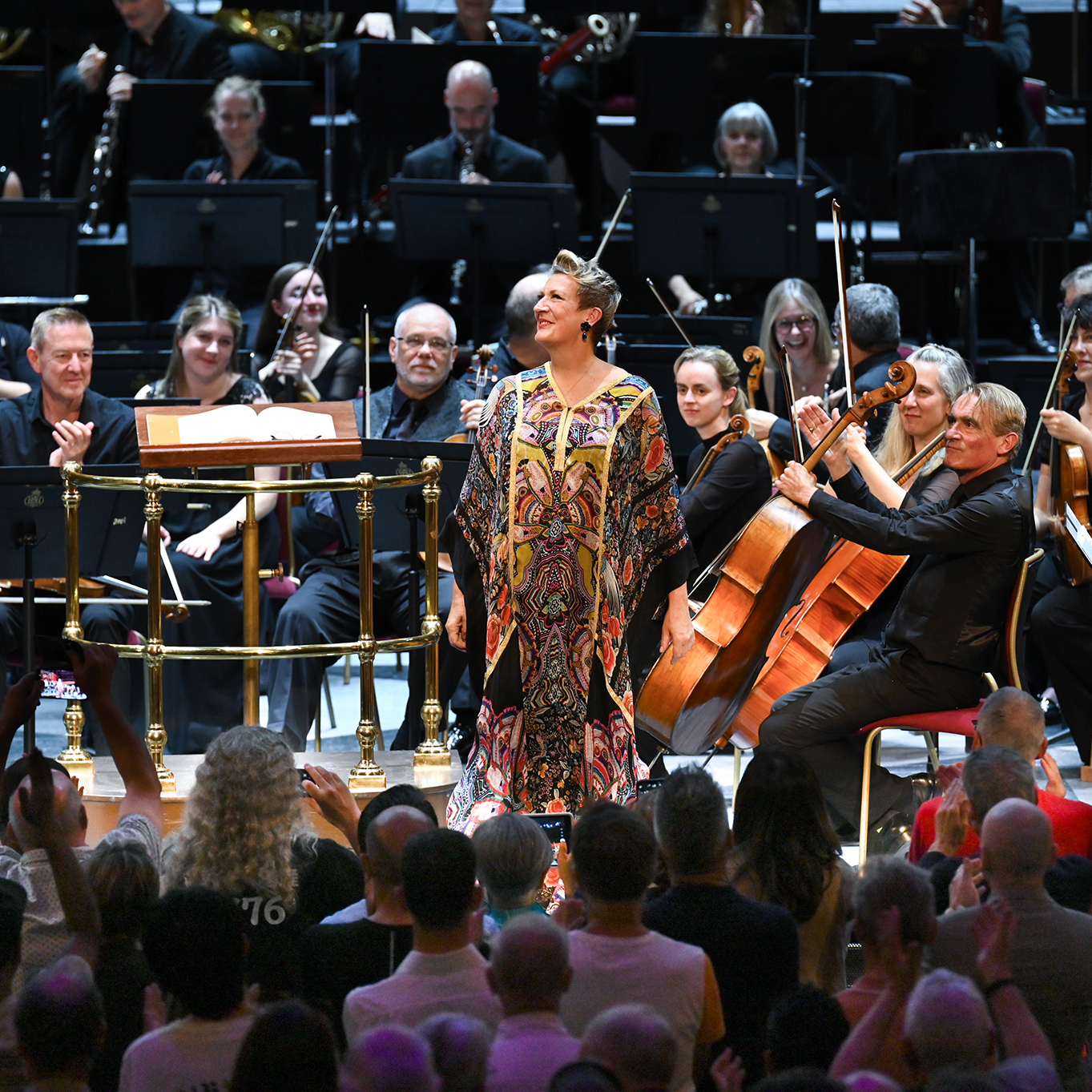
Among Pejačević’s sizable output of songs are four with orchestra, making a viable sequence in its own right. Dame Sarah Connolly (above) brought out the searching whimsicality from Karl Henckell’s Butterfly Songs, whether the fanciful imaginings of ‘Golden stars, little bluebells’ or the more concrete thoughts of ‘Flutter, o butterfly’ with delicate contributions by flute and glockenspiel. The setting of Kael Kraus’s Transformation taps deeper emotion, not least with those ecstatic violin solos between stanzas (eloquently rendered by Yuri Torchinsky), whereas that of Rainer Maria Rilke’s Love Song is notable less for the gently undulating phrases of its vocal writing than for the soaring ecstasy of its central interlude which only double one’s regret that neither composer nor poet lived long enough to collaborate on an opera project as had been mooted.

Making up this sequence were three songs by Alma Mahler-Werfel, taken from sets published in 1910 and 1915. Neither those contrived sentiments of Richard Dehemel’s The Silent Town or self-conscious emoting of Otto Julius Birbaum’s Light in the Night summons an especially personal response; only the winsome poise of Rilke’s I feel warm and close with you implies any individuality. The orchestrations by Colin and David Matthews are sensitive and apposite, but the latter might reasonably have expected more from the Proms in his 80th birthday-year.

Opening this concert was a beautifully judged reading of the overture to Weber’s final opera Oberon – less often heard now that overtures are no longer the automatic curtain-raisers they once were but which, in its deft interplay of evocative and energetic, still casts a potent spell.

By contrast, Rachmaninoff’s First Symphony has come much more into its own now that the composer’s orchestral output has moved to the centre of the repertoire. Unheard for 48 years after its disastrous premiere in 1897, it remains a testament to the young composer’s ambition – not least in an opening Allegro whose implacable ‘motto’ sets the course for this movement overall. Storgårds had its measure, not least in the mounting fervency of its development, then delivered a probing account of a scherzo the more ingenious for its pervasive understatement.

Although it will never supplant that of its successor in audience affection, the slow movement is a minor miracle of thematic subtlety and emotional restraint as came through via felicitous playing by the BBC Philharmonic woodwind. Launching the finale in suitably visceral fashion, Storgårds (rightly) made the most of its contrasts between the celebratory and the speculative – any remaining ambivalence not so much resolved as forced into submission through a coda which renders the fatalism of Tchaikovsky’s Pathétique from a distinctly personal vantage.

So, an unlikely programme which worked well as a concert – the more so given it proceeded without an interval. Those in the audience surreptitiously eating or drinking between pieces might have preferred otherwise, but for both music and performances it was nothing but gain.

For more on the 2023 BBC Proms, visit the festival’s website at the BBC. Meanwhile click on the names for more information on artists Dame Sarah Connolly, John Storgårds and the BBC Philharmonic Orchestra – and for information on the composers Dora Pejačević and Alma Mahler-Werfel