Listening to Beethoven #176 – Man strebt, die Flamme zu verhehlen, WoO 120

man-strebt

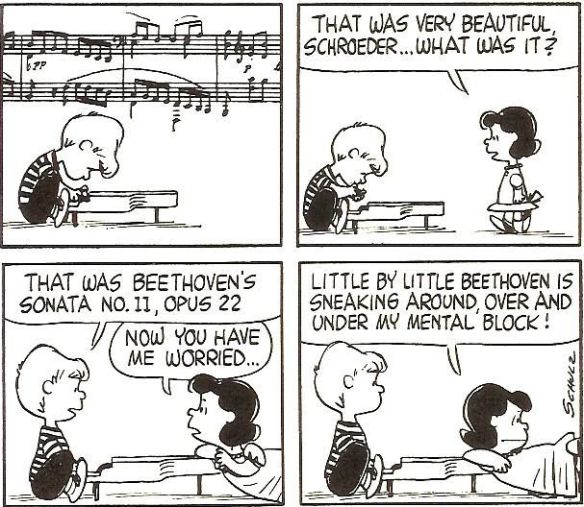
Peanuts comic strip, drawn by Charles M. Schulz (c)PNTS

Man strebt, die Flamme zu verhehlen WoO 120 for voice and piano (1802, Beethoven aged 30)

Dedication Johanna von Weissenthurn
Text Johanna von Weissenthurn
Duration 2′

Listen

Background and Critical Reception

Beethoven dedicated his song Man Strebt, die Flamme zu Verhehlen (One strives to conceal the flame) to Johanna Franul von Weissenthurn, an actress, poet, and playwright active in Vienna beginning in 1789.

Charles Petzold, in his Beethoven 250 series, sets the song in a good deal of context here, revealing a little more about the elusive Frau Weissenthurn in the process.

Thoughts

Given that this song only lasts just over two minutes, it has an unusually elaborate introduction from the piano – maybe part of Beethoven’s portrait-setting?

When the voice enters it sounds preoccupied, and the piano responds again. Translated, the text talks of how ‘a glance says more than a thousand words…a glance will often unbolt the door of passion long concealed. The voice seems to be portraying the glance, the piano more intent on opening the door with its florid right hand.

Recordings used

Natalie Pérez, Jean-Pierre Armengaud (Warner Classics)

Hermann Prey (baritone), Leonard Hokanson (piano) (Capriccio)

Both versions convey the preoccupied feel of this text.

Also written in 1802 Zeller Sammlung kleiner Balladen und Lieder Z123

Next up Sonata for piano and violin no.6 in A major Op.30/1

On record: Stephen Wilkinson – A Celebration of Conductor and Composer (Prima Facie)

stephen-wilkinson

William Byrd Singers, *BBC Northern Singers / Stephen Wilkinson

Dickinson Late Afternoon in November (1975)*

Ellis Sequentia in tempore Natali Sancti (1965)

McCabe Siberia; Visions (both 1983).

Traditional (arr. Wilkinson) Four Choruses from Grass Roots (2003); Betjeman’s Bells (2012)

Wilkinson That Time of Year (1976)

Prima Facie PFCD147 [60’55”] English texts included

Reviewed by Richard Whitehouse

What’s the story?

The always enterprising label Prima Facie releases an album to celebrate the centenary of the conductor and composer Stephen Wilkinson (b1919), whose many decades of work with both the BBC Northern Singers and the William Byrd Choir is appropriately commemorated here.

What’s the music like?

The selection begins with Peter Dickinson’s Late Afternoon in November, a setting of a poem he himself wrote and one whose distanced, often desolate imagery inspires music in which the underlying slowness of pulse and stark emphasis placed on certain words or phrases yields an anguished tone rare in the composer’s output. This performance by the BBC Northern Singers was indeed the world premiere and emphasizes Wilkinson’s assured direction of a demanding piece, the commitment in whose realization hardly something that could be taken for granted.

The remainder is sung by the William Byrd Singers, of whom Wilkinson was the director for almost 40 years. It duly makes the most of Visions, John McCabe‘s elaborate and often eight-part setting of a poem by James Clarence Mangan whose ranging across mellifluous vocalise and visceral chant is conveyed accurately and with not a little sensitivity. If that of the same poet’s Siberia encourages a more direct and (understandably) plangent response, the overall textural variety in this four-part chorus is felicitously judged throughout what is another responsive reading.

For many years a senior producer for BBC Radio in Manchester, David Ellis is also a notable composer, witness his resourceful and often imaginative response to the traditional sequence for Christmas time Sequentia in tempore Natali Sancti. In its astute alternation between full choir and solo voices, it makes for an admirable foil to the straightforward approach adopted by Wilkinson in That Time of Year – a setting of Shakespeare’s Sonnet LXXIII that enfolds its autumnal musings within a sound-world that is monochrome while luminous in character.

The programme is interspersed with Wilkinson’s arrangements of four folksongs taken from his collection Grass Roots – being Welsh, English, Irish and Scottish respectively. Thus, the ruminative As I walked out is followed by the gentle eloquence of Rowing down the Tide, the winsome melancholy of The Lark in the Clear Air, before the steadily accumulating vivacity of The Piper o’ Dundee. Also included here is the charming Betjeman’s Bells, three settings of texts by the Poet Laureate whose music was ingeniously derived from traditional sources.

Does it all work?

As an overall sequence, very much so. While none of these pieces makes use of the extended techniques encountered in much post-war choral music, they are rarely easy technically and the care in preparing these performances (including several world premieres) is evident from every bar. A pity that full recording details have not been included, though the quality of the remastering means that few, if any, allowances need be made for presumed older recordings. The booklet notes place each of these pieces within a meaningful as well as relevant context.

Is it recommended?

Indeed. That Wilkinson is still active as composer, and reader for his daughter’s early-music ensemble Courtiers of Grace, is itself gratifying. This archival release goes much of the way towards explaining why his presence on the English choral scene has been a beneficent one.

For further information on this release, and to purchase, visit the Prima Facie Records website, and for more on Stephen Wilkinson click here

In concert – English Symphony Orchestra / Kenneth Woods: New Notes

3choirs festival

English Symphony Orchestra / Kenneth Woods

Doolittle Woodwings (2018, arr. 2020) [Version premiere]
Elcock
Symphony no.8 Op.37 (2019-20) [World premiere]
Beethoven
Symphony no.7 in A major Op.92 (1811-12)

Town Hall, Kidderminster
Wednesday 28 July 2021 (2pm)

Written by Richard Whitehouse

It may have taken over 15 months, but the English Symphony Orchestra this afternoon gave its first concert with audience, as part of the Three Choirs Festival, in what was essentially an event rescheduled from last year that continued its estimable 21st Century Symphony Project.

The premiere was that of the Eighth Symphony by Steve Elcock (above), born in Chesterfield in 1957 and resident in central France, whose music has only recently come to prominence via releases on the Toccata Classics label fronted by the redoubtable Martin Anderson. Symphonic writing has dominated Elcock’s output this past quarter-century, and if his latest piece has antecedents in a string quartet composed back in the early 1980s, there can be no doubt it continues those processes of organic evolution and integration central to the seven works that came before it.

The present piece reflects the impact of having heard the Sixth Symphony of Allan Pettersson (awaiting its UK premiere after 55 years), but whereas that hour-long epic centres on fateful arrival, Elcock’s 20-minute entity is more about striving towards a destination which remains tantalizingly beyond reach. Various pithy motifs are sounded in the opening pages, the earlier stages pursuing a productive interplay between relative stasis and dynamism as is thrown into relief by the emergence (10 minutes in) of a trumpet melody which crystallizes the course of this piece as it builds inexorably to a powerful climax then subsides into a searching postlude that recedes beyond earshot. Overt resolution may be avoided, yet the sense of cohesion and inevitability audible throughout its course makes for an engrossing and rewarding experience.

That was certainly the impression left by this well prepared and finely realized performance, notable for the way in which Elcock’s idiomatic while demanding string writing was realized with manifest conviction. A 10-strong wind ensemble (along with cello and double-bass) had opened the concert with Emily Doolittle’s Woodwings, the songs and calls of nine Canadian birds rendered over five characterful movements somewhere between Poulenc and Messiaen, with a finale whose relatively freeform structure made for an intriguing and enticing payoff.

After the interval, Beethoven‘s Seventh Symphony received a performance as uninhibited and exhilarating as the piece itself. That all repeats in the first, third and fourth movements is no longer the surprise it might once have been: more startling was Kenneth Woods’s decision – entirely justified – to proceed without a pause into the second movement, so underlining the A-A minor pivot which uncannily anticipates that of Mahler’s Sixth almost a century later. Other highlights were the bracing cross-rhythms of the transition into the first movement’s reprise, the flexible pacing of the scherzo’s trio melody– poised ideally between hymn and dance, then a finale whose coda threatened to breach the confines of Kidderminster’s Town Hall but whose ultimate elation clearly left its mark on the audience’s enthusiastic response.

An impressive return to live performance from the ESO (above) and a harbinger of just what can be expected in its 2021/22 season. Before that comes another in this orchestra’s series of online concerts with a fascinating chamber realization of Bartók’s opera Duke Bluebeard’s Castle.

You can find information on the ESO’s next concert at their website, and more on their latest recording, ‘Fables’, here. For more on the composer Steve Elcock, head to his website – and for the recordings on Toccata Classics, click here

Talking Heads: Simon Dobson

simon-dobson

Interview with Alec Snook

Simon Dobson is a man of many disciplines. To date his musical career has found him out front as a conductor and composer, then behind the scenes as an arranger and multi-instrumentalist. On occasion all those disciplines combine, often with the London-based Parallax Orchestra, with whom he has worked on shows for rock and metal bands. The last year has seen a return to solo composition, with his second artist album MDCNL, released by Lo Recordings in May 2021, delivering five substantial musical statements including the single Quiet, Pls. Here he gives Arcana the lowdown…

In the making of your new LP ‘MDCNL’, was your hand forced to change recording styles/techniques due to the on-going pandemic?

Yeah, pretty much everything about the way I work had to change. Until last year I’d mostly worked to commission, one nail biting month to another, but with ensembles not meeting there were no commissions and no conducting work. I’d been looking to move away from that for a while if truth be told and so I got into production.

What is your relationship with electronic music composition as opposed to the more ‘traditional’ orchestral music that you trained in?

Other than loving listening to it and being a huge fan of it, my relationship with it is super new. This was pretty much the first time (other than demoing stuff at home to later be recorded) that I’d produced music electronically…which is pretty weird, actually. Being a composer and a conductor is obviously a bit of a ‘musical control freak’ thing and there’s more control to be had in the production of electronic music and all the infinite variations it contains. I’ve always been a fan of acts like Squarepusher and Aphex Twin though, I feel like all roads were going to lead me here at some point.

Do you feel that instrumental composers have to work harder to create a narrative or tell a story?

Maybe. Telling a story is hard regardless of the forces you’re writing for. I feel like the world of electronic music is just a language with more words or a shelf with more paints, though.

Does taking a more electronic focussed ensemble on the road appeal to you?

For sure. I love the idea of making electronic music live (and I do have some well tekkers plans up my sleeve), but for the moment getting over the panic of being ready to perform again in ANY way (having not played for the longest time in my adult life) is the first thing to tackle.

simon-dobson-2

When writing and arranging for guitar bands, what shifts in focus or strategies need to take place?

Big talk. Firstly, I’m always aware that in those work situations whatever I write is always beholden to someone else’s music. It’s only ever there to back it up and enhance it, so sometimes it’s hard to let go of ego and be utterly cool with stuff getting chopped or dissed if it’s “too far out” (it never is). Secondly, I generally only arrange for acts or a style I’m into (for example metal), that way I can throw myself into it and have fun as a composer/arranger.

Do you feel more pressure when collaborating with another band/artist? Or does it give you a freedom to step away from pieces that weren’t initially conceived by you?

If I’m working for an act or an orchestra I’m well into, I’ll obviously want them to think that my work is rad. So, I work hard at that shit for sure, but yeah, if I don’t have that sense of total ownership of a piece of music it is easier to be subjective about it.

What order of priority do you give to your orchestral work; the film scores; and the contemporary music arranging?

Honestly, music is my life so there is no strict priority order. I love the orchestral arranging work because I know I can add sheen and value to someone’s creations (plus metal/orchestra stuff is literally the funnest job ever, and the culmination of how I grew up loving heavy music but being classically trained). Film score stuff is new to me but again a very specific discipline and super fun; and contemporary composition is often solitary and hardcore but utterly fulfilling. I basically throw myself right into anything I do – ‘cos it’s music, and music is rad.

If you could work with one film director on a project, who would it be and why?

Either Werner Herzog or Wes Anderson. I know these two are miles apart, but they always have music that I absolutely love. I love the fun, quirky thing with Wes, I reckon I could give that a good crack, and I love the abstract serenity and epic emptiness of Herzog film scores; I’d love to write some weird soundscapes with a string quartet for whatever mad thing it is he does next.

Which other contemporary bands/artists, past or present, are you finding inspiring at the moment?

Anna Meredith (obvs, as always), Olly Coates, Colin Stetson, Steve Reich, Brian Eno (of course), Radiohead (for ever and ever), Matt Calvert, Mica Levi, Esbjorn Svensson, Tigran Hamasyan, Grace Lightman, LYR... you know, the normal bunch.

What other projects do you have coming up this year, whether studio or live?

I’m currently working on a big orchestral gig with my London based crew, Parallax Orchestra. This is a live gig with a band, but I can’t say anything about it just yet, safe to say I’m currently buried under a mountain of orchestral arranging. I’ve got an interesting contemporary commission on the horizon in collaboration with my mates LYR, and I will also be writing a sax quartet for my friend Andy Scott‘s group Apollo.

Oh, I’m also involved in a long-term project working with a local beekeeping start-up called Pollenize, writing generative music based on real time data sets coming out of beehives in Plymouth where I live. Other than that, who knows, MDCNL2 maybe…

Simon Dobson’s MDCNL is out now on Lo Recordings, while a new remix from Human Pyramids of Quiet, Pls has been released today (30 July 2021). You can hear that in the Soundcloud embed above.

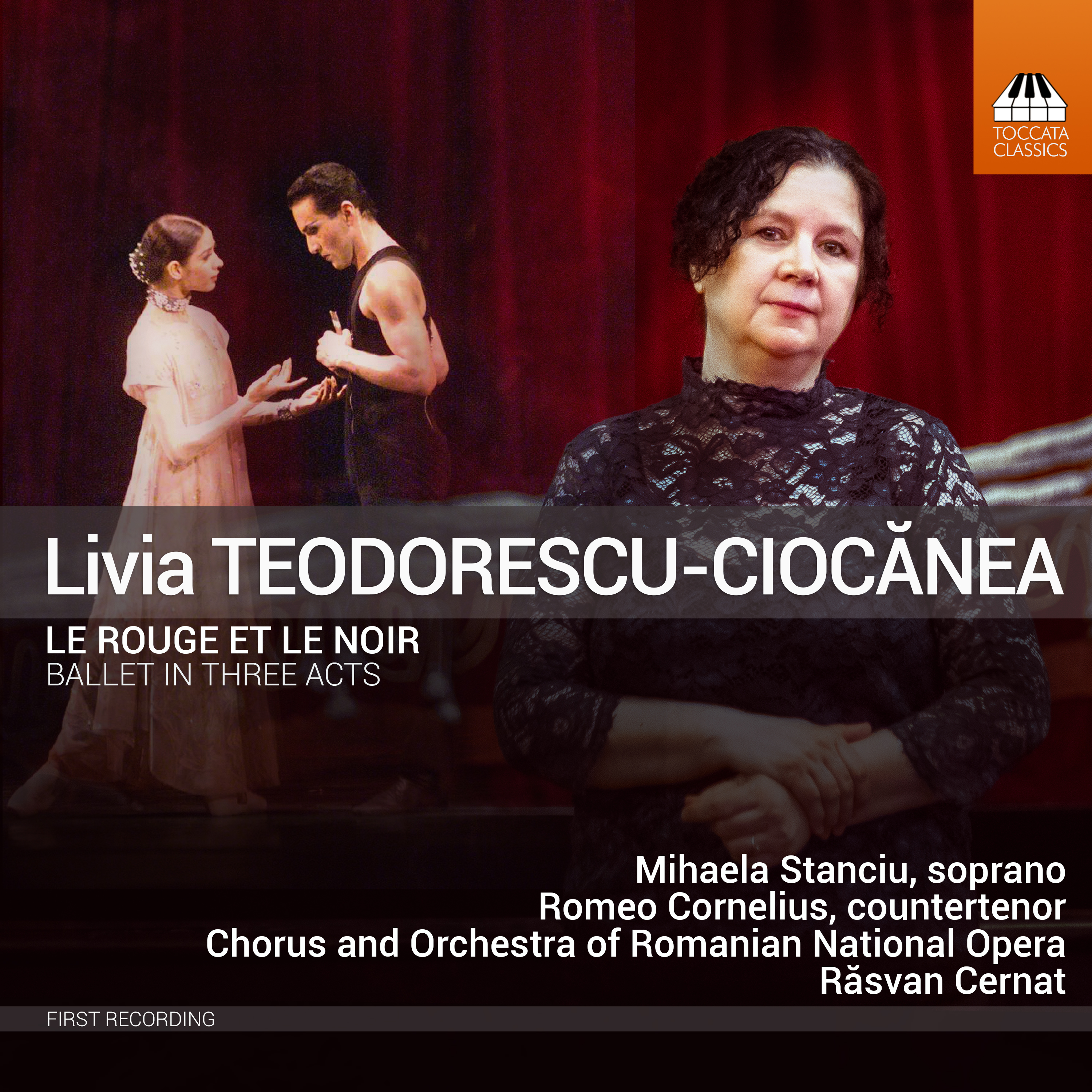
On record – Livia Teodorescu-Ciocănea: Le rouge et le noir (Romanian National Opera / Răsven Cernat) (Toccata Classics)


TOCC_0595

Teodorescu-Ciocănea
Le rouge et le noir (1999-2000)

Mihaela Stanciu (soprano), Romeo Cornelius (countertenor), Chorus and Orchestra of Romanian National Opera / Răsven Cernat

Toccata Classics TOCC0595 [75’25”] Synopsis included

Producers Florentina Herghelegiu, Erika Nemescu
Engineer Alexandru Părlea

Recorded 11-15 June 2000 at studios of Romanian Radio Broadcasting Corporation, Bucharest

Written by Richard Whitehouse

What’s the story?

Toccata Classics here continues its coverage of Livia Teodorescu-Ciocănea (b1959) with the ballet Le rouge et le noir, whose frequently lurid scenario allows her orchestral prowess and range of invention full rein – making for a musical experience cohesive almost despite itself.

What’s the music like?

Alongside a distinguished academic career (her PhD in composition was undertaken at the University of Huddersfield), Teodorescu-Ciocănea has amassed a sizable output that ranges across all the main genres. Her music has been compared to that of Horaţiu Rădulescu and Ştefan Niculescu in its usage of ‘spectral’ elements, but its expressive character is arguably closet to that of Pascal Bentoiu with its pivoting around post-romantic and modernist traits. Appropriate, then, for a ballet score complementing its subject-matter in no uncertain terms.

In her introductory essay, the composer describes Stendhal’s novel upon which this ballet is based as a ‘‘powerful and romantic one’’; which might almost be thought euphemisms for a scenario in which histrionics are emphasized to the point of – and even beyond – overkill. All is revealed in her track-by-track synopsis, but maybe this is a score best tackled – at least on first hearing – minus the distractions of Stendhal’s narrative with its cumbersome symbolism or mostly unsympathetic protagonists; one that culminates in a disingenuously tragic outcome.

Appreciating this ballet ‘in the abstract’ is facilitated, moreover, by the theatrical immediacy of its music. Structured in three acts, framed by a prologue and epilogue, it draws the listener through the story with no inherent longueurs (the ballet initially lasted for around 95 minutes, which Teodorescu-Ciocănea has reduced to its present 75 through withdrawing the numbers ‘‘that seemed to me redundant or transitional’’). Highlights are the second half of Act Two’s first scene – a propulsive passacaglia set in the mayor’s house; the subsequent scene, with its plangent and evocative love-duet set at Vergy; the brief while potent Passion Tango in Act Three’s second scene; and the Epilogue which brings about the denouement with a fervour and a dramatic inexorability that comprehensively transcends the narrative which inspired it.

Does it all work?

For the most part, yes. Listeners might well be advised to tackle the music straight off, rather than study the scenario beforehand. In the (understandable) absence of the visual component, this is a piece best evaluated on its own terms; without the cringing element of melodrama as derived from Stendhal, yet another of those ‘classics’ novels which has rightly been relegated to an academic footnote in history. The present performance surely presents this work to best advantage – vocalists Mihaela Stanciu and Romeo Cornelius eloquent in their contributions, and Răsven Cernat securing a visceral response from the forces of Romanian National Opera. The track-listing gives immediate access to each scene in the three acts, while Joel Crotty’s biographical outline is invaluable given the almost complete absence of material in English.

Is it recommended?

Yes, in the hope Toccata will go on to release examples of Teodorescu-Ciocănea’s orchestral and choral music – not least the oratorio Poppy Fields, her ‘in memoriam’ for those who fell in the First World War and on a scale as was largely ignored by major composers in the UK.

Listen

Buy

You can discover more about this release at the Toccata Classics website, where you can also purchase the recording. To read more about Toccata’s exploration of Teodorescu-Ciocănea’s piano music, click here