
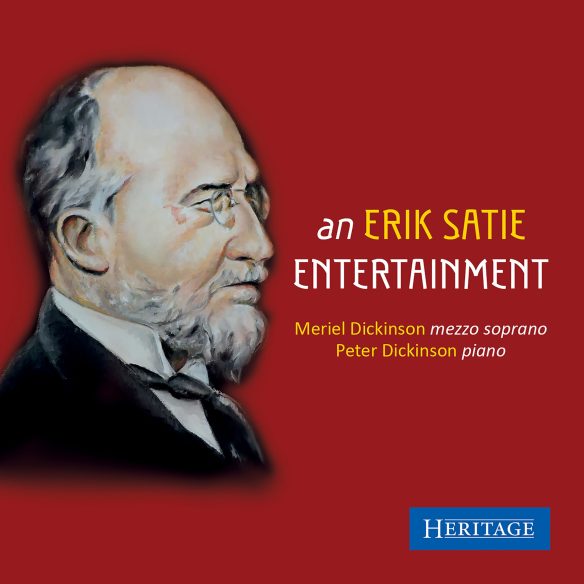
On record: Meriel & Peter Dickinson: An Erik Satie Entertainment (Heritage Records)

satie-dickinson

Meriel Dickinson (mezzo-soprano / reader), Peter Dickinson (piano / reader)

Heritage Records HTGCD171 [68’09”] French texts included
Producer Antony Hodgson
Engineer Tony Faulkner

Recorded 6 October 1975 at All Saints’ Church, Petersham (Unicorn LP only) Remastered by Peter Newble

Reviewed by Richard Whitehouse

What’s the story?

The Heritage label continues its worthwhile excavation of overlooked ‘deep catalogue’ with this selection of Erik Satie’s piano pieces, songs and prose as performed by Meriel and Peter Dickinson, whose recitals were a notable fixture of the UK music-scene over several decades.

What’s the music like?

After the lively and rumbustious march Le Piccadilly (1904), Trois melodies (1887) show the composer’s poignant take on domestic song-writing from the period. The haunting Deuxième Gnossienne (1893) is followed by the hieratic plangency of Hymne: ‘Salut Drapeau!’ (1891), while the Deuxième Pièce froide (1897) anticipates the quirky humour to come. Tendrement (1902) ranks among Satie’s most disarming songs, as does the amiable Proudre d’or (1900/1) within his piano music. Two winsome songs from incidental music for the play Geneviève de Brabant (1899/1900) precede two piano pieces – the mystically aloof Première Gymnopédie (1888) and the demurely anarchic Vexations (1893) – which, between them, outline the extent of Satie’s creative thinking. Similarly, the gently facetious humour of Trois melodies (1916) affords pointed contrast with the introspective mystery of the early Chanson (1887) then the considered evocation which is Chanson medieval (1906); further reminders that demarcation between this composer’s seemingly serious and humorous sides cannot be taken as absolute.

An undoubted bonus of the added live material is the Dickinsons’ readings from Satie’s own writings. Thus, there is Peter’s deadpan rendering of Satie’s Self-Portrait as provided for his publisher, its barbed whimsy duly complemented by brief piano interludes from his comedy Le Piège de Méduse (1913), while those gnomic expressions that are Quatres petites melodies (1920) inhabit similarly elliptical domain. Peter reads from the composer’s fanciful outline of his ‘routine for living’ in A Musician’s Diary, while Meriel tells of his ironic attitude towards Beethoven in Satie’s Fakes; between them, she sings the compact confessionals that are Trois Poèmes d’amour (1914). The gnomic song-cycle Ludions (1923), among Satie’s final works, makes a suitably telling foil to Peter’s reading of the archetypal Satie text In Praise of Critics. The selection concludes with a brace of songs – the blithely sardonic La Diva de l’Empire (1904) then the quintessentially Satie confection Je te veux (1897), its deftest interplay of charm and guile with a knowing sentimentality evidently to the pleasure of those listening.

Does it all work?

Very much so, given that Meriel and Peter are so attuned to the facets of Satie’s inimitable genius. At the time of this LP and its attendant recitals, its sheer extent had still to be fully assessed, which does not lessen the significance of the Dickinsons’ efforts (as with Satie’s younger contemporary and English counterpart Lord Berners) in championing this music at the highest artistic level. Both the transfer of the original Unicorn disc and the live extracts (mono) have been capably done – revealing few, if any, limitations in the source-material.

Is it recommended?

It is, not least as an informed and appealing introduction to this music by artists for whom its advocacy was clearly a labour of love. A pity that English translations of the song-texts were not included, though these are mostly accessible online, and their omission is a minor caveat.

For further information on this release, and to purchase, visit the Heritage Records website, and for more on Meriel and Peter Dickinson click here
Switched On: Arandel: InBach Vol.2 (InFiné)

arandel

reviewed by Ben Hogwood

What’s the story?

The second instalment of Arandel’s InBach project comes just a year after the first. The French producer, who chooses to remain anonymous for now, has been discovering a wide range of raw material beyond last year’s reinterpretations, and has enjoyed the new perspectives offered by live performance of the first album material.

Now the music takes on more spoken word contributions, as well as using rare instruments recorded at the Musée de la Musique in Paris. The record also features Ondes Martenot player Thomas Bloch and the cello of label mate Gaspar Claus.

What’s the music like?

Extremely varied. Arandel has an orchestral mind, which means he can approach music from many different directions. The stripped-back woodwind of Invention 5, for instance, builds from almost nothing to a full, symphonic climax with electronic choral voices, showing how the French producer ‘gets’ Bach’s increase in intensity.

Concerto for No Keyboard, on the other hand retreats to the lower end of the spectrum and applies the sort of electronic squiggles you would expect to hear from Wendy Carlos – whose Switched On Bach was a big influence on Arandel’s working.

The starry-eyed Doxa Notes is a beautiful way to start the album, and develops into a lush palette of electronics, with a spoken word top from Myra Davies. It is a reinterpretation of Aux Vaisseaux, itself based on Bach’s 14 Canons on The Goldberg Ground, BWV 1087.

Spoken word is an important component of this album and Nos Contours is an even better vocal number. Developed from Bodyline, a track on the first album, it features bubbling electronics under Ornette’s low but steady vocal, both bending under the weight of increased percussion towards the end.

Arandel’s handling of Bach’s original material is always respectful but is more than happy to take risks. Capriccio is otherworldly but in a good way, a reworking of Bach’s Capriccio on the departure of a beloved brother which is in fact a memorial to Arandel’s own brother. Its spectral voicing is almost overrun by a large electronic choir, but is in fact swept up by its power.

Praeludium takes a dubby, four to the floor beat and pushes resolutely onwards, while the autotune of Fabula’s vocal over Bach’s Meine Seele Warter Auf Den Herrn will be more divisive, but it is nothing if not effective.

Confirmation of Arandel’s more adventurous approach can be found in Octobre, a pleasingly unconventional take on the famous Air. Luxurious in its Hamlet cigar promotion, this music is stripped back to a chamber organ and oboe sound here, together with well chosen atmospherics and a time-taken voiceover from the producer’s nephew, with a dreamlike story of an ominous gang of children.

Finally Myriade provides a soothing and rather moving close, with another voiceover – from no less than Bridget St.John – complementing the slow-moving, majestic harmonies.

Does it all work?

Yes. Some of the interpretations are more divisive than others, but this is a good thing, as Arandel is showing a wide range of possibilities when working with Bach’s music. When it comes to electronic music his is surely the most flexible of original material with which to work, and the fact it can be reproduced more or less faithfully says a lot about its staying power.

Is it recommended?

Yes. An essential purchase for those familiar with Arandel’s way of working, InBach Vol.2 suggests that the ideas are only just getting going rather than drying up! These powers of invention and imagination will surely serve the producer well as he moves on to even more ambitious things.

Stream

Buy

On record – Mihalovici: Piano Music (Matthew Rubinstein) (Toccata Classics)

TOCC-0376-Mihalovici-piano-music-cover

Mihalovici
Sonatine, Op. 11 (1922-3). Quatre Caprices, Op. 29 (1928). Ricercari, Op. 46 (1941). Quatre Pastorales, Op. 46 (1950). Sonate, Op. 90 (1964). Passacaille (pour la main gauche), Op. 105 (1975)

Matthew Rubinstein (piano)

Toccata Classics TOCC0376 [73’52”]

Producer Boris Hofmann
Engineer Henri Thaon

Recorded 5 & 6 June, 30 & 31 July 2018 at Jesus-Christus-Kirche, Berlin

Written by Richard Whitehouse

What’s the story?

Toccata Classics turns to the Romanian émigré Marcel Mihalovici (1898-1985) whose music has been poorly served by recording but whose works for piano, most often premiered by his wife Monique Haas, affords (in this selection) a representative overview of his sizable output.

What’s the music like?

Among the shorter pieces, the Sonatine typifies the neo-classical objectivity of the composer’s earlier music with the nimble fluidity of its outer movements framing an Andante of winsome delicacy. More testing pianistically, the Quatre Caprices recall Mihalovici’s slightly younger (and similarly Paris-based) contemporary Alexander Tcherepnin in their oblique poise along with that stealthily accumulating energy made manifest in the motoric Allegro – its ‘furioso’ marking subtly underlined here – though not before an Andantino of ruminative elegance. If the Quatre Pastorales strikes a deeper note, this is likely through the deft folk inflections as are manifest across the alternate whimsy and exuberance of these miniatures – culminating with a final Allegro reminiscent of Enescu in its ringing sonorities and cascading harmonies.

A breakthrough in several respects, Ricercari proceeds less as a set of variations than of free variants on a discursive theme whose indebtedness to a passacaglia – not merely for its tempo – is explored intensively during what follows. Surprisingly, perhaps, most of the ‘variations’ are rapid or at least flowing in manner – the propulsive ninth of these heading into a fugue as revisits the theme with renewed impetus in a gradual accumulation of energy; culminating in a notably equivocal restatement of the theme, itself making way for the tenuous final gesture.

The latter two works come from Mihalovici’s high maturity – the Sonate outwardly evoking Classical precepts with its clearly defined three movements. Less so the opening Allegretto’s nonchalant overriding of expected formal divisions, the central Lento’s freewheeling play on gesture and phrase (with its tangible recourse to the ‘doina’ crucial to Romanian traditional music), then the final Allegro’s capricious yet purposeful unfolding towards a conclusion of no mean agility in which the composer’s pianism is at its most combative and declamatory.

The left-hand Passacaille is a fair definition of ‘late masterpiece’, its gnomic theme made the basis of 18 variations whose diversity of motion and consistent brevity belie the formal focus with which the composer builds towards the lengthier closing brace. Hence the 17th with its plaintive demeanour and probing introspection, then the 18th – a ‘quasi una cadenza’ – that steers a determined course through to its unexpectedly stark close: mastery of means allied to that of technique in this undoubted enhancement of a distinctive if often intractable medium.

Does it all work?

It does, not least because Mihalovici is clearly a master at combining different stylistic facets that are more than the sum of their influences. Matthew Rubinstein evidently appreciates this with interpretations of methodical attention to detail, allied to playing of undoubted panache.

Is it recommended?

It is, given that only two pieces had been earlier recorded with only Ricercari easily available. Spaciously defined sound from the fabled Jesus-Christus-Kirche, and detailed notes by Lukas Näf. Hopefully, recordings of Mihalovici’s orchestral and chamber music will prove feasible.

Listen

Buy

You can discover more about this release at the Toccata Classics website, where you can also purchase the recording.

Playlist – A Song of Summer

song-of-summer

Today has been the hottest day of 2021 so far in England…and it has presented the ideal opportunity to indulge in portraits of our sunniest season from British composers. Here is the music in an hour-long Spotify playlist:

During the First World War, Frank Bridge escaped to the country – where he wrote Two Poems for Orchestra and the tone poem Summer, completed in 1916. It is a lovely piece, typically compact but creating a heat haze immediately through the strings. The enchanted atmosphere continues until one of his very best melodies is revealed.

Four of the best-known pieces by Frederick Delius set the hottest season to music. In A Summer Garden is the least common but arguably the most appealing. Delius uses the orchestra with an expert brush to paint the laziness of a summer day, with sultry harmonies and hazy, impressionistic textures. The woodwind add their bird calls, and lazy melodies flit around the orchestra, rising to an apex but then subsiding back into shelter.

Summer Evening, one of the three small tone poems completed in 1890, captures the moment where a hot day starts to subside, its lazy melodies suggesting the lingering heat on the ground and brightness in the sky, in spite of some lengthening shadows.

Later still in the day, Summer Night On The River (1911) captures the lazy lapping of the water and the tricks played by the dappled light, before slumber finally calls.

Meanwhile John Ireland, a master miniaturist for the piano, excels himself in Summer Evening (1919). This dreamy, four-minute piece, written just after the end of the First World War, has longing and contentment in equal measure.

Then we hear a brief fragment of Elgar, the softly lilting part song As Torrents In Summer, a Henry Wadsworth Longfellow setting from his stage work King Olaf.

Britten’s folksong arrangement The Last Rose of Summer is one of his most meaningful and magical. The deep piano chords set the scene for a beautiful melody, and a sad text – for in the second verse it is almost impossible not to draw parallels with the war, ‘where thy mates of the garden lie senseless and dead’.

Arnold Bax offers another post-First World War piece, his Summer Music dating from 1920, but this is another celebration of the season, depicting ‘a hot, windless June midday in some woodland place of Southern England’. There are some typically long-breathed melodies to add to the attractive woodwind scoring, and a lovely, restful close.

Finally Delius’ A Song Of Summer itself, conducted by the composer’s long-time devotee Sir Thomas Beecham. This later piece (1931) has a particularly rich palette, with songful oboe, flute and horn above dappled strings, before some more explicit folk references. Delius’ writing for orchestra has acquired more depth in the time since his previous three summer evocations, and – to this ear at least – the influence of Wagner and Debussy feels stronger than before.

On record – Early Stereo Recordings Vol.4: Albéniz, Bizet, Kodály & Ravel (First Hand)

early-stereo-recordings-4

Philharmonia Orchestra / Eugene Goossens (a), Guido Cantelli (d); Royal Philharmonic Orchestra / Vittorio Gui (b) Paul Kletzki (c), Eugene Goossens (e)

Albéniz (orch. Arbós) Iberia – excerpts (1905-09, orch. c1928) (a)
Bizet Petite Suite (1871, orch. 1880) (b)
Kodály Dances of Galánta (1933) (c)
Ravel Daphnis et Chloé Suite no.2 (1909-12): Danse générale (d); Boléro (1928) (e)

First Hand Records FHR79 [78’21”]

Producers David Bicknell (a), Lawrance Collingwood (b,d,e), unknown (c)
Engineers Christopher Parker (a-d), Robert Gooch (e)

Recorded 12 July 1955 (b), 18 September 1957 (e) at Abbey Road Studios, London; 15 February (a), 24 March (c) and 28 May 1956 (d) at Kingsway Hall, London

Written by Richard Whitehouse

What’s the story?

First Hand Records continues its exploration of pioneering stereo recordings from the EMI archives with this collection of orchestral works, mainly from the earlier decades of the 20th century, as demonstrates the success of various HMV producers and engineers in harnessing the potential of stereophonic sound to the playing of what, in the 1950s, were the two finest London orchestras – the Philharmonia and Royal Philharmonic, working with conductors in music with which they were not necessarily associated over the greater part of their careers.

What are the performances like?

Starting with an incisive yet expressively deadpan take on Ravel’s Danse générale, all that survives in stereo of Guido Cantelli’s recording of the Second Suite from Daphnis et Chloé, the selection proceeds to excerpts from Albéniz’s piano cycle Iberia, orchestrated by Enrique Arbós. Seldom encountered in concert nowadays, these five pieces (all of the First, plus one each from the Second and Third Books) constitute a worthwhile suite in themselves. Eugene Goossens duly underlines his prowess in earlier 20th-century music with performances that bring out the evocative poise of Evacación, then alternate fervour and piety of El Corpus en Sevilla, before the capricious charm of Triana and capering energy of El Puerto; the cumulative emotional charge of El Albaicin closing this sequence with unfailing panache.

Goossens is hardly less persuasive in Ravel’s Boléro – at this time, not quite the ubiquitous showpiece it became – the inexorably accumulating momentum ideally served by his refusal to rush its devastatingly effective trajectory; the final stage largely taking care of itself when allowed to emerge inevitably. A further worthwhile revival is that of Bizet’s Petite Suite, five miniatures drawn from his earlier cycle for piano duet Jeux d’enfants and given with winning deftness by Vittorio Gui – demonstrably in his element when the sessions for his re-recording of Mozart’s Le nozze di Figaro finished ahead of schedule. Kodály’s Dances of Galánta has itself returned to favour in recent years, but few accounts are ever likely to match that of Paul Kletzki in his steering this ever more animated sequence through to its breathless conclusion.

Do they all work?

Pretty much, allowing for occasional lapses in ensemble that are notably few given the hectic schedule these London orchestras pursued at this time. Remastering has been deftly handled by Ian Jones – Albéniz and Bizet being transferred from HMV Stereosonic tapes, respectively by Giampaolo Zeccara and Ted Kendall (the latter’s 1997 set of Mahler ‘first recordings’ for Conifer is fondly remembered). There are extensive background notes from David Patmore, along with observations by Peter Bromley, whose tenacity has made possible this FHR series.

Are they recommended?

Indeed, not least given the interest of the actual music and the relative unfamiliarity of most of the recordings. The rapid standardization of the listening experience through the medium of streaming has made such releases as this more valuable by (hopefully) making potential listeners aware of just what became possible with the greater recourse to the stereophonic process, as of those numerous triumphs (among not a few failings) which resulted given the right combination of technology and musicality. Further instalments are keenly anticipated.

Listen & Buy


You can get more information on the disc at the First Hand website, where you can also find information on the first, second and third volumes in the series