In concert – Michael Collins & Michael McHale: Widor, Bax, Muczynski & Horovitz @ Wigmore Hall

collins-mchale

Michael Collins (clarinet), Michael McHale (piano)

Widor Introduction et Rondo Op.72 (1898)
Bax Clarinet Sonata in D major (1934)
Muczynski Time Pieces Op.43 (1984)
Horovitz Sonatina (1981)

Wigmore Hall, London
Monday 17 May (review of the online broadcast)

Written by Ben Hogwood

What a joy to see audiences back in Wigmore Hall on a Monday lunchtime, as the venue took its first available opportunity of 2021. The gathering was for an enterprising program of 20th century works for clarinet and piano from Michael Collins and Michael McHale, pleasingly off the beaten track in its selection and proving highly accessible.

Viewed online in this case, the excitement was palpable – from Andrew McGregor’s introduction for the live broadcast on BBC Radio 3 to the performers’ demeanour as they began. The clarinetist successfully overcame an instrument malfunction, too, which caused him to repeat the first few minutes of the Bax sonata.

Collins and McHale began with Widor, however, a competition piece written for students of the Paris Conservatoire in 1898. Both performers settled immediately, Collins with a beautifully floated introduction and McHale with sensitive pedaling, the pianist then echoing the excitable flourishes from of clarinet when the Rondo itself arrived. This work occupies a happy place in Widor’s output, and was a joyful overture here.

The mood deepened for the Clarinet Sonata in D major of Sir Arnold Bax from 1934. First performed by Frederick Thurston, it is an unusually structured work, but the two movements sit together nicely. It was during the beautifully floated opening that Collins had to change his clarinet, but the advantage of this was that we were able to marvel at his control for a second time, supported by rippling figures from McHale. The first movement unfolded as though in one long phrase, revealing the influence of Wagner but establishing Bax’s own melodic grace too. The second movement had impressive urgency, with chromatic surges from the piano and impressive breath control from Collins. A typically deep second theme was matched by a lovely, poised closing section.

The Polish-American composer Robert Muczynski has an intriguing works list including many pieces for woodwind, and the Time Pieces of 1984 are among his most-performed. Each of the four movements looks to bring out different qualities of the clarinet and Collins was fully alive to their possibilities. The busy first piece was enjoyable, clarinet and piano ducking and diving in their interplay, while time became suspended in the outer sections of the second piece, lost in thought. The third explored the timbres of the solo clarinet, wonderfully nuanced by Collins, while the spicy dialogue of the fourth was laden with syncopation and brilliantly played.

The Sonatina for clarinet and piano from Joseph Horovitz dates from 1981, when it was first performed by Gervase de Peyer and Gwenneth Pryor in the Wigmore Hall itself. Like Muczynski, Horovitz is at home writing for wind and brass. Working within a compressed structure, the Sonatina was packed with incident and melody. A perky first movement unfolded with easy, winsome phrases, while the second was more introspective and took time for soul searching. Not so the finale, whose offbeat japes were carefree and witty in this performance, instinctively played.

It was over all too soon – but we were treated to an encore, Collins every bit as enthused as the audience. The warm-hearted Summer, from Paul Reade’s suite Victorian Kitchen Garden, was the ideal choice.

This concert is available to play for 30 days using the YouTube embedded link above.
Live review – English Symphony Orchestra / Kenneth Woods: Elgar Reimagined Part 2

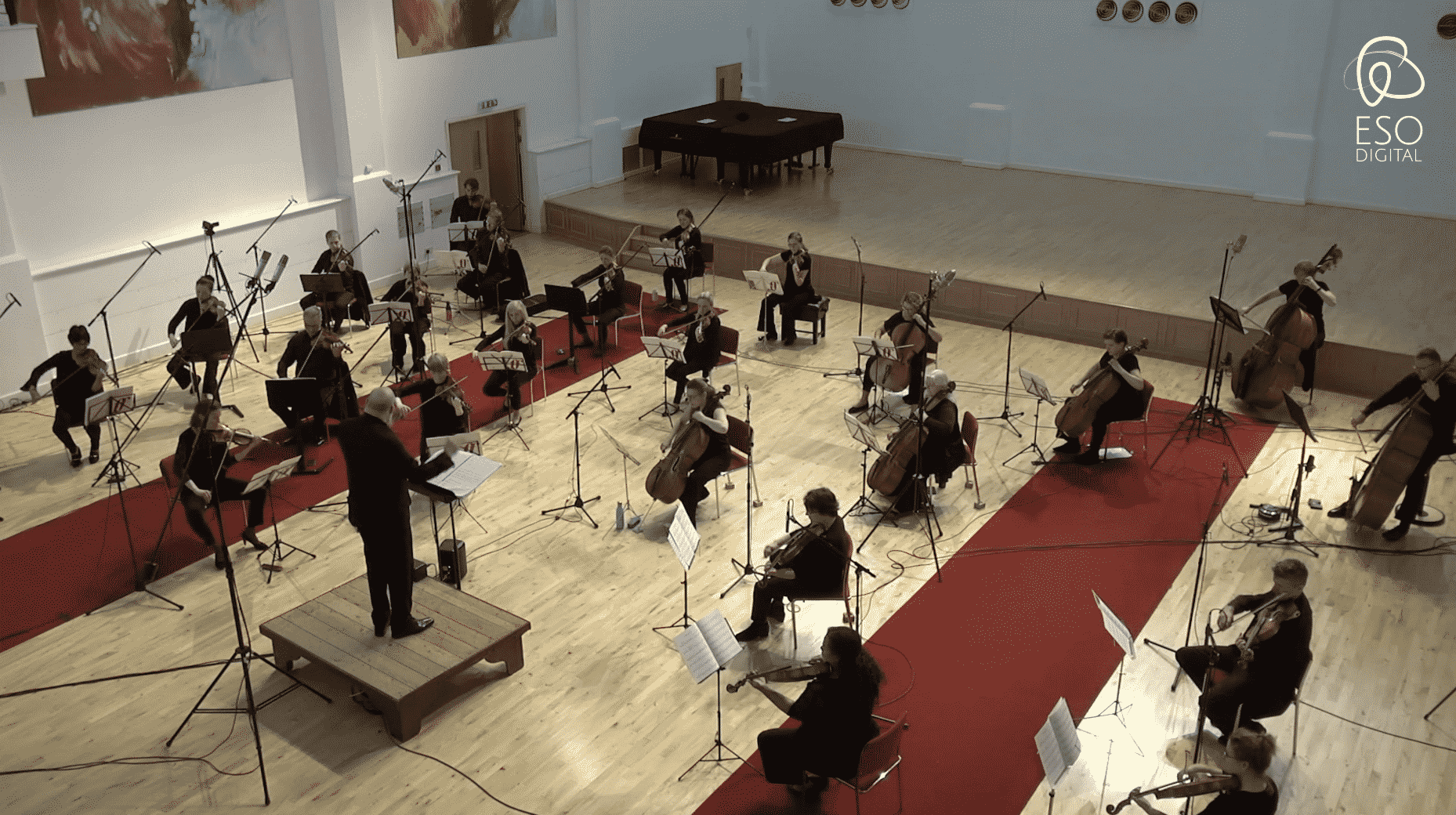
ElgarStringQuartet-Screenshot

English Symphony Orchestra / Kenneth Woods

Elgar, arr. David Matthews String Quartet in E minor Op.83 (1918)

Wyastone Concert Hall, Monmouth
Recorded September 22 2020 for online broadcast from Friday 14 May 2021

Written by Richard Whitehouse

Following its programme of miniatures – original and arrangements – for cello and strings in March, this latest online concert by the English Symphony Orchestra returned to Elgar for a reading of his String Quartet arranged by David Matthews for a full complement of strings.

This was the second in a triptych of chamber works composed in rural seclusion at Brinkwells in Sussex, Elgar having escaped the wartime disillusion of London for what was to be his last sustained period of creativity. Less introspective than the Violin Sonata that preceded it while less emotionally charged than the Piano Quintet that came after, the String Quartet is the most finely proportioned of the three – unfolding as a sustained sweep whose subtle transformation of thematic elements across and between its three movements make it among the finest of his later compositions. Heard in this guise, it follows on from the Serenade then Introduction and Allegro as the hitherto missing large-scale work for string orchestra of Elgar’s high maturity – which should hopefully commend it to an audience beyond that of the composer’s devotees.

Matthews has numerous arrangements to his credit (not least Schumann’s Piano Concerto as recast for marimba), and he has been mindful to balance the soloistic and ensemble potential of this music, so the result is neither straightforward transcription nor radical re-conception. The opening Allegro moderato discreetly emphasises an autumnal musing that sets the tone for much of what follows; even finer is the second movement – marked Piacevole – whose equability yields a main theme suffused with intensity, the extent of which is only revealed towards the close. If the emotional acuity of the final Allegro is marginally diffused when rendered for larger forces, there is no lack of rhythmic definition as the music proceeds to a coda whose terse decisiveness is far removed from the opulence of just a few years before.

Its idiomatic nature was enhanced by the ESO’s attentive playing under Kenneth Woods, a natural follow-on to their take on the Piano Quintet in Donald Fraser’s arrangement (Avie). Heard together, these two parts of Elgar Reimagined should make for a desirable recording.

You can watch the concert on the English Symphony Orchestra website here

For more information on the English Symphony Orchestra you can visit their website here

Let’s Dance – DJ Kicks mixed by Special Request (!K7)

special-request-dj-kicks

reviewed by Ben Hogwood

What’s the story?

The DJ Kicks story continues apace, and continues to choose imaginatively, with no sign of the quality dipping. Stepping up for this release is Paul Woolford, donning his Special Request moniker. As a listener he saw the DJ Kicks series ‘as a benchmark of quality and a time-stamped gateway into an artist’s state of mind’, going on to say that ‘for this volume, I wanted to focus on lush melodics. I kept that as a constant thread throughout, choosing only records I cherish…it’s not a ‘current snapshot’ by any means, more a chronicle of some of my all-time favourites.’

What’s the music like?

Given Woolford’s history and pedigree, the idea of sharing in his favourite music is too good to resist – and so it proves. It is no surprise to report a varied set of house and break beat, moving from classic disco-house to full blooded drum and bass, by way of variations in between. The mix is pleasingly rough around the edges in its blending of music, giving it a more authentic feel.

Woolford takes us straight to the heart of the dancefloor with Alicia MyersRight Here Right Now, remixed by John Morales, a very cool cut of swooning vocal house, and he backs this up with instrumentals from Harvey and Morgan Geist, complete with trumpet solo. Being such a prolific writer and producer, Woolford can’t resist adding some varied examples of his own canon, so we get KissFM NY87 Mastermix and Vellichor trading riffs and busy percussion while pushing the mix forwards.

Woolford then gives us sun-soaked techno from As One, Virgo (the brilliant synth-heavy R U Hot Enough?) and Ace Mo, complementing them with diverse beats from Krystal Klear, Speedy J, LS1 Housing Authority and μ-Ziq. Bleeps and blips, warm keyboard pads, dynamic percussive runs – all are found in a thrilling sequence of dance music, the direct style of Woolford’s own productions embodied in the music he chooses.

Two of his own remixes form highlights of the later section of the mix, FC Kahuna’s cool Hayling and μ-Ziq’s Twangle Frent, underpinned by a massive, sonorous bass sound. Now the pace is frenetic, with flurries of drums from Galaxian and Four Horsemen Of The Apocalypse cutting to a widescreen breakdown powering the Tim Reaper mix of another Special Request production, Pull Up. The two collaborate on another stormer, Elysian Fields, before a final Woolford collaboration wraps up the mix, the shimmering 96 Back co-write Petrichor.

Does it all work?

Very much so. Woolford is well-versed in pleasing his crowd, so the notion of a CD-length DJ Kicks mix comes easily to him. The only difficulty, you sense, was choosing what to leave out of the mix! In 25 tracks we get an excellent history lesson with no preaching, a view behind Woolford’s own creative process.

Is it recommended?

Highly. Special Request is an inspired, stellar addition to the DJ Kicks series, which just keeps on getting better. As a celebration of dance music’s primal power to move, you couldn’t ask for more.

Stream

Buy


Switched On – Jas Shaw: Sollbruchstelle 1-3 (Delicacies)

sollbruchstelleI

reviewed by Ben Hogwood

What’s the story?

The conditions brought on by the pandemic in the last year have shifted the goalposts for many composers. Working under lockdown has changed perspectives, often through necessity – and few people have experienced this more than Jas Shaw. A highly productive composer and producer, Shaw was confined to base by the risk of catching Covid and an operation on his cell disorder AL amyloidosis.

Typically his response to spending so much time in one room was a productive one, an album comprising three EPs of luminous ambience, sitting squarely between acoustic and electronic. He chose the title Sollbruchstelle (the German for ‘breaking point’) himself, interpreting that as a mixture of sadness and hope – but reflecting the difficulty he and many others have had to overcome in the last year.

What’s the music like?

Easy to listen to, but with emotive depth. Shaw’s resilience is immediately clear in the surefooted confidence of his writing, and everything unfolds at a natural pace, as instinctive for him as breathing it would seem.

The first EP begins with a really lovely piece of music, Hålla tummarna – a Swedish phrase meaning ‘to hold one’s thumbs’, to wish someone luck. In this case there are single, harp-like lines tracing shapes in the sky, with reassuring harmonies around. It turns into a she, meanwhile, occupies a lower part of the spectrum, with slow moving ambience in sonorous tones, like the slowed-down pealing of bells.

Volume 2 sharpens the tones, and The revenge of noise on harmony and I wig on a cone have serrated edges, the first compressing into a woolly pile at the end. The friendly bleeps of Felt compute, might delete contrast with this, as does the thick timbres of Absent and incorrect, with slowly moving chords that could describe the motion of an iceberg.

Each of the volumes have seven tracks, and the third begins with the absentminded thoughts of Rhyme undisturbed and the appealing minimalism of Snacks of carelessness, with its mottled piano sound. Shaw is always on the move in this section, and the brief Norwegian Blue and more substantial Double stop generate surprising energy, the latter twinkling at the edges. Finally Made not to fade gives some welcome solace, a reassurance surely for Shaw himself.

The three EPs that make up the full Sollbruchstelle album, work equally well as standalone units or as part of an 80-minute whole. Shaw used a piece of artwork by Leafcutter John for each, representing the music – as you can see on this page.

sollbruchstelleII

Does it all work?

Yes. Because of Shaw’s natural approach, the music here has plenty of room, and doesn’t try to do too much – but its understated impact is lasting. Shaw has a natural way with minimal loops without ever sounding contrived, and the continual changes of colour, light and shade form vivid patterns in the listener’s eye.

sollbruchstelleIII

Is it recommended?

Enthusiastically. If you’ve heard Shaw in his more energetic guise as half of Simian Mobile Disco, the electronic project with James Ford which is currently on hold, you will warm to this softer side of his musical personality – which is wholly convincing, albeit in much more ambient clothing. Shaw makes slowly evolving gems that dance in the half light.

Stream

Buy


Listening to Beethoven #150 – 5 Pieces for musical clock, WoO 33

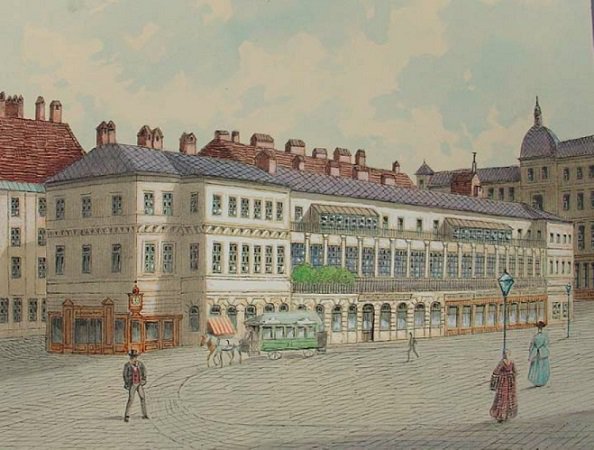
Müller’sches Gebäudehe by F. Sager. This was the art gallery where Joseph Count Deym von Střítež exhibited

5 Pieces for musical clock, WoO 33 (1799, Beethoven aged 28)

Dedication Joseph Count Deym von Střítež

Duration 16′

  1. Adagio. Adagio assai in F major
  2. Scherzo. Allegro in G major
  3. Allegro in G major
  4. Allegro non più molto in C major
  5. Minuet. Allegretto in C major

written by Ben Hogwood

Background and Critical Reception

Keith Anderson, in his extensive booklet notes for a collection of Beethoven chamber rarities on Naxos, writes about the Five Pieces for Musical Clock. The first two date possibly from 1794, but Anderson says the last three ‘were completed by 1800 for the exhibition of waxworks and musical automata displayed by Count Josef Deym, under the name of Müller, having returned to Vienna, after self-imposed exile caused by the death of an opponent in a duel.’

A gruesome state of affairs, but apparently, in a need to resurrect his reputation, the Count ‘had commissioned music from Haydn and Mozart, among others. He died in 1804, leaving his widow Josephine, the apparent object of Beethoven’s amorous inclinations, with four children and social problems to surmount from the fact that her husband had been déclassé, a result of his choice to embark on commercial ventures. The pieces for musical clock are transcribed for organ, an instrument the higher range of which corresponded to the higher register of the clock musical apparatus.’

Thoughts

There is a strange and slightly eerie quality to these five pieces when played on the organ. The first piece is a free spirit and quite ghoulish. Although it is marked Adagio there is a fantasy-like quality and a restless movement throughout its six minutes.

The second piece is a cheery triple-time dance played on a whistle, light as a feather. The third is cut from similar cloth, a twirl in the right hand used as a basis for a short piece that sparkles.

These two shorter pieces are given perspective by the longer fourth, a full blown sonata Allegro of jaunty persuasion. Beethoven enjoys moving between the parts, though the melodies are less obvious. The fifth piece, a Minuet, is a natural companion, and carries the same slight amusement level, the composer with tongue in cheek.

Recordings used and Spotify Links

Simon Preston (Deutsche Grammophon)
Janette Fishell (Naxos)

Simon Preston enjoys the unpredictable movements of these pieces, and chooses the ideal light registration for them. Janette Fishell is perhaps better recorded, and enjoys the humourous opportunities Beethoven offers.

You can chart the Arcana Beethoven playlist as it grows, with one recommended version of each piece we listen to. Catch up here!

Also written in 1799 Haydn String Quartet in F major Op. 77/2

Next up Piano Concerto no.1 in C major Op.15