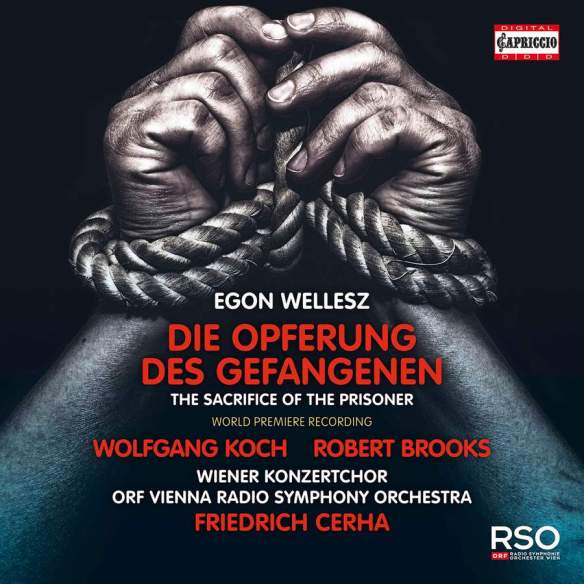
Wolfgang Koch (bass-baritone) Field Commander, Robert Brooks (tenor) Prince’s Shield Bearer, Ivan Urbas (bass) Head of the Council, Hae-Sang Hwang (soprano), Patricia Dewey (contralto), Wiener Konzertchor, ORF Vienna Radio Symphony Orchestra / Friedrich Cerha
Egon Wellesz
Die Opferung des Gefangenen Op.40 (The Sacrifice of the Prisoner) (1924-5)
Capriccio C5423 [56’01”]
Producer Kurt Kindl
Engineer Hans Moralt
Recorded 24 March 1995 at Konzerthaus, Vienna (live peformance)
Reviewed by Richard Whitehouse
What’s the story?
Capriccio continues its coverage of Egon Wellesz (1885-1974) with this live recording of the stage-work Die Opferung des Gefangenen (The Sacrifice of the Prisoner), one of his most striking large-scale dramatic pieces from the inter-war era when he was established among Austria’s leading composers.
What’s the music like?
Although now most highly regarded for the orchestral and chamber works written while in exile after 1938 (settling in Oxford, he was made a fellow of Lincoln College and became a leading authority on Byzantine music and opera of the early Baroque), Wellesz was earlier best known for his theatrical works (four ballets and five operas) as were heard throughout German-speaking territories. Not least The Sacrifice of the Prisoner, first staged in Cologne on 2nd April 1926 and whose designation ‘opera-ballet’ indicates a hybrid conception that was very much in vogue during this period – composers as distinct as Stravinsky, Martinů, Milhaud and Weill all attempting something similar, whatever the differences in aesthetic.
With a scenario by Eduard Stucken, the work concerns the territorial (and, moreover, tribal) conflict between those peoples of Quiché and Rabinal – in what is present-day Guatemala – during the early 15th century. The action is unfolded in starkly ceremonial terms (Capriccio has not included an English translation of the libretto, but Hannes Heher’s detailed booklet provides more than sufficient context) such as leave little room for exploration of character or scenic evocation, yet this does not preclude (indeed, might have encouraged) a musical response as is both personal and affecting. Sample any of the five ‘Dances’ (tracks 6, 8, 11, 13 and 15) to hear Wellesz opening out its expressive ambit in striking and evocative ways.
After the Cologne premiere, there were stagings at Magdeburg in 1927 and Berlin in 1930, before the advent of the Third Reich made further performances impossible. This account, still the only one from the post-war era, was of a concert presentation given in Vienna just over a quarter-century ago and conveys this work’s hieratic power as well as its emotional pathos in gratifying measure. Perhaps a future DVD release of a full staging will yet reveal even more of its dramatic potency, but no-one with even a passing interest in the theatrical possibilities of what was arguably the most innovative decade from the last century should pass up the opportunity to encounter what is much more than just a fascinating period piece.
Does it all work?
It does, and not least for reasons such as might have irked its composer – Wellesz’s invoking of a highly stylized and ritualistic theatre being not that far removed from what his younger German contemporary Carl Orff was working towards at around this time. There are fervent contributions by Wolfgang Koch and Robert Brooks among the vocalists, while chorus and orchestra respond with comparable dedication to Friedrich Cerha who, whether as composer, conductor, or administrator, has left an indelible mark on post-war Austrian musical culture.
Is it recommended?
Indeed, allowing this music will not appeal to all tastes. Those new to Wellesz may prefer to start with the earlier of his nine symphonies (CPO) or Capriccio’s release of his concertos for violin and piano (C67181), but no-one hearing the present piece will likely be left unmoved.
For further information on this release, and to purchase, visit the Capricciowebsite. For more on Egon Wellesz, the composer’s website is a helpful resource.
With an almost complete absence of live music in Europe currently, online concerts are a relative godsend – provided you are willing to stare at the same screen you might have used for work earlier in the day. With this in mind, Arcana took the opportunity to visit the Berliner Philharmoniker’s Digital Concert Hall, with the purpose of watching the orchestra’s Golden Twenties festival.
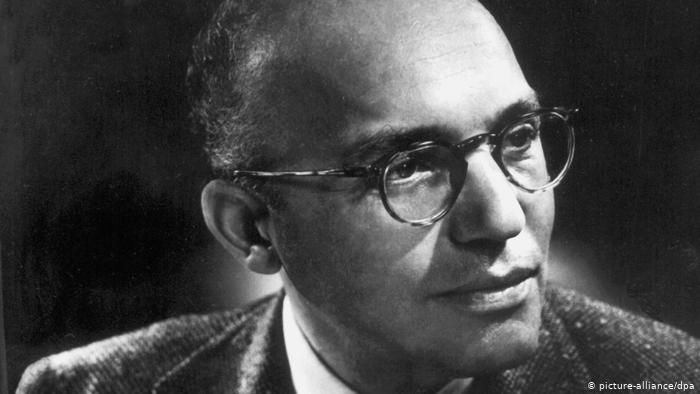
This celebration of one of the most vibrant artistic periods in Berlin’s history centred on the instrumental music of Kurt Weill (above), with imaginative repertoire choices putting his music into a helpful and contrasting context. His teacher Busoni featured briefly, along with Hindemith, Eisler and Richard Strauss.
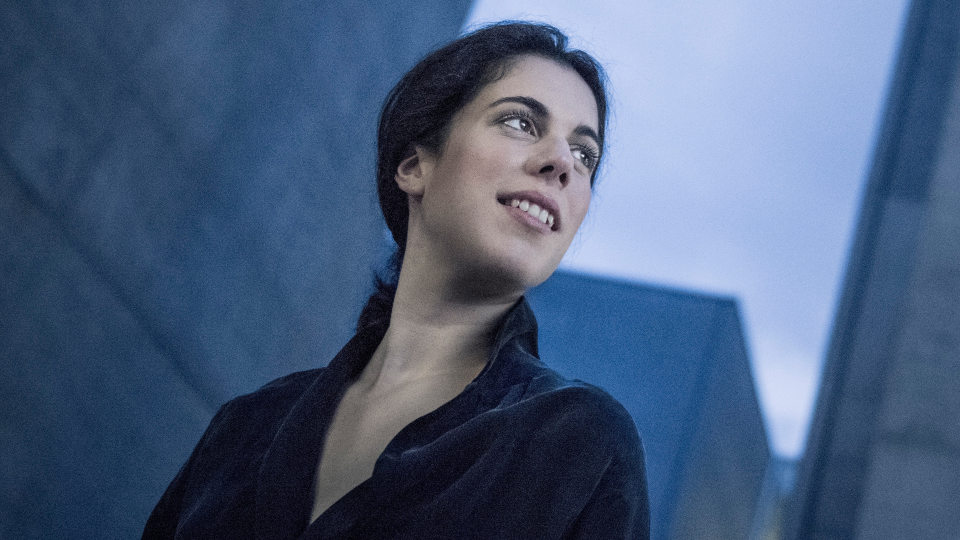
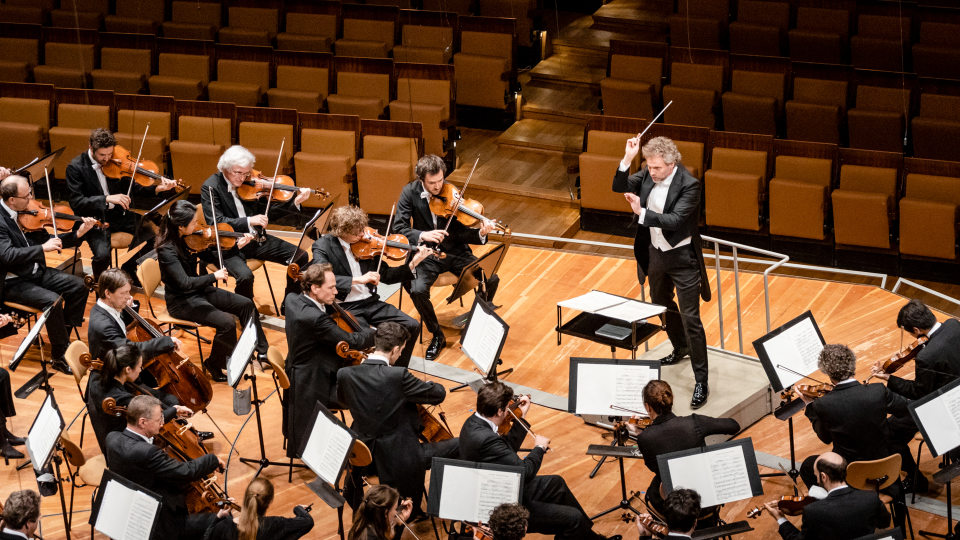
More of Strauss later, but having reviewed the first concert – with a fine Berlin premiere performance of Weill’s First Symphony – Arcana watched the symphonic sequel with the Karajan Academy of the Berliner Philharmoniker, energetically directed by Marie Jacquot (below).
Their programme included two fine Weill pieces but began with the Suite no.3 for orchestra by Hanns Eisler. For a composer whose songs feature relatively often in recital, Eisler’s orchestral music is scarcely heard. This is a shame because it is packed with good tunes and more than a dash of humour – which Suite no.3 enjoyed. This brisk, and in some cases brusque piece, had an appealing and gritty determination, with elements of the baroque toccata in its forward momentum. The instrumentation is that of a band rather than an orchestra, with guitar and snare drums taking prominent roles, which also appeals – and the playful rondo worked well, even though it could have had more of a smile on its face. There was excellent musicianship in this bittersweet account, topped by the muted trumpet of a soft-hearted intermezzo.
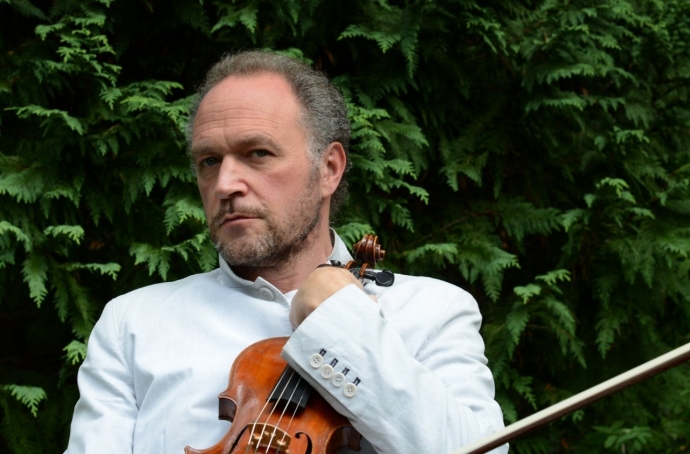
Weill’s Violin Concerto was next, a substantial work written for soloist and wind orchestra – but with no strings, an innovative set-up predating Stravinsky’s own work for piano and winds. The baleful clarinets in the opening statement reflected the composer’s feelings on the passing of his teacher, Feruccio Busoni. As the movement got into gear the movement was more mechanical, driven on by soloist Kolja Blacher (above), with considerable tension at the end of the first movement. A more playful second movement nocturne ensued, with pinpoint xylophone contributions, before an authoritative cadenza and an affecting Serenata with a high line. Blacher was particularly impressive here, technically secure throughout and broadly expressive. The finale had a strong sense of purpose, again superbly marshalled by Jacquot. A poignant pause ensued but was followed by a headlong rush into the closing pages, the soloist at the wheel, and the orchestra superb in their pithy contributions.
Weill’s Second Symphony followed the interval, a substantial piece which actually received its premiere in Amsterdam in 1934. With a tighter grip on the musical material than the first, it features an economical use of the orchestra. Here there were lovely solos from the woodwind but with a good deal of forward momentum and bite to the strings. Ensemble was tautly defined throughout, and there was a nice element of humour in the unexpectedly jaunty theme for the Largo second movement. Impassioned cello and flute solos led to an intense apex of feeling in the middle. Jacquot, whose conducting was clear and sprightly throughout, urged the players on in a tightly controlled third movement, with bustling rhythms and a longer, meaningful trumpet solo before a quick rush to finish a really excellent concert.
Due to Coronavirus a few adjustments had to be made to the third concert. Replacing Sir Donald Runnicles as the conductor was Thomas Søndergård (above), making his Berliner Philharmoniker debut – which as a result meant the substitution of works from Schreker, Berg and d’Albert with works by Sibelius and Prokofiev.
The scheduled Kurt Weill performance, the suite arranged by Wilhelm Brückner-Rüggeberg from The Rise and Fall Of The City Of Mahagonny, just about kept us in 1920s Berlin. Prior to that we heard the suite from Prokofiev’s opera The Love For Three Oranges, completed in 1919. Prokofiev’s music of this period is all about energy, dissonance and wit, and Søndergård was great to watch as he brought these qualities to the fore in music we seldom hear live nowadays. There was a satisfying heft to the orchestral sound, and while the performance could have gone even further with its sardonic wit, the turbulent finale was very well done, as was a keenly felt slow movement with richly textured strings.
Søndergård specialises in the music of Sibelius, and the Sixth Symphony is one of the Berliners’ most-performed symphonies from his output. This account had sumptuous sound and control as its principal merits, a compelling beginning cutting to an exceptionally fluid faster movement. Similarly the second movement, with a wavelike profile, had wonderful sound, while the scherzo was notable for its clear as spring textures. In the finale the conductor’s use of silence proved key, as did Sibelius’ notes themselves of course. Conducted with passion, this was a satisfying account with a reverent ending.
By this time the ear was yearning for the festival’s main character, Kurt Weill – and the smaller band used for The Rise and Fall of the City of Mahagonny gave us the highlights of the concert. Weill does not tend to feature in Søndergård’s repertoire, so one wonders how long he had to learn it – but he was inside the score with obvious enjoyment, allowing the players to express themselves and encouraging them to play with the tempo stylishly. Trombone and alto sax were excellent in the Moderato assai section, while the interlocking brass in the Molto vivace made a beautiful sound. The final Largo held most of the emotional cards, however, with a driven march bringing us home convincingly.
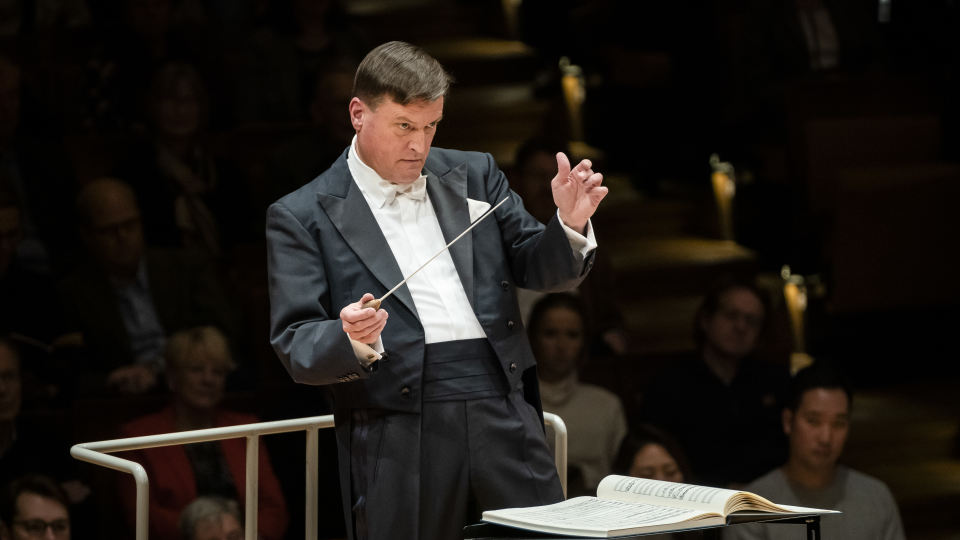
Christian Thielemann took charge of the fourth concert, a nicely weighted combination of the familiar and the unlikely. Thielemann does much for the Hindemith cause, and the composer’s Neues vom Tage overture was a bracing opener in concert form, laced with humour and packed with melodic interest.
Busoni was an inspired choice, a composer who remains difficult to pin down and who still sounds on the edge of modernity. His Tanzwalz, a colourful tribute to Johann Strauss II, has persuasive rhythms, spicy added notes and rich orchestral textures, which the orchestra thoroughly enjoyed. Thielemann’s conducting enhanced the rhythmic profile and the dance elements of the piece – as it did in the complementary Künstlerleben that followed. The violins really sang in the Busoni, as did the cellos towards the start of the Johann Strauss.
Richard Strauss followed, Camilla Nylund replacing Diana Damrau for a set of typically songs. These were well chosen, ranging from the fervent singing of Ständchen to the walking pace of the serene Wiegenlied, where the orchestra added nicely pointed counterpoint to Nylund’s expressive vibrato. Allerseelen was passionately sung, as was Morgen, with the necessary restraint and a beautiful duet between singer and solo violinist, unfortunately not credited.
We had a choral curiosity from Strauss to finish, the Berliner Philharmoniker’s second ever performance of Die Tageszeiten, published as the composer’s Op.76 in 1928. Written for male chorus and orchestra, this comparatively late work sets four sections of the day, as described by poet and regular Strauss collaborator Joseph Eichendorff in his Wanderlieder.
The men of the Rundfunkchor Berlin used the Philharmonie imaginatively, distanced across the stalls above the orchestra, who sat at much closer proximity thanks to their regular testing regime. The piece began with a call to arms, full of spring vigour, before the warm sunbeams breathed calm on the slower Afternoon Rest, which became increasingly chromatic. The wind was a more obvious presence in Evening, depicted by rollng timpani and restless orchestral figures, while Night made a beatific start, with some lovely singing from the men. The density increased but was tapered by a rather lovely unaccompanied chorale near the end, subsiding to a serene finish which was conducted with affection and satisfaction by Thielemann
While Coronavirus inevitably affected the content and artistic direction of The Golden Twenties, it still proved an interesting and stimulating festival, and it was especially satisfying to to see Kurt Weill’s instrumental music getting more of the recognition it surely deserves.
Concert 2
Eisler Suite for Orchestra no.3 Op.26 ‘Kuhle Wampe’ Weill Violin Concerto Op.12 Weill Symphony no.2
Konja Blacher (violin), Scholars of the Karajan Academy / Marie Jacquot
Concert 3
Prokofiev The Love for Three Oranges Suite Op.33bis Sibelius Symphony no.6 in D minor Op.104 Weill The Rise and Fall of the City of Mahagonny: Suite (arr. Wilhelm Brückner-Rüggeberg)
Berliner Philharmoniker / Thomas Søndergård
Concert 4
Hindemith Neues vom Tage (News of the Day), Overture from the Opera with Concert Ending Busoni Tanz-Walzer Op.53 Johann Strauss II Künstlerleben Op.316 Richard Strauss Ständchen Op.17/2; Freundliche Vision Op.48/1, Wiegenlied Op.41/1, Allerseelen Op.10/8, Zueignung Op.10/1, Morgen Op.27/4 Richard Strauss Die Tageszeiten Op.76
Camilla Nylund (soprano), Rundfunkchor Berlin, Berliner Philharmoniker / Thomas Søndergård
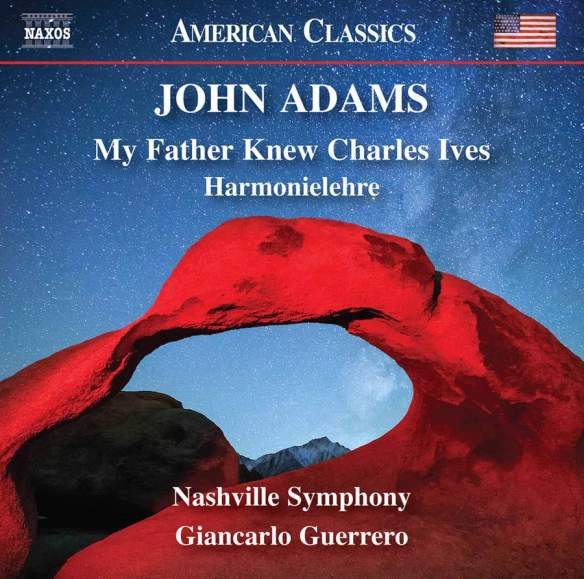
John Adams
My Father Knew Charles Ives (2003)
Harmonielehre (1985)
Naxos American Classics 8.559854 [69’03”]
Producer Tim Handley
Engineer Trevor Wilkinson
Recorded 5-7 October 2018 (Harmonielehre), 25-27 October 2019 (My Father Knew Charles Ives), Laura Turner Concert Hall, Nashville
Reviewed by Richard Whitehouse
What’s the story?
Naxos adds to its coverage of John Adams with this release featuring two major orchestral works – the one among the most enticing of his latter-day output, the other among the most characteristic (and recorded) of the pieces that first accorded him international prominence.
What’s the music like?
Adams has long expressed a penchant for the music of America’s great visionary of the late-Romantic era, and My Father Knew Charles Ives is his oblique while affectionate homage to the composer who gave American classical music its aesthetic basis. Not that the title should be taken literally – rather, the work’s three movements add up to an inclusive portrait of Ives in a way not dissimilar to that of the composer’s orchestral sets. Thus, the opening Concord deftly identifies the cultural environment behind Ives’s thinking besides alluding to some of his most inimitable music, while The Lake builds upon this with evocative and atmospheric writing whose concertante role for piano also finds resonance in the senior composer’s music. The final and longest movement, The Mountain returns to those transcendental strivings as infused Ives’s creative maturity, though its finely sustained initial pages are not followed up by the falling back on well-rehearsed minimalist routines that ensue. Conversely, the closing pages inhabit an ethereal introspection as makes for an understated and affecting apotheosis.
Hard to believe it is now 36 years since Harmonielehre first blazed a trail over the Western musical landscape, or that what once provoked extreme reactions (causing a near riot at the 1987 Huddersfield Contemporary Music Festival) should have come to represent a musical lingua franca imitated many times in the interim. That this earliest of Adams’s ‘symphonic’ works remains among his most representative is fully reaffirmed here. Giancarlo Guerrero finds a viable balance between drama and lyricism in the lengthy opening movement, then builds the mingled Wagnerian and Mahlerian resonances of The Amfortas Wound toward a climax of potent anguish (if such is the music’s intent). The luminous opening of Meister Eckhardt and Quackie demonstrates the best in the Nashville Symphony – as with its superb release of Christopher Rouse (Naxos 8.559852) – and while even astute pacing cannot make the closing peroration sound other than manufactured, the approach yields a methodical and eventful sense of purpose as makes its ‘travelling in hope’ more compelling than any arrival.
Does it all work?
It does, from the perspective that Adams often makes his larger-scale works cohere through sheer force of impact more than formal ingenuity – his trademark post-minimalism proving renewable at almost every turn. Guerrero’s take on My Father Knew Charles Ives is certainly preferable to the composer’s rather calculated account with the BBC Symphony Orchestra (Nonesuch), while his Harmonielehre can rank high among the seven available recordings of this piece – among which, Kent Nagano with the Montréal Symphony Orchestra (Decca) currently leads the field.
Is it recommended?
Yes, not least when recording and annotations are first rate. Hopefully, future Naxos releases of Adams will explore further his extensive back catalogue and revive such as the impressive ‘symphony’ El Dorado, which still awaits its second recording after virtually three decades.
For further information on this release, and to purchase, visit the Naxoswebsite. For more on John Adams, the composer’s website is a great resource. Meanwhile the Nashville Symphony website is here, and you can visit conductor Giancarlo Guerrero’s website here
An Orphica by Joseph Dohnal (Kunsthistorisches Museum)
Piano Sonata in C major WoO 51 (1791-98, Beethoven aged 26)
Dedication Eleonore von Breuning
Duration 7′
1. Allegro
2. Adagio
Listen
Background and Critical Reception
There are conflicting reports on the origins of this short piano sonata. Some scholars suggest the work was begun in 1791, with Beethoven still in Bonn – while others interpret correspondence to mean the composer was writing for the orphica, a small keyboard instrument like the clavichord that was in use at the time.
This would date the work to 1794 at the earliest, with more correspondence mentioning Eleonore von Breuning that suggested it was intended for her. There are two completed movements, making the sonata similar in design to the two works of Op.49. The second was finished by Beethoven’s friend Ferdinand Ries, and published posthumously in 1830.
Thoughts
The dimensions of this piece may be similar to the Op.49, but so is the musical style. The fact the composition spans several years suggests Beethoven was sufficiently attached to the music to want to see it through to the end, and listening to the work confirms his instincts were strong.
The first movement begins with an attractive flourish, and the right hand is allowed to run free. The open textures and movement between the hands face back towards the Baroque rather than forwards, but Beethoven’s use of unusual keys in the development of the main theme are a sign he was still subtly innovating.
The second movement, in F major, is a tender Adagio that has no need to hurry, and subsides to a gentle conclusion, a nicely poised aria in all but name.
Recordings used
Jenő Jandó (Naxos) Ronald Brautigam (BIS)
Spotify links
Jenő Jandó
Ronald Brautigam
You can chart the Arcana Beethoven playlist as it grows, with one recommended version of each piece we listen to. Catch up here!
Also written in 1798 KoželuchSinfonia Concertante in E flat major
Next up8 Variations on ‘Une fièvre brûlante’ WoO 72
Piano Sonata no.19 in G minor Op.49/1 for piano (1795-7, Beethoven aged 26)
1 Andante
2 Rondo: Allegro
Dedication unknown
Duration 8′
Listen
Background and Critical Reception
The two short sonatas by Beethoven published as Op.49 in 1805 have become very popular with pianists of a more moderate ability (such as yours truly!). For this we have to thank the composer’s brother Kaspar, who assembled the two works in 1802 and gave them to publishers, though they date from several years earlier.
We have already encountered the second piece from this set, written in G major, and its counterpart shares the same pitch but operates in the minor key. Angela Hewitt, writing for her Hyperion recording, tells how the sonatas ‘were billed by their publisher as Sonate facile, a good marketing ploy, and one that reminds us of Mozart’s C major sonata K545, written in 1788. It is interesting to learn that the same publishing house, less than a month after bringing out Beethoven’s pieces, brought out Mozart’s work for the first time, with the same title’.
Hewitt, who clearly loves this piece, declares it a ‘two-movement work that is perfection in miniature’. ‘It has become almost commonplace to say that early Beethoven sounds like Mozart, but to me this sonata is pure Beethoven from start to finish’.
Thoughts
It is easy to share Hewitt’s enthusiasm for this short but expressive piece. The first movement certainly has a Mozartian simplicity but it is also very serious, a straight-faced counterpart to the exuberance of the Sonata published alongside it. Beethoven speaks with the profound nature of a Baroque overture, as though he were introducing a bigger Suite rather than a short piece.
The second movement casts off the shadows of the first, moving to the major key for a brighter approach – yet it still reverts to the minor key for a brief episode. In the end the outlook is positive, with a gently rocking coda to end the piece in a serene mood.
Recordings used and Spotify links
Emil Gilels (Deutsche Grammophon) Alfred Brendel (Philips) András Schiff (ECM) Angela Hewitt (Hyperion) Paul Badura-Skoda (Arcana) Stephen Kovacevich (EMI) Igor Levit (Sony Classical) Ronald Brautigam (BIS)
The approaches to this piece are fascinating. Two of the most contrasted viewpoints – both valid – are held by Paul Badura-Skoda, playing the fortepiano, and Emil Gilels. Badura-Skoda is quite fast in the first movement but feels slower in the second, while Gilels’ approach is expansive to say the least in the opening pages, but he makes it work with deep expression. His second movement has a spring in its step, enjoying its relative freedom.
You can hear clips of Hewitt’s recording at the Hyperion website
You can chart the Arcana Beethoven playlist as it grows, with one recommended version of each piece we listen to. Catch up here!
Also written in 1797 PleyelFlute Concerto in B flat major B106 .


 Arcana.fm