Wigmore Mondays: Trio Mediæval

Trio Mediæval [Anna Maria Friman (voice, hardanger fiddle), Linn Fuglseth (voice, melody chimes, shruti box), Jorunn Lovise Husan (voice, melody chimes)]

Anon (Gregorian chant) Salve Regina 1:48
Anon 13th-century English Salve mater Miscericordie 5:33; Salve virgo virginum 7:57-11:10
Trad. Norwegian Solbønn
Trad. Swedish Limu Limu Lima
Trad. Norwegian Lova line; Villemann og Magnhild
Trad. Swedish St. Örjan och draken; Om ödet skulle skicka mig; Jag haver ingen kärare
Anon (Gregorian chant) Benedicta es caelorum regina
Anon 14th-century English Benedicta es caelorum regina; Alma mater / Ante thorum;
Anon 13th-century English Dou way Robyn / Sancta Mater
Trad. Norwegian So ro liten tull; Sulla lulla
Trad. Swedish Du är den första

Wigmore Hall, London; Monday 17 September 2018

You can listen to the BBC Radio 3 broadcast by clicking here

Written by Ben Hogwood

This is a placeholder – review and guide coming soon.

Further listening

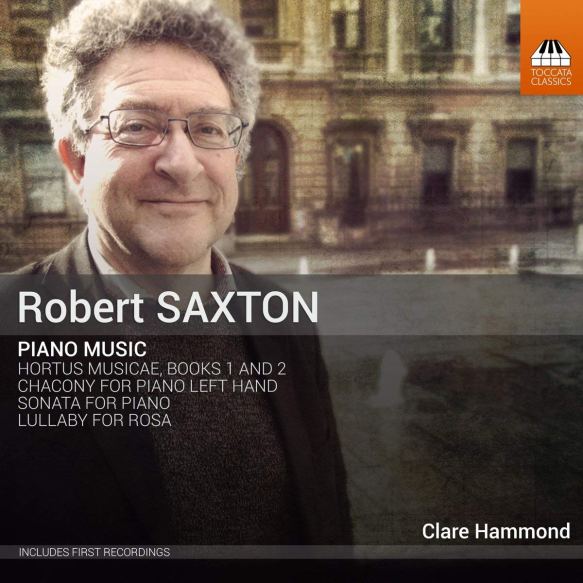
On record: Clare Hammond – Robert Saxton: Piano Music (Toccata Classics)

Saxton Piano Music

Clare Hammond

Saxton
Hortus Musicae, Books One (2013) and Two (2015)
Chacony for the Left Hand (1988)
Sonata (1981)
Lullaby for Rosa (2016)

Toccata Classics TOCC0458 [55’44”]

Producer / EngineerMichael Ponder
Recorded21 & 22 August 2017 at the Church of St John the Evangelist, Oxford

Reviewed by Richard Whitehouse

What’s the story?

A disc collating most of the solo piano output by Robert Saxton (b1953) in performances by Clare Hammond, who has championed his work over recent years and is the dedicatee of two books of shorter pieces comprising Saxton’s most significant music for this instrument so far.

What’s the music like?

Saxton came of age as a composer during the early 1980s, with such pieces as the Sonata for Piano. This was completed in 1981, the centenary of Bartók’s birth and the pivoting of whose mature piano music between stasis and dynamism is evident in the present work’s methodical unfolding towards a coruscating climax; rounded off by a limpid if by no means valedictory chorale. Hammond has the measure of this compact yet eventful piece, not least its unforced and resourceful tonal follow-through as subsequently became a hallmark of Saxton’s thinking.

Such is audible in the Chacony for Piano Left Hand composed in 1988 for Leon Fleischer. Its antecedents in archetypal examples by Purcell and Bach are never hard to detect, but Saxton ‘personalizes’ this form through a tonal framework that facilitates its evolution as a sequence of interrelated variations – as defined harmonically as it is seamless texturally. Concerning the latter aspect, Saxton notes that he was at pains to ensure his music sounded as though written for two hands – a quality that is audibly to the fore in Hammond’s admirably fluent reading.

Both these pieces have been previously recorded, but the two volumes of Hortus Musicae are new to disc and evince piano writing no less idiomatic and arguably more personal than before. The inspiration is that of a ‘musical garden’ in all its allegorical and metaphysical implications, with the five pieces which comprise the First Book (2013) embodying this in ingenious ways – not least the stealthy (Andrew Marvell-inspired) floral clock of Hortus Temporis, or synthesis of formal precision and expressive eloquence in Hortus Infinitatis.

The seven pieces of the Second Book (2015) are even more diverse and contrasted in and between themselves. Here, too, the inspiration is often more concrete – hence the invoking of fondly remembered music in Beech Bank (á la recherche)…, or deft play on meanings which motivates the heady course of Hortus Animae Alis Fugacis; a concluding piece in every sense. The fact these 12 pieces outline a circular tonal trajectory makes further books unlikely, but Saxton will hopefully find a means of extending the sequence up to 24 pieces.

Does it all work?

Indeed. Saxton has long been a composer able to fuse serial and tonal elements without the results seeming at all contrived or inhibited. The two books of Hortus Musicae abound in evocative and arresting musical imagery which Hammond conveys as convincingly as she realizes the not inconsiderable technical challenges. The disc is rounded off by Lullaby for Rosa (2016), a minute-long ‘welcome gift’ for this pianist’s daughter and a further instance of how deftly Saxton integrates technical ingenuity within a context of limpid wistfulness.

Is it recommended?

Very much so. The piano sound is spacious in balance as well as realistic in tone, while the composer contributes an entertaining booklet note that takes in an overview of his ancestry and formative years. Hopefully there will be further releases of his music from this source.

You can read more about this release and listen to clips on the Toccata Classics website, or listen in full on Spotify below:

On record: Málaga Philharmonic Orchestra / Paul Mann – Rodney Newton: Orchestral Music Vol.1 (Toccata)

Newton Orchestral Music, Volume One – Symphony no.1; Symphony no.4 ‘Distant Nebulae’

Málaga Philharmonic Orchestra / Paul Mann

Newton
Symphony no.1 (1969)
Symphony no.4 (1975)
Distant Nebulae (1979)

Toccata Classics TOCC0459 [70’29”]

Producer/Engineer Albert Moraleda
Recorded September 18-22 at Sala Beethoven, Sala de Ensayos de Carranque, Málaga

Reviewed by Richard Whitehouse

What’s the story?

The ever-enterprising Toccata Classics begins another series, devoted to the orchestral output of Rodney Newton (b1945) who, best known for his brass band and film music, has been no less active in the concert domain, with 14 symphonies to date and numerous other pieces.

What’s the music like?

We begin at the start of this symphonic output, with the Symphony no.1 that Newton completed in 1969. He suggests Shostakovich and Vaughan Williams as primary influences, though that of Malcolm Arnold (then the leading British symphonist of the younger generation) is also detectable in the livelier episodes of the opening movement and a finale alternating between jazzy incisiveness and high-flown eloquence. Best, though, is the central Lento – its serenity increasingly undermined by more troubled elements on the way to a radiant close. Had this symphony appeared a decade or so before, it might well have found favour at a Cheltenham Festival of the period; heard today, its wide-eyed naivety – in terms of expression while not technique – appears more a resolute statement of intent for where its composer was headed.

One instance is the Symphony no.4 of 1975, its more forward-looking idiom underpinned by an adept recourse to serial technique and a continuous variation at its most resourceful in the opening Metamorphosis whose seamless and cumulative momentum readily confirms   a symphonist of conviction. There follows an Elegy of overt if not unrelieved sombreness, then a Scherzo malevolo dominated by suitably strident material and climaxing in a ‘break’ for kit-percussion such as leads into the finale. This Passacaglia, Variations and Epilogue builds stealthily, with increasing allusions to earlier ideas, to a powerful culmination whose impact resonates throughout the raptly inward concluding bars. Had Sir Charles Groves been able to secure its premiere, Newton’s symphonic profile would surely have been far greater.

The disc is rounded off by Distant Nebulae (1979), which received two semi-professional performances before this recording. Although inspired by the ‘cosmic landscape’ of Ives’s The Unanswered Question, its interplay of chorale-like melody and modal harmony suggests more Copland and even Barber; the music evoking that ‘’gentle meditation on the night sky and the mysteries of the universe’’, of which the composer speaks, in suitably pensive terms. Just maybe this could be Newton’s means of finding favour with a non-specialist audience?

Does it all work?

Very largely. That the First Symphony is a ‘starting out’ piece does not lesson its undoubted appeal, and it clearly commended itself to the Málaga Philharmonic players who render it with relish. The Fourth presents tougher challenges which are not entirely surmounted here (notably in the extensive outer movements), but this is not to question the commitment of these musicians – presided over by the dependable Paul Mann, whose service to present-day British symphonism (at least as represented by Toccata Classics!) could hardly be gainsaid.

Is it recommended?

Indeed. The sound is spacious and well-focussed (if just a touch overbearing at climaxes), while Newton contributes an informative and personable booklet note. As with Steve Elcock and Matthew Taylor, one looks forward to further symphonic odysseys from this source.

You can read more about this release and listen to clips on the Toccata Classics website, or listen in full on Spotify below:

Wigmore Mondays: Ilker Arcayürek & Ammiel Bushakevitz – Schubert: The Path of Life

Ilker Arcayürek (tenor, above), Ammiel Bushakevitz (piano, below)

Schubert
Fischerweise D881 (1826) (2:21 – 5:12)
An Silvia D891 (1826) (5:21 – 8:06)
Der Wanderer an den Mond D870 (1826) (8:21 – 10:32)
Atys D585 (1817) (10:51 – 15:00)
Sei mir gegrüsst D741 (1821-22) (15:20 – 19:20)
Wehmut D772 (1822) 19:46 – 23:10)
Der Wanderer D493 (1816) (23:16 – 28:42)
Litanei auf das Fest aller Seelen D343 (1816) (28:47 – 32:20)
Einsamkeit D620 (1818-1822) (34:45 – 52:03)

Wigmore Hall, London; Monday 10 September 2018

You can listen to the BBC Radio 3 broadcast by clicking here

Written by Ben Hogwood

A fascinating anthology of Schubert songs from BBC Radio 3’s New Generation artist, tenor Ilker Arcayürek, and pianist Ammiel Bushakevitz. If you wanted an introduction to the composer’s approach to song in his mid-twenties – sadly towards the end of his short life – then you could hardly ask for better than this.

The performers include songs short and long, bright and downbeat, bringing to the table some of the contrasting moods Schubert uses in his songs, which are surely the crowning glory of his compositional output.

The concert begins with the steady passage of Fischerweise (Fisherman’s Song, 2:21 on the broadcast) – a bright song, full of purpose and with a piano part that burbles like the water. The fisherman’s ‘work gives him vigour’, proclaims von Schlechta’s poetry, and this song is a great way to set the scene.

Following that is An Silvia (5:21), written in the same year of 1826, nicely pointed in this performance with an effortless conversation between singer and piano, exchanging short musical figures. Right from the start of Der Wanderer an den Mond (8:21) a clear story is being told by piano and tenor, leading ultimately to happiness in the major key at the end.

Atys (10:51) is an earlier song and quite urgent, especially when the piano leans provocatively on the more chromatic notes. Meanwhile Sei mir gegrüsst (I greet you, 15:20) is a more languid affair that looks forward towards Schumann, with a highly distinctive and slightly awkward (but highly effective) vocal line.

Wehmut (Melancholy, 19:46) has a solemn piano introduction and ultimately gives way from the joys of spring to the cold regret of winter. In Der Wanderer (23:16) we hear hollow octaves from the piano for dramatic effect at 27:32, where the ‘ghostly breath that calls back to me’ sends shivers down the spine in Arcayürek’s delivery. Then Litanei auf das Fest aller Seelen (Litany for the Feast of All Souls, 28:47) explores a lovely major key contrast after the desolation of Der Wanderer’s end.

And so to Einsamkeit (34:45), the remarkable 18-minute song that Schubert expert Graham Johnson cites as the first example of his song cycle writing. Certainly it is a song of epic proportions, a kind of forebear of today’s suite-like progressive rock epics – but also of the song cycle as a whole, as employed not just by Schubert but by Schumann, Mahler and others. While Schubert traverses a wide range of moods and emotions there is still a telling shift at 45:32, where the poet proclaims ‘give me my fill of gloom’, before a dramatic recitative. After this tour de force both performers end in relative contentment given what has gone before.

Perhaps not surprisingly this concert ended with demands for an encore, given Ilker Arcayürek’s clear yet rounded delivery and the extremely responsive piano playing of Ammiel Bushakevitz. They responded with Wandrers Nachtlied II D768 (1822, from 53:35 – 56:13), a lovely bit of space after the tumult of Einsamkeit. It put the seal on a very fine recital indeed – a place to introduce yourself to the Schubert song if you haven’t already done so.

Further listening

Ilker Arcayürek has already recorded a disc of Schubert songs with Simon Leppner for the Champs Hill label, which can be heard on Spotify below:

Only one song from that release was included in this concert – the below playlist contains all the others in versions from leading Schubert interpreters:

Prom 69 – Baiba Skride, Boston SO / Andris Nelsons – Bernstein Serenade & Shostakovich Symphony no.4

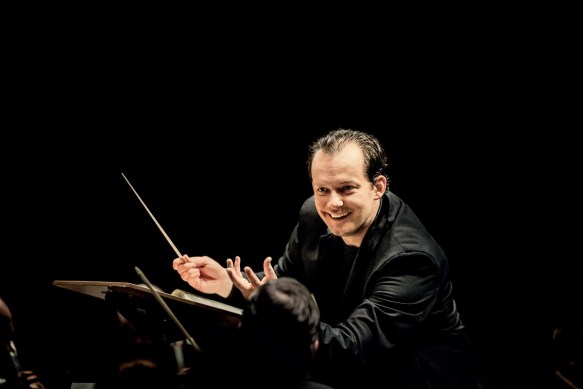
Prom 69 Baiba Skride (violin, below), Boston Symphony OrchestraAndris Nelsons (above)

Bernstein Serenade (after ‘Symposium’) (1954)
Shostakovich Symphony no.4 in C minor Op.43 (1936)

Royal Albert Hall, Monday 3 September 2018

Reviewed by Richard Whitehouse

You can listen to this Prom on the BBC Proms website here

The second of the Boston Symphony’s Proms, with its music director Andris Nelsons, offered a pertinent coupling which played to this orchestra’s strengths, while also suggesting that the interpretive insights of this much-lauded partnership are by no means to be taken for granted.

Time was when Bernstein’s Serenade was something of a rarity in live performance, but what is surely its composer’s most successful piece for the concert hall had come into its own well before the onset of his centenary celebrations. This sequence inspired by (though not indebted to) Plato’s consideration of Love in his Symposium was a gift on which Bernstein seized with alacrity, condensing its seven eulogies into five movements such as amount to a varied while cohesive totality to which he aspired without equalling in the concert music of his later years.

Baiba Skride proved a sympathetic exponent, segueing deftly from the lyricism of Phaedrus to the incisiveness of Pausanias and savouring the whimsical irony of Aristophanes. The fussiness of Erixymachus was pertly done and eloquence of Agathon not unduly emotive, for all its expansiveness; the finale almost achieving unity in the rumination of Socrates as overtaken by the ebullience of Alcibiades. Nelsons secured an engaging response from the reduced strings, while keeping some over-effusive percussion writing within sensible limits.

A pity that the sizable audience was not ideally attentive, suggesting that Bernstein as concert composer was less to its liking than when in ‘musical’ mode. It seemed rather more focussed for Shostakovich’s Symphony no.4 – an era-defining piece kept under wraps for a quarter-century after its completion, before gradually making its way into the 20th-century repertoire where it has been ever since. Subversive and despairing in equal measure, it duly received a commanding account where the BSO conveyed both visceral power and fastidious ensemble.

Were these the deciding factors of a great performance, this would assuredly have been one. Yet behind the formidable technical façade was a lack of empathy with this most emotionally charged of symphonies, not least a first movement whose stark alternations of Stravinskian energy and Mahlerian anguish Nelsons drew into a formally unified if expressively uniform whole. With its subtler pivoting between anxiety and elegance, the central intermezzo was finely rendered, even if its closing percussion ostinato was neither sardonic nor speculative.

Come the finale and Nelsons found an ideal tempo for its opening funeral march, though its overtones of heroism and plangency felt passed over on the way into a toccata section which lacked cumulative intensity for all its incisiveness. The ensuing divertimento gave several of the orchestra’s principals their moment in the spotlight that they took with panache, then the entry of duelling timpani was clumsily prepared going into a peroration as was imposing but never inexorable; the postlude which follows one of somnolence rather than numbed despair.

As so often this season, there was no encore – Nelsons purposely extending the silence at the close of the Shostakovich as its own epitaph. It set the seal on a lucidly conceived and superbly executed reading that yet missed out on what makes this piece an experience like few others.