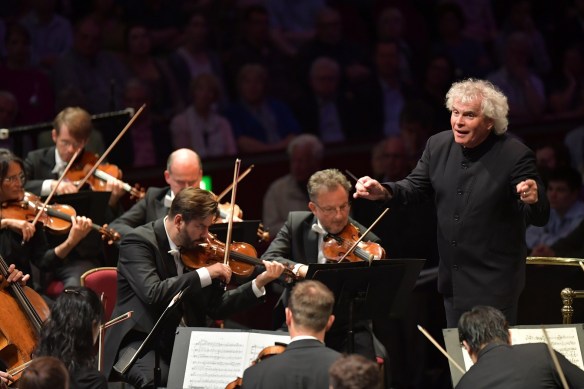
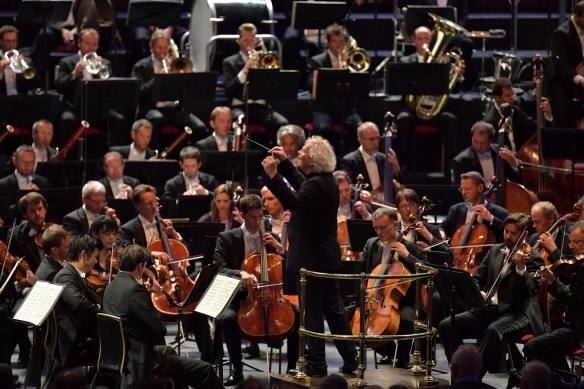
BBC Proms 2017 – Malcolm Sargent tribute: BBC Symphony Orchestra / Sir Andrew Davis

Beatrice Rana, BBC Symphony OrchestraSir Andrew Davis

arr. Sir Henry Wood The National Anthem

Berlioz Le carnaval romain Overture, Op.9 (1844)

Schumann Piano Concerto in A-minor, Op.54 (1845)

Elgar Cockaigne (In London Town) Op.40 (1900-01)

Walton Façade – Suite No.1; Popular Song (1922-28)

Holst The Perfect Fool – Ballet Music (1918-22)

Delius On Hearing the First Cuckoo in Spring (1912)

Britten Variations and Fugue on a Theme of Purcell (The Young Person’s Guide to the Orchestra), Op.34 (1945)

Royal Albert Hall, Monday 24 July 2017

Sir Malcolm Sargent holds a prominent place in Proms history, especially so for those Prom goers of an older vintage. It was therefore only right that in the 50th year since his passing there was a concert commemorating one of English classical music’s favourite sons. Sargent lived in a flat opposite the Royal Albert Hall, a blue plaque marking this clearly visible from Door 4 of the auditorium.

Calling Sargent a ‘favourite son’ is a statement that needs to be qualified, for not everybody held him in such high esteem. For orchestral players he could be anything but, being a hard taskmaster, but he was hugely popular with Proms audiences, boosting the profile of the festival and the Last Night in particular, to an art form fit for television. As tonight’s conductor Sir Andrew Davis recounted in a glowing tribute, he also knew how to get the best out of large choral and orchestral forces. Davis was a prommer in the 1960s, and held fond memories of Elgar, Shostakovich and Britten under the Sargent baton.

Davis himself is now 73, but still a sprightly figure who lovingly led his BBC Symphony Orchestra charges in a wide variety of English music, recreating the program given for Sargent’s 500th Prom in 1966. We ducked and dived through Berlioz, and his Le carnaval romain overture, before a glittering account of Schumann’s Piano Concerto from Beatrice Rana, herself in glittering green (above). Her quiet moments were especially profound, and she took charge of the more tempestuous passages of the outer movements with impressive control and expression. Balance is often a problem between piano and orchestra in the cavernous Royal Albert Hall acoustic, but here it was nicely achieved, and with phrases that were fleet of foot (and hand!) Rana showed why she is a highly coveted soloist.

Davis (below) came into his own for the second half. An English music expert whose interpretations are now virtually unrivalled, he brought forward the bustling streets of London for Elgar’s Cockaigne Overture, balancing the organ with the orchestra impeccably as he did so. The big tunes were affectionately wrought and great fun, as they were in Walton’s mischievous music for Façade, an entertaining suite where the percussion section, led by the ever masterful David Hockings, came out on top form.

Holst’s ballet music for The Perfect Fool was treated to a delicately shaded performance, sonorous trombones underpinning a rewarding orchestral sound, with dances of great character. Meanwhile Delius gave us a sunkissed reverie, On Hearing the First Cuckoo in Spring, temporarily overriding the clouds outside.

Finally we moved to Britten, and a performance of the Young Person’s Guide To The Orchestra that was as much fun to watch as it was to listen to. The composer’s clever navigation of each orchestral section is a great introduction for new listeners but also reminds the older ones of the colours and expressive techniques each instrument can produce. Davis handled the twists and turns to great effect, and this hugely entertaining evening reached its peak with all sections combined, Purcell’s original theme now refracted through Britten’s technicolour lens.

It was a great way to finish and a fitting tribute to Sargent, who conducted the work’s world premiere back in 1946. He would surely have been proud of Davis and his charges, who sent the crowd away smiling – something Sargent himself achieved on countless occasions.

Ben Hogwood (photos (c) Ben Hogwood (plaque) and Chris Christodoulou (performances)

Stay tuned for the first in Arcana’s Ask The Audience series, where drum ‘n’ bass DJ Rob Chung will give his verdict on the Malcolm Sargent Prom. Coming shortly!

BBC Proms 2017 – I Fagiolini introduce Monteverdi to the Cadogan Hall

I Fagiolini / Robert Hollingworth (above) Photo (c) BBC/Chris Christodoulou

Monteverdi Cruda Amarilli; Sfogava con le stele; Longe da te, cor mio; Possente spirto from Orfeo, Chiome d’oro, Vorrei baciarti, o Filli

Roderick Williams Là ci darem la mano (BBC commission: world premiere)

Monteverdi Laudate pueri Dominum a 5 (concertato); Volgendo il ciel per l’immortal sentiero

Cadogan Hall, Monday 17 July 2017

Listen to this concert on the BBC iPlayer

As an introduction to the wide musical canon of Claudio Monteverdi (1567-1643), there is surely no better place to start than with this vividly coloured concert from I Fagiolini and their quirky leader Robert Hollingworth.

They gave the Cadogan Hall – and BBC Radio 3 listeners – an insight into his daring harmonic world, showing just how keenly Monteverdi could respond to the challenges of word setting. They also showed how he could operate equally effectively in a reverent sacred setting, using the same imagination as in the wild and wonderful secular works.

Monteverdi, who was born 450 years ago to the year, is essentially a ‘Renaissance’ composer (the period running very roughly from 1400 to 1600) but he wrote in such an original way that even now his music sounds forward-looking.

The first trio of madrigals in this concert showed the composer’s skill with unaccompanied voices, and the clarity with which I Fagiolini could deliver them. Cruda Amarilli (from 2:14 on the broadcast link) Sfogava con le stele (5:17) and the darker Longe da te, cor mio (8:45) were all performed with the utmost clarity.

Monteverdi is also the acknowledged father of opera, with L’Orfeo (1607) the first example in the form. It is a remarkable work, and this lengthy excerpt (from 13:09 to 22:30) shows why. Tenor Matthew Long held his notes with impeccable control, but also showered them with the composer’s written embellishments, fluctuating the note ever so slightly to give extra expression. He was shadowed by violins (Rachel Podger and Kati Debretzeni) and cornetts (Gawain Glenton and Conor Hastings).

Back to the madrigals, and the seventh book Monteverdi published in Venice in 1613. Chiome d’oro (Golden tresses) (24:14) had an attractive introduction with the two violins dovetailed, a sign of things to come from the sopranos Anna Crookes and Ciara Hendrick, and their beautiful duet from 25:06. From 27:37-32:32 the spotlight changed to Hollingworth, whose nervous lover was characterised to perfection, and Kendrick, his intended. As the song progressed so he moved progressively closer to her, and by the end the two leaned in towards s kiss – a simple but extremely effective staging!

From 35:30-42:13 we heard a new work, Roderick Williams imaginatively setting Lorenzo da Ponte’s words used by Mozart in the famous Don Giovanni aria Là ci darem la mano, here set for a five-voice choir. Williams writes through the eyes and ears of Monteverdi and the results were intriguing and often laced with humour. In the middle he added a clever invention, the reading of a letter from Monteverdi while the singers tried to outdo each other in the background. The madrigal ended in a flurry of sexual tension.

Roderick Williams takes the applause with I Fagiolini and Robert Hollingworth after the world premiere of his interpretation of Là ci darem la mano.

Finally a pair of real wonders, a setting of Laudate pueri Dominum (from 44:33) and then an extended madrigal, Volgendo il ciel per l’immortal sentiero (52:42–1:03:13), designed for the praise of the Emperor in spite of the Thirty Years War. It is a mini-masterpiece, capped by the central dance (59:10) and its lilting rhythms begun by theorbo player Eligio Quinteiro. In these capable hands we enjoyed the complete purity of C major, beautifully spun by Monteverdi’s hand.

A wonderful concert, then, performed in the vivacious spirit that I Fagiolini bring to all their performances, celebrating the humour and quirky rhythms within the music, but bringing the seriousness of Monteverdi’s invention to play also. I urge you to hear it!

Ben Hogwood

Ask the Audience at the BBC Proms – Sam Hogwood on Verdi’s Requiem

Ask The Audience Arcana at the Proms
sammi-2This is the final installment of this year’s series where Arcana invites a friend to a Prom who does not normally listen to classical music. In an interview after the concert each will share their musical upbringing and their thoughts on the concert – whether good or bad! Here, it felt right to bring the editor’s wife along! So Samantha Hogwood (above) gives her thoughts on Prom 74.

Soloists, BBC Proms Youth Choir, Orchestra of the Age of Enlightenment / Marin Alsop

Verdi Requiem (1874)

You can watch this Prom on the BBC iPlayer here

Arcana: Mrs Hogwood, what was your musical upbringing?

Well a lot of it was from my father, who’s now a silver fox…and we were brought up on things like Pink Floyd, Queen and Fleetwood Mac, and lots of blues and jazz – though no specific names jump out at me. He used to play things like Rick Wakeman, Mike Oldfield’s Tubular Bells, Jean Michel Jarre’s Oxygene – all that kind of stuff – and all sorts of what might be considered wacky music! There was one particular album – Rick Wakeman I think – where it was like a battle. King Arthur I think it was, and there was a cover where there was a horse being stabbed, I remember lying on the floor behind the sofa with my dad’s headphones on, imagining what it was like to do battle, and feeling sad that so many horses must have died. I was completely knocked out by things like that.

king-arthur

The cover of Rick Wakeman‘s King Arthur

There are so many amazing bands, but things that stick in your mind…and music I used to hear when sharing a flat with my dear friends Kate and Jan. I think of Fleetwood Mac, Stevie Nicks, Judy Tzuke, then bands like Hawkwind, The Clash and loads more. Listening to Abba with my dear friend Anne as well. I used to hate the Sex Pistols though because they used to gob on everyone! I love Orb-type stuff, the Chemical Brothers, Basement Jaxx, and Underworld had a massive influence on me when I moved down to London. I used to listen to loads of music then, in my room.

Could you name three musical acts you love, and why you love them?

Well we’ve seen the Super Furry Animals together a lot, and I love them so much because they’re wacky, original and colourful:

I used to love David Lee Roth, and had a poster of him over my bed. It wasn’t that I fancied him necessarily – well, I did! – but it was the cockiness he portrayed, the glint in his eye, the kind of music he sang and the humour as well – like the song Just A Gigolo, with his band mates onstage – a bit like Magic Mike. I went to three or four concerts on my own to see him!

I would say Joni Mitchell too, because every time I hear her voice she takes me to a place that I completely identify with, whether it’s Big Yellow Taxi, Blue or Heartbreak – stuff that you’ve done that you know you can’t get back, you have to accept it. It’s joyous but heartbreaking too, and every time I hear her I just want to melt. I know all the words, all the nuances, and all the notes, and I love her songwriting.

What has been your experience of classical music so far?

Well quite a lot from the beginning, because my mum and dad used to listen to stuff like Strauss – the music to 2001 – or Holst‘s The Planets­ – but there was a whole lot more. Apparently I kicked off about learning classical guitar, so they took me to do that, and I got to grade 8. Mum and Dad do like to regale the fact that I was so frustrated with practising that I once bit my guitar! There were chew marks around it! That’s basically what they will remember. I did very well in exams but I used to bite my guitar a lot and was locked in my room and made to practise. I gave it to a woman in London.

Then I met you – my husband now! – and we realised we had a lot in common. You would suggest stuff to go and see. We talk about music a lot, and I used to regale the music I listened to – and still do now. After a period of time I went to the Proms with you, but I haven’t been very often. I love listening to classical music, and we’ve been to see Holst’s The Planets and Britten’s War Requiem, which was incredible but more depressing – but the voices lifted you up. I’m really lucky to have seen that, but I do find it difficult to sit still while I’m listening for a long period of time at concerts, where I would like to move around. If I was watching a film it would be different.

How did you rate your first Proms experience?

It was mind blowing. It made my hair stand on end, as soon as I heard the orchestra and the singers I was blown away. There was one particular part that they use a lot in the X-factor, that we’re all familiar with – which is really annoying – but I loved it. It was colourful and beautiful. There were dips on occasion when the soloists were singing, which is what seems to happen, but I would say I was really listening to it, and at times I was closing my eyes and feeling the music.

I absolutely loved it, but I’ve been to a few concerts with you and so I guess you knew I would like it! I’m very good at switching myself off and on again from the day, because you can’t go somewhere in a bad mood and enjoy a concert, so I find you do have to do that sometimes.

I haven’t been to the Proms as often as you have but I think it is an amazing cultural institution that has been going for so long. I think they have been good at introducing new things, and having the tickets where you can stand is really good. I definitely think they could do more to introduce classical music to the greater public though, because I know for a fact those who have heard it on advertisements or TV have no idea where it’s come from, or the context, and they would love to go and see it. They could do more to introduce the more general classical music to encourage people.

That’s where I think your website could be the most amazing thing. Nobody makes enough of an effort to introduce people to new kinds of classical music. We’ve got loads of friends who love the classical music we’ve played at parties, from 1 o’clock in the afternoon, people who have loved it but don’t know an awful lot about it. It would be amazing if we could encourage more people like that along to the Proms to experience the environment, because tonight was absolutely gorgeous and amazing!

Would you go again?

Definitely. I loved it!

Verdict: SUCCESS


BBC Proms – BBC Singers & Ensemble Intercontemporain: Boulez, Elliott Carter & Bartók

prom-65_cr_bbc-chris-christodoulou_4

Baldur Brönnimann conducts the Ensemble Intercontemporain at the BBC Proms on Friday 2 September, in a Prom also featuring violinist Jeanne-Marie Conquer, IRCAM computer music artists Andrew Gerzo, Carlo Laurenzi and Jérémie Henrot, and the BBC Singers. (c) Chris Christodolou

Prom 65; Royal Albert Hall, Friday 2 September 2016

Bartók Three Village Scenes (1926); Boulez Anthèmes 2 (1997); Carter Penthode (1985); Boulez Cummings ist der Dichter (1970)

Listen on the BBC iPlayer here

Tonight’s late Prom suggested a certain nostalgic element in that the composers performed were at the forefront of these concerts from the late-1960s to the early 1990s, since when the evolution of contemporary music has increasingly become divorced from notions of progress.

Not least in the case of the Three Village Scenes that Bartók wrote in response to a hearing of Stravinsky’s Les noces, and that essentially freed his music from any vestige of late-romantic rhetoric. Not heard at the Proms for over three decades, these concise pieces alive with vitality and (in the second of them) pathos responded well to the poise and precision accorded by the Ensemble Intercontemporain (who gave this piece with Pierre Boulez in 1974 and ’79) – with the BBC Singers conveying the abrasiveness and humour of the vocal writing in like measure.

Although among his late works, Boulez’s Anthèmes 2 looks back via a brief solo predecessor to the Stravinsky memorial tribute a quarter-century earlier. Less encompassing in its musical scope than his other electro acoustic pieces, it brings to a head Boulez’s preoccupation with a cumulative s verse-and-refrain format unfolding as continuous variations in sound and space. Ably as the three IRCAM engineers facilitated this latter, it was the playing of Jeanne-Marie Conquer (below) – a world-class soloist if she chose to be – which took centre stage in every respect.

prom-65_cr_bbc-chris-christodoulou_6

A rather different side of Boulez’s composing was evident with Cummings ist der Dichter – a work which, for all that its title came about by accident, represents an oasis of conviction from an era beset by creative uncertainty. How much of this is due to harmonic enrichment brought about by the 1986 revision is arguable, though the manner in which the text emerges out of its syllabic and parenthetical austerity to assume unexpected textural richness and intricacy was inherent from the outset, and the present account left little doubt as to this music’s eloquence.

Between these works came Elliott Carter’s Penthode, not heard at these concerts since being premiered here 31 years ago and that could not then have been heard as merely an instalment in a creative odyssey still having over two decades to run. The five paths of its title taken by five ‘broken’ ensembles, the piece unfolds as a single-movement chamber symphony whose slow underlying pulse is increasingly overridden by music of a quizzical and often humorous demeanour; not least when directed with evident verve and assurance by Baldur Brönnimann.

An increasingly familiar figure in the UK, Brönnimann is in a line of conductors – stretching back to Boulez and beyond – as ensures this music retains its relevance for later generations, such that tonight’s Prom could never be mistaken for a nostalgic look back to a lost future.

Richard Whitehouse

BBC Proms 2016 – Berliner Philharmoniker & Sir Simon Rattle: Mahler Symphony no.7

berlin-rattle-1

Sir Simon Rattle conducts the Berliner Philharmoniker in Mahler‘s Symphony no.7 (c) Chris Christodoulou

Prom 64; Royal Albert Hall, 2 September 2016

You can watch this Prom on the BBC iPlayer

Mahler is the composer Sir Simon Rattle was born to conduct. That may sound like a grandiose statement, but for four decades now Rattle has been immersed in the composer’s music. Now he is at the top of the musical pile, on the verge of taking over the London Symphony Orchestra job next year, and this Prom was another opportunity to appraise the results of his tenure – not always easy – with the Berlin Philharmonic.

The results were little short of spectacular. To see the Berlin Philharmonic in the flesh is to witness the pinnacle of orchestral playing, especially when the woodwind principals are soloists in their own right – flautist Emmanuel Pahud, clarinetist Andreas Ottensamer and oboist Albrecht Mayer to name but three.

All were integral to a performance of Mahler’s Symphony no.7 that will live long in the memory. The work is often regarded as problematic, and sprawling, but in this performance Rattle and his charges brought compelling characterisation to the central movements in particular.

In the right performance the work still sounds remarkably modern given its 1913 composition date, using sonorities composers of today would struggle to create. Mahler writes two Nachtmusik movements, placed two and four in the five-movement structure, and here it felt as though we had stepped unwittingly into a magical garden in the heat of summer.

The night time flying bodies were out in force, realised through music that was at turns macabre, enchanting or just downright weird – allusions to the Habañera could be detected in the second movement. The mandolin and guitar in the fourth movement were odd in the extreme but also gave prime examples of Mahler’s amazing scoring, able to reduce a symphony orchestra of 110 from ear splitting climaxes to near-silent conversation in the blink of an eye.

berlin-rattle-2

Horn player Stefan Dohr was rightly cheered for his contribution to the first Nachtmusik, a recurring folk-like motif that set the outdoor tone beautifully. The first movement was an invigorating Alpine march, with warmer moments when the violins swept into the second main theme, and a colder, steely approach when the march took a greater hold. The scherzo, placed third, had no such let-up, and was a macabre dance into the darker areas of the mind.

This undercurrent followed the music to the end, for although the last movement was largely jubilant, and let timpanist Rainer Seegers off the hook with a riotous opening solo, it frequently looked into the unknown. Nowhere was this more evident than the approach to the end, Rattle making sure the brief but significant pause and harmonic detour was signposted.

Rattle is often accused of micro managing Mahler but here his interventions were both instinctive and stylish, followed to a letter by his superb orchestra. The audience hung on their every note, and although some of Mahler’s phrases and turns of foot are difficult to follow and comprehend, this account was as strong and sweeping as any.

By way of a palette cleanser, Rattle and some of his charges began with the 1965 piece Éclat by Pierre Boulez. This was an exercise in texture and resonance, Boulez using instruments primarily for their reverberant qualities. It was indeed a vibrant set of sounds, but they were occasionally difficult to connect – purely because of the anticipation of the Mahler to follow and the exuberance of the crowd. We were there to see a memorable performance – and Rattle duly delivered. Berlin’s loss will most definitely be London’s gain.

Ben Hogwood