In concert – Sean Shibe, BBC Philharmonic Orchestra / Anja Bihlmaier @ BBC Proms: Richard Strauss, Mark Simpson ‘ZEBRA’ & Berlioz

Sean Shibe (guitar), BBC Philharmonic Orchestra / Anja Bihlmaier

Richard Strauss Tod und Verklärung Op.24 (1888-89)
Simpson ZEBRA (or, 2-3-74: The Divine Invasion of Philip K. Dick) (2025) [BBC commission: World premiere]
Berlioz Symphonie fantastique Op.14 (1829-30)

Royal Albert Hall, London
Tuesday 22nd July 2025

Reviewed by Richard Whitehouse Photos (c) BBC / Mark Allan

The current BBC Proms season features several high-profile premieres, not the least of them being tonight’s from Liverpool-born clarinettist and composer Mark Simpson, remembered at these concerts for his orchestral fanfare sparks launching 2012’s Last Night in no uncertain terms.

On one level, ZEBRA (or, 2-3-74: The Divine Invasion of Philip K. Dick) is a straightforward three-movement concerto following the customary formal trajectory. No work that draws its inspiration from one of Sci-Fi’s most distinctive authors could be deemed predictable and so it proved with this musical representation of an epiphany which, experienced in his mid-40s, pervaded his thinking until his untimely death. Whether or not possessing divine overtones, it duly provided an imaginative context for the present work as it unfolds from a combative and even assaultive opening movement, through a mostly ruminative yet sometimes restive elegy, into a finale whose rapidly accruing energy surges towards an apotheosis of theatrical overkill – the ‘Zebra’ of the title as demonstrative as it remained elusive a presence during Dick’s life.

Music whose virtuosity summoned an orchestral response to match – the BBC Philharmonic Orchestra responding with alacrity to Simpson’s often febrile textures and translucent sonorities under the assured guidance of Anja Bihlmaier. Ultimately, of course, this was Sean Shibe’s show – his magnetic presence and mastery of electric guitar making it a notable addition to a genre still lacking in worthwhile contributions. His encore of a dreamily disembodied soundscape might even have been paying oblique homage to the great, happily not so late Robert Fripp.

On another level, Simpson’s concerto chimed ideally with the likely concept of this concert. One that commenced with an unexceptionally fine account of Richard Strauss’s Tod und Verklärung, Bihlmaier characterizing its more inward episodes with affecting poignancy as compensated for a lack of implacability in its early stages or a slightly underwhelming affirmation toward its close. Rarely in doubt was the direction in which this composer’s metaphysical musings were headed, even if the outcome was a performance no more than the sum of its best parts.

Berlioz pursued a rather less elevated ‘death and transfiguration’ in his Symphonie fantastique, but an approach with which Bihlmaier seemed more fully in accord. The lengthy introduction of Rêveries – Passions was eloquently delineated, and if the main portion of this movement (without exposition repeat) was overly self-contained, it elided naturally into Un bal with its ingratiating waltz offset by passages of despondency and elation. The highlight was a Scène aux champs which unfolded seamlessly from its plangent cor anglais solo, through mounting agitation, near catastrophe then uneasy resignation, to its mesmeric ending made more so by undulating timpani chords. After this, Marche au supplice (with first-half repeat) built with ominous tread to a climax almost graphic in its depiction of the ‘hero’ condemned to death.

An outburst of applause suggested many had not anticipated the orgy to come, but Bihlmaier responded with a Songe d’une nuit du Sabbat that, if lacking the ultimate drama, set the seal on an engaging performance with the BBC Philharmonic at something like its collective best.

You can listen back to this Prom concert on BBC Sounds until Sunday 12 October.

Click on the artist names to read more about Sean Shibe, Anja Bihlmaier, the BBC Philharmonic Orchestra and composer Mark Simpson – and for more on the BBC Proms

Published post no.2,605 – Thursday 24 July 2025

Arcana at the Proms – Prom 62: Bavarian Radio Symphony Orchestra / Sir Simon Rattle – Mahler: Symphony no.6

Mahler Symphony no.6 in A minor (1903-04)

Bavarian Radio Symphony Orchestra / Sir Simon Rattle

Royal Albert Hall, London
Friday 6 September 2024

reviewed by Ben Hogwood Photos (c) Chris Christodoulou (taken from the previous night’s Prom)

This was Sir Simon Rattle‘s fifteenth encounter with the music of Gustav Mahler at the BBC Proms – and a third outing under his baton for the Sixth Symphony, which he first conducted in charge of the National Youth Orchestra of Great Britain 40 years ago.

This time he was visiting, having returned to Germany to take charge of the Bavarian Radio Symphony Orchestra, a feeling for the concertgoers akin to welcoming a distant relative and hearing about their latest job. The Munich ensemble have formidable Mahler credentials, no doubt introduced by Eugen Jochum from their founding in 1949 but notably honed by Rafael Kubelík, with whom they recorded all the symphonies for Deutsche Grammophon. This account of the Sixth proved them to be the ideal foil for Rattle, the Liverpudlian welcomed with great cheers around the hall.

Sir Simon knows his Mahler better than arguably any other living conductor, and the breadth and depth he brought to his interpretation was breathtaking. So too was the sheer audible spectrum, for which we have to thank Mahler, for this is one of those works that has simply everything, from the tiniest murmur from bass strings to the thunderous hammer strokes of the finale. Some way between that lies the tender theme he wrote for his wife Alma, a glowing light in the first movement under the tender caress of its beautiful wind choir. Around this and in the last movement were fleeting glimmers of sunshine from the cowbells, an unusual addition to the percussion section that charmed from their offstage position, evoking the open meadows but with shivers of cold wind from the rest of the orchestra, outlines icily drawn by strings and brass.

These moments were welcome respite from the tumult of Mahler’s marching music, obsessively hammered home in the fast movements, the orchestra turning this way and that at quick speed. The marching music, so virulent in the first movement, quickly develops a sour taste, and Rattle was alive to that in the scherzo – placed third. This is a time-honoured practice for him, in accordance with Mahler’s order of performance when conducting but not his initial order of composition. The controversy continues to follow the work around, and although many (this author included) prefer the scherzo placed second – ratcheting up the tension – Rattle’s shaping of the piece overall made his own choice a convincing one.

The orchestra were simply stunning. The strings – rarely given due credit in big symphonic performances such as this – were united beyond criticism, the violins in remarkable unison – and particularly beautiful in the serene opening to a magical slow movement. Brass were also as one in their clarion calls, but turned vulgar when they needed to. The wind section was beautifully shaped and coloured, with an appropriately plaintive oboe solo in the trio section of the scherzo. Underpinning the performance were the rolling timpani, the thunder to the lightning strikes of the percussion, whose power was simply brutal at times, The hammer blows, struck twice in the finale, were terrifying strokes of fate and delivered with appropriately cold theatre.

This was a performance that will stick in the memory for years, one from which my ears are still ringing. Mahler’s ghastly premonitions of later existence were brought to life in shocking technicolour, though Rattle revelled at the same time in its beautiful evocations of nature. These were ultimately swept aside, with red-blooded highs and cold-blooded lows, all blended into the same intoxicating musical cocktail. For sheer emotional power, this symphony – and this performance – had it all.

You can listen to the Bavarian Radio Symphony Orchestra and Sir Simon Rattle in their recent live recording of the Sixth symphony below:

Published post no.2,294 – Saturday 7 September 2024

Arcana at the Proms – Prom 57 – Ultra Lounge: Henry Mancini and Beyond

For full repertoire list, see the bottom of this article

Monica Mancini, Rachel John, Oliver Tompsett (vocals), Freddie Benedict, Kevin Fox, Johanna Marshall, Liz Swain (backing vocals), BBC Concert Orchestra / Edwin Outwater

Royal Albert Hall, London
Monday 2 September 2024

reviewed by Richard Whitehouse Photo (c) Andy Paradise

Among a plethora of centenary commemorations for composers classical or otherwise, it was good to see that of Henry Mancini marked with a Prom that featured a decent selection of his music next to that of relative contemporaries in this programme of unalloyed ‘easy listening’. The period 1955-75 was an era when such music not only flourished but was taken seriously by moguls in the music industry, witnessed by the sheer number of in-house orchestras with ‘their’ conductors who secured reputations comparable to those of their pop contemporaries.

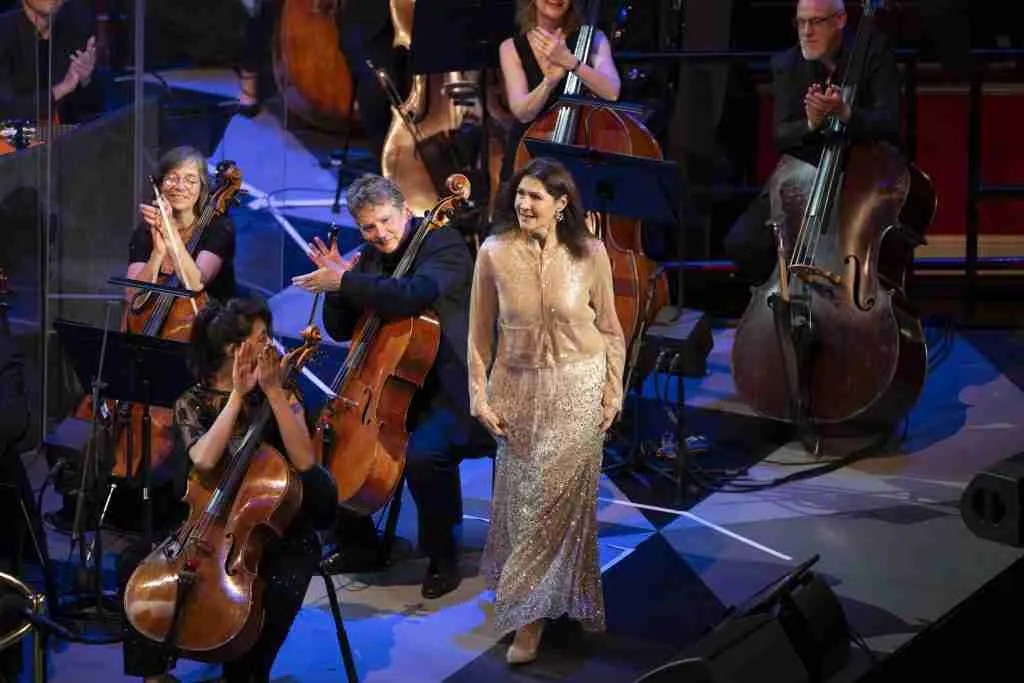
The BBC Concert Orchestra has long flown the flag for this music, as has its principal guest conductor Edwin Outwater. They launched this evening in fine style with the main title from Mancini’s Charade, its ominous allure complemented by the panache of the theme from Peter Gunn then the slinky humour of Baby Elephant Walk; a mellifluous Days of Wine and Roses bringing the first appearance from tonight’s quartet of backing vocalists. The evergreen Moon River had an elegant cameo by the composer’s daughter Monica Mancini (above), its pathos set in relief by the enigmatic theme from The Pink Panther then irresistible sleaziness of Harold Arlen’s Blues in the Night. More Mancini followed with the driven percussive of Rain Drops in Rio then sultry Lujon with its eponymous percussion instrument. Quincy Jones hit an early high with his ricocheting Soul Bossa Nova, as also Juan García Esquivel with his catchy Mucha Muchacha and Les Baxter in his stealthy Quiet Village. Burt Bacharach’s bittersweet Alfie was graced with an eloquent vocal by Rachel John, then Nicholas RoubanisMisirlou evocatively brought up the interval.

The late Laurie Johnson created TV gold with the suave tones of The Shake, theme from The Avengers, as did Morton Stevens with his high-octane Hawaii Five-O. Rachel John sounded a shade coy in Bacharach’s The Look of Love (memorably covered by Scott Walker), his genial Casino Royale hitting the spot as did Julius Wechter’s breezy Spanish Flea. The vocal quartet added ambivalence to Bobby Scott / Ric Marlow co-write A Taste of Honey then ethereality to Michel Legrand’s The Windmills of Your Mind or a neat line in scat to Mancini’s Party Poop. If Oliver Tompsett undersold the sassiness of Sid Ramin’s Music to Watch Girls By, there was no mistaking the faux-chinoiserie of Mancini’s Hong Kong Fireworks and suavity of Baxter’s Shooting Star. Rachel John made Bacharach’s This Guy’s in Love With You a candidate for the most perfect pop-song, with Baxter’s Saturday Night on Saturn more inane in context. Not so Esquivel’s Whatchamacallit with its quirky Ondioline (more stylophone then theremin), then Oliver Tompsett pointed the double-entendre of Bacharach’s What’s New Pussycat? before a gyrating take on Les Reed’s / Gordon Mills’ It’s Not Unusual, indelibly linked with Tom Jones.

It would have been perfectly feasible to assemble a evening devoted to Mancini by taking in his edgier film-scores to such 1950s classics as The Creature of the Black Lagoon and Touch of Evil, but making this a nostalgia-fest doubtless commended itself to a near-capacity house – not that you had to be over a certain age to enjoy what was on offer or to have seen the TV series Animal Magic whose theme-tune, Johnson’s Las Vegas, made an effervescent encore.

List of repertoire performed:

Mancini (arr. Stanley Black): Charade – Main Title (1963)
Mancini: Peter Gunn – Theme (1958)
Mancini (arr. Black): Baby Elephant Walk (1961)
Mancini: Days of Wine and Roses (1962)*d
Mancini: Moon River (1961)a
Mancini (arr. Gavin Sutherland): The Pink Panther – Theme (1963)*
Arlen (arr. Fiona Brice): Blues in the Night (1941)*
Mancini (arr. George Moore): Rain Drops in Rio (1961)
Mancini: Lujon (1961)
Jones (arr. Alasdair Malloy): Soul Bossa Nova (1962)*
Esquivel (arr. Sam Gale): Mucha Muchacha (1962)d
Baxter (arr. Moore): Quiet Village (1951)
Bacharach (arr. Les Reed): Alfie (1966)b
Roubanis (arr. Callum Au): Misirlou (1941)

Johnson (arr. Mike Townend): The Shake (1965)
Stevens (arr. Malloy): Hawaii Five-O (1968)
Bacharach (arr. Richard Balcombe): The Look of Love (1967)b
Bacharach (arr. Balcome): Casino Royale (1967)
Wechter (arr. Malloy): Spanish Flea (1965)
Scott/Marlow (arr. Brice): A Taste of Honey (1960)d
Legrand (arr. Balcombe): The Windmills of Your Mind (1968)d
Ramin (arr. Balcombe): Music to Watch Girls By (1967)c
Mancini (arr. Moore): Party Poop (1968)d
Mancini (arr. Black): Hong Kong Fireworks (1978)
Baxter (arr. Moore): Shooting Star (1968)
Bacharach (arr. Balcombe): This Guy’s in Love With You (1968)b
Baxter (arr. Moore): Saturday Night on Saturn (1957)
Esquivel (arr. Gale): Whatchamacallit (1959)
Bacharach (arr. Balcombe): What’s New Pussycat (1965)c
Reed/Mills (arr. Balcombe): It’s Not Unusual (1965)c

(All titles Proms premieres except *)

aMonica Mancini, bRachel John, cOliver Tompsett (vocals), dFreddie Benedict, Kevin Fox, Johanna Marshall, Liz Swain (backing vocals), BBC Concert Orchestra / Edwin Outwater

You can get details about this year’s season at the BBC Proms website – and you can click on the names to read more about the BBC Concert Orchestra and conductor Edwin Outwater

Published post no.2,292 – Thursday 5 September 2024

Arcana at the Proms – Prom 55: Vikingur Ólafsson, Berliner Philharmoniker / Kirill Petrenko – Schumann & Smetana

Schumann Piano Concerto in A minor Op.54 (1841-5)
Smetana Má vlast (1874-9)

Vikingur Ólafsson (piano), Berliner Philharmoniker / Kirill Petrenko

Royal Albert Hall, London
Saturday 31 August 2024

reviewed by Richard Whitehouse Photos (c) Chris Christodoulou

This first concert in its latest Proms visit by the Berliner Philharmoniker and chief conductor Kirill Petrenko featured a complete performance of Smetana’s Má vlast as the second half of a programme that, at barely the length of an average Mahler symphony, need not be unusual.

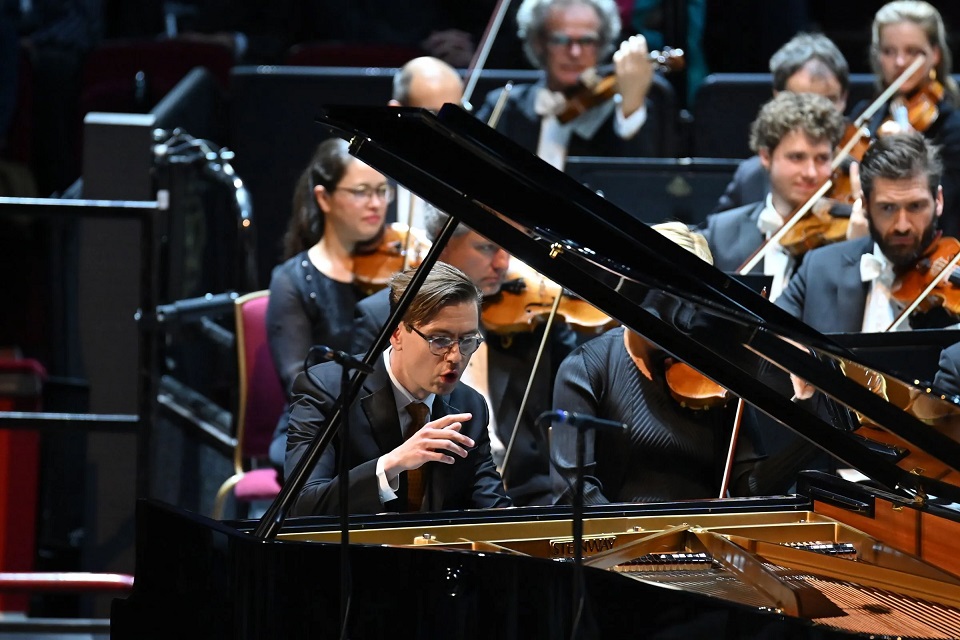
Few would, in any case, object to Vikingur Ólafsson tackle Schumann’s Piano Concerto in an account as dextrously articulated as it was unerringly proportioned. Not least an initial Allegro such as avoided any tendency to mid-tempo ‘drift’, those subtly contrasted themes building a cumulative impetus carried into the combative cadenza then a coda whose tensile energy was judged to a nicety by Petrenko. Some might have felt the Intermezzo too interventionist in its alternation of capriciousness and pathos, but absence of the cutesiness and cloying was more than its own justification and not least when that transition into the final Allegro had such an expectancy. Rhythmically supple with unwavering focus on its overall continuity, this set the seal on a reading whose technical finesse and interpretative insight ensured a riveting listen.

Ólafsson caused some stir at these concerts three years ago with Bach and Mozart concertos, and it was the former composer who provided the encore: the Adagio from the Fourth Organ Sonata (BWV528), transcribed here by August Stradel and rendered with understated poise.

More Czech music so soon after the Czech Philharmonic’s brace of Proms might have been too much of a good thing, but Petrenko’s Má vlast was very different from Jakub Hrůša’s in its lithe expression and streamlined textures. Nor was there was any lack of emotional depth – hence those earlier stages of Vyšehrad as it emerged eloquently on harps towards a fervent climax, its dramatic central section of a razor-sharp precision before subsiding into the main theme’s moving return. Vltava was scenically evocative and formally cohesive as it took in folk-dance, nocturnal landscape and treacherous rapids prior to its resplendent emergence in Prague, then Šárka unfolded its narrative of a matriarchal icon and her heroic demise with an impulsiveness that went into overdrive – without being overdriven – at its dramatic close.

It may be more generalized as to content, but the initial half of From Bohemia’s Woods and Fields is spellbinding as it conjures a pantheist ecstasy (in the process, anticipating Janáček and Minimalism) to which the BPO players were audibly attuned – Petrenko mindful not to overstate the relative blatancy of what follows. Most impressive, even so, were the final two stages whose gaunt rhetoric and granitic sound-world most often make for uneasy listening. Not here, however, as Petrenko gauged the motivic eddying of Tábor so that its underlying momentum held good through to the inevitable segue into Blaník. Emotional tension here was unremitting, the intensive interplay of Vyšehrad-theme with Hussite-chorale building to an apotheosis of Beethovenian power before letting loose for a coda of visceral exhilaration.

Its composite nature makes Má vlast difficult to sustain in performance, but there could be no doubt Petrenko managed this through his and the BPO’s acute yet never wanton control over every facet of the greater concept. A memorable performance and an impressive achievement.

You can get details about this year’s season at the BBC Proms website – and you can click on the names to read more about the Berliner Philharmoniker, their chief conductor Kirill Petrenko and piano soloist Vikingur Ólafsson

Published post no.2,289 – Monday 2 September 2024

Arcana at the Proms – Prom 53: Remembering Sir Andrew Davis

Stravinsky Symphony in Three Movements (1942-5)
Reich Jacob’s Ladder (2023) [BBC co-commission: UK premiere]
Tippett The Midsummer Marriage – Ritual Dances (1946-52)
Elgar Variations on an Original Theme ‘Enigma’ Op.36 (1898-9)

Synergy Vocals [Tara Bungard (soprano), Micaela Haslam (soprano/director), Will Wright, Ben Alden (tenors)], BBC Symphony Orchestra / Martyn Brabbins

Royal Albert Hall, London
Friday 30 August 2024

reviewed by Richard Whitehouse Photos (c) Andy Paradise

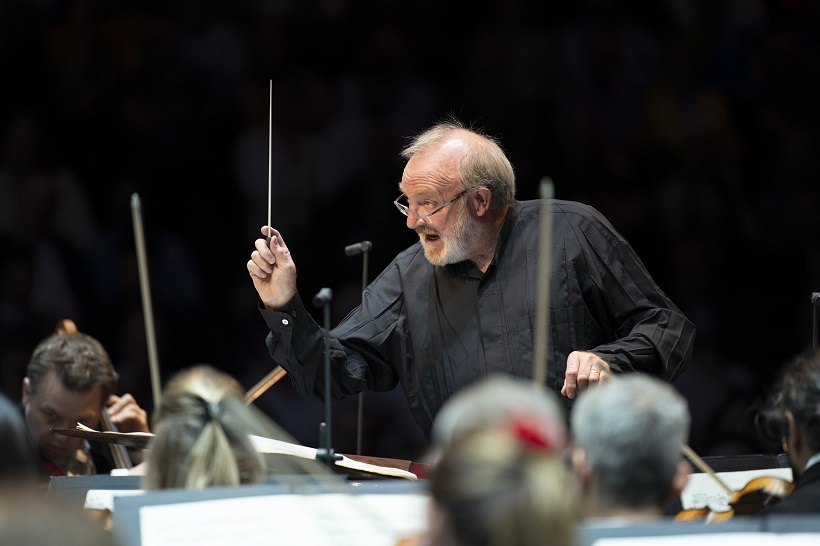
What should have been the 133rd concert that Sir Andrew Davis conducted at the Proms became a commemorative event after his untimely death in April but, with Martyn Brabbins presiding over a thoughtfully amended programme, the outcome could not have been more appropriate.

Proceeding unaltered, the first half began with Stravinsky’s Symphony in Three Movements in a performance redolent of Otto Klemperer in its deliberation if without that conductor’s heft – not least an opening movement whose rhythmic trenchancy felt a little dogged as it unfolded. Best was the Andante – its deadpan humour complemented by the beatific poise at its centre, then a transition of hushed expectancy to launch the finale. Here the closing build-up might have been more visceral, but the conclusiveness of that final chord could hardly be doubted.

Davis (above) was hardly known as proponent of Minimalism in general or Steve Reich in particular, thus his scheduling this first UK performance of the latter’s Jacob’s Ladder could be taken as significant. Playing just under 20 minutes, this is artfully structured as four short ‘expository’ sections followed by four longer ‘developmental’ ones. The former pitted its four vocalists – a telling number in this context of eight strings, six woodwind, two vibraphones and one piano – against an instrumental ensemble that took precedence in those latter sections; the final one brings them together in new-found accord. Dealing with scalic patterns in all their conceptual and metaphorical implications, the musical content typifies late Reich in ruminative elegance or subdued intensity which, if it offers no revelations, is yet satisfying in its stylistic deftness.

Schumann’s Second Symphony had been planned for a second half as now commenced with the Ritual Dances from Tippett’s The Midsummer Marriage – an opera, and composer, close to Davis’ heart. Unfailingly cohesive to the degree its series of elemental and seasonal dances interwove with their respective ‘transformations’ and ‘preparations’, this account was equally notable for its textural clarity even in those most contrapuntally intricate passages, along with a colouristic sense sustained up to the climactic return of its initial music for a magical envoi.

When Brabbins last conducted Elgar’s ‘Enigma’ Variations at the Proms, it was the final item in a 60th-birthday tribute that began with Pictured Within – a latter-day equivalent involving 14 different composers. Tonight’s account gave eloquent insight into what has become almost too familiar a work, evident from the outset in a ‘Theme’ of melting pathos. Highlights from those that followed included the soulfulness of ‘C.A.E.’, pensiveness of ‘R.P.A.’ or elegance of ‘Ysobel’ with its lilting viola from Sebastian Krunnies. ‘Nimrod’ started imperceptibly but built towards a nobly wrought apex, with the affectionate portrayed ‘Dorabella’ or searching evocation of ‘***(Romanza)’ no less affecting. The ‘E.D.U.’ finale moved confidently to an organ-clad peroration exuding what Elgar elsewhere termed a ‘‘massive hope for the future’’.

Just before this performance, Brabbins spoke for a capacity house in paying tribute to Davis with his dedication to music-making in the UK and beyond; something Sir Andrew brought to every one of his 132 appearances at the Proms, across 54 years of dedication to his cause.

You can get details about this year’s season at the BBC Proms website – and you can click on the names to read more about the BBC Symphony Orchestra, their conductor Martyn Brabbins, and an obituary of Sir Andrew Davis himself

Published post no.2,287 – Sunday 1 September 2024